
There is Pleasure in the Pathless Woods
(Lord Byron)
There is a pleasure in the pathless woods,
There is a rapture on the lonely shore,
There is society where none intrudes,
By the deep Sea, and music in its roar:
I love not Man the less, but Nature more,
From these our interviews, in which I steal
From all I may be, or have been before,
To mingle with the Universe, and feel
What I can ne’er express, yet cannot all conceal.
There is Pleasure in the Pathless Woods Summary
The poem “There is Pleasure in the Pathless Woods” is an excerpt from Lord Byron’s larger narrative poem Childe Harold’s Pilgrimage. It appears in Canto IV, which was completed in 1817 and published in 1818. Childe Harold’s Pilgrimage was one of Byron’s most famous works, written in Spenserian stanzas and reflecting his personal feelings, travels, and views on society and nature.
This particular excerpt showcases Byron’s Romantic ideals, including his reverence for nature, his embrace of solitude, and his desire to escape the constraints of human civilization. The poem was likely inspired by Byron’s travels through Europe, particularly Italy, and his experiences with its landscapes, seascapes, and ruins.
Lord Byron’s poem “There is Pleasure in the Pathless Woods” reflects his deep love and admiration for nature. The speaker finds joy in places untouched by human interference, like the pathless woods and the lonely shore. He takes pleasure in the quiet and peace of these natural spaces, away from the hustle and chaos of society. The sound of the ocean and the beauty of untouched landscapes bring him a sense of freedom and happiness that he cannot find among people.
Byron makes it clear that he does not dislike people, but he loves nature even more. In nature, he feels a deeper connection to the universe, something spiritual and profound. It is as if being surrounded by the natural world helps him escape from the person he has been in society and allows him to feel something beyond himself. This feeling is so powerful that it cannot be fully explained in words, though it is impossible to completely hide either.
Overall, the poem conveys Byron’s belief that nature is a source of peace, inspiration, and truth. It reminds us of the beauty of solitude and how stepping away from the distractions of life can help us connect to something greater. Through nature, we can rediscover ourselves and experience a unique kind of joy that human society cannot provide.
There is Pleasure in the Pathless Woods Analysis
There is a pleasure in the pathless woods,
There is a rapture on the lonely shore,
There is society where none intrudes,
By the deep Sea, and music in its roar:
I love not Man the less, but Nature more,
From these our interviews, in which I steal
From all I may be, or have been before,
To mingle with the Universe, and feel
What I can ne’er express, yet cannot all conceal.
Reference to Context:
The excerpt is taken from Lord Byron’s Childe Harold’s Pilgrimage (Canto IV), published in 1818. This larger narrative poem reflects Byron’s personal thoughts and observations during his travels across Europe. In this specific passage, Byron articulates the joy and peace he experiences in nature, contrasting it with the complexities of human society. The lines embody key Romantic ideals, including the glorification of nature, the celebration of solitude, and a deep emotional connection to the universe. Through this introspective reflection, Byron reveals his desire to escape societal constraints and find solace in the natural world.
Explanation:
“There is a pleasure in the pathless woods”
The poet begins by expressing his joy in wandering through untamed, untouched forests. The “pathless woods” symbolize a space free from human interference, evoking a sense of freedom and liberation. The absence of defined paths represents the unpredictability and authenticity of nature.
“There is a rapture on the lonely shore”
Byron finds an intense, almost spiritual joy (“rapture”) in the solitude of the shore. The shore, a meeting point of land and sea, becomes a metaphor for a space of reflection and transformation, where the soul connects with the natural world.
“There is society where none intrudes”
Here, Byron introduces a paradox, finding “society” or companionship in solitude. This line highlights the profound connection he feels with nature, suggesting that it offers a sense of community and belonging that human interactions cannot provide.
“By the deep Sea, and music in its roar”
The sea, vast and powerful, becomes a source of inspiration and peace. Its “music” refers to the rhythmic crashing of waves, symbolizing nature’s eternal and harmonious power. Byron finds beauty and meaning in this natural symphony.
“I love not Man the less, but Nature more”
Byron clarifies that his love for nature is not born out of disdain for humanity. Instead, his affection for the natural world surpasses his attachment to human society. This statement reflects his Romantic belief in the purity and transcendence of nature compared to the artificiality of civilization.
“From these our interviews, in which I steal / From all I may be, or have been before”
These “interviews” refer to his moments of communion with nature. Through these encounters, Byron escapes his past and the pressures of society, rediscovering himself. Nature allows him to shed his worldly identity and connect with a more profound and universal essence.
“To mingle with the Universe, and feel / What I can ne’er express, yet cannot all conceal”
Byron describes a mystical union with the universe. While this connection transcends language, it is so powerful that it cannot be entirely hidden. The ineffable nature of this experience emphasizes its spiritual and transformative quality.
Poetic Device:
Alliteration
The repetition of consonant sounds at the beginning of nearby words adds rhythm and musicality to the poem. Examples include “pleasure in the pathless woods” (repetition of the “p” sound), “or have been before” (repetition of the “b” sound), and “yet cannot all conceal” (repetition of the “c” sound). This device enhances the poem’s lyrical quality, making it more engaging and reflective of the harmonious connection Byron feels with nature.
Imagery
Imagery involves vivid descriptions that appeal to the senses, helping the reader visualize and emotionally connect with the poem. Examples include “pathless woods” (visual imagery of untamed forests), “lonely shore” (evoking a peaceful seascape), and “deep Sea, and music in its roar” (auditory imagery of the crashing waves). The imagery transports the reader into the natural settings Byron admires, allowing them to feel the same solitude and peace he experiences.
Paradox
A paradox is a statement that appears contradictory but reveals a deeper truth. For example, “There is society where none intrudes” suggests that Byron finds a form of companionship or connection in solitude. This paradox highlights the spiritual presence of nature and reflects the Romantic ideal of finding peace and fulfillment outside human society.
Personification
Personification attributes human characteristics to non-human elements. An example is “music in its roar,” where the sea is personified by giving its sound a musical quality. This gives nature a lively, emotional presence and emphasizes its harmonious and powerful relationship with the poet.
Symbolism
Symbolism uses objects, settings, or concepts to represent deeper meanings. Examples include “Pathless woods” symbolizing freedom and escape, “Lonely shore” representing solitude and introspection, and “Deep Sea” symbolizing vastness and mystery. The symbols elevate the poem from being a literal description of nature to a profound reflection on humanity’s spiritual connection with the natural world.
Enjambment
Enjambment occurs when a sentence or phrase continues from one line of poetry to the next without a pause. For example, “From these our interviews, in which I steal / From all I may be, or have been before.” This creates a flowing, conversational rhythm, mimicking the continuous, boundless thoughts Byron has while immersed in nature.
Contrast
Contrast highlights the differences between two elements to emphasize a theme. Byron contrasts “Man” with “Nature,” expressing a preference for nature’s purity and spiritual depth over the complexities of society. This sharpens the poem’s central theme, emphasizing the superiority of nature as a source of peace and inspiration.
Metaphor
Metaphors are comparisons that imply one thing is another, without using “like” or “as.” Examples include “music in its roar,” comparing the sea’s roar to music, and “To mingle with the Universe,” suggesting a metaphorical merging of the self with the infinite cosmos. These metaphors enrich the language, making abstract emotions more tangible for the reader.
Anaphora
Anaphora is the repetition of a word or phrase at the beginning of successive lines or clauses. An example is “There is a pleasure… There is a rapture…,” which emphasizes the joy and peace Byron feels in nature. This repetition creates a rhythm that mirrors the tranquility he experiences.
Inversion (Hyperbaton)
Inversion involves rearranging the normal word order for emphasis. For example, “I love not Man the less, but Nature more” reverses the structure to place emphasis on the contrast between Man and Nature. This draws attention to Byron’s feelings, making the line more impactful.
Key Points
Author
Lord Byron (George Gordon Byron) was a central figure of the Romantic movement, known for his introspective and deeply emotional poetry. This poem is an excerpt from Childe Harold’s Pilgrimage (Canto IV), published in 1818. It reflects his personal feelings, experiences, and Romantic ideals, including his admiration for nature and solitude.
Structure and Form
The poem is written in the Spenserian stanza, a form first developed by Edmund Spenser in The Faerie Queene (1590). This stanza consists of nine lines, with the first eight in iambic pentameter (ten syllables per line) and the final line, called an Alexandrine, in iambic hexameter (twelve syllables). It follows the rhyme scheme ABABBCBCC, which ties the lines together in a flowing, harmonious manner. Byron adapted this complex form for Childe Harold’s Pilgrimage to add depth and beauty to his reflections.
Speaker
The speaker is a contemplative persona, likely representing Byron himself, who shares his profound emotional connection with nature. He reflects on the joy, peace, and transcendence he finds in the natural world, contrasting it with human society’s limitations.
Setting
The poem is set in wild, untamed natural landscapes, including pathless woods, lonely shores, and the vast, roaring sea. These settings evoke solitude, freedom, and a spiritual connection to the universe, emphasizing the power and beauty of untouched nature.
Theme
The main themes include the beauty and power of nature, the joy of solitude, and the spiritual transcendence found in connecting with the natural world. It also explores the Romantic ideal of rejecting societal constraints and celebrating individuality and introspection.
Plot
The speaker expresses the joy he feels in nature’s untamed landscapes, finding companionship in solitude and harmony in the music of the sea. He contrasts his love for humanity with his deeper love for nature, which allows him to transcend his worldly self and feel a mystical union with the universe.
Tone
The tone is contemplative, peaceful, and reverent, with a subtle melancholic undercurrent as the speaker reflects on his dissatisfaction with human society compared to the joy he finds in nature.
Style
Byron’s style is lyrical, symbolic, and steeped in Romanticism. He uses vivid imagery, paradox, and the intricate Spenserian stanza to create a harmonious flow and elevate his themes. The ineffable nature of his experiences with nature reflects the Romantic focus on emotions and the sublime.
Message
The poem conveys that nature offers peace, joy, and spiritual fulfillment that human society cannot provide. It emphasizes the value of solitude and the transformative power of connecting with the natural world. Byron encourages readers to seek harmony with nature and rediscover their inner selves, highlighting the timeless relationship between humanity and the universe.
Lord Byron (George Gordon Byron)
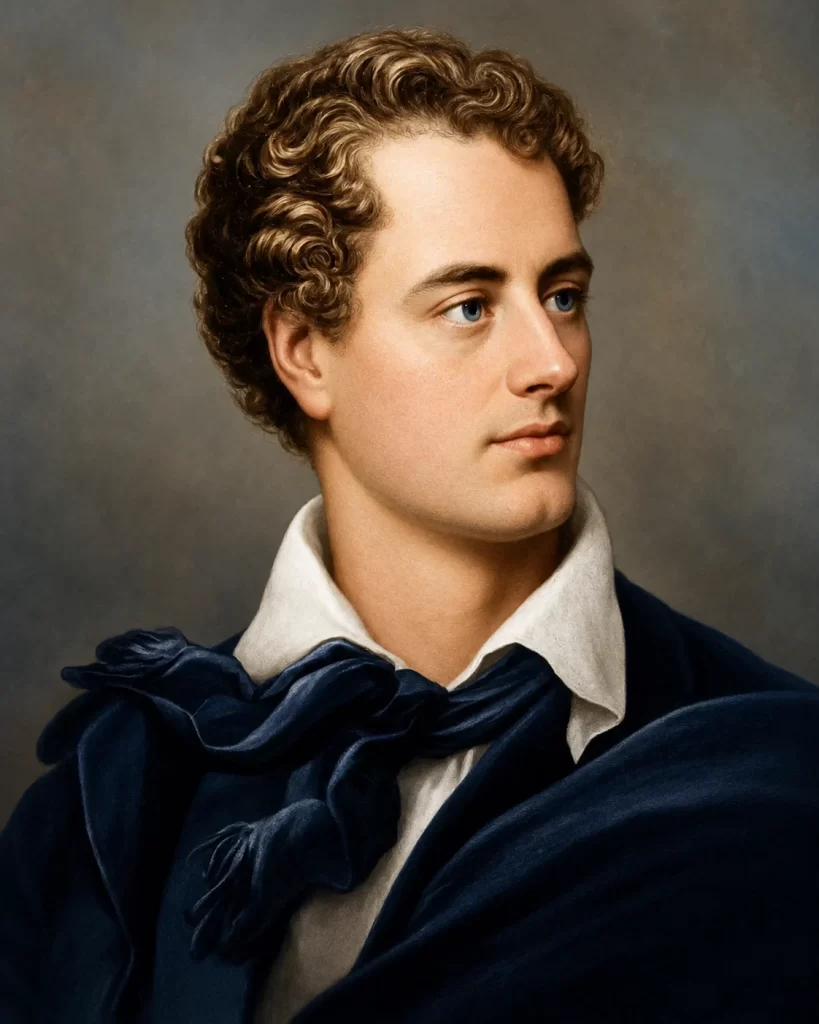
Birth and Early Life:
Born: January 22, 1788, in London, England.
Family: Byron was the only child of Captain John Byron and Catherine Gordon. After his father abandoned the family, Byron was raised in a financially unstable and challenging environment.
He inherited the title of 6th Baron Byron at the age of 10 upon the death of his great-uncle, which granted him access to Newstead Abbey, a family estate in Nottinghamshire.
Education:
Byron attended Harrow School and later Trinity College, Cambridge, where he began to develop his love for literature and poetry.
He published his first collection of poems, Hours of Idleness, in 1807, which received harsh criticism. This criticism prompted him to respond with a satirical poem, English Bards and Scotch Reviewers, showcasing his wit and literary skill.
Literary Achievements:
Byron became a leading figure of the Romantic Movement, emphasizing emotion, nature, individuality, and the sublime.
His most famous works include:
Childe Harold’s Pilgrimage (1812–1818): A semi-autobiographical narrative poem that brought him instant fame.
Don Juan (1819–1824): A satirical, epic poem considered one of his greatest works.
The Giaour, The Corsair, and Lara: These narrative poems feature his signature “Byronic hero.”
The Byronic Hero:
Byron is credited with popularizing the Byronic hero, a brooding, rebellious, and emotionally complex character who often defies societal norms. This archetype reflects Byron’s own personality and appears in many of his works.
Personal Life and Scandals:
Byron’s life was as dramatic as his poetry, filled with scandal, love affairs, and controversy.
He had numerous relationships with both men and women, including rumored affairs with Lady Caroline Lamb, Lady Oxford, and his half-sister Augusta Leigh.
Byron’s tumultuous marriage to Annabella Milbanke ended in separation amid accusations of infidelity and abuse.
Exile and Later Life:
Following public scandals, Byron left England in 1816, never to return.
He traveled extensively in Europe, living in Switzerland, Italy, and Greece. His travels greatly influenced his poetry and lifestyle.
Involvement in Greek Independence:
Byron became deeply committed to the Greek War of Independence against the Ottoman Empire. He used his wealth and influence to support the cause and personally joined the fight in Greece.
He died of a fever in Missolonghi, Greece, on April 19, 1824, at the age of 36, and is celebrated as a national hero in Greece.
Legacy:
Byron’s poetry and rebellious persona left a lasting impact on literature and popular culture.
He remains one of the most celebrated and controversial figures of the Romantic era.
His exploration of individualism, passion, and nature continues to resonate with readers today, and his archetype of the Byronic hero influenced countless writers and artists.
Word Meaning
| Tough Word | Meaning in English | Meaning in Hindi |
| Pathless | Without a path; untrodden or unexplored | बिना रास्ते का; अनछुआ |
| Rapture | Extreme joy or happiness | अत्यंत आनंद या खुशी |
| Shore | The land along the edge of a sea or lake | समुद्र या झील का किनारा |
| Intrudes | To enter without permission or disturb | बिना अनुमति के प्रवेश करना या बाधा डालना |
| Roar | A loud, deep sound like that of a lion or waves | तेज़, गहरी आवाज़ जैसे शेर या लहरें |
| Steal | To take away secretly; in the poem, to escape quietly | चोरी करना; कविता में, चुपचाप निकल जाना |
| Mingle | To mix or blend together | घुलना-मिलना या मिलाना |
| Ne’er | A poetic contraction for “never” | “कभी नहीं” का काव्यात्मक रूप |
| Conceal | To hide or keep something secret | छिपाना या गुप्त रखना |
Themes
Nature’s Beauty and Power
The poem celebrates the unmatched beauty, harmony, and purity of the natural world. The speaker finds joy and peace in untamed landscapes like “pathless woods” and the “lonely shore,” highlighting nature’s ability to inspire and rejuvenate the soul. Nature is portrayed as a sanctuary, offering a profound emotional and spiritual connection.
Solitude and Escape
The speaker emphasizes the value of solitude and its ability to provide freedom from societal constraints. In solitude, he finds “society where none intrudes,” suggesting that being alone with nature offers a sense of companionship and fulfilment unavailable in human interactions.
Transcendence and Unity with the Universe
The poem explores the mystical connection between humanity and the cosmos. Through interactions with nature, the speaker experiences a sense of unity with the universe that transcends words. This spiritual mingling with the greater whole emphasizes the sublime power of nature and its ability to elevate the human spirit.
Contrast Between Nature and Society
Byron contrasts the purity and freedom of nature with the complexities and artificiality of human society. While the speaker does not disdain humanity, he prefers the simplicity and authenticity of nature, where he can escape societal pressures and rediscover himself.
Romantic Individualism
The poem reflects the Romantic ideal of individual emotion and personal connection with the sublime. The speaker’s introspection and emotional engagement with nature emphasize the importance of personal experience and self-discovery, key elements of the Romantic movement.
There is Pleasure in the Pathless Woods Questions and Answers
Very Short Answer Questions
Who wrote the poem?
Lord Byron (George Gordon Byron).
From which larger work is the poem taken?
Childe Harold’s Pilgrimage (Canto IV).
What poetic form is used in the poem?
Spenserian stanza.
What is the rhyme scheme of the Spenserian stanza?
ABABBCBCC.
What meter is used in the poem?
Iambic pentameter for the first eight lines and an Alexandrine (iambic hexameter) for the ninth.
What does the “pathless woods” symbolize?
Freedom and escape from societal constraints.
What does the “lonely shore” represent?
Solitude and introspection.
What is the speaker’s relationship with nature?
He loves nature deeply and finds joy and peace in it.
How does the speaker view human society?
He does not hate humanity but prefers the purity of nature.
What is the “music in its roar” referring to?
The harmonious sound of the sea.
What is the tone of the poem?
Contemplative and reverent.
What is the central theme of the poem?
The beauty and spiritual power of nature.
What does the speaker mean by “I love not Man the less, but Nature more”?
He values nature more than human society.
What does the speaker feel when in nature?
A mystical connection with the universe.
What poetic device is used in “music in its roar”?
Personification.
Which Romantic ideal is reflected in the poem?
The glorification of nature and the value of solitude.
What does the phrase “mingle with the Universe” mean?
To feel a spiritual unity with the cosmos.
What type of imagery is prominent in the poem?
Nature imagery (woods, shore, sea).
What movement does the poem belong to?
The Romantic movement.
What message does the poem convey?
Nature offers peace, joy, and transcendence that society cannot provide.
Short Answer Questions
Who is the author of the poem, and what inspired him to write it?
The author is Lord Byron, a prominent Romantic poet. The poem is inspired by his travels across Europe and his love for nature, solitude, and the sublime. It reflects Byron’s Romantic ideals and his preference for the natural world over societal constraints.
What is the Spenserian stanza, and how is it used in the poem?
The Spenserian stanza is a nine-line poetic form with a rhyme scheme of ABABBCBCC. The first eight lines are written in iambic pentameter, and the ninth is a twelve-syllable Alexandrine. Byron uses this structure in Childe Harold’s Pilgrimage to create a flowing, harmonious rhythm for his reflective and descriptive narrative.
What is the tone of the poem, and how does it support the theme?
The tone is contemplative, peaceful, and reverent, with a touch of melancholy. It supports the theme by emphasizing the speaker’s deep emotional connection with nature, his sense of joy and solace in solitude, and his dissatisfaction with the artificiality of human society.
What does the phrase “There is society where none intrudes” mean?
This paradoxical statement means the speaker finds companionship and connection in solitude with nature. It suggests that being in the natural world offers a deeper sense of belonging and peace than human interactions.
How does the speaker contrast his love for nature with his feelings about humanity?
The speaker states, “I love not Man the less, but Nature more,” clarifying that he does not hate humanity but finds greater joy and peace in nature. Nature’s purity and harmony contrast with the complexities and constraints of human society.
What role does nature play in the poem?
Nature serves as a source of joy, freedom, and spiritual transcendence. The speaker experiences harmony and unity with the universe through his connection to natural elements like the woods, the shore, and the sea.
What is the significance of the imagery in the poem?
The imagery of the “pathless woods,” “lonely shore,” and “deep Sea” creates vivid mental pictures of untouched natural landscapes. It symbolizes freedom, solitude, and the vastness of existence, reinforcing the poem’s themes of nature’s beauty and spiritual power.
What does the speaker mean by “To mingle with the Universe”?
The speaker expresses his desire to connect spiritually with the cosmos through his experiences in nature. This feeling of transcendence allows him to escape societal constraints and feel part of something much greater than himself.
How does the poem reflect the ideals of Romanticism?
The poem reflects Romantic ideals by celebrating the beauty and power of nature, valuing solitude and individual emotion, and exploring spiritual transcendence. It also critiques human society’s artificiality and highlights the importance of personal introspection and connection with the sublime.
What is the main message of the poem?
The poem conveys that nature provides a unique source of joy, peace, and spiritual fulfillment that human society cannot offer. It emphasizes the value of solitude, the importance of connecting with the natural world, and the transcendence that comes from such a relationship.
Critical Analysis
Introduction
The poem is an excerpt from Childe Harold’s Pilgrimage (Canto IV) by Lord Byron, one of the most celebrated poets of the Romantic era. It explores Byron’s deep admiration for nature, his preference for solitude, and his transcendental connection with the natural world. Written during a period of personal exile and inspired by his travels across Europe, the poem captures the quintessential Romantic ideals of freedom, individual emotion, and the sublime beauty of untouched landscapes.
Central Idea
The poem revolves around the speaker’s profound connection to nature, which offers joy, peace, and a sense of belonging that human society cannot provide. Byron contrasts the purity and harmony of the natural world with the constraints and complexities of human civilization. The poem celebrates solitude and portrays nature as a medium through which the speaker experiences a mystical unity with the universe, transcending words and societal expectations.
Structure and Rhyme Scheme
The poem is written in the Spenserian stanza, a poetic form developed by Edmund Spenser in The Faerie Queene (1590). The stanza consists of nine lines, with the first eight lines in iambic pentameter (ten syllables) and the final line, known as an Alexandrine, in iambic hexameter (twelve syllables). The rhyme scheme ABABBCBCC creates a flowing, melodic rhythm that enhances the poem’s lyrical and reflective tone. This intricate structure allows Byron to blend narrative and lyrical elements seamlessly, making the poem both descriptive and introspective.
Themes
Nature’s Beauty and Power: The poem celebrates the grandeur of nature, portraying it as a source of peace, joy, and spiritual fulfillment.
Solitude and Escape: Byron emphasizes the value of solitude, suggesting that being alone in nature offers freedom and self-discovery.
Transcendence and Unity: Nature provides a spiritual connection with the universe, allowing the speaker to escape societal constraints and experience something beyond human comprehension.
Contrast Between Nature and Society: Byron contrasts the purity and authenticity of nature with the artificiality and restrictions of human civilization.
Romantic Individualism: The poem reflects the Romantic ideal of personal emotion and introspection, celebrating the individual’s unique relationship with nature.
Style
Byron’s style in the poem is deeply lyrical, reflective, and Romantic. He uses a conversational tone to convey personal emotions, making the poem relatable and intimate. The vivid imagery of “pathless woods,” “lonely shore,” and the “deep Sea” transports readers to untamed natural landscapes. Byron’s language is both simple and profound, capturing the ineffable feelings of joy and transcendence that nature evokes. The use of the Spenserian stanza enhances the musicality and flow of the poem, while the final Alexandrine in each stanza provides a sense of conclusion and reflection.
Poetic Devices
Imagery: Vivid descriptions of natural elements like woods, shores, and the sea evoke strong visual and emotional responses.
Alliteration: Repetition of consonant sounds adds rhythm and harmony, e.g., “pleasure in the pathless woods.”
Personification: Nature is given human qualities, such as the “music in its roar” (the sea).
Paradox: The line “There is society where none intrudes” emphasizes the spiritual connection the speaker finds in solitude.
Symbolism: Nature symbolizes freedom, purity, and transcendence, while society represents restriction and artificiality.
Enjambment: The flow of ideas across multiple lines mirrors the boundlessness of nature and thought.
Critical Commentary
Critics have praised the poem for its profound exploration of nature and its lyrical beauty. According to literary critic Matthew Arnold, Byron’s works often reflect the conflict between the individual and society, which is evident in this poem. William Hazlitt admired Byron’s ability to evoke intense emotions and his celebration of solitude and freedom. Some critics, however, have noted that Byron’s focus on personal emotion occasionally borders on self-indulgence. Nonetheless, the poem is widely regarded as a masterful representation of Romantic ideals.
Message
The poem conveys the idea that nature offers joy, peace, and spiritual fulfillment that human society cannot provide. It encourages readers to seek solace in solitude and connect with the natural world to rediscover their inner selves. Byron suggests that through nature, individuals can experience a deeper, almost mystical unity with the universe, which transcends words and societal norms.