
Ulysses
(Alfred, Lord Tennyson)
It little profits that an idle king,
By this still hearth, among these barren crags,
Match’d with an aged wife, I mete and dole
Unequal laws unto a savage race,
That hoard, and sleep, and feed, and know not me.
I cannot rest from travel: I will drink
Life to the lees: All times I have enjoy’d
Greatly, have suffer’d greatly, both with those
That loved me, and alone, on shore, and when
Thro’ scudding drifts the rainy Hyades
Vext the dim sea: I am become a name;
For always roaming with a hungry heart
Much have I seen and known; cities of men
And manners, climates, councils, governments,
Myself not least, but honour’d of them all;
And drunk delight of battle with my peers,
Far on the ringing plains of windy Troy.
I am a part of all that I have met;
Yet all experience is an arch wherethro’
Gleams that untravell’d world whose margin fades
For ever and forever when I move.
How dull it is to pause, to make an end,
To rust unburnish’d, not to shine in use!
As tho’ to breathe were life! Life piled on life
Were all too little, and of one to me
Little remains: but every hour is saved
From that eternal silence, something more,
A bringer of new things; and vile it were
For some three suns to store and hoard myself,
And this gray spirit yearning in desire
To follow knowledge like a sinking star,
Beyond the utmost bound of human thought.
This is my son, mine own Telemachus,
To whom I leave the sceptre and the isle,—
Well-loved of me, discerning to fulfil
This labour, by slow prudence to make mild
A rugged people, and thro’ soft degrees
Subdue them to the useful and the good.
Most blameless is he, centred in the sphere
Of common duties, decent not to fail
In offices of tenderness, and pay
Meet adoration to my household gods,
When I am gone. He works his work, I mine.
There lies the port; the vessel puffs her sail:
There gloom the dark, broad seas. My mariners,
Souls that have toil’d, and wrought, and thought with me—
That ever with a frolic welcome took
The thunder and the sunshine, and opposed
Free hearts, free foreheads—you and I are old;
Old age hath yet his honour and his toil;
Death closes all: but something ere the end,
Some work of noble note, may yet be done,
Not unbecoming men that strove with Gods.
The lights begin to twinkle from the rocks:
The long day wanes: the slow moon climbs: the deep
Moans round with many voices. Come, my friends,
‘T is not too late to seek a newer world.
Push off, and sitting well in order smite
The sounding furrows; for my purpose holds
To sail beyond the sunset, and the baths
Of all the western stars, until I die.
It may be that the gulfs will wash us down:
It may be we shall touch the Happy Isles,
And see the great Achilles, whom we knew.
Tho’ much is taken, much abides; and tho’
We are not now that strength which in old days
Moved earth and heaven, that which we are, we are;
One equal temper of heroic hearts,
Made weak by time and fate, but strong in will
To strive, to seek, to find, and not to yield.
Summary
Tennyson wrote “Ulysses” on October 20, 1833. He was only 24 years old. The poem was written just weeks after he received news of the sudden death of his closest friend, Arthur Henry Hallam.
For nearly nine years, the poem was not published. It circulated privately in manuscript form among Tennyson’s friends. This “ten-year silence” was a period of deep grief and artistic revision for Tennyson.
The poem was finally published in the collection simply titled Poems, released in 1842. It appeared in the second volume of the two-volume set.
The poem begins with Ulysses (also known as Odysseus) back home in his kingdom of Ithaca after many years of fighting in the Trojan War and traveling the seas. Instead of being happy to be home, he is bored and miserable. He describes himself as an “idle king” stuck by a fireplace with an old wife. He feels that being a king is useless because he spends his time making laws for people who don’t know him and whom he considers “savage” or uneducated.
Ulysses explains that he cannot rest; he wants to “drink life to the lees” (live life to the absolute fullest). He remembers his past adventures fondly—both the good times and the bad times, alone and with friends. He feels that he has become famous for his travels (“I am become a name”), but he isn’t satisfied with just having memories. He believes that if he stops traveling, he will be like a sword that rusts because it isn’t being used. To him, just breathing isn’t enough to call it “life.”
He talks about how experience is like an archway: when you look through it, you see an “untravelled world” in the distance. The more he moves forward, the more the horizon moves back, meaning there is always something new to discover. He feels that it is a waste of time to stay in one place for three years (or “three suns”) when his spirit is still desperate to follow knowledge “like a sinking star” beyond the limits of normal human thought.
Ulysses then introduces his son, Telemachus. He decides to leave the kingdom and the crown to his son. He believes Telemachus is the right person for the job because he is patient, decent, and prudent. Telemachus is good at the slow, steady work of civilizing the people and handling daily duties, which Ulysses finds boring. Ulysses sums up their difference simply: “He works his work, I mine.”
In the final section, Ulysses turns to address his old crew of sailors. He points out the ship in the harbor and the dark sea. He admits that they are all old now and not as physically strong as they used to be in the “old days” when they fought wars. However, he reminds them that they can still do something noble before they die. He tells them it is “not too late to seek a newer world.”
The poem ends with Ulysses convincing his crew to sail away with him one last time, “beyond the sunset.” He knows the journey might be dangerous—the waves might wash them down, or they might die and reach the Happy Isles (heaven)—but he doesn’t care. The poem concludes with his famous declaration that even though they are weak in body, their will is strong. They are determined “to strive, to seek, to find, and not to yield.”
Ulysses Analysis
It little profits that an idle king,
By this still hearth, among these barren crags,
Match’d with an aged wife, I mete and dole
Unequal laws unto a savage race,
That hoard, and sleep, and feed, and know not me.
Reference to Context:
These lines are the opening verse of the poem “Ulysses,” written by the Victorian poet Alfred, Lord Tennyson.
The poem is a dramatic monologue spoken by the Greek hero Ulysses (Odysseus) after he has returned to his kingdom of Ithaca following the Trojan War. In these specific lines, Ulysses expresses his dissatisfaction with his life as a settled king. He contrasts his boring, domestic reality with his desire for adventure, revealing that he feels trapped by the routine of governing a people he does not respect.
Explanation:
Line 1: “It little profits that an idle king,”
Ulysses begins with a complaint. The phrase “It little profits” means “it is useless” or “there is no benefit.” He refers to himself as an “idle king”—not because he is lazy, but because he feels his current life lacks meaningful action. To a man used to battling monsters and sailing stormy seas, sitting on a throne feels like doing nothing.
He rejects the traditional idea that being a king is the ultimate goal. Instead of feeling powerful, he feels stagnant. He believes that staying in one place without new challenges is a waste of his time and ability.
Line 2: “By this still hearth, among these barren crags,”
He describes his surroundings to show how trapped he feels. The “still hearth” refers to his fireplace at home. While a hearth usually represents warmth and comfort, Ulysses sees it as a symbol of boredom and lack of motion (“still”). He hates the quiet, domestic life.
He describes his island kingdom, Ithaca, as “barren crags” (dry, rocky cliffs). By calling the land “barren,” he suggests that it offers him no excitement or growth. The landscape mirrors his own feelings of emptiness; his home feels lifeless to him.
Line 3: “Match’d with an aged wife, I mete and dole”
Ulysses refers to his faithful wife, Penelope, simply as “aged.” This highlights the reality of getting old and suggests he feels a disconnect from her. He feels “match’d” (paired) with her not in passion, but in the shared condition of aging. It emphasizes that he does not find satisfaction in his marriage anymore, only a reminder of his mortality.
The words “mete and dole” describe his daily work as a king. “Mete” means to measure, and “dole” means to hand out in small amounts. He feels like a shopkeeper or a bureaucrat, simply measuring out rewards and punishments in tiny, boring amounts. He finds this administrative work petty and beneath a hero of his stature.
Line 4: “Unequal laws unto a savage race,”
He complains about the “unequal laws” he has to enforce. This suggests he finds the legal system of his kingdom imperfect or unfair, and fixing it feels like a tedious chore rather than a noble duty. He has no patience for the small details of politics.
He insults his own people by calling them a “savage race.” This shows his arrogance and his feeling of superiority. He views his subjects as uneducated and rough people who are far below his intellectual level. He feels completely alienated from the citizens he is supposed to protect.
Line 5: “That hoard, and sleep, and feed, and know not me.”
Ulysses describes the lives of his people with scorn. He says they only do basic animal activities: hoarding (gathering wealth), sleeping, and feeding (eating). He believes they are merely existing to survive, whereas he wants to truly live and seek glory. He looks down on them for being satisfied with such a simple life.
The final phrase, “know not me,” is crucial. It reveals his deep loneliness. Although he is their king, his people do not understand his true nature or his past experiences. They see him only as a ruler who signs laws, not as the legendary voyager who saw the world. He feels like a stranger in his own home.
Poetic devices:
Metaphor
“Idle king”: Ulysses uses this to describe his feeling of uselessness. He isn’t literally doing nothing, but he feels his administrative tasks are spiritually empty compared to his adventures.
“Still hearth”: A hearth (fireplace) usually represents warmth and home comfort. Here, it acts as a metaphor for stagnation and lack of movement (“still”).
“Barren crags”: This literal description of Ithaca’s rocky landscape also serves as a metaphor for his emotional state—dry, lifeless, and unyielding.
Hyperbole
“Savage race”: Ulysses exaggerates the backwardness of his own people. While they are likely just farmers and shepherds, he dismisses them as “savages” to highlight the intellectual distance between him and them.
Irony
“Match’d with an aged wife”: There is a subtle irony here. Ulysses complains that his wife is old, yet he himself is also an old man. He refuses to see himself as “aged” in spirit, creating a contrast between his physical reality and his internal desire.
Enjambment
“I mete and dole / Unequal laws…”: The sentence runs over from one line to the next without a pause. This creates a prose-like, conversational flow, making it feel like Ulysses is speaking his thoughts naturally rather than reciting a rigid poem.
I cannot rest from travel: I will drink
Life to the lees: All times I have enjoy’d
Greatly, have suffer’d greatly, both with those
That loved me, and alone, on shore, and when
Thro’ scudding drifts the rainy Hyades
Vext the dim sea: I am become a name;
For always roaming with a hungry heart
Much have I seen and known; cities of men
And manners, climates, councils, governments,
Myself not least, but honour’d of them all;
And drunk delight of battle with my peers,
Far on the ringing plains of windy Troy.
Reference to Context:
These lines are from the poem “Ulysses” by Alfred, Lord Tennyson.
In this section, Ulysses shifts from complaining about his boring present life to reminiscing about his glorious past. He explains his philosophy of life: he refuses to stop moving. He recalls his vast experiences—both the joys and the hardships—during his voyages and the Trojan War, arguing that these experiences have defined who he is.
Explanation:
Lines 6–7: “I cannot rest from travel: I will drink / Life to the lees:”
Ulysses declares his refusal to settle down. When he says, “I cannot rest from travel,” he means that staying in one place goes against his very nature. He is addicted to the journey. He views stopping as a kind of death, and he is determined to keep moving until the very end.
The phrase “drink life to the lees” is a famous metaphor. “Lees” are the sediments or dregs found at the very bottom of a bottle of wine. Ulysses compares life to a glass of wine. He doesn’t just want to sip the top; he wants to drink every single drop, right down to the bottom sediment. This means he wants to experience absolutely everything life has to offer, even the bitter or difficult parts, rather than wasting a single drop of existence.
Lines 7–9: “All times I have enjoy’d / Greatly, have suffer’d greatly, both with those / That loved me, and alone,”
Ulysses reflects on the intensity of his past. He emphasizes that he has never done anything halfway; he has enjoyed things “greatly” and suffered “greatly.” He is a man of extremes. Whether he was celebrating a victory or enduring a tragedy, he felt it deeply. He rejects a mediocre or “safe” middle ground.
He also mentions the social aspect of his travels. He has experienced these highs and lows “with those that loved me” (his crew and friends) and “alone.” This shows that he values companionship but is also capable of facing the world by himself. He acknowledges that his character was forged both in the camaraderie of war and in the solitude of the ocean.
Lines 9–11: “on shore, and when / Thro’ scudding drifts the rainy Hyades / Vext the dim sea:”
He describes the physical settings of his adventures. He has faced challenges “on shore” (on land) and at sea. The “scudding drifts” refers to clouds moving quickly across the sky, driven by the wind. This imagery paints a picture of a stormy, turbulent atmosphere, which Ulysses seems to prefer over the calm, boring safety of his home.
The “Hyades” is a group of stars in the constellation Taurus. In ancient mythology, these stars were believed to bring rain when they rose in the sky. By saying the stars “Vext [vexed/annoyed] the dim sea,” Ulysses is personifying the stars, suggesting they agitated the ocean and created storms. This highlights his skill as a sailor who navigated through the most dangerous weather conditions.
Lines 11–12: “I am become a name; / For always roaming with a hungry heart”
The line “I am become a name” is a powerful statement of identity. It means he has become a legend. He is no longer just a man; he is a symbol of adventure. When people hear the name “Ulysses,” they immediately think of travel and courage. However, it can also suggest a sadness—that perhaps he is now only a legend to people, rather than a real person they know intimately.
He describes himself as having a “hungry heart.” This is a metaphor for his insatiable curiosity. Just as a hungry person needs food, Ulysses needs new experiences to survive. He is never satisfied with what he already knows; he always craves more knowledge and more sights. This “hunger” is what drives him away from his home.
Lines 13–15: “Much have I seen and known; cities of men / And manners, climates, councils, governments, / Myself not least, but honour’d of them all;”
Ulysses lists the vast knowledge he has gained. He hasn’t just seen landscapes; he has studied sociology and politics. He mentions “cities of men,” “manners” (cultures), and “governments.” This shows that he is an intellectual hero, not just a brute fighter. He understands how the world works because he has seen how different societies function.
He adds “Myself not least, but honour’d of them all.” This means that wherever he went, he was not just a spectator; he was a participant who was respected. He was treated as an equal by kings and leaders all over the world. He takes pride in the fact that he was “honour’d” everywhere, contrasting this with his current subjects who “know not me.”
Lines 16–17: “And drunk delight of battle with my peers, / Far on the ringing plains of windy Troy.”
Here, he recalls the specific thrill of the Trojan War. He uses the phrase “drunk delight of battle,” which links back to his earlier desire to drink life. For Ulysses, combat was an intoxicating experience. He felt alive when fighting alongside his “peers” (equals like Achilles and Agamemnon), contrasting them with the “savage race” he rules now.
He describes the setting as the “ringing plains of windy Troy.” The plains are “ringing” because of the clash of armor and swords. The description of Troy as “windy” is a specific detail from Homer’s Iliad. These lines show that he misses the adrenaline and the glory of the war, which felt more “real” to him than his peaceful life as an old king.
Poetic Device:
Metaphor
“Drink life to the lees”: This is the most famous metaphor in the poem. Ulysses compares life to a glass of wine. The “lees” are the sediments at the bottom of the bottle. He doesn’t want to just sip the wine; he wants to drain the glass completely, consuming every drop of experience, even the bitter sediment at the end.
“Hungry heart”: He compares his desire for travel to physical hunger. Just as a starving man needs food, Ulysses needs adventure to survive.
“Drunk delight of battle”: He compares the thrill of fighting to intoxication. The adrenaline of war made him feel “drunk” or euphoric.
Personification
“The rainy Hyades / Vext the dim sea”: The Hyades are a cluster of stars. Ulysses gives them human qualities, saying they “vext” (vexed/annoyed) the ocean. It suggests the stars deliberately tormented the water to create storms, highlighting the universe as an active force he had to battle.
“Hungry heart”: Giving the heart the human physical sensation of hunger gives the emotion a life of its own.
Metonymy
“I am become a name”: Metonymy is replacing a thing with a word closely associated with it. Here, Ulysses replaces his physical self with his “name.” He is saying he has become a living legend or a symbol. People know the story of Ulysses more than they know the man Ulysses.
Allusion
“Hyades”: A reference to Greek mythology. The Hyades were nymphs who were transformed into stars; their rising in the sky was associated with the rainy season.
“Troy”: A historical/mythological allusion to the Trojan War, the setting of Homer’s Iliad, establishing Ulysses’ background as a warrior.
Repetition
“Greatly, have suffer’d greatly”: The repetition of the word “greatly” emphasizes the intensity of his life. He didn’t just feel things a little bit; everything was extreme. It creates a sense of balance between his joy and his pain.
Alliteration
“Drunk delight”: The hard ‘d’ sound mimics the heavy, forceful nature of the battle and his intense enjoyment of it.
Auditory Imagery
“Ringing plains”: This appeals to the sense of hearing. The plains of Troy are described as “ringing,” suggesting the loud clash of bronze armor, shields, and swords. It brings the noise of the battle to life for the reader.
Visual Imagery
“Scudding drifts”: Creates a vivid picture of clouds moving rapidly across a stormy sky, driven by high winds.
“Dim sea”: Paints the ocean as dark, mysterious, and dangerous, contrasting with the “lights” of the home he is leaving.
I am a part of all that I have met;
Yet all experience is an arch wherethro’
Gleams that untravell’d world whose margin fades
For ever and forever when I move.
Reference to Context:
These lines are from the poem “Ulysses” by Alfred, Lord Tennyson.
In this famous philosophical section, Ulysses reflects on how his past has shaped him and how he views the future. He realizes that his identity is a collection of his experiences, but he also recognizes that knowledge is infinite. He uses a powerful metaphor of an “arch” to explain that the more he explores, the more he realizes how much is left to discover.
Explanation:
Line 18: “I am a part of all that I have met;”
This is one of the most celebrated lines in literature. Ulysses acknowledges that his identity is not fixed; rather, it is a fluid collection of every person, place, and event he has encountered. He has left a piece of himself in every place he visited, and conversely, every place he visited has left a mark on him.
It suggests a reciprocal relationship with the world. He isn’t just a man who traveled through the world; the world became part of him. His character is a mosaic made up of his battles, his voyages, and his interactions. This justifies why he cannot stay home—if he stops meeting new things, he stops growing as a person.
Lines 19–20: “Yet all experience is an arch wherethro’ / Gleams that untravell’d world…”
Here, Ulysses uses a brilliant architectural metaphor. He compares his past experience to an arch (a doorway or gateway). Usually, we think of “experience” as something we have finished or collected. However, Ulysses sees experience not as a wall that ends the journey, but as a door (arch) that you look through.
When he looks through this arch of his past experiences, he sees the “untravell’d world” gleaming on the other side. This represents the future knowledge and adventures he hasn’t had yet. The word “gleams” suggests that this unknown future is shining, inviting, and full of promise. It lures him forward.
Lines 20–21: “…whose margin fades / For ever and forever when I move.”
This describes the optical illusion of the horizon. The “margin” refers to the edge of the world or the horizon line. When you walk toward the horizon, it doesn’t get closer; it moves away from you. The more you move forward, the further the horizon recedes.
Ulysses applies this to knowledge and travel. He realizes that you can never “finish” learning or exploring. The moment you learn one thing (move forward), a new mystery appears in the distance (the margin fades). It is an endless pursuit. Rather than being discouraged by this never-ending chase, Ulysses is inspired by it. He accepts that the journey has no end, and that is exactly why he loves it.
Poetic Device:
Metaphor (The Arch of Experience)
“Yet all experience is an arch wherethro’ / Gleams that untravell’d world” This is the poem’s most complex and famous image. Ulysses compares his past experience to an architectural arch (a doorway).
Usually, we think of experience as something we “collect” (like money in a bank).
Ulysses sees it as a gateway. The more he experiences, the bigger the arch becomes, and the more of the “untravell’d world” (future knowledge) he can see through it.
The word “Gleams” suggests that this unknown future is shining and inviting, tempting him to enter.
Metaphor (The Margin)
“Whose margin fades / For ever and forever when I move” He uses the horizon (“margin”) as a metaphor for the limits of human knowledge.
Alliteration
“Fades / For ever and forever”: The repetition of the soft ‘f’ sound creates a sense of distance and fading, mimicking the receding horizon.
Enjambment
“Whose margin fades / For ever…” The line breaks right after “fades,” and the sentence spills over into the next line. This structural device mimics the action of the horizon slipping away (fading) into the distance.
How dull it is to pause, to make an end,
To rust unburnish’d, not to shine in use!
As tho’ to breathe were life! Life piled on life
Were all too little, and of one to me
Little remains: but every hour is saved
From that eternal silence, something more,
A bringer of new things; and vile it were
For some three suns to store and hoard myself,
And this gray spirit yearning in desire
To follow knowledge like a sinking star,
Beyond the utmost bound of human thought.
Reference to Context:
These lines are from the poem “Ulysses” by Alfred, Lord Tennyson.
In this passionate section, Ulysses rejects the idea of retirement. He argues that simply staying alive (breathing) is not the same as truly living. He uses a famous metaphor of a sword to explain that potential is wasted if it isn’t used. He expresses a desperate need to use the little time he has left to learn new things, rather than sitting idle for the few years remaining before his death.
Explanation:
Lines 22–23: “How dull it is to pause, to make an end, / To rust unburnish’d, not to shine in use!”
Ulysses complains about the boredom of stopping. To “make an end” means to retire or stop working. He believes that pausing his adventures makes his life “dull” and meaningless. He refuses to accept that his active life is over just because he is old.
He uses a brilliant metaphor here, comparing himself to a metal sword or shield. If a sword is used in battle, it stays shiny (“burnished”). If it is left hanging on a wall, it gathers rust. Ulysses is saying that if he stays home, he will “rust” (decay and become useless). He wants to “shine in use,” meaning he wants to keep active and vital until the very end.
Line 24: “As tho’ to breathe were life! Life piled on life”
He makes a sharp distinction between biological existence and true living. He mocks the idea that just “breathing” counts as being alive. For Ulysses, being alive means doing something, facing challenges, and exploring. Merely surviving is not enough for him.
The phrase “Life piled on life” expresses his greed for experience. He says that even if he had multiple lifetimes (life stacked on top of life), it still wouldn’t be enough time to see everything he wants to see. One single human lifespan is far too short for his ambition.
Lines 25–26: “Were all too little, and of one to me / Little remains:”
Explanation: He acknowledges his mortality here. He admits that out of the one life he was given, “little remains.” He knows he is an old man and doesn’t have many years left. This realization doesn’t make him want to rest; instead, it makes him more urgent and impatient.
Because his time is running out, he feels he cannot waste a single moment. He realizes that the vast amount of knowledge in the world is too big for one person to grasp, but he is determined to grab as much as he can in his final years.
Lines 26–28: “but every hour is saved / From that eternal silence, something more, / A bringer of new things;”
Ulysses views time as a precious commodity. Every hour that he stays active is an hour “saved” or rescued from death (“that eternal silence”). He sees death as a void of silence, so he wants to fill his remaining time with noise, action, and movement.
He calls every new hour a “bringer of new things.” This shows his optimism. He believes that every moment offers a chance to learn something new or see something he has never seen before. He refuses to see the future as a decline; he sees it as an opportunity for discovery.
Lines 28–29: “and vile it were / For some three suns to store and hoard myself,”
He uses strong language here, calling it “vile” (disgusting or shameful) to stay at home. “Three suns” is a poetic way of saying “three years.” He is guessing he might only have about three years of life left.
He refuses to “store and hoard” himself. He feels that if he stays in his castle to protect his old body, he is being selfish. He believes his life energy is meant to be spent and used up, not saved in a safe place like a miser hoarding gold.
Lines 30–32: “And this gray spirit yearning in desire / To follow knowledge like a sinking star, / Beyond the utmost bound of human thought.”
He refers to himself as a “gray spirit,” acknowledging his old age (gray hair) but emphasizing that his spirit is still young and hungry. He is “yearning” (deeply desiring) for more. His body may be weak, but his mind is desperate for one last adventure.
He compares his quest for knowledge to chasing a “sinking star.” When a star sets below the horizon, it disappears into the unknown. Ulysses wants to sail past the horizon, “beyond the utmost bound of human thought.” He wants to go where no human has ever gone before and learn things that are currently impossible to know.
Poetic Device:
Metaphor (The Sword)
“To rust unburnish’d, not to shine in use!”
This is an implied metaphor. Ulysses compares himself to a metal sword or a piece of armor.
If a sword is unused, it “rusts” (decays). If it is used in battle, it stays “burnished” (polished and shiny) from friction and care.
Meaning: He believes that resting will destroy him. He only maintains his value and strength through action.
Metaphor (The Miser)
“To store and hoard myself”
Ulysses compares his life energy to money or gold.
A miser “hoards” gold in a dark room where it does no good. Ulysses feels that if he stays home to stay safe, he is “hoarding” his spirit rather than spending it on adventure.
Simile
“To follow knowledge like a sinking star”
He compares knowledge to a star that is setting (sinking) below the horizon.
Visual: Just as you can never catch a star that drops below the edge of the world, you can never fully catch all knowledge. It is a pursuit of something that is constantly moving away from you.
Metonymy
“For some three suns”
“Suns” is used to represent years.
Since the sun completes a cycle every year (in terms of seasons/solstices), he uses the celestial body to mark time. It sounds more epic and grand than saying “three years.”
Euphemism
“That eternal silence”
This is a softer, poetic way of referring to Death.
Instead of saying “until I die,” he describes death as a state where there is no more sound, storytelling, or battle cry.
Personification
“But every hour is saved… A bringer of new things”
He gives the “hour” human qualities. He imagines Time not as an enemy, but as a servant or messenger that brings him gifts (“new things”) if he chooses to use it wisely.
Contrast (Antithesis)
“As tho’ to breathe were life!”
Ulysses creates a sharp contrast between Breathing (biological survival) and Life (meaningful action).
He argues that just because your heart is beating, it doesn’t mean you are truly alive.
Hyperbole (Exaggeration)
“Life piled on life / Were all too little”
He exaggerates his desire. He says that even if he were given ten different lives to live, it still wouldn’t be enough time to explore the universe.
“Beyond the utmost bound of human thought”
He wants to go further than what is humanly possible to think or imagine.
This is my son, mine own Telemachus,
To whom I leave the sceptre and the isle,—
Well-loved of me, discerning to fulfil
This labour, by slow prudence to make mild
A rugged people, and thro’ soft degrees
Subdue them to the useful and the good.
Reference to Context:
These lines are from the poem “Ulysses” by Alfred, Lord Tennyson.
In this section, Ulysses introduces his son, Telemachus, to the reader (or perhaps to his mariners). This moment serves as a formal abdication; Ulysses is officially stepping down as king. He explains why he is leaving the throne to his son. He highlights the differences between their personalities, suggesting that while he (Ulysses) is made for adventure, Telemachus is perfectly suited for the steady, patient work of governing a kingdom.
Explanation:
Lines 33–34: “This is my son, mine own Telemachus, / To whom I leave the sceptre and the isle,”
Ulysses formally presents his son. The phrase “mine own Telemachus” shows a sense of pride and possession. He is acknowledging his heir. He then states clearly that he is handing over his power (“the sceptre”) and his territory (“the isle” of Ithaca). The sceptre is a ceremonial staff held by a king, symbolizing his authority to rule.
By “leaving” these things to Telemachus, Ulysses is freeing himself. He is passing the burden of leadership to someone else so that he can go back to sea. It is a practical arrangement: the kingdom gets a ruler, and Ulysses gets his freedom.
Lines 35–36: “Well-loved of me, discerning to fulfil / This labour, by slow prudence to make mild”
Ulysses clarifies that he loves his son (“Well-loved of me”). He wants to make sure no one thinks he is abandoning his family out of anger. He describes Telemachus as “discerning,” which means he has good judgment and insight. Ulysses admits that ruling is a “labour” (hard work), not a joy, and he believes his son is smart enough to handle it.
He praises Telemachus for having “slow prudence.” Prudence means being careful and wise. Ulysses is impulsive and fast, but he knows a king needs to be patient and steady. He admits that his son has the patience to “make mild” (calm down and civilize) the rough population of the island, a task Ulysses himself failed to do because he lacked patience.
Lines 37–38: “A rugged people, and thro’ soft degrees / Subdue them to the useful and the good.”
Ulysses describes his subjects as “rugged” (rough, unmannered, or wild). He believes it is Telemachus’s job to fix them. The phrase “thro’ soft degrees” is very important. It means making changes slowly, step-by-step, rather than by force. Ulysses knows that his son is good at this gentle, gradual approach to leadership.
The goal is to “subdue” (control) the people and guide them toward “the useful and the good.” This suggests that Telemachus will focus on practical improvements—agriculture, economy, and morality. While Ulysses seeks “glory” and “knowledge,” he recognizes that his son’s focus on being “useful” is exactly what the kingdom needs to survive.
Poetic Device:
Metonymy (Symbols of Power)
“To whom I leave the sceptre and the isle”
The Sceptre: This is a ceremonial staff held by a monarch. Here, Ulysses uses the object to represent the abstract concept of kingship or political power.
The Isle: He uses the physical island (Ithaca) to represent the people and the responsibilities of ruling them.
Effect: It makes the transfer of power feel concrete. He is handing over the physical tools of the job so he can leave.
Contrast
The Entire Section:
Tennyson uses this section to set up a contrast between Ulysses and Telemachus.
Ulysses is associated with “battle,” “roaming,” and “thunder.”
Telemachus is associated with “slow prudence,” “soft degrees,” and “common duties.”
This makes Telemachus a foil to Ulysses—a character whose calm nature highlights Ulysses’ wild nature.
Metaphor
“Thro’ soft degrees”
Ulysses compares the process of civilizing people to a gentle slope or a gradual temperature change.
He does not want to force them (which would be “hard” or “steep”); he wants to change them subtly over time.
“Rugged people”: He compares his subjects to rough terrain or unpolished stone. They are “rugged” (wild/uncultured) and need to be smoothed out.
Alliteration
“Make mild”: The repetition of the soft ‘m’ sound reinforces the meaning of the phrase—calming things down and making them gentle.
Enjambment
“To fulfil / This labour” & “Make mild / A rugged people”
The thought continues past the line break. This creates a smooth, flowing rhythm that mimics the “slow,” steady approach of Telemachus, contrasting with the choppy, energetic rhythm used when Ulysses talks about war.
Most blameless is he, centred in the sphere
Of common duties, decent not to fail
In offices of tenderness, and pay
Meet adoration to my household gods,
When I am gone. He works his work, I mine.
Reference to Context:
These lines are from the poem “Ulysses” by Alfred, Lord Tennyson.
In this section, Ulysses concludes his description of his son, Telemachus. He is justifying why he is leaving the kingdom in his son’s hands. He portrays Telemachus as a morally perfect and responsible man who is suited for the quiet life of a ruler, contrasting this with his own restless and adventurous nature.
Explanation:
Lines 39–40: “Most blameless is he, centred in the sphere / Of common duties,”
Ulysses calls his son “most blameless.” This means Telemachus is a person of high moral character who never does anything wrong. He is reliable and safe. While this is a compliment, it also highlights the difference between them: Ulysses has made mistakes and angered gods during his travels, while Telemachus has lived a safe, perfect life at home.
He says Telemachus is “centred in the sphere of common duties.” This means his son is completely focused on the everyday tasks of running a kingdom. Telemachus is happy operating within a limited “sphere” (a small, defined world) of routine jobs. Ulysses, on the other hand, hates limits and boundaries; he wants the whole world, not just a “sphere” of duties.
Lines 40–41: “…decent not to fail / In offices of tenderness,”
Ulysses describes his son as “decent.” In this context, it means he is respectable and trustworthy. Ulysses is confident that Telemachus will “not fail” in his responsibilities. He knows the kingdom will be safe because his son is so consistent and careful.
The phrase “offices of tenderness” refers to acts of kindness, care, and sympathy. “Offices” here means duties or roles. Ulysses admits that his son is much better at being kind and gentle to people than he is. While Ulysses is a hard warrior, Telemachus is a soft-hearted leader who will care for the people and his aging mother, Penelope.
Lines 41–43: “…and pay / Meet adoration to my household gods, / When I am gone.”
Ulysses mentions the “household gods” (small statues kept in homes to protect the family, known as Lares and Penates in Roman culture). He trusts Telemachus to pay “meet” (appropriate or proper) adoration to them. This means Telemachus will respect tradition and religion. He will keep the family rituals alive.
This is important because Ulysses is about to leave forever (“When I am gone”). He needs to know that someone will stay behind to honor the ancestors and keep the home spiritual. Telemachus represents stability and tradition, allowing Ulysses to leave without guilt.
Line 43: “He works his work, I mine.”
This is the concluding sentence of the section about his son, and it is a very famous line. It perfectly summarizes the relationship between the two men. Ulysses does not look down on his son, but he acknowledges they are fundamentally different.
He is saying: “He has his job (ruling, settling disputes, being a good citizen), and I have my job (exploring, fighting, sailing).” He accepts that they have different destinies. This line clears the way for Ulysses to leave; he realizes he is not needed there because Telemachus is actually better at being a king than he is.
Poetic Device:
Metaphor (The Sphere)
“Centred in the sphere / Of common duties”
Ulysses describes Telemachus’s life as a sphere.
Visual Meaning: A sphere is a closed, perfect, and contained shape. This represents a life that is safe, predictable, and focused on the inside (domestic affairs).
Contrast: This contrasts sharply with Ulysses’ symbol—the Arch (Line 19) or the Horizon. Ulysses lives for the open, infinite line; Telemachus lives for the closed, safe circle.
Allusion
“My household gods”
This refers to the Lares and Penates of ancient Roman religion (though Ulysses is Greek, Tennyson uses Roman terminology).
These were small statues kept in the home to protect the family and the pantry.
Effect: It emphasizes Telemachus’s role as the guardian of tradition, stability, and the family ancestry, which Ulysses is abandoning.
Epigram / Aphorism
“He works his work, I mine.”
An epigram is a concise, clever, and memorable statement.
This short sentence perfectly summarizes the entire conflict of the poem. It is balanced and final.
Meaning: It establishes a “separate but equal” status. It acknowledges that society needs both types of men: the steady administrator (Telemachus) and the wild explorer (Ulysses).
Euphemism
“When I am gone”
This phrase has a double meaning. It refers literally to his departure on the ship, but it also serves as a euphemism for his eventual death.
Telemachus will care for the gods and the people after Ulysses has died.
There lies the port; the vessel puffs her sail:
There gloom the dark, broad seas. My mariners,
Souls that have toil’d, and wrought, and thought with me—
That ever with a frolic welcome took
The thunder and the sunshine, and opposed
Free hearts, free foreheads—you and I are old;
Old age hath yet his honour and his toil;
Death closes all: but something ere the end,
Some work of noble note, may yet be done,
Not unbecoming men that strove with Gods.
Reference to Context:
These lines are from the poem “Ulysses” by Alfred, Lord Tennyson.
In this section, the scene shifts dramatically. Ulysses turns away from his thoughts about his son and looks out toward the harbor. He addresses his old crew—his “mariners”—who have accompanied him on his previous voyages. He acknowledges that they are all old now, but he tries to inspire them to join him on one final, dangerous journey before they die.
Explanation:
Lines 44–45: “There lies the port; the vessel puffs her sail: / There gloom the dark, broad seas.”
Ulysses points out the physical setting to his men. He says, “There lies the port,” directing their attention to the harbor where their ship is waiting. The phrase “the vessel puffs her sail” means the wind is already filling the sails, showing that the ship is ready and eager to leave. The machinery of travel is prepared; they just need to get on board.
He describes the ocean as “dark, broad seas” that “gloom.” This creates a mysterious and slightly scary atmosphere. “Gloom” is usually a noun, but here it is used as a verb, suggesting the sea is darkening as evening falls. Ulysses is not looking for a sunny vacation; he is attracted to the vast, unknown darkness of the deep ocean, which represents the mystery of death and the unknown.
Lines 45–46: “My mariners, / Souls that have toil’d, and wrought, and thought with me—”
He addresses his crew with deep affection, calling them “Souls.” He emphasizes that they are not just servants, but partners who have shared his life. He lists three things they have done together: “toil’d” (worked physically hard), “wrought” (built or created things), and “thought” (made plans and decisions).
This line highlights that their bond is mental as well as physical. They didn’t just row the boat; they “thought” with him. Ulysses respects them as intellectuals and equals. He is reminding them of their shared history to build a sense of brotherhood before he asks them to risk their lives again.
Lines 47–49: “That ever with a frolic welcome took / The thunder and the sunshine, and opposed / Free hearts, free foreheads—”
Ulysses praises the attitude of his crew. He says they accepted everything with a “frolic welcome”—meaning they greeted every challenge with joy and excitement. Whether it was “thunder” (bad times/storms) or “sunshine” (good times/victory), they treated it all as a game or an adventure. They were never afraid or complaining.
He describes them as having “Free hearts, free foreheads.” A “free heart” means they were courageous and not burdened by fear. A “free forehead” suggests they held their heads high and didn’t frown with worry. They faced the world openly and boldly (“opposed”), standing tall against whatever fate threw at them.
Lines 49–50: “…you and I are old; / Old age hath yet his honour and his toil;”
Ulysses is realistic; he admits, “you and I are old.” He doesn’t try to hide their physical weakness. However, he redefines what it means to be old. He argues that old age is not just for resting; it has its own specific type of “honour” and “toil” (work).
He believes that elderly people still have a responsibility to be useful and dignified. Even though they can’t fight like young men, there is still important work for them to do. He is trying to convince them that retirement is not the only option for the elderly—adventure is still possible.
Lines 51–53: “Death closes all: but something ere the end, / Some work of noble note, may yet be done, / Not unbecoming men that strove with Gods.”
Ulysses acknowledges that “Death closes all”—meaning death is the final end for everyone, and it is coming soon for them. But he uses this as a motivation. He says “ere the end” (before the end), they have time to do “something more.” He wants to perform one last “work of noble note”—a great deed that people will remember.
He reminds them of their legendary past, saying they are men who “strove with Gods.” In the Odyssey and Iliad, these men literally fought against gods like Poseidon. Ulysses tells them that because they once fought gods, it would be shameful to die sitting quietly in rocking chairs. They should do something “not unbecoming” (suitable) for heroes of their status.
Poetic Device:
Personification
“The vessel puffs her sail”
Ulysses gives the ship human qualities. He describes the ship as “puffing,” like a person breathing heavily or expanding their chest with pride. It suggests the ship is alive and eager to leave, just like him.
“Old age hath yet his honour and his toil”
He personifies “Old Age” as a person who possesses things (honour and work). This treats aging not as a condition of weakness, but as a distinct phase of life with its own dignity.
Synecdoche
“Souls that have toil’d”
He refers to his sailors as “souls.” This emphasizes their spiritual connection and inner strength rather than just their physical bodies (which are now old).
“Free hearts, free foreheads”
He uses body parts to represent their character.
“Free hearts”: Represents their courage and lack of fear.
“Free foreheads”: Represents their confidence. A person who is afraid or worried wrinkles their forehead; a “free” forehead belongs to someone who faces the world openly and boldly.
Merism (Contrast)
“The thunder and the sunshine”
This is a figure of speech where two opposites are used to represent a whole.
“Thunder”: Represents the bad times, storms, and battles.
“Sunshine”: Represents the good times, victories, and calm seas.
Meaning: He is saying they accepted everything fate threw at them—both the good and the bad—with the same “frolic” (happy) attitude.
Allusion
“Strove with Gods”
This references the Trojan War and the Odyssey.
In Greek mythology, the heroes literally fought against gods (like Poseidon and Ares).
Effect: It reminds the reader that these are not just ordinary old men; they are legends who have survived divine wrath.
The lights begin to twinkle from the rocks:
The long day wanes: the slow moon climbs: the deep
Moans round with many voices. Come, my friends,
‘T is not too late to seek a newer world.
Push off, and sitting well in order smite
The sounding furrows; for my purpose holds
To sail beyond the sunset, and the baths
Of all the western stars, until I die.
It may be that the gulfs will wash us down:
It may be we shall touch the Happy Isles,
And see the great Achilles, whom we knew.
Reference to Context:
These lines are from the poem “Ulysses” by Alfred, Lord Tennyson.
In this atmospheric section, the sun is setting, and night is beginning to fall. Ulysses uses this transition from day to night to signal the start of his journey. He urgently calls his friends to board the ship. He outlines their destination—which is not a specific city, but the unknown horizon—and accepts the possibility that they might die on the way.
Explanation:
Lines 55–56: “The lights begin to twinkle from the rocks: / The long day wanes: the slow moon climbs: the deep / Moans round with many voices.”
Ulysses describes the scene as evening arrives. He sees “lights begin to twinkle” from the houses on the rocky cliffs of Ithaca. This signifies that people are settling in for the night, safe in their homes. However, for Ulysses, the end of the day signals the start of his work. “The long day wanes” suggests that his life (the long day) is nearing its end, but the “slow moon climbs,” bringing a new phase of existence.
He personifies the ocean, calling it “the deep.” He says it “moans round with many voices.” This creates a haunting, almost magical atmosphere. The sound of the waves crashing against the shore sounds like voices calling out to him, inviting him to leave the safety of the land and return to the mystery of the sea.
Lines 56–57: “Come, my friends, / ‘T is not too late to seek a newer world.”
He issues a direct invitation: “Come, my friends.” Even though they are old men, he insists, “‘T is not too late.” This is the central message of the poem—optimism in the face of old age. He believes that as long as they are alive, there is still time for discovery.
He wants to seek a “newer world.” He isn’t satisfied with the world he already knows (the old world of Europe and Asia). He wants to find something completely undiscovered. This reflects the Victorian era’s fascination with exploration and the expansion of human knowledge.
Lines 58–59: “Push off, and sitting well in order smite / The sounding furrows;”
Ulysses gives a command to launch the ship (“Push off”). He tells his men to “sit well in order,” referring to the disciplined rows of oarsmen on a Greek ship. Even though they are old, they still remember the discipline and teamwork of sailing.
He tells them to “smite” (hit hard) the “sounding furrows.” A furrow is usually a trench made in soil by a plow, but here it refers to the tracks made in the water by the oars. When the oars hit the waves, the water makes a loud noise (“sounding”). He wants them to row with strength and purpose, cutting through the sea.
Lines 59–61: “for my purpose holds / To sail beyond the sunset, and the baths / Of all the western stars, until I die.”
Ulysses states his “purpose” (his goal). He intends to sail “beyond the sunset.” In ancient times, people believed the world ended at the western horizon. To sail beyond the sunset meant to sail off the edge of the map, into the unknown or the afterlife.
He mentions “the baths of all the western stars.” The ancients believed that when stars set in the west, they literally dipped into the ocean to “bathe” before rising again. Ulysses wants to chase the sinking stars. He is committing to a journey with no return ticket; he will keep sailing “until I die.”
Lines 62–64: “It may be that the gulfs will wash us down: / It may be we shall touch the Happy Isles, / And see the great Achilles, whom we knew.”
Ulysses is realistic about the dangers. He admits, “It may be that the gulfs will wash us down.” “Gulfs” refers to deep ocean whirlpools or waves. He accepts that the ship might sink, and they might all drown. He is not afraid of this outcome; he accepts it as the cost of adventure.
However, there is also a hope. He says they might reach the “Happy Isles” (also known as the Elysian Fields). In Greek mythology, this was the paradise where great heroes went after death. If they die, they might be reunited with “the great Achilles,” their comrade who died in the Trojan War. Ulysses finds comfort in the idea that whether they live or die, they will be among heroes again.
Poetic Device:
Personification
“The deep / Moans round with many voices”
Ulysses gives the ocean (“the deep”) human qualities. He says it “moans” and has “voices.”
Effect: This creates a haunting atmosphere. The sea isn’t just water; it is a living entity calling out to him, urging him to return to it.
“The slow moon climbs”
The moon is described as climbing, giving it deliberate action. The word “slow” emphasizes the passage of time—the day is dying, and the night (death/mystery) is taking over.
Metaphor (The Plow)
“Smite / The sounding furrows”
The Image: A “furrow” is a trench cut into the earth by a farmer’s plow.
The Comparison: Ulysses compares his ship to a plow and the ocean to a field. Just as a plow cuts the earth, the ship’s oars cut the water.
“Sounding”: This adds Auditory Imagery. When the oars hit the water, they make a loud, rhythmic splashing sound.
Metaphor (Ancient Cosmology)
“The baths / Of all the western stars”
This refers to the ancient Greek belief that when stars “set” in the West, they literally dipped into the ocean to bathe before rising again the next night.
Meaning: To sail “beyond” these baths means to sail off the edge of the known map—into the unknown or the afterlife.
Symbolism
“Beyond the sunset”
The sunset symbolizes the end of the day, but here it also symbolizes the end of life (Death).
Ulysses wants to sail past death. He isn’t afraid of the end; he wants to see what comes after it.
Anaphora
“It may be that the gulfs will wash us down: / It may be we shall touch the Happy Isles,”
Anaphora is the repetition of a phrase at the beginning of neighboring lines.
Repeating “It may be” highlights the uncertainty of their journey. They don’t know what will happen, but they are accepting of both outcomes (drowning or paradise).
Allusion
“The Happy Isles”
This is an allusion to the Elysian Fields (or Isles of the Blessed) in Greek mythology. This was the resting place for the souls of great heroes.
“The great Achilles”
He refers to the greatest warrior of the Trojan War, who was killed. By mentioning Achilles, Ulysses reveals his secret hope: he hopes that if they die, they will be reunited with their old friends in glory.
Tho’ much is taken, much abides; and tho’
We are not now that strength which in old days
Moved earth and heaven, that which we are, we are;
One equal temper of heroic hearts,
Made weak by time and fate, but strong in will
To strive, to seek, to find, and not to yield.
Reference to Context:
These are the final, closing lines of the poem “Ulysses” by Alfred, Lord Tennyson.
In this climatic conclusion, Ulysses acknowledges the reality of old age but refuses to let it defeat him. He accepts that he and his men are physically weaker than they used to be, but he asserts that their spiritual strength—their willpower—remains untouched. These lines are considered some of the most inspiring in English literature, summarizing the poem’s central theme of resilience and the human refusal to give up.
Explanation:
Lines 65–67: “Tho’ much is taken, much abides; and tho’ / We are not now that strength which in old days / Moved earth and heaven,”
Ulysses begins with an honest admission. He says, “Tho’ much is taken,” acknowledging that age has stolen their youth, energy, and physical power. However, he immediately counters this by saying, “much abides” (remains). He is weighing his losses against his gains. While the body is worn out, the wisdom and experience they have gained are still there.
He reflects on their legendary past, recalling the “old days” when they “moved earth and heaven.” This is a slight exaggeration (hyperbole) referring to the Trojan War, where their actions were so significant that they involved both human armies (earth) and the gods (heaven). He admits they no longer have that kind of explosive, world-changing physical power, but he refuses to dwell on it sadly.
Line 67: “…that which we are, we are;”
This simple statement is incredibly powerful in its acceptance. Ulysses is saying, “We are exactly who we are right now, and that is enough.” He stops comparing himself to his younger self. He is not trying to pretend he is twenty years old again. He accepts his current reality with dignity.
It signifies a moment of self-realization. Instead of lamenting what he has lost, he focuses on the essence of his character that has survived time. It is a declaration of identity: their bodies have changed, but their core selves remain intact.
Line 68: “One equal temper of heroic hearts,”
He describes his crew as having “One equal temper.” The word “temper” refers to the hardness and elasticity of metal, like a sword that has been tempered in fire to make it strong. It implies that their souls have been hardened and tested by the fires of war and adventure. They all share this same resilient quality.
By calling them “heroic hearts,” he elevates them. They are not just old sailors; they are heroes. The word “equal” suggests a unity among them—they are all in this together, sharing the same brave spirit and the same history. They are a brotherhood of survivors.
Lines 69–70: “Made weak by time and fate, but strong in will / To strive, to seek, to find, and not to yield.”
Ulysses makes the final distinction between the body and the mind. He admits they are “Made weak by time and fate”—forces they cannot control have aged them. “Time” destroys the body, and “fate” dictates when they will die. Physically, they are undeniably weaker.
However, he counters this with “but strong in will.” This is the victory of the poem. The human will is stronger than nature. He lists four infinite verbs that define the human spirit: “To strive” (to fight/struggle), “to seek” (to look for new things), “to find” (to discover), and “not to yield” (never to give up or surrender). This final line is a permanent promise to keep pushing forward, no matter the odds.
Poetic Device:
Antithesis (Contrast)
“Tho’ much is taken, much abides”
Antithesis is placing two opposite ideas next to each other to create a balance.
Taken vs. Abides: Ulysses balances the loss of his youth (“taken”) with the wisdom and experience that remains (“abides”). It creates a tone of realistic optimism.
Hyperbole (Exaggeration)
“Moved earth and heaven”
Ulysses exaggerates the power of his crew in the old days.
While they were great warriors, they didn’t literally move the planet or the sky. He uses this hyperbole to express the magnitude of their past glory and the epic nature of the Trojan War (which involved both men and gods).
Metaphor (Metallurgy)
“One equal temper of heroic hearts”
The word “temper” comes from blacksmithing/metallurgy. To “temper” steel is to heat it and cool it to make it tough and elastic, so it doesn’t break under pressure.
Meaning: Ulysses compares his men’s souls to tempered steel. They have been put through the “fire” of war and the “cooling” of time, making them unified and unbreakable.
Repetition
“that which we are, we are”
The repetition of “we are” (and the use of simple, one-syllable words) creates a tone of absolute acceptance.
He isn’t trying to be something else. This declaration is solid and unshakeable, reinforcing their identity.
Paradox
“Made weak by time and fate, but strong in will”
This is a paradox: How can they be weak and strong at the same time?
Resolution: Tennyson separates the Physical (Time/Fate makes the body weak) from the Spiritual (The Will remains strong). The weakness of the body highlights the strength of the spirit.
Climax (Ascending Order)
“To strive, to seek, to find, and not to yield.”
The poem ends with a series of four infinite verbs that build in intensity.
“To strive” (The struggle begins)
“To seek” (The journey implies a goal)
“To find” (The discovery is made)
“Not to yield” (The ultimate resolution to never give up, even after finding it).
This creates a powerful, rhythmic beat (iambic meter) that sounds like a drumbeat or a marching pace, leaving the reader with a feeling of endless determination.
Structure, Form, Rhyme Scheme and Meter
Form: Dramatic Monologue
The poem is written as a Dramatic Monologue.
Definition: A poem where a single character (the speaker) addresses a silent listener or audience at a critical moment in their life. Through his speech, the character inadvertently reveals his own personality, hidden motives, and inner thoughts.
The Speaker: Ulysses (Odysseus), the aging Greek hero.
The Audience: The audience shifts throughout the poem.
Lines 1–32: He seems to be speaking to himself (a soliloquy) or a general audience, expressing his internal dissatisfaction.
Lines 33–43: He introduces his son, likely to the court or the reader.
Lines 44–70: He directly addresses his “Mariners” (his crew).
Structure: Three distinct movements
The poem is not divided into formal stanzas (it is one long block of text in some versions, or paragraph breaks in others), but it has a clear three-part logical structure:
Part 1: The Complaint (Lines 1–32)
Topic: Ulysses rejects his domestic life. He complains about the boredom of being an “idle king” and expresses his philosophical hunger for travel and knowledge.
Mood: Restless, philosophical, and dissatisfied.
Part 2: The Abdication (Lines 33–43)
Topic: Ulysses introduces his son, Telemachus. He formally hands over the responsibility of ruling the kingdom to him.
Mood: Calm, practical, and detached. This section acts as a bridge between his internal thoughts and his future action.
Part 3: The Call to Action (Lines 44–70)
Topic: Ulysses addresses his crew. He urges them to join him on one last voyage before death.
Mood: Inspiring, urgent, and heroic. The rhythm speeds up here as he prepares to leave.
Rhyme Scheme: Blank Verse
By avoiding rhyme, Tennyson makes Ulysses sound like he is speaking naturally and seriously. It gives the poem a “conversational” but elevated tone, suitable for a king.
Meter: Iambic Pentameter
The poem is written in Iambic Pentameter, which is the standard meter for epic poetry and Shakespearean plays.
The Rule: Each line has 10 syllables, divided into 5 pairs (feet).
The Rhythm: The pattern is usually unstressed-STRESSED (da-DUM). This mimics the natural heartbeat or the sound of oars rowing in the water.
Example of strict Iambic Pentameter (Line 1):
It LIT | tle PRO | fits THAT | an I | dle KING
Breaking the Meter (Variations): Tennyson frequently breaks this perfect rhythm to reflect Ulysses’ emotional state. He uses Spondees (two stressed syllables in a row) to slow the poem down and add weight.
Example of a Spondee (Line 59):
To SAIL | be YOND | the SUN | SET, and…
Notice how “SUN” and “SET” are both stressed? This forces the reader to slow down, emphasizing the vast distance he intends to travel.
Alfred, Lord Tennyson
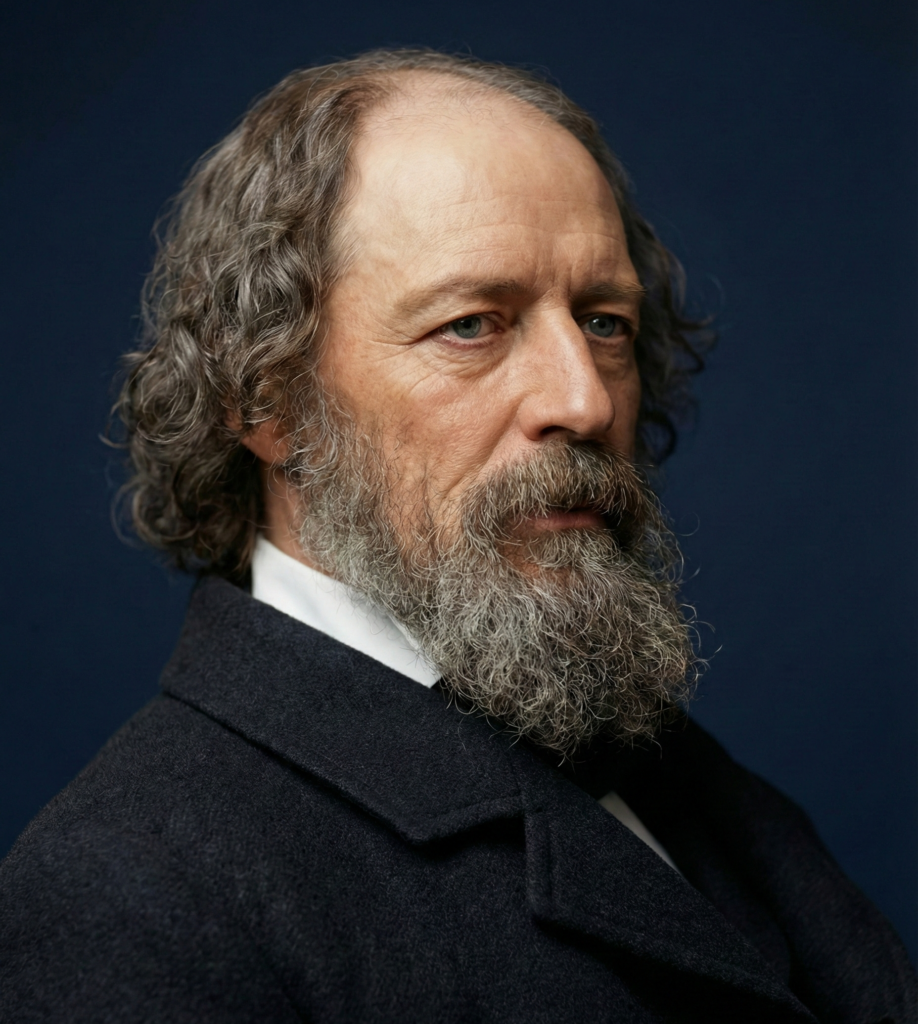
Alfred, Lord Tennyson (1809–1892) was the most renowned poet of the Victorian era. As the Poet Laureate of Great Britain and Ireland for over 40 years, he became the voice of his age, capturing its doubts, scientific discoveries, and deep sense of melancholy.
Early Life & Family (1809–1827)
Alfred Tennyson was born on August 6, 1809, in Somersby, Lincolnshire, England. He was the fourth of 12 children born to George Clayton Tennyson and Elizabeth Fytche.
A Troubled Home: His father, George, was a rector (clergyman) but was a deeply unhappy man. He had been disinherited by his own father in favor of a younger brother, which left him bitter, financially unstable, and prone to violent alcoholism and depression.
“Black Blood”: The Tennyson family had a history of mental illness (which they called the “black blood” of the Tennysons). Several of Alfred’s brothers suffered from severe mental health issues, ranging from drug addiction to insanity. Alfred himself feared he would inherit this madness, a fear that haunts much of his poetry.
Early Genius: To escape the chaos of his home, Alfred retreated into storytelling and writing. He began writing poetry at age 8. By his teenage years, he had written plays and an epic poem.
First Publication: In 1827, at age 17, he and his brothers Charles and Frederick published Poems by Two Brothers anonymously. It didn’t sell well, but it marked his start.
Cambridge & Arthur Hallam (1827–1831)
In 1827, Tennyson entered Trinity College, Cambridge. This period was the happiest and most formative time of his life.
The Apostles: He joined an elite, secret intellectual society called the Cambridge Apostles. The group debated philosophy, religion, and literature.
Arthur Henry Hallam: At Cambridge, Tennyson met Arthur Henry Hallam. Hallam was brilliant, charismatic, and considered the future leader of his generation. He became Tennyson’s closest friend and greatest supporter. Hallam eventually got engaged to Tennyson’s sister, Emilia, making their bond even stronger.
Golden Medal: In 1829, Tennyson won the Chancellor’s Gold Medal for poetry with his poem “Timbuctoo.”
Leaving Cambridge: In 1831, Tennyson’s father died. Alfred had to leave Cambridge without taking his degree to return home and help care for his family, which was now in financial trouble.
The Tragic Turning Point (1833)
1833 was the defining year of Tennyson’s life.
The Death of Hallam: In September 1833, Arthur Hallam died suddenly of a cerebral hemorrhage (stroke) in Vienna at the age of 22.
The Impact: The news devastated Tennyson. He lost his best friend, his literary critic, and his sister’s fiancé all at once. This grief plunged him into a deep depression that lasted for years.
Literary Response: This tragedy sparked Tennyson’s greatest works. In the weeks following Hallam’s death, he began writing the separate lyrics that would eventually become In Memoriam A.H.H. He also wrote early drafts of “Ulysses” and “Morte d’Arthur” during this period, using poetry to process his need to “keep going.”
The “Ten Years’ Silence” (1833–1842)
The “Ten Years’ Silence” refers to a decade-long period in Alfred, Lord Tennyson’s life when he stopped publishing new poetry. Although he was virtually silent to the public, this was paradoxically the most creative and transformative period of his artistic life.
1. The Causes of the Silence
The silence was triggered by a “double blow” that hit Tennyson in 1833: a devastating personal tragedy and a professional humiliation.
The Personal Tragedy (Grief): In September 1833, his best friend and soulmate, Arthur Henry Hallam, died suddenly of a stroke in Vienna at age 22. Hallam was not just a friend; he was Tennyson’s literary confidant and was engaged to Tennyson’s sister. The shock plunged Tennyson into a deep, paralyzing depression. He felt that the joy of life had vanished.
The Professional Trauma (Criticism): Shortly before Hallam’s death, Tennyson published a book of poems in 1832. It was savagely attacked by critics, particularly John Wilson Croker in the Quarterly Review. Croker mocked Tennyson’s poetry as “absurd,” “affected,” and “effeminate.” Tennyson, who was incredibly sensitive to criticism, was humiliated and decided he would not publish again until he had perfected his craft.
2. Life During the Silence
During these ten years, Tennyson lived a life of obscurity, poverty, and instability.
The “Penny-Post Poet”: Tennyson had no steady income and his family’s finances were in ruin. He became a drifter, moving between cheap lodgings in London and staying with friends. He was often disheveled, smoking infinite amounts of tobacco, and looking like a “dirty, majestic gypsy.”
The Broken Engagement: In 1836, he fell in love with Emily Sellwood. However, in 1840, her family forbade the marriage. They believed Tennyson was too poor to support a wife and were worried about the “black blood” (epilepsy and mental illness) that ran in the Tennyson family. This heartbreak added to his isolation.
Hypochondria: He became obsessed with his health, fearing he would go blind or inherit the “madness” of his father and brothers. He even spent time in a sanitarium to treat his “nerves.”
3. The “Silence” was a Myth
While he was silent to the public, he was incredibly loud on paper. He did not stop writing; he stopped sharing.
The Great Revision: Tennyson took the harsh criticisms of 1832 to heart. He spent years obsessively rewriting his early poems (like The Lady of Shalott and The Lotos-Eaters), stripping away the “flowery” and weak language that critics hated. He turned them into tight, disciplined masterpieces.
New Masterpieces: To cope with his grief over Hallam, he began writing “elegies” in a small notebook. These disconnected scribbles would eventually become his greatest work, In Memoriam A.H.H. He also wrote the drafts for Ulysses, Morte d’Arthur, and Break, Break, Break during this dark time.
4. The End of the Silence (1842)
The silence ended in 1842 when Tennyson finally felt ready to face the world again. He published “Poems” (in two volumes).
Volume 1 contained the heavily revised versions of his old poems.
Volume 2 contained his new works (including Ulysses and Locksley Hall).
The Result: The reception was a triumph. The critics who had mocked him ten years earlier now hailed him as a master. The “Ten Years’ Silence” had transformed him from a promising but flawed young poet into the greatest literary voice of the Victorian age.
The Rise to Fame (1842–1850)
Tennyson slowly re-emerged from his depression and silence.
The 1842 Collection: He published Poems in two volumes. This collection included masterpieces like “The Lady of Shalott,” “Ulysses,” and “Locksley Hall.” It was a massive critical success and established him as a serious poet.
The Year of Triumph (1850): Three major events happened in this “miracle year”:
Publication of In Memoriam: He finally published the elegy he had been writing for Hallam for 17 years. It was an instant sensation, resonating with Victorian readers who were struggling with the conflict between religion and science.
Marriage: With the success of his book, he was finally financially stable enough to marry Emily Sellwood. They named their first son Hallam in honor of his friend.
Poet Laureate: William Wordsworth died, and Queen Victoria appointed Tennyson as the new Poet Laureate.
The Victorian Sage (1850–1892)
For the next 40 years, Tennyson was a celebrity. He looked the part of a poet—tall, bearded, wearing a cloak and a wide-brimmed hat.
Isle of Wight: He moved to a secluded house called Farringford on the Isle of Wight to escape his fans (tourists would often peer over his garden wall to see him).
Major Works:
1. Poems (1842)
This two-volume collection was the turning point in Tennyson’s career, ending his “Ten Years’ Silence” and establishing his fame.
Significance: It contains many of his most famous shorter poems.
Key Poems Included:
“Ulysses” (The dramatic monologue of the aging hero)
“The Lady of Shalott” (A tragic ballad based on Arthurian legend)
“Locksley Hall” (A prophetic poem about the future and failed love)
“Morte d’Arthur” (The death of King Arthur)
“Break, Break, Break” (An elegy for his friend Arthur Hallam)
2. The Princess (1847)
Type: A long narrative poem.
Theme: It tackles the controversial Victorian topic of women’s education and gender roles. It tells the story of a princess who founds a university for women that excludes men.
Famous Lyrics: It includes famous musical interludes like “Sweet and Low” and “The Splendour Falls.”
3. In Memoriam A.H.H. (1850)
Type: A massive elegy (a poem of mourning).
Significance: Considered his masterpiece. It was written over 17 years to mourn the death of his best friend, Arthur Henry Hallam. It is not just about grief, but also about faith, science, and evolution.
Famous Line: “’Tis better to have loved and lost / Than never to have loved at all.”
Impact: This poem was so powerful that it convinced Queen Victoria to appoint him Poet Laureate.
4. Maud, and Other Poems (1855)
Type: A monodrama (a long poem told by one unstable narrator).
Theme: It explores madness, love, and war. It was Tennyson’s personal favorite, though critics found it dark and strange.
Key Poem Included:
“The Charge of the Light Brigade”: One of the most famous war poems in history, written about a disastrous British cavalry charge during the Crimean War (“Into the valley of Death / Rode the six hundred”).
5. Idylls of the King (1859–1885)
Type: A cycle of twelve narrative poems.
Significance: This was his lifelong project. It retells the legends of King Arthur, the Knights of the Round Table, Guinevere, and Lancelot.
Theme: It uses the rise and fall of Camelot as an allegory for the rise and fall of Victorian society and moral values.
6. Demeter and Other Poems (1889)
Type: A collection written in his old age (he was 80).
Key Poem Included:
“Crossing the Bar”: Written just three years before his death, this short poem compares dying to a ship sailing out into the ocean. Tennyson requested that this poem always be printed as the final poem in any collection of his work.
Final Years & Death
The Peerage: In 1884, after declining it twice, Tennyson accepted a peerage from the Queen, becoming Baron Tennyson of Aldworth and Freshwater. He was the first writer to be raised to the nobility solely for his writing.
Old Age: He remained mentally sharp until the end, continuing to write poetry into his 80s.
Death: Alfred, Lord Tennyson died on October 6, 1892, at the age of 83.
Burial: He was buried in Westminster Abbey in the “Poets’ Corner,” resting alongside Geoffrey Chaucer and Robert Browning. His funeral was a national event, with thousands of mourners lining the streets.
Word Meaning
| Tough Word | Meaning in English | Meaning in Hindi |
| Profits | Benefits; is useful | फायदा होना / लाभ होना |
| Idle | Lazy; inactive; doing nothing | बेकार / निष्क्रिय |
| Hearth | Fireplace (symbol of home) | अंगीठी / घर की चौखट |
| Barren | Unproductive; empty | बंजर / उजाड़ |
| Crags | Steep, rugged rocks or cliffs | खड़ी चट्टानें |
| Match’d | Paired; married to | जोड़ीदार / ब्याहा हुआ |
| Aged | Old; elderly | वृद्ध / बूढ़ी |
| Mete | To measure out | नापना / मापन करना |
| Dole | To distribute in small amounts | बांटना (थोड़ी मात्रा में) |
| Unequal | Unfair; varying in justice | असमान / अन्यायपूर्ण |
| Savage | Wild; uncivilized | जंगली / असभ्य |
| Race | A group of people; tribe | जाति / कबीला |
| Hoard | To collect and hide away wealth | जमा करना / इकट्ठा करना |
| Rest | To stop or cease | रुकना / विश्राम करना |
| Lees | Sediment at the bottom of wine | तलछट / गाद |
| Scudding | Moving fast and smoothly | हवा के साथ तेजी से उड़ना |
| Drifts | Clouds or rain driven by wind | हवा के झोंके / उड़ते बादल |
| Hyades | A cluster of stars (rain-bringers) | तारों का समूह (वर्षा लाने वाले) |
| Vext (Vexed) | Disturbed; agitated; annoyed | परेशान किया / क्षुब्ध किया |
| Dim | Dark; unclear | धुंधला / अंधेरा |
| Roaming | Wandering; traveling aimlessly | घूमना / भटकना |
| Hungry heart | Strong desire/craving for more | अतृप्त मन / तीव्र इच्छा |
| Manners | Customs; social behavior | तौर-तरीके / संस्कार |
| Climates | Different regions/weather conditions | जलवायु / प्रदेश |
| Councils | Assemblies; meetings of leaders | सभाएँ / परिषदें |
| Governments | Systems of ruling | सरकारें / शासन व्यवस्था |
| Honour’d | Respected; held in high esteem | सम्मानित / आदरणीय |
| Drunk | Consumed deeply; enjoyed fully | पिया / मग्न हो गया |
| Delight | Great pleasure; joy | आनंद / खुशी |
| Peers | Equals; companions of same rank | साथी / बराबरी वाले |
| Ringing | Echoing sound (of battle) | गूंजता हुआ |
| Plains | Flat lands; battlefields | मैदान / समतल भूमि |
| Windy Troy | The city of Troy (prone to wind) | हवादार ट्रॉय नगर |
| Arch | Archway/Door (metaphor for experience) | मेहराब / द्वार |
| Wherethro’ | Through which | जिसके माध्यम से / जिसके आर-पार |
| Gleams | Shines faintly | चमकता है |
| Untravell’d | Unexplored; not yet visited | अनजाना / जहाँ यात्रा न की हो |
| Margin | Edge; border; horizon | किनारा / क्षितिज |
| Fades | Disappears gradually | धुंधला होना / ओझल होना |
| Dull | Boring; uninteresting | नीरस / उबाऊ |
| Pause | To stop temporarily | ठहरना / विराम लेना |
| Rust | To corrode due to disuse | जंग लगना |
| Unburnish’d | Unpolished; not shiny | बिना चमक का / बिना घिसा हुआ |
| Use | Action; practice | उपयोग / प्रयोग |
| As tho’ | As if | मानो / जैसे कि |
| Piled | Stacked on top of each other | ढेर लगा हुआ |
| Remains | Is left over | शेष रहना / बचा रहना |
| Eternal | Everlasting; never-ending | अनंत / शाश्वत |
| Silence | Quietness (metaphor for Death) | सन्नाटा / मृत्यु |
| Bringer | One who brings/provides | लाने वाला |
| Vile | Disgusting; shameful | नीच / घृणित |
| Suns | Years (poetic) | सूर्य / वर्ष |
| Store | To keep safe for future | संचित करना / रखना |
| Gray spirit | Old soul/mind | वृद्ध आत्मा / अनुभवी मन |
| Yearning | Longing deeply; desiring | तड़प / लालसा |
| Sinking star | A star setting below the horizon | डूबता हुआ तारा |
| Utmost | Furthest; extreme | अंतिम / अधिकतम |
| Bound | Boundary; limit | सीमा / हद |
| Sceptre | Royal staff (symbol of rule) | राजदंड |
| Isle | Island (Ithaca) | द्वीप / टापू |
| Discerning | Having good judgment | विवेकी / समझदार |
| Fulfil | To carry out; complete | पूरा करना / निभाना |
| Labour | Hard work; task | परिश्रम / कार्य |
| Prudence | Wisdom; caution | विवेक / सावधानी |
| Make mild | To calm; to civilize | नरम बनाना / सभ्य बनाना |
| Rugged | Rough; harsh; uncultured | कठोर / असभ्य |
| Soft degrees | Gradual steps | धीरे-धीरे / क्रमिक रूप से |
| Subdue | To conquer; control | वश में करना / काबू पाना |
| Blameless | Innocent; without fault | निर्दोष / निष्कलंक |
| Centred | Focused; fixed upon | केंद्रित |
| Sphere | Area of responsibility | कार्यक्षेत्र / दायरा |
| Common duties | Everyday tasks | सामान्य कर्तव्य |
| Decent | Respectable; proper | शालीन / उचित |
| Offices | Acts; services; functions | कार्य / सेवाएं |
| Tenderness | Kindness; gentleness | कोमलता / दयालुता |
| Meet | Suitable; proper | उपयुक्त / उचित |
| Adoration | Worship; deep respect | पूजा / आराधना |
| Household gods | Family deities/statues | कुलदेवता |
| Port | Harbor | बंदरगाह |
| Vessel | Ship | जहाज / जलयान |
| Puffs | Swells (with wind) | फूलना (हवा से) |
| Gloom | Look dark/threatening | अंधेरा छाना / उदास दिखना |
| Broad | Wide; vast | विशाल / चौड़ा |
| Mariners | Sailors | नाविक |
| Toil’d | Worked physically hard | कड़ी मेहनत की |
| Wrought | Shaped; created; made | गढ़ा / बनाया |
| Frolic | Playful; cheerful; merry | उल्लासपूर्ण / खेल-कूद |
| Opposed | Faced; resisted | सामना किया / विरोध किया |
| Free hearts | Brave; unburdened hearts | मुक्त हृदय / निडर मन |
| Free foreheads | Confident look (no frowns) | चिंतामुक्त मस्तक |
| Hath | Has (old English) | पास होना / रखना |
| Ere | Before | पहले |
| Noble note | Honorable reputation/deed | महान कार्य / कीर्ति |
| Unbecoming | Unsuitable; inappropriate | अनुचित / शोभा न देने वाला |
| Strove | Struggled; fought | संघर्ष किया |
| Twinkle | Shine intermittently | टिमटिमाना |
| Wanes | Declines; fades; ends | ढलना / समाप्त होना |
| Climbs | Rises up | ऊपर चढ़ना |
| The deep | The ocean | गहरा समुद्र |
| Moans | Makes a low, sad sound | विलाप करना / कराहना |
| Seek | To search for | खोजना / तलाशना |
| Push off | Leave the shore; launch | रवाना होना / नौका चलाना |
| Smite | Strike; hit hard | जोर से मारना |
| Sounding | Making noise | आवाज करता हुआ |
| Furrows | Waves/tracks made by ship | लहरें / पानी की लकीरें |
| Purpose | Goal; intention | उद्देश्य / लक्ष्य |
| Holds | Remains firm | कायम रहना / स्थिर रहना |
| Baths | Setting place of stars (ocean) | स्नान (यहाँ तारों का अस्त होना) |
| Gulfs | Whirlpools; deep currents | गहरी खाड़ियाँ / भंवर |
| Wash us down | Sink us; drown us | डुबो देना |
| Happy Isles | Paradise (Heaven for heroes) | स्वर्ग / आनंद के द्वीप |
| Abides | Remains; stays | शेष रहना / टिकना |
| Temper | Resilience; quality of mind | स्वभाव / कठोरता |
| Fate | Destiny | भाग्य / नियति |
| Yield | Surrender; give up | हार मानना / झुकना |
Themes
The Hunger for Adventure
This is the main feeling that drives the whole poem. Ulysses is not happy just sitting at home. He is like a man who is starving for travel and new experiences. He doesn’t just want to visit a few places; he wants to see absolutely everything the world has to offer. He feels that staying in one place is a waste of life.
He explains that learning is like walking through a doorway (an arch). The more you learn and walk forward, the more you realize how huge the world is and how much you still haven’t seen. He calls this the “untravell’d world.” He feels a deep need to “drink life to the lees,” which means he wants to enjoy every single drop of life until the cup is empty. This theme celebrates the human desire to keep exploring and never being satisfied with just staying safe.
Refusal to Give Up (Resilience)
This is the most powerful and famous message of the poem. Ulysses and his group of sailors have been through many wars and hard times. They are physically old now, and their bodies are tired. Ulysses admits that they are “made weak by time,” meaning they are not as strong as they were when they were young.
However, Ulysses argues that true strength is not about your muscles; it is about your mind and your will. He refuses to accept defeat or to just give up because he is old. He focuses on the strength that is still left inside him. The poem ends with a promise to “strive, to seek, to find, and not to yield.” This teaches us that no matter how difficult life gets or how old you become, you should never quit.
Old Age is Not the End
Usually, society thinks that old age is a time to rest, retire, and sit quietly waiting for the end. Ulysses completely disagrees with this idea. He knows he is going to die soon because his “long day wanes,” but he doesn’t want to waste his final years sitting in a chair. He believes that old people can still do important work (“honor and toil”).
He feels a sense of urgency. Because he knows his time is short, he feels that every single hour is precious. He wants to save every hour from death (the “eternal silence”) by doing something useful. He tells his old friends that it is “not too late” to start a brand new adventure. This theme tells us that life isn’t over until the very moment you die, and you are never too old to do something great.
Living vs. Existing
Ulysses makes a big difference between just staying alive (surviving) and actually living a full life. He says, “As though to breathe were life!” This means that just because you are breathing, it doesn’t mean you are truly living. He looks at his people who just eat, sleep, and save money, and he thinks they are merely existing like animals.
To explain this, he compares himself to a metal sword. If a sword is used in battle, it stays shiny and bright (“burnish’d”). If a sword hangs on a wall and is never used, it gets covered in rust. Ulysses thinks that if he stays home and does nothing, he will “rust” away. He believes that to be truly alive, you must be active, face challenges, and keep moving.
Duty vs. Passion
The poem shows a conflict between what Ulysses should do (his Duty) and what he wants to do (his Passion). As a king, he has a job to take care of his people, his laws, and his family. However, he finds this job boring. He feels trapped by the daily routine of being a ruler. His real passion is sailing the dangerous seas and discovering new things.
He solves this problem by giving the kingdom to his son, Telemachus. Telemachus is patient, calm, and good at handling the daily rules and “common duties.” Ulysses realizes that his son is actually better at being a king, while he (Ulysses) is better at being an explorer. He says, “He works his work, I mine.” This theme shows that different people have different paths in life, and it is okay to follow your passion.
Very Short Answer Questions
Who is the poet of “Ulysses”?
Alfred, Lord Tennyson.
What literary form is the poem written in?
It is a dramatic monologue.
Who is the speaker of the poem?
Ulysses (Odysseus), the aging King of Ithaca.
Whom is Ulysses addressing in the final section of the poem?
His mariners (sailors/crew).
Who is Ulysses’ son and successor?
Telemachus.
What is the name of Ulysses’ wife mentioned in the poem?
Penelope (referred to as his “aged wife”).
What island kingdom does Ulysses rule?
Ithaca.
What does Ulysses say he will “drink to the lees”?
Life.
What metaphor does Ulysses use for experience?
An arch (wherethro’ gleams that untravell’d world).
What does the “sinking star” symbolize?
Limitless knowledge.
What does Ulysses compare staying at home to?
A sword rusting unburnished.
What does the “hearth” represent in the poem?
Domestic life and safety (which Ulysses rejects).
Who is the “savage race” Ulysses refers to?
His own subjects/people of Ithaca.
What famous war did Ulysses fight in before returning home?
The Trojan War.
What is the “eternal silence” a metaphor for?
Death.
Whom does Ulysses hope to see in the “Happy Isles”?
The great Achilles.
What are the “Happy Isles”?
The Elysian Fields (Greek paradise for heroes).
What does Ulysses want to sail “beyond”?
The sunset.
What time of day is set in the poem?
Twilight / Evening.
What does the phrase “mete and dole” refer to?
The boring administrative duties of a king.
What constellation is mentioned as “rainy”?
The Hyades.
What adjective does Ulysses use to describe his spirit?
Gray.
How does Ulysses describe his son’s method of ruling?
Slow prudence and soft degrees.
What does Ulysses say “closes all”?
Death.
What is the meter of the poem?
Iambic pentameter (blank verse).
What personal tragedy inspired Tennyson to write this poem?
The death of his best friend, Arthur Hallam.
What does Ulysses claim he has become to the world?
A name.
How does Ulysses describe the hearts of his crew?
Heroic.
What does the “untravell’d world” represent?
The future and unknown experiences.
What are the four final verbs of the poem?
To strive, to seek, to find, and not to yield.
Short Answer Questions
How does Ulysses contrast himself with his son, Telemachus?
Ulysses presents himself and Telemachus as foils representing two different ways of living. Ulysses is the restless explorer, characterized by a “hungry heart” and a desire to “drink life to the lees” amidst danger and the unknown. In contrast, he describes Telemachus as “centered in the sphere of common duties,” possessing the “slow prudence” needed to govern and civilize a “rugged people.” While Ulysses seeks the “dark, broad seas,” Telemachus is suited for the domestic “hearth” and the administration of laws, highlighting the distinction between the adventurous spirit and the dutiful, steady administrator.
Explain the significance of the metaphor “I will drink life to the lees.”
This metaphor expresses Ulysses’ intense desire to experience life completely and exhaustively. The “lees” refer to the sediment at the bottom of a wine bottle, implying that he does not want to just sip the “wine” of existence but consume every last drop, including the bitter or rough parts. It rejects a passive existence in favor of a total immersion in experience. By saying this, Ulysses declares that mere biological survival (“to breathe”) is insufficient; he demands a life of deep sensation, action, and thorough involvement until the very end.
What does Ulysses mean by “I am a part of all that I have met”?
This statement reflects Ulysses’ philosophy that identity is fluid and cumulative. He believes that his character is composed of all the people, places, and experiences he has encountered during his travels. It suggests a reciprocal relationship: he has been shaped by the world, and he has likewise left his mark upon it. Rather than being defined by his static role as a king in Ithaca, his true self is a mosaic of his adventures in “Windy Troy” and the “cities of men,” emphasizing that a person is defined by their interactions with the wider world.
Analyze the imagery of the “arch” in lines 19-21 (“Yet all experience is an arch wherethro’…”).
Ulysses uses the architectural image of an arch to describe human knowledge and experience. Instead of viewing experience as a closed room or a completed collection, he sees it as a gateway or frame through which he can see the “untravell’d world.” As he moves forward (travels), the horizon (“margin”) of that world constantly recedes (“fades for ever and forever”). This powerful visual suggests that the pursuit of knowledge is endless; every new discovery opens up a vista of further unknowns, making the journey infinite and the destination unreachable.
How does the poem redefine the concept of old age?
Tennyson challenges the conventional view of old age as a time for rest, reflection, and withdrawal from public life. Ulysses acknowledges the physical reality of aging—”you and I are old”—and admits they are “made weak by time and fate.” However, he reframes this period as one possessing its own “honour and his toil.” He insists that “some work of noble note” can still be done before death. The poem argues that while physical strength fades, the “will” to strive remains, suggesting that the elderly have a responsibility to remain active and engaged rather than “rusting” in idleness.
What is the symbolic meaning of the “sea” versus the “hearth” in the poem?
The poem sets up a binary opposition between the “hearth” and the “sea.” The hearth symbolizes domesticity, safety, stability, and the known world of Ithaca; it is associated with the “barren crags,” the “aged wife,” and the “idle king.” In contrast, the sea (“the dark, broad seas,” “the deep”) represents danger, freedom, the unknown, and the spiritual mystery of death. For Ulysses, the hearth is a place of stagnation where he “rusts,” while the sea is the place of vitality where he “shines,” representing the human soul’s pull toward exploration and the infinite.
Why does Ulysses refer to his subjects as a “savage race”?
Ulysses’ description of his people as a “savage race” reveals his alienation and intellectual distance from them. He perceives their lives as limited to basic animal functions—”hoard, and sleep, and feed”—lacking the higher spiritual or intellectual “hunger” that drives him. He feels they “know not me,” meaning they cannot comprehend his complex nature or his history. This harsh label emphasizes the gap between the visionary hero who seeks “knowledge like a sinking star” and the agrarian population concerned only with material survival, justifying his decision to leave them in Telemachus’s care.
Discuss the meaning of the final line: “To strive, to seek, to find, and not to yield.”
This famous closing line encapsulates the poem’s central theme of resilience and the unbending human will. It is a sequence of four infinitives that build a rhythm of determination. “To strive” implies the struggle against obstacles; “to seek” implies looking for new goals; “to find” implies achieving discovery; and “not to yield” implies the refusal to give up, even in the face of death or failure. It serves as a universal mantra for the Victorian spirit of progress and the personal determination to keep going despite grief or age.
How does the setting of “twilight” contribute to the poem’s mood?
The setting of the poem at twilight—”The long day wanes: the slow moon climbs”—creates a mood of melancholy urgency. The fading light symbolizes the end of Ulysses’ life (his “long day”), reminding the reader that death is approaching (“Death closes all”). However, the transition from day to night also signals the time for departure and mystery. The “lights begin to twinkle” from the homes he is leaving, while the “dark” sea beckons. This liminal time between day and night mirrors Ulysses’ position between life and death, adding emotional weight to his final call for adventure.
Why is the poem considered a “dramatic monologue”?
“Ulysses” is a dramatic monologue because it features a single speaker (Ulysses) addressing a silent audience (first himself, then the court/reader, then his mariners) at a critical moment in his life. Through his speech, Ulysses inadvertently reveals his inner character—his arrogance, his restlessness, and his nobility—without a narrator describing him. The focus is entirely on his psychological state and his subjective view of the world. The reader must infer the setting and the reactions of the listeners solely through Ulysses’ words, which is the defining characteristic of this poetic form.
Essay Type Questions
Provide a detailed character sketch of Ulysses as depicted in the poem. Is he a hero or an escapist?
Ulysses, as presented by Tennyson, is a complex and multi-layered character who embodies the restless spirit of the Victorian age. On one hand, he is the quintessential hero of endurance and exploration. He possesses an unquenchable thirst for knowledge and experience, declaring that he “cannot rest from travel” and wishes to “drink life to the lees.” This portrays him as a man of immense vitality who refuses to be defined by his age or his past achievements. He is intellectually superior to those around him, viewing life not as a state of being but as a continuous process of becoming. His famous desire “to follow knowledge like a sinking star” reveals a spirit that is transcendent, constantly pushing against the boundaries of human thought.
However, Tennyson also reveals a darker, more critical side to Ulysses’ character, making him arguably an escapist. Ulysses is deeply dissatisfied with his domestic life, referring to his wife Penelope as “aged” and his subjects as a “savage race” who only “hoard, and sleep, and feed.” This reveals a degree of arrogance and a lack of empathy for the common people he is supposed to rule. Instead of finding purpose in the “common duties” of kingship—improving the lives of his people—he views these responsibilities as tedious and beneath him. By leaving the throne to Telemachus, he is effectively abandoning his post to pursue his own personal desires, framing his escapism as a noble quest.
Despite these flaws, Ulysses ultimately stands as a symbol of the indomitable human will. He acknowledges his physical limitations, admitting that he and his crew are “made weak by time and fate.” Yet, he refuses to let his physical decline dictate his spiritual capacity. His resilience is his most defining trait; he transforms the tragedy of old age into a new opportunity for honor. He rallies his men not with promises of wealth, but with the grim yet inspiring reality that “death closes all,” and therefore they must do something “noble” before the end.
In conclusion, Ulysses is neither purely a hero nor purely an escapist; he is a blend of both. He represents the tension between social duty and individual passion. While his rejection of his family and people may seem selfish, his refusal to “rust unburnish’d” and his commitment “to strive, to seek, to find, and not to yield” elevate him to a figure of mythic grandeur. He inspires readers to reject stagnation and to face the inevitable end of life with courage and purpose.
Discuss “Ulysses” as a dramatic monologue. How does the form contribute to the poem’s meaning?
“Ulysses” is one of the finest examples of a dramatic monologue in English literature. A dramatic monologue is a poem in which a single speaker addresses a silent listener (or listeners) at a critical moment in their life, inadvertently revealing their own character, motives, and internal conflicts. In this poem, Ulysses speaks first to himself (soliloquy), then likely to his court, and finally to his mariners. The form allows Tennyson to explore the psychology of the aging hero from the inside out, without the interference of a narrator. We see the world strictly through Ulysses’ eyes, which helps us understand his deep frustration with Ithaca and his desperate longing for the sea.
The structure of the monologue mirrors the movement of Ulysses’ mind. It begins in a mood of weary contemplation as he surveys the “barren crags” of his island. The rhythm is slow and halted, reflecting his boredom. As the poem progresses and he begins to think about his past adventures, the rhythm accelerates, becoming more energetic. By the time he addresses his mariners in the final section, the language becomes grand and rhetorical. This shift in tone—from the grumbling of an “idle king” to the inspiring speech of a captain—demonstrates the transformative power of his memory and his will. The form captures the dynamic process of him psyching himself up to leave.
Furthermore, the dramatic monologue allows for irony and ambiguity. Because we only hear Ulysses’ side of the story, we must judge him based on his own words. When he dismisses his people as “savage” and his son’s work as merely “prudence,” the reader can detect his arrogance and his inability to appreciate the value of stability. He reveals more than he intends to; while he tries to present himself as a noble seeker of knowledge, he also reveals himself as a man who cannot handle the mundane responsibilities of real life.
Finally, the silence of the listeners is significant. We never hear Telemachus accept the throne, nor do we hear the mariners agree to sail. This emphasizes Ulysses’ isolation. He is a man out of time, speaking into the void, trying to impose his will upon a world that has moved on. The dramatic monologue form ultimately highlights the solitude of the genius or the hero who feels superior to his surroundings and can only find companionship in his own memories and future ambitions.
Analyze the relationship between Ulysses and his son, Telemachus. How do they serve as foils to one another?
The relationship between Ulysses and Telemachus is central to the poem’s exploration of the conflict between passion and duty. Tennyson presents the two characters as foils—opposites that highlight each other’s distinct qualities. Ulysses represents the chaotic, adventurous, and destructive force of the hero. He is associated with “thunder,” “roaming,” and the “dark, broad seas.” Telemachus, on the other hand, represents the orderly, civilizing, and constructive force of the administrator. He is associated with “slow prudence,” “soft degrees,” and the “hearth.”
Ulysses describes Telemachus with a tone that is respectful but undeniably detached and perhaps slightly condescending. He calls him “blameless” and acknowledges that he is “discerning to fulfil this labour.” However, the words Ulysses chooses—”common duties,” “decent,” “household gods”—suggest that he views Telemachus’s world as small and unexciting. Ulysses cannot respect the quiet work of “making mild a rugged people” because it lacks the glory of battle and discovery. He essentially creates a division of labor: “He works his work, I mine.” This implies that while Telemachus’s work is necessary for society, it is not suitable for a man of Ulysses’ spirit.
Conversely, Telemachus serves to highlight Ulysses’ irresponsibility. By describing Telemachus as “centered in the sphere of common duties,” Ulysses inadvertently reminds the reader that he should be centered there too. Telemachus is willing to stay and do the hard, boring work of governing a difficult population, paying “meet adoration” to the gods and caring for his mother. In comparison to this “blameless” devotion, Ulysses’ decision to sail away looks like an abandonment of his family and his people.
Ultimately, the contrast suggests that society needs both types of men. It needs the Telemachus figures to maintain order, create laws, and ensure stability (“the useful and the good”). But it also needs the Ulysses figures to push boundaries, explore the unknown, and expand the horizons of human possibility. By placing them side by side, Tennyson acknowledges the validity of the quiet life of duty while simultaneously championing the louder, more dangerous life of the spirit.
How does Tennyson use imagery and symbolism to convey the central themes of the poem?
Tennyson employs a rich tapestry of imagery and symbolism to articulate the themes of stagnation versus action. One of the most powerful images is that of the Arch of Experience (“all experience is an arch wherethro’ / Gleams that untravell’d world”). This architectural metaphor changes how we view life; instead of building a collection of memories, life is a gateway. The horizon is not a limit but a moving boundary that recedes as we approach it. This visual perfectly captures the theme of the “insatiable thirst for knowledge”—the idea that the more we know, the more we realize we do not know.
Another central symbol is the contrast between the Rusted Sword and the Shining Sword. Ulysses cries out, “How dull it is to pause, to make an end, / To rust unburnish’d, not to shine in use!” Here, the metal sword represents the human soul and potential. Activity and friction (battle/adventure) keep the soul bright and sharp. Inactivity leads to corrosion and decay. This industrial, metallic imagery reinforces the Victorian work ethic and the idea that “living” requires constant motion and utility.
The Sea serves as the ultimate symbol of the unknown, death, and freedom. It is described as “dark,” “broad,” and “moaning with many voices.” It is a place of mystery that contrasts with the static, rocky safety of the land (Ithaca). The sea beckons Ulysses not just to travel, but to a spiritual transcendence. When he speaks of sailing “beyond the sunset” and the “baths of all the western stars,” he is merging the literal journey across the ocean with the metaphorical journey into death and the afterlife.
Finally, the Time of Day—twilight—is symbolic of Ulysses’ life stage. “The long day wanes: the slow moon climbs.” The setting sun represents the end of his vitality and the approach of the “eternal silence.” However, Tennyson uses the stars (the Hyades, the sinking star) to provide a counter-symbol of guidance and hope. Even in the gathering darkness of old age, there are lights to follow. These symbols work together to create a mood that is melancholy yet deeply inspiring, grounding the abstract philosophical themes in concrete physical reality.
“Old age hath yet his honour and his toil.” Discuss Tennyson’s philosophy of old age as presented in the poem.
In “Ulysses,” Tennyson presents a revolutionary philosophy of old age that challenges the traditional view of decline and retirement. Rather than viewing the elderly as obsolete or useless, Ulysses argues that old age is a distinct phase of life with its own specific responsibilities and possibilities. He admits the physical reality of aging with brutal honesty: “you and I are old” and “made weak by time and fate.” He does not pretend to have the strength of youth that once “moved earth and heaven” during the Trojan War. This realism makes his subsequent optimism even more powerful.
The core of this philosophy is the separation of the body from the will. While the body may weaken, the will—the driving force of the human spirit—can remain “strong.” Ulysses redefines what it means to be “useful” in old age. It is not about physical labor or fighting wars, but about the pursuit of “some work of noble note.” He suggests that the elderly have a unique perspective (“wisdom”) that allows them to do things “not unbecoming men that strove with Gods.” The “toil” of old age is intellectual and spiritual: to continue seeking truth and meaning until the very end.
Tennyson also introduces the concept of urgency. In youth, time feels infinite; in old age, every hour becomes precious. Ulysses views every hour “saved from that eternal silence” as a victory. This creates a powerful argument against the passivity often associated with retirement. He calls upon his “Souls that have toil’d” to engage in one last great effort. The goal is not necessarily to succeed (he admits the gulfs may “wash us down”), but to make the attempt.
Ultimately, the poem acts as a protest against the “dying of the light.” Tennyson suggests that the dignity of old age comes from resistance—resistance against complacency, resistance against the comfort of the “hearth,” and resistance against the inevitability of death. The final line, “To strive, to seek, to find, and not to yield,” becomes a mantra for aging. It implies that as long as one refuses to “yield” or give up mentally, one is truly alive, regardless of physical frailty. This philosophy turns the end of life into a heroic climax rather than a quiet fading away.
Critical Analysis
Introduction
“Ulysses” is a famous poem written by the English poet Alfred, Lord Tennyson in 1833. He wrote this poem after his best friend, Arthur Hallam, died suddenly. Tennyson was very sad, and he wrote this poem to help himself cope with his grief.
The poem is a Dramatic Monologue, which means it is like a speech given by a character in a play. The speaker is Ulysses (also known as Odysseus), a legendary Greek hero who fought in the Trojan War. In this poem, Ulysses is now an old man who has returned home to his kingdom. Instead of being happy to be back, he feels bored and restless. He talks about how much he misses his old life of adventure and how he wants to go on one last voyage before he dies.
Central Idea
The main idea of the poem is that you should never give up, no matter how old or weak you become.
Ulysses believes that life is only meaningful if you are active and learning new things. He thinks that just sitting at home, eating, and sleeping is not really “living”—it is just existing. Even though he knows he is old and might die soon, he refuses to stop. He believes that the human spirit (the Will) is stronger than the body. The poem encourages us to keep moving forward, to keep exploring, and to stay brave until the very end of our lives.
Summary
The poem unfolds in three distinct movements:
The Soliloquy (Lines 1–32): The poem begins with Ulysses (Odysseus), the legendary Greek hero, feeling bored and unhappy after returning home to his kingdom of Ithaca. Even though he is the king, he hates sitting still and dealing with everyday rules and “savage” people who don’t understand him. He misses his past life of great adventures and battles. He feels that simply staying alive and breathing isn’t enough; he wants to truly live and explore the world until the very last moment of his life.
The Abdication (Lines 33–43): Ulysses realizes that he is not suited to be a calm, administrative ruler. He decides to hand over his kingdom and crown to his son, Telemachus. He describes Telemachus as a smart and patient man who is perfect for the job of governing the people and keeping the peace. By giving the throne to his son, Ulysses feels free to leave. He believes his son will do the work of a king (“common duties”), while he goes off to do the work of an explorer.
The Address to the Mariners (Lines 44–70): In the final part of the poem, Ulysses speaks to his old crew of sailors. He admits that they are all old and weak now, but he reminds them that their spirits are still strong. He urges them to join him on one last dangerous voyage into the unknown ocean. He knows they might die, but he wants to do something noble before the end. The poem ends with his famous promise to keep moving forward: “To strive, to seek, to find, and not to yield.”
Structure & Rhyme Scheme
Form: Dramatic Monologue. The entire poem is spoken by a single character (Ulysses) to a silent audience. This allows the reader to psychoanalyze the speaker through his own words.
Meter: Iambic Pentameter (ten syllables per line, alternating unstressed/stressed). This gives the poem a dignified, heroic, and speech-like rhythm (e.g., “To STRIVE, to SEEK, to FIND, and NOT to YIELD”).
Rhyme Scheme: Blank Verse (Unrhymed). There is no end rhyme. Tennyson chose this to make Ulysses sound natural, meditative, and serious, rather than lyrical or song-like.
Syntax: The poem makes heavy use of Enjambment (sentences running over the line breaks without pausing). This mimics Ulysses’ restlessness and his desire to keep moving forward without stopping.
Theme
The Hunger for Adventure
Ulysses has an unstoppable desire to explore. He believes that staying in one place and ceasing to travel is a waste of life. He compares experience to an “arch”—the more he travels, the more he sees how much of the world is left to discover. He wants to experience life fully until the very end.
Refusal to Give Up (Resilience)
This is the poem’s central message. Although Ulysses and his men are old and physically weak, their spirits remain strong. Ulysses argues that true strength comes from the will, not the body. He promises to keep fighting and pushing forward, famously vowing “to strive, to seek, to find, and not to yield.”
Old Age is Not the End
Ulysses rejects the idea that old people should retire and rest. He believes that even in the final years of life, people can still do “noble work.” He feels a sense of urgency to make his last days count before death (“eternal silence”) arrives. He insists it is never too late to start a new adventure.
Living vs. Existing
Ulysses distinguishes between merely surviving (“breathing”) and truly living. He views his subjects, who only eat and sleep, as merely existing. He uses the metaphor of a sword: if used, it shines; if unused, it rusts. He believes that to be truly alive, one must be active, useful, and constantly moving, rather than “rusting” in safety.
Duty vs. Passion
The poem contrasts social responsibility (Duty) with personal desire (Passion). Ulysses finds his duty as a king boring and restrictive. He resolves this conflict by handing the kingdom to his son, Telemachus, who is better suited for the patient work of ruling. This allows Ulysses to follow his true passion for the sea. As he says, “He works his work, I mine.”
Style
Tennyson’s style in “Ulysses” is grand, rhetorical, and elevated.
Diction: He uses archaic and heavy words (wrought, smite, mete, hyades) to create a sense of ancient authority.
Tone: The tone shifts from melancholy and bored in the first section to calm and detached in the middle, and finally to passionate and inspiring in the end.
Visuals: The poem moves from the “barren crags” and “still hearth” (images of stasis) to the “dark broad seas” and “sinking star” (images of motion and depth).
Poetic Devices
Metaphor
A comparison between two unlike things without using “like” or “as.” Tennyson uses this heavily to explain complex ideas.
“I will drink life to the lees”
Comparison: Life is compared to a cup of wine.
Meaning: “Lees” are the sediments at the bottom of a wine bottle. Ulysses wants to experience every single drop of life, even the bitter parts at the end.
“All experience is an arch”
Comparison: Experience is compared to a doorway (arch).
Meaning: Learning isn’t a room you finish furnishing; it’s a door you walk through. Every time you learn something new, you see a new world (horizon) opening up ahead of you.
“To rust unburnish’d, not to shine in use”
Comparison: Ulysses compares himself to a metal sword or tool.
Meaning: If a sword is used in battle, it stays bright (“burnish’d”). If it hangs on a wall, it gets rusty. Ulysses feels he is “rusting” by doing nothing at home.
Simile
A direct comparison using “like” or “as.”
“To follow knowledge like a sinking star”
Meaning: He chases knowledge as if it were a star setting over the horizon—something beautiful that is always just out of reach, pulling him further into the unknown.
Personification
Giving human qualities to non-human objects.
“The vessel puffs her sail”
Meaning: The ship is described as if it is breathing or eager to leave.
“The deep / Moans round with many voices”
Meaning: The ocean (“the deep”) is given a human voice. It seems to be calling out to Ulysses, urging him to return to it.
Synecdoche
Using a part of something to represent the whole thing.
“Free hearts, free foreheads”
Meaning: He uses body parts (hearts and foreheads) to represent his entire crew and their brave, independent spirits.
“The lights begin to twinkle from the rocks”
Meaning: The “lights” represent the homes and the people living in them.
Alliteration
The repetition of the same letter or sound at the beginning of adjacent words.
“Drink delight of battle” (Repetition of ‘D’)
“Classics… climates, councils” (Repetition of ‘C’)
“Silence… sinking star” (Repetition of ‘S’)
Effect: This adds a musical quality to the poem. The ‘S’ sound (sibilance) in the final lines creates a smooth, hushed, and mysterious atmosphere.
Enjambment
When a sentence runs over from one line of poetry to the next without punctuation (like a comma or period) at the end of the line.
Example:
Yet all experience is an arch wherethro’ / Gleams that untravell’d world whose margin fades…
Effect: This forces the reader to keep moving quickly to the next line to find the meaning. It mimics Ulysses’ own restlessness and his desire to keep moving forward.
Contrast (Antithesis)
Placing two opposite ideas together to highlight their differences.
Ulysses vs. Telemachus:
Ulysses is “wild,” “roaming,” and loves the sea.
Telemachus is “centered,” “prudent,” and loves the hearth (home).
Taken vs. Abides:
“Tho’ much is taken, much abides” balances what they have lost (youth) with what they still have (experience/will).
Symbolism
The Sea: Represents freedom, danger, the unknown, and death.
The Hearth: Represents safety, domestic life, and stagnation (boredom).
The Sunset: Represents the end of the day, but symbolically represents the end of Ulysses’ life (death).
Critical Commentary
The Ambiguity of the Hero: While traditionally read as a poem of courage, critics often point out a darker side. Is Ulysses a hero, or is he a selfish old man abandoning his wife and kingdom? In Dante’s Inferno, Ulysses is punished in Hell for this exact voyage (for counseling his men to sail to their deaths). Tennyson allows this tension to exist: Ulysses is inspiring, yet he is also irresponsible.
Victorian Context: The poem reflects the Victorian era’s obsession with progress and work ethic. The fear of “rusting” mirrors the industrial age’s fear of uselessness. However, it also reflects the deep anxiety of the age—the fear that science and time were eroding traditional faith (“The long day wanes”).
Autobiographical Depth: The poem is ultimately Tennyson speaking to himself about his grief over Arthur Hallam. The line “I cannot rest from travel” is Tennyson saying he cannot let grief paralyze him.
Message
The poem delivers a timeless message of Carpe Diem (Seize the Day), but with a stoic twist. It does not suggest we should party because life is short; rather, it suggests we must work because life is short. It teaches that meaning is found in the struggle itself, not necessarily the victory. It encourages the reader to define themselves by their “Will” rather than their circumstances or age.
Conclusion
“Ulysses” is a triumph of English literature because it transforms the tragedy of old age into a heroic victory. It acknowledges that death is inevitable (“The long day wanes”), yet it refuses to bow down to it. By ending with the powerful monosyllabic beat of “To strive, to seek, to find, and not to yield,” Tennyson leaves the reader not with a sense of an ending, but with a sense of infinite forward motion. It remains the ultimate anthem for anyone refusing to give up on life.