The Ramayana: The Bali Vadh Episode
1. Then struck by Rama’s arrow, Valin, harsh in battle, fell
suddenly like a tree cut down.
2. Adorned with pure gold, his whole body toppled to the
ground, like the flagstaff of the king of gods when its ropes
are released.
3. As that lord of the hosts of monkeys and apes fell to the
ground, the earth grew dim, like the sky when the moon
vanishes.
4. And yet, though he had fallen to the ground, the great
monkey’s majesty, life, power, and valor did not leave his
body.
5. For the wonderful jewel-studded gold necklace that Sakra
had given him sustained the life, power, and majesty of the
monkey-chief.
6. With his gold necklace, the heroic leader of the monkey
troops looked like a rain cloud edged by the glowing light
of evening.
7. Though he had fallen, it was as if his lingering splendor
had been broken into three shining parts: his necklace, his
body, and the arrow piercing his vital organs.
8. For that missile, shot from Rama’s bow, had opened the
path to heaven for that warrior and gained for him the
highest state.
9–11. Like unassailable great Indra, like irresistible great Indra,
great Indra’s fallen son, gold-garlanded Valin, lion-chested,
long-armed, blazing-faced, tawny-eyed, lay fallen thus in
battle, resembling a fire whose flame has gone out, like
Yayati fallen from the world of the gods through exhaustion
of his merit, or the sun cast down to earth by Time at the end
of the world. Followed closely by Laksmana, Rama approached
and looked at him.
12. Now when Valin saw Raghava and mighty Laksmana, he
spoke these words which, though harsh, were civil and
consistent with righteousness.
13. ‘Because of you, I have met my death while in the heat of
battle with someone else. What possible merit have you
gained by killing me when I wasn’t looking?
14–15. ‘”Rama is well-born, virtuous, powerful, compassionate,
and energetic. He has observed vows, knows pity, is devoted
to the welfare of the people, knows when to act, and is firm
in his vows.” That is how everyone spreads your good
reputation throughout the world.’
16. ‘Considering those good qualities of yours and your exalted
lineage as well, I engaged in battle with Sugriva though
Tara tried to stop me.
17. ‘Since I didn’t see you, I had no idea you would strike me
when I was in the heat of battle with another, heedless of
you.
18. ‘I did not know that your judgment was destroyed and
that you were a vicious evildoer hiding under a banner of
righteousness, like a well overgrown with grass.
19. ‘I did not know that you were a wicked person wearing
the trappings of virtue, concealed by a disguise of
righteousness like a smoldering fire.
20–21. ‘I did no harm either in your kingdom or in your city, nor
did I insult you; so why did you kill me, an innocent
forest-ranging monkey, living only on fruit and roots,
when I had joined battle here with someone else and was
not fighting against you?
22. ‘You are the handsome, renowned son of a ruler of men.
You also have the visible signs associated with
righteousness, king.
23. ‘What man, born in a kshatriya family, learned, free of
doubts, and bearing signs of righteousness, would perform
such a cruel deed?
24. ‘Born in a royal family, reputed to be virtuous, why do
you go about with the appearance of decency when you
are in fact not decent, Rama?
25. ‘Conciliation, generosity, forbearance, righteousness,
truthfulness, steadiness, and courage, as well as
punishment of wrongdoers are the virtues of kings, your
majesty.
26. ‘We are but forest-dwelling beasts, Rama, living on roots
and fruit. That is our nature, while you are a man and a
lord of men.
27. ‘Land, gold, and silver are reasons for conquest. But what
possible profit could there be for you in the fruit
belonging to me in this forest?
28. ‘Both statesmanship and restraint as well as punishing
and rewarding are royal functions that must not be
confused. Kings must not act capriciously.
29. ‘But you, instead, care only for your own desire. You are
wrathful, unsteady, confused about your royal functions,
and interested only in shooting your arrows.
30. ‘You have no reverence for what is right, no settled
judgment concerning statecraft; and because you are
addicted to pleasures, you are driven by your passions,
lord of men.
31. ‘Now that you have done this despicable deed and killed
me, an innocent creature, with your arrow, what will you
say in the presence of virtuous men, Kakutstha?
32. ‘A king-killer, a brahman-killer, a cow-killer, a thief, a man
who delights in killing, an atheist, a man who marries
before his elder brother—all of them go to hell.
33. ‘Virtuous people cannot wear my skin, my fur and bones
are forbidden, and my flesh cannot be eaten by people
like you who observe the law.
34. ‘Only five among the five-clawed creatures can be eaten
by brahmans and kshatriyas, Raghava: the hedgehog, the
porcupine, the lizard, the rabbit, and fifth, the turtle.
35. ‘Wise men do not touch my skin or bones, king, and my
flesh must not be eaten; yet I, a five-clawed creature,
have been killed.
36. ‘With you as her protector, Kakutstha, the earth has no
protector and is like a virtuous young wife with a
deceitful husband.
37. ‘Treacherous, dishonest, mean, with false humility, how
could a wretch like you be born of the great Dasaratha?
38. ‘I have been killed by this mad elephant Rama, who has
broken the fetters of good conduct, overstepped the laws
of virtuous men, and disregarded the goad of lawfulness.
39. ‘If you had fought openly in battle, prince, I would have
killed you, and you would now be gazing on Vaivasvata,
god of death.
40. ‘But I, who am unassailable in battle, have been struck
down by you when you could not be seen, as a man
sleeping under the influence of drink may be killed by a
snake.
41. ‘I could have given you Ravana, not killed in battle but
bound around the neck; yet for that same outcome you
killed me, wishing to please Sugriva.
42. ‘Had Maithili been hidden in the ocean waters or even in
the underworld, at your command I would have brought
her back like the white she-mule.
43. ‘It is fitting that when I have gone to heaven, Sugriva
should obtain the kingdom. But for you to have killed me
unjustly in battle is not fitting.
44. ‘Granted, all people, being what they are, are destined
for death. But if what you have accomplished is proper,
think of a good defense.’
45. When he had spoken in this way, the great son of the king
of the gods, pained by the arrow that had wounded him,
his mouth dry, looked at Rama, radiant as the sun, and
fell silent.
1. Stricken and losing consciousness, Valin had addressed
to Rama those words that were civil, beneficial, consistent
with righteousness and statecraft, yet harsh.
2–3. As he finished speaking, that best of monkeys was like a
darkened sun, like a rain cloud that has given up its
water, or like an extinguished fire. Rama, having been
censured, at last addressed Valin, lord of monkeys, with
unsurpassed words distinguished by righteousness and
statecraft:
4. ‘How can you, who do not understand righteousness,
statecraft, pleasure, or even worldly conduct, in your
foolishness reproach me here today?
5. ‘My friend, in your monkey frivolousness, you wish to
revile me here without consulting elders endowed with
judgment and respected as teachers.
6. ‘This earth with its mountains, woods, and forests belongs
to the Iksvakus, as does the right of punishing and rewarding
its beasts, birds, and men.
7. ‘It is protected by righteous Bharata, who is truthful and
upright, who knows the true nature of righteousness, pleasure,
and statecraft, and who devotes himself to punishing and
rewarding.
8. ‘He is a king who knows the proper place and time for
action. In him are well established both statesmanship
and humility, as well as truth and valor, as prescribed in
sacred texts.
9. ‘With his command given for the sake of righteousness,
we and the other princes go about the entire world seeking
the continuance of righteousness.
10. ‘While that tiger among kings, Bharata, devoted to
righteousness, protects the whole earth, who could suppress
righteousness?
11. ‘Firm in our own high duty, honoring Bharata’s command,
we duly chastise whoever strays from the path of
righteousness.
12. ‘But you violate righteousness and are condemned by
your actions. You are engrossed in the pursuit of pleasures,
and you have not kept to the path of kings.
13. ‘An older brother, a father, and a bestower of learning—
these three are to be regarded as fathers by one who
walks the path of righteousness.
14. ‘A younger brother, one’s own son, and also a pupil with
good qualities—these three are to be thought of as one’s
sons, if righteousness is the standard here.
15. ‘Righteousness is subtle, monkey, and extremely difficult
to understand even for good people. The self in the heart
of all beings knows good and evil.
16. ‘You are frivolous and consult with frivolous, weak-minded
monkeys, like someone blind from birth who consults
with others blind from birth. What then can you possibly
see?
17. ‘But I shall tell you clearly the meaning of my statement,
for you should not condemn me simply because you are
angry.
18. ‘Learn therefore the reason why I have killed you: You
have forsaken everlasting morality and live in sin with
your brother’s wife.
19. ‘Out of lust you committed a sinful deed: While great
Sugriva is alive, you lived in sin with your daughter-in-law
Ruma.
20. ‘You acted according to your desires, monkey, and in
violating your brother’s wife, you departed from
righteousness. That is why this punishment was
administered to you.
21. ‘Leader of monkey troops, I see no way other than
punishment to chastise someone who is opposed to
righteousness and deviates from universal custom.
22. ‘Death is the punishment prescribed for a man who out of
lust approaches his daughter, sister, or younger brother’s
wife.
23. ‘Now Bharata is the ruler of the earth, and we merely carry
out his commands. How then can we overlook your
violation of righteousness?
24. ‘Wise Bharata is intent on chastising those addicted to
sensual pleasures, righteously disciplining whoever
transgresses major laws.
25. ‘And we have made Bharata’s command our sacred law,
lord of monkeys, and are intent on punishing those who,
like you, transgress the proper limits.
26. ‘My friendship with Sugriva is just like my friendship with
Laksmana. And for the sake of his wife and kingdom, he is
devoted to my highest good.
27. ‘Moreover, I made a promise at that time in the presence
of the other monkeys. And how can someone like me
disregard a promise?
28. ‘Therefore, for all those important reasons that are
consistent with righteousness, you must agree that your
punishment is appropriate.
29. ‘Your chastisement must be viewed as righteous in every
way. A person who keeps righteousness clearly in view
must assist his friend.
30. ‘Then too men who have done evil but have been punished
by kings become pure and go to heaven just as do virtuous
men.
31. ‘My noble ancestor Mandhatr inflicted a terrible punishment
on a mendicant who committed a sin like the sin you
committed.
32. ‘Sins have been committed as well by other heedless rulers
of the earth. But when they made atonement, that taint
was removed.
33. ‘So enough of this sorrow! Your death was decided upon
justly, tiger among monkeys: We were not being arbitrary.
34. ‘By snares, nooses, and various traps, men in hiding or
out in the open catch all kinds of beasts who run away
terrified or confidently stand still.
35. ‘Men seeking meat shoot animals that are attentive or
inattentive or even facing the other way, and there is
nothing wrong with this.
36. ‘Even royal seers who fully understand righteousness go
hunting here. And so, monkey, I struck you down with an
arrow in battle regardless of whether you fought back or
not. After all, you are only a monkey.
37. ‘There is no doubt, best of monkeys, that it is kings who
give life and prosperity and otherwise unattainable
religious merit.
38. ‘One should not harm them, nor censure them, nor insult
them, nor say displeasing things to them. They are gods
in human form going about on earth.
39. ‘Yet you, who know nothing of righteousness and simply
follow your passions, rebuke me for abiding by my sacred
ancestral laws.’
40. Addressed by Rama in that way, Valin, lord of monkeys,
was deeply disturbed. Joining his palms in supplication,
he replied to Rama.
41. ‘Best of men, there is no doubt that what you have said is
true. Indeed, a lowly person should not talk back to an
exalted one.
42. ‘Please do not find fault with me even for the unseemly,
displeasing words I spoke before by mistake, Raghava.
43. ‘For you understand worldly interests and know the truth,
and you are devoted to the well-being of the people. Your
immutable judgment about determining crime and
punishment is correct.
44. ‘You know righteousness. Therefore, with righteous words,
comfort even me, known to be a flagrant violator of
righteousness.’
45. Like an elephant mired in mud, Valin cried out in distress,
his voice choked with tears. Then looking at Rama he said
softly:
46. ‘I do not grieve as much for myself, or Tara, or even my
kinsmen as I do for my eminently virtuous son Angada of
the golden armbands.
47. ‘Cherished since his childhood, he will be so wretched at
not seeing me that he will dry up like a pond whose
waters have been drunk.
48. ‘Show the same high regard to Angada as to Sugriva, for
you are their teacher and protector, abiding by the rules of
what must be done and what must not be done.
49. ‘And, king and lord of men, you should think of Sugriva
and Angada with the same affection as you have for
Bharata and Laksmana.
50. ‘And please arrange it so that Sugriva will not think ill of
poor Tara who is guilty only through my guilt.
51. ‘For the kingdom can be served only by someone you
favor, who is under your control and obedient to your
wishes.’
52. Rama then consoled Valin, who now saw things clearly:
53. ‘You must not worry about us, or even about yourself, best
of monkeys, for we made our determination with regard
to you according to the law.
54. ‘Neither he who inflicts punishment on one who deserves
punishment nor he who is punished when he deserves
punishment perishes: Each serves the due process of
justice.
55. ‘Therefore, freed from sin by meeting with this punishment,
you have returned to your own righteous nature by the
path determined by righteousness.’
56. When he heard the sweet, calm speech of great Rama,
who followed the path of righteousness and crushed his
enemies in battle, the monkey said these very fitting words:
57. ‘If when I was half unconscious with the pain of the
arrow, lord, I unwittingly censured you, whose fearful
prowess is equal to great Indra’s, please be gracious and
forgive me, ruler of the earth.’
The excerpt titled “The Bali Vadh Episode” is taken from “The Rāmāyaṇa of Vālmīki: An Epic of Ancient India,” Volume IV, Kishkindhā Kāṇḍa, translated by Rosalind Lefeber, under the general editorship of Robert P. Goldman by Princeton University Press in Princeton, New Jersey, in the year 1994, spans pages 87 through 95.
Summary
The excerpt is titled “The Bali Vadh Episode” and is derived from the scholarly work “The Rāmāyaṇa of Vālmīki: An Epic of Ancient India,” specifically Volume IV, which covers the Kishkindhā Kāṇḍa. This volume features an introduction, translation, and annotation by Rosalind Lefeber, under the general editorship of Robert P. Goldman. The text was published by Princeton University Press in Princeton, New Jersey, in the year 1994, spans pages 87 through 95.
Valmiki is known in Sanskrit literature as the Adi Kavi, which means the first poet. He wrote the Ramayana, which is considered the first epic poem. There are no clear historical records about his life, but popular stories say that he was once a robber. He used to rob people in the forest to support his family. His life changed when he met some wise sages. Their words made him realise that his actions were wrong. After this, he gave up his old life and spent his time in prayer, meditation, and learning.
Valmiki became a poet because of a very touching incident. One day, he saw a pair of cranes in the forest. They were happy and together. Suddenly, a hunter killed the male crane. The female crane cried loudly in pain and sorrow. Valmiki felt deep pity for her. His strong feelings came out as a curse to the hunter: “O hunter, you have killed the crane in love; you will never gain fame and honour.” These words came out in a special rhythm. This rhythm later became known as the shloka. Valmiki used this form to write the whole Ramayana.
Valmiki is special because he is not only the writer of the Ramayana but also a character in the story. He tells the story of Rama. When Sita is sent away, she stays in Valmiki’s ashram. Her twin sons, Luv and Kush, are born and brought up there, and Valmiki teaches them.
The Ramayana is a very long epic with about twenty-four thousand shlokas. Scholars do not fully agree on when it was written, but it is believed to have been started around the fourth century BC and completed by the second century AD. The present form of the epic is well arranged, though some scholars think that the first and last parts were added later. Even then, Valmiki is accepted as the main author of the Ramayana.
The introduction also clarifies that in this specific version, Rama is portrayed as a Mahapurush (a great man subject to human limitations and debates) rather than purely as an all-knowing avatar.
The plot begins on the battlefield in the forest of Kishkindha. King Valin is locked in a fierce duel with his brother Sugriva. Suddenly, Valin is struck in the chest by a powerful arrow shot by Prince Rama, who is hiding behind a tree. Valin falls to the ground, his life sustaining only due to Indra’s divine golden necklace.
Though dying, Valin retains his majestic bearing. He confronts Rama and launches a scathing attack on his morality. Valin asks how a prince renowned for virtue could shoot an enemy who was not looking. He argues that Rama has violated the warrior code (Kshatriya Dharma) which forbids striking an unaware opponent. He also mocks Rama for killing a “forest beast” who has no gold or land to offer, calling the act politically senseless and cowardly.
Rama emerges and calmly defends his actions. He asserts that as the representative of the Ikshvaku dynasty (ruled by Bharata), he has jurisdiction over the entire earth, including forests and animals. He charges Valin with the capital crime of incest for forcefully taking Ruma, the wife of his younger brother Sugriva. Furthermore, Rama classifies Valin as a monkey (Mriga), arguing that kings have the right to hunt animals using snares and stealth, regardless of whether the animal is fighting or fleeing.
Overwhelmed by Rama’s logic and realizing the gravity of his sin, Valin undergoes a transformation. He retracts his harsh words and accepts his death as a just punishment. He pleads with Rama not for his own life, but for the safety of his son, Angada, and his wife, Tara. Rama comforts the dying king, assuring him that his death has served as atonement (Prayashchitta) for his sins. Valin dies in peace, believing he will attain heaven.
The Ramayana: The Bali Vadh Episode Analysis
1. Then struck by Rama’s arrow, Valin, harsh in battle, fell
suddenly like a tree cut down.
2. Adorned with pure gold, his whole body toppled to the
ground, like the flagstaff of the king of gods when its ropes
are released.
3. As that lord of the hosts of monkeys and apes fell to the
ground, the earth grew dim, like the sky when the moon
vanishes.
4. And yet, though he had fallen to the ground, the great
monkey’s majesty, life, power, and valor did not leave his
body.
5. For the wonderful jewel-studded gold necklace that Sakra¹
had given him sustained the life, power, and majesty of the
monkey-chief.
Reference to Context:
These lines are taken from the Ramayana of Valmiki, specifically from Volume IV, the Kishkindha Kanda. This section details the Valin Vadh (The Killing of Valin) episode. The original text was composed in Sanskrit by the ancient sage Valmiki, who is known as the “First Poet” (Adi Kavi). This English translation is by Rosalind Lefeber and edited by Robert P. Goldman, published by Princeton University Press.
In this specific scene, Prince Rama has just intervened in the duel between the monkey brothers, Valin and Sugriva. Fulfilling his promise to Sugriva, Rama shoots a powerful arrow from a hidden position, striking Valin. These lines describe the immediate aftermath of that shot: the dramatic fall of the mighty Monkey King and the mystical way his life force clings to him despite the mortal wound.
Explanation:
Line 1: “Then struck by Rama’s arrow, Valin, harsh in battle, fell suddenly like a tree cut down.”
This line describes the exact moment the battle ends. Valin was in the middle of a fierce fight (“harsh in battle”) and felt invincible. However, the arrow shot by Rama changes everything in a split second. The phrase “struck by Rama’s arrow” shows that the attack was direct and powerful, instantly stopping the warrior in his tracks.
The poet uses a simile here, comparing Valin to a “tree cut down.” This image helps us understand the suddenness and heaviness of his fall. A large, strong tree does not wither away slowly; when it is chopped, it crashes to the ground with great force. Similarly, Valin was a giant figure, strong and rooted, but Rama’s arrow cut him down instantly.
The description “harsh in battle” reminds us of Valin’s nature. He was not a weak opponent; he was a terrifying and aggressive fighter. The fact that he fell “suddenly” highlights the incredible power of Rama’s weapon. It emphasizes that even the toughest warrior can be brought down in a moment by a superior force.
Line 2: “Adorned with pure gold, his whole body toppled to the ground, like the flagstaff of the king of gods when its ropes are released.”
Here, the focus shifts to Valin’s appearance as he falls. He is described as being “adorned with pure gold,” referring to his jewelry and royal ornaments. Even in defeat, he looks like a king. The image of his “whole body” toppling suggests a complete collapse; he didn’t just stumble, he lost all control of his physical form.
Valmiki uses a very specific cultural comparison here: “the flagstaff of the king of gods.” In ancient Indian tradition, during the festival of Indra (the king of gods), a massive, decorated pole or flagstaff was raised up with ropes. At the end of the festival, the ropes were released, allowing the heavy pole to crash down to the earth.
By comparing Valin to this holy flagstaff, the poet elevates Valin’s status. He is not just a monkey; he is like a divine monument associated with Indra (who is actually his father in the myth). The comparison paints a picture of a majestic, decorated object falling from a great height, creating a scene that is both tragic and grand.
Line 3: “As that lord of the hosts of monkeys and apes fell to the ground, the earth grew dim, like the sky when the moon vanishes.”
This line emphasizes Valin’s importance to his people and the world. He is called the “lord of the hosts of monkeys and apes,” reminding us that he is a ruler of a vast kingdom. His fall is not just the death of an individual; it is the collapse of a leader who held his society together.
The phrase “the earth grew dim” is a metaphor for the loss of hope and brightness. It suggests that Valin was the source of light and energy for the land. When he hit the ground, it was as if a shadow passed over the world. Nature itself seems to be mourning his defeat, reacting to the tragedy with darkness.
The poet compares this darkness to “the sky when the moon vanishes.” The moon provides gentle light and guidance in the dark; without it, the world is pitch black. This suggests that Valin was a guiding light for the forest creatures. His sudden fall left his kingdom in a state of gloom and uncertainty, just like a night sky that has suddenly lost its moon.
Line 4: “And yet, though he had fallen to the ground, the great monkey’s majesty, life, power, and valor did not leave his body.”
This line presents a surprising contrast. Usually, when a warrior is shot and falls, they look weak and defeated. However, the text says that Valin’s “majesty” and “valor” did not leave him. Even though he is lying in the dust, he still looks like a powerful king. He retains his dignity despite being mortally wounded.
The poet lists four specific qualities that stayed with him: majesty (royal presence), life (he is not dead yet), power (physical strength), and valor (bravery). This tells the reader that Valin is a special being. The arrow was fatal, but it could not instantly steal his spirit or his impressive aura.
This line sets the stage for the conversation that will follow. Because his “life” and “power” have not yet left him, Valin is still conscious. He is not just a corpse; he is a dying hero who still has the strength to speak, argue, and challenge his killer. It highlights his extraordinary resilience.
Line 5: “For the wonderful jewel-studded gold necklace that Sakra had given him sustained the life, power, and majesty of the monkey-chief.”
This line explains the mystery of the previous line. The reason Valin is still alive and glowing with power is a magical object: a “jewel-studded gold necklace.” This is not ordinary jewelry; it is a divine artifact that acts as a life-support system for the dying king.
The text mentions that “Sakra” gave him this necklace. Sakra is another name for Indra, the King of Gods and Valin’s biological father. This connects Valin to the divine. The necklace represents the protection and love of his father. As long as he wears it, his life force is preserved, even against a deadly wound.
The necklace “sustained the life… of the monkey-chief.” This means the necklace is holding his soul in his body for a few final moments. It allows Valin the time to have his final, important debate with Rama. Without this divine gift, he would have died instantly; with it, he remains majestic until the moment he passes it on to his brother.
6. With his gold necklace, the heroic leader of the monkey
troops looked like a rain cloud edged by the glowing light
of evening.
7. Though he had fallen, it was as if his lingering splendor
had been broken into three shining parts: his necklace, his
body, and the arrow piercing his vital organs.
8. For that missile, shot from Rama’s bow, had opened the
path to heaven for that warrior and gained for him the
highest state.
9–11. Like unassailable great Indra, like irresistible great Indra,
great Indra’s fallen son, gold-garlanded Valin, lion-chested,
long-armed, blazing-faced, tawny-eyed, lay fallen thus in
battle, resembling a fire whose flame has gone out, like
Yayati² fallen from the world of the gods through exhaustion
of his merit, or the sun cast down to earth by Time at the end
of the world. Followed closely by Laksmana, Rama approached
and looked at him.
Reference to Context:
These lines are taken from the Ramayana of Valmiki, specifically Volume IV, the Kishkindha Kanda. This excerpt belongs to the Valin Vadh (The Killing of Valin) episode. The original epic was composed in Sanskrit by the sage Valmiki, traditionally known as the “First Poet” (Adi Kavi). This English translation is by Rosalind Lefeber, edited by Robert P. Goldman, and published by Princeton University Press.
In this scene, the mighty monkey king Valin has just been struck down by Prince Rama’s arrow during a duel with his brother, Sugriva. These lines describe Valin lying on the ground, mortally wounded but still radiating a divine and majestic aura, moments before Rama and Lakshmana approach him.
Explanation:
Line 6: “With his gold necklace, the heroic leader of the monkey troops looked like a rain cloud edged by the glowing light of evening.”
The poet uses a striking visual simile to describe the dying king. Valin is dark-skinned or perhaps shadowed by his approaching death, resembling a dark “rain cloud.” In contrast, his divine golden necklace shines brightly around his neck. This creates a beautiful image of a dark storm cloud that is outlined (“edged”) by the golden sunlight of the setting sun.
This comparison highlights the contrast between life and death. The “rain cloud” often symbolizes heaviness or a storm that has passed, representing Valin’s defeated state. The “glowing light of evening” represents the final, brilliant moments of the day—just as this is the final, brilliant moment of Valin’s life. He is dying, but he is still beautiful and imposing.
Calling him the “heroic leader of the monkey troops” reinforces his status. Even while lying on the ground, he does not look weak or pitiful. The gold necklace, given by Indra, ensures that he retains the aura of a celestial leader. The imagery suggests that his fall is a natural, cosmic event, like a sunset, rather than just a gruesome death.
Line 7: “Though he had fallen, it was as if his lingering splendor had been broken into three shining parts: his necklace, his body, and the arrow piercing his vital organs.”
This line analyzes the composition of the scene. The poet observes that Valin’s “splendor” (his glowing presence) hasn’t disappeared but has split into three distinct focal points. Even in defeat, the scene is radiant, demanding the viewer’s attention.
The three parts represent different aspects of the moment:
The Necklace: Represents his divine origin and immortality.
The Body: Represents his physical strength and royal status.
The Arrow: Represents the power of Rama that defeated him. Even the weapon that killed him contributes to the “splendor” because it came from a divine source (Rama).
The mention of the arrow “piercing his vital organs” is a stark reminder of reality amidst the beauty. It connects the physical violence of the death with the spiritual beauty of the scene. The arrow is not just a tool of death; it is a “shining part” of the picture because it is the instrument delivering Valin to his liberation.
Line 8: “For that missile, shot from Rama’s bow, had opened the path to heaven for that warrior and gained for him the highest state.”
This line explains the spiritual significance of Valin’s death. In the Indian epic tradition, being killed by a great hero or an avatar like Rama is often seen as a blessing in disguise. The “missile” (arrow) is not just ending his life; it is “opening the path to heaven.”
The text states that the arrow gained him “the highest state.” This refers to Moksha or a high celestial realm (Swarga). Because Valin dies at the hands of the righteous Rama, his sins are cleansed. The physical pain of the arrow is the price he pays for spiritual liberation.
This perspective changes the tragedy into a triumph. To the ordinary eye, Valin has lost. But in a spiritual sense, he has won the ultimate prize. The arrow acts as a key that unlocks the door to the next world, transforming a battlefield execution into a sacred ritual of release.
Lines 9–11: “Like unassailable great Indra… lay fallen thus in battle, resembling a fire whose flame has gone out, like Yayati fallen from the world of the gods… Followed closely by Laksmana, Rama approached and looked at him.”
These lines heap praise upon Valin, comparing him to the greatest figures in mythology. He is compared to “great Indra” (his father) repeatedly, emphasizing his god-like power. Descriptions like “lion-chested,” “long-armed,” and “blazing-faced” paint a portrait of physical perfection. He is the ideal warrior, physically superior even in death.
The poet uses two powerful similes for his fallen state. First, he is like a “fire whose flame has gone out”—once fierce and hot, now cooling into ash. Second, he is compared to Yayati, a legendary king who was cast down from heaven when his merit ran out. This compares Valin’s fall to a fallen angel or a demigod losing his place in the sky, reinforcing that this is a tragedy of cosmic proportions.
The scene concludes with the approach of Rama and Lakshmana. The comparison to the “sun cast down to earth by Time” finalizes the image of an era ending. As Rama approaches, the focus shifts from the fallen king to the encounter between the killer and the victim. It sets the stage for the intense debate on ethics (Dharma) that is about to follow.
12. Now when Valin saw Raghava and mighty Laksmana, he
spoke these words which, though harsh, were civil and
consistent with righteousness.
13. ‘Because of you, I have met my death while in the heat of
battle with someone else. What possible merit have you
gained by killing me when I wasn’t looking?
14-15. “‘Rama is well-born, virtuous, powerful, com passionate,
and energetic. He has observed vows, knows pity, is devoted
to the welfare of the people, knows when to act, and is
firm in his vows.” That is how everyone spreads your
good reputation throughout the world.
Reference to Context:
These lines are from the Ramayana of Valmiki, specifically Volume IV, the Kishkindha Kanda. They are part of the Valin Vadh (The Killing of Valin) episode. The text is a translation by Rosalind Lefeber, edited by Robert P. Goldman, and published by Princeton University Press.
In this scene, Valin lies mortally wounded after being shot by Rama while fighting Sugriva. Rama and Lakshmana have just approached the fallen king. Despite his pain and impending death, Valin addresses Rama directly. These lines mark the beginning of Valin’s famous accusation, where he challenges Rama’s morality and questions the ethics of the ambush.
Explanation:
Line 12: “Now when Valin saw Raghava and mighty Laksmana, he spoke these words which, though harsh, were civil and consistent with righteousness.”
This line sets the tone for the dialogue. Valin sees “Raghava” (Rama) and Lakshmana approaching him. Instead of screaming in incoherent rage or begging for mercy, Valin speaks. The narrator notes a paradox: his words are “harsh” (critical and angry) yet “civil” (polite and structured). This shows Valin’s high status; even when dying, he maintains the decorum of a king.
The phrase “consistent with righteousness” (Dharma) is crucial. It suggests that Valin’s complaints are not just emotional outbursts; they are legal and ethical arguments. He believes Rama has violated the code of conduct for warriors. By acknowledging that Valin’s words are consistent with righteousness, the poet validates Valin’s viewpoint, setting the stage for a genuine debate on ethics rather than a simple villain’s rant.
The mention of “mighty Laksmana” alongside Rama reminds us that Rama is not alone. The two brothers represent the human/royal authority that has entered the forest. Valin’s ability to speak “civilly” in such a situation highlights his self-control and wisdom, contrasting with his earlier description as a fierce, animalistic fighter.
Line 13: “’Because of you, I have met my death while in the heat of battle with someone else. What possible merit have you gained by killing me when I wasn’t looking?”
This is the core of Valin’s accusation: the charge of cowardice and unfair play. He states clearly that he was “in the heat of battle with someone else” (Sugriva). In the warrior code (Dharma), interfering in a one-on-one duel is generally considered a sin. A warrior should face his enemy openly.
Valin asks, “What possible merit have you gained?” In the Indian context, “merit” (Punya) is spiritual currency gained by doing good deeds. Valin is sarcastically asking Rama how a cowardly act like shooting a man in the back could possibly add to his spiritual account. He implies that Rama has actually lost merit by doing this.
The phrase “when I wasn’t looking” highlights the lack of opportunity for defense. Valin argues that he was denied the chance to fight back or even see his attacker. This paints Rama’s act as an assassination rather than a fair kill. Valin challenges the utility of the act, questioning what glory or honor could possibly come from slaying an unaware opponent.
Lines 14–15: “’Rama is well-born, virtuous, powerful, compassionate, and energetic… That is how everyone spreads your good reputation throughout the world.”
Here, Valin lists the virtues that the world attributes to Rama: “well-born” (noble lineage), “virtuous” (dharmic), “compassionate” (kind), and “firm in his vows.” This list serves as a mirror. Valin is holding up Rama’s public image to contrast it with his private action.
This technique is a rhetorical device. By praising Rama first, Valin makes his criticism sharper. He is essentially saying, “The world says you are a perfect, ethical hero, but your actions here prove otherwise.” It exposes the gap between Rama’s reputation and his current behavior in the forest.
The line “That is how everyone spreads your good reputation” suggests that Rama’s fame is perhaps based on hearsay or past deeds, not his true character as seen by Valin. Valin feels betrayed not just by an arrow, but by the reputation of the man who shot it. He expected a “well-born” prince to fight fairly, and he feels deceived by the disconnect between Rama’s fame and his actions.
16. ‘Considering those good qualities of yours and your exalted
lineage as well, I engaged in battle with Sugrlva though
Tara tried to stop me.
17. ‘Since I didn’t see you, I had no idea you would strike me
when I was in the heat of battle with another, heedless of
you.
18. ‘I did not know that your judgment was destroyed and
that you were a vicious evildoer hiding under a banner of
righteousness, like a well overgrown with grass.
19. ‘I did not know that you were a wicked person wearing
the trappings of virtue, concealed by a disguise of righteousness
like a smoldering fire.
20-21. ‘I did no harm either in your kingdom or in your city, nor
did I insult you; so why did you kill me, an innocent
forest-ranging monkey, living only on fruit and roots,
when I had joined battle here with someone else and was
not fighting against you?
Reference to Context:
These lines are from the Ramayana of Valmiki, specifically Volume IV, the Kishkindha Kanda. They are part of the Valin Vadh (The Killing of Valin) episode. The text is a translation by Rosalind Lefeber, edited by Robert P. Goldman, and published by Princeton University Press.
In this passage, Valin continues his scathing indictment of Rama. Having been mortally wounded by Rama’s unseen arrow while fighting his brother Sugriva, Valin expresses his shock and betrayal. He explains why he entered the battle despite warnings and accuses Rama of hypocrisy—hiding evil intent behind a mask of virtue.
Explanation:
Line 16: “Considering those good qualities of yours and your exalted lineage as well, I engaged in battle with Sugriva though Tara tried to stop me.”
Valin explains his fatal mistake: he trusted Rama’s reputation too much. Before the fight, his wife, Tara, had warned him that Sugriva had secured the friendship of the mighty Prince Rama and that it was dangerous to fight. However, Valin dismissed her fears. He believed that a man of Rama’s “exalted lineage” (the Ikshvaku dynasty) would never intervene in a duel between brothers.
This line highlights the tragedy of Valin’s death. He was not killed because he was reckless, but because he had faith in the warrior code (Kshatriya Dharma). He assumed that a noble prince would follow the rules of fair combat. His respect for Rama’s “good qualities” is ironically what led him to walk into the trap.
The mention of Tara adds emotional weight. Tara is depicted as wise and intuitive, foreseeing the danger that Valin’s pride blinded him to. By admitting Tara tried to stop him, Valin acknowledges that the warning signs were there, but his belief in Rama’s honor made him ignore them.
Line 17: “Since I didn’t see you, I had no idea you would strike me when I was in the heat of battle with another, heedless of you.”
Valin reiterates the unfairness of the attack. He emphasizes that he “didn’t see” Rama. In honorable warfare, a warrior announces his presence and challenges his opponent. By remaining hidden, Rama denied Valin the basic respect due to a king and a warrior.
The phrase “heedless of you” means Valin was not paying attention to Rama; his entire focus was on Sugriva. Attacking a distracted opponent is considered a breach of martial ethics. Valin paints himself as a victim who was taken advantage of while his back was turned.
This line underscores the surprise element. Valin had no idea that a third party would interfere. He viewed the conflict as a domestic dispute between brothers. Rama’s intervention shattered the expected boundaries of the duel, leaving Valin confused and betrayed.
Lines 18–19: “I did not know that your judgment was destroyed… vicious evildoer hiding under a banner of righteousness, like a well overgrown with grass… wicked person wearing the trappings of virtue… like a smoldering fire.”
These lines contain some of the harshest criticisms of Rama found in the entire epic. Valin uses powerful similes to describe Rama’s hypocrisy. He compares Rama to a “well overgrown with grass.” A well covered by grass looks like solid ground, but if you step on it, you fall to your death. Similarly, Rama looks safe and virtuous, but acts treacherously.
The second simile, “smoldering fire” covered by ashes, conveys a similar meaning. On the surface, the ash looks cool and harmless, but underneath, there is a fire that burns. Valin accuses Rama of wearing a “disguise of righteousness” (Dharma-dhvajin—one who waves the flag of dharma but does not follow it).
Valin claims Rama’s “judgment was destroyed.” He implies that Rama has lost his moral compass. To Valin, a true hero does not hide. By ambushing him, Rama has proven himself to be a “vicious evildoer” and a “wicked person,” contradicting the holy robes and ascetic appearance he currently wears in the forest.
Lines 20–21: “I did no harm either in your kingdom or in your city… so why did you kill me, an innocent forest-ranging monkey… when I had joined battle here with someone else and was not fighting against you?”
Valin questions the jurisdiction and motive of the attack. He points out that he lives in the forest (Kishkindha), far away from Rama’s kingdom (Ayodhya). He has never attacked Rama’s city or insulted him personally. Therefore, there is no Casus Belli (cause for war).
Valin categorizes himself as an “innocent forest-ranging monkey” living on “fruit and roots.” This is a strategic argument. He is defining himself as a simple animal, a part of nature, distinct from the political world of men. He argues that human kings should not concern themselves with the squabbles of forest creatures.
The question “Why did you kill me?” is rhetorical and desperate. Valin highlights the disconnect: he was fighting someone else (Sugriva), not Rama. He essentially asks: “This was not your fight. You had no grievance with me. Why did you make yourself the executioner in a quarrel that had nothing to do with you?”
22. ‘You are the handsome, renowned son of a ruler of men.
You also have the visible signs associated with righteousness,
king.
23. ‘What man, born in a kshatriya family, learned, free of
doubts, and bearing signs of righteousness, would perform
such a cruel deed?
24. ‘Born in a royal family, reputed to be virtuous, why do
you go about with the appearance of decency when you
are in fact not decent, Rama?
25. ‘Conciliation, generosity, forbearance, righteousness, truthfulness,
steadiness, and courage, as well as punishment of
wrongdoers are the virtues of kings, your majesty.
Reference to Context:
These lines are taken from the Ramayana of Valmiki, specifically Volume IV, the Kishkindha Kanda. They belong to the famous Valin Vadh (The Killing of Valin) episode. The text is a translation by Rosalind Lefeber, edited by Robert P. Goldman, and published by Princeton University Press.
In this section, the dying Monkey King Valin is in the middle of a heated debate with Prince Rama. Valin has been shot from a hiding place while fighting his brother. Shocked by this unchivalrous act, Valin questions Rama’s morality, contrasting Rama’s noble appearance with what Valin sees as a shameful and cruel action.
Explanation:
Lines 22–23: “You are the handsome, renowned son of a ruler of men. You also have the visible signs associated with righteousness, king. What man, born in a kshatriya family… would perform such a cruel deed?”
Valin begins by acknowledging Rama’s royal status. He calls Rama “handsome” and “renowned,” admitting that Rama looks like a perfect hero. He mentions the “visible signs associated with righteousness.” In ancient Indian culture, it was believed that great men bore physical marks (like specific lines on the hands or a glowing aura) that proved their destiny to be just and good. Valin sees these marks on Rama.
However, Valin uses this observation to point out a contradiction. He asks a sharp rhetorical question: How can someone who looks so noble act so cruelly? He specifically mentions the Kshatriya family. A Kshatriya is a member of the warrior/ruling caste, whose highest duty is to fight with honor and protect the innocent.
By asking, “What man… would perform such a cruel deed?”, Valin is accusing Rama of failing his caste duty. A true Kshatriya faces his enemy head-on. Shooting someone from behind a tree is considered the act of a coward or a hunter, not a warrior-prince. Valin implies that Rama’s action has disgraced his noble birth.
Line 24: “Born in a royal family, reputed to be virtuous, why do you go about with the appearance of decency when you are in fact not decent, Rama?”
This line is a direct attack on Rama’s character. Valin separates “reputation” from “reality.” He notes that Rama is “reputed to be virtuous” (people say he is good), but his actions prove otherwise. Valin is calling Rama a hypocrite—someone who pretends to be good but is actually “not decent.”
The phrase “appearance of decency” refers to Rama’s ascetic garb (matted hair, bark clothes) and his calm demeanor. He looks like a saint or a holy warrior. But Valin argues that this is just a costume. By killing Valin while he was distracted, Rama has revealed his true nature to be deceptive.
Valin uses Rama’s name at the end of the sentence to make it personal. He is not just criticizing a random soldier; he is challenging the famous Prince of Ayodhya. He is essentially saying, “You tricked the world with your polite face, but now I see the truth.”
Line 25: “Conciliation, generosity, forbearance, righteousness, truthfulness, steadiness, and courage, as well as punishment of wrongdoers are the virtues of kings, your majesty.”
Here, Valin acts as a teacher, reminding Rama of Rajadharma (the Duties of a King). He lists the essential qualities a king must possess. “Conciliation” means trying to make peace before fighting. “Forbearance” means having patience. “Truthfulness” and “Courage” are self-explanatory. Valin lists these to suggest that Rama lacks them.
Valin implies that Rama failed in “Conciliation” because he never tried to talk to Valin or ask for his help; he just shot him. He failed in “Courage” because he hid behind a tree. Valin is lecturing Rama, telling him that being a king is about more than just power—it is about character, which Rama seems to have lost.
The last virtue listed is “punishment of wrongdoers.” This is ironic because Rama will later use this exact point to defend himself (claiming Valin is the wrongdoer). However, at this moment, Valin mentions it to show that he knows the law. He believes that he is the innocent victim and that Rama is the one who has twisted the law to commit a crime.
26. ‘We are but forest-dwelling beasts, Rama, living on roots
and fruit. That is our nature, while you are a man and a lord
of men.
27. ‘Land, gold, and silver are reasons for conquest. But what
possible profit could there be for you in the fruit belonging
to me in this forest?
28. ‘Both statesmanship and restraint as well as punishing
and rewarding are royal functions that must not be confused.
Kings must not act capriciously.
29. ‘But you, instead, care only for your own desire. You are
wrathful, unsteady, confused about your royal functions,
and interested only in shooting your arrows.
30. ‘You have no reverence for what is right, no settled judgment
concerning statecraft; and because you are addicted to
pleasures, you are driven by your passions, lord of men.
Reference to Context:
These lines are taken from the Ramayana of Valmiki, specifically Volume IV, the Kishkindha Kanda. They are part of the critical Valin Vadh (The Killing of Valin) episode, translated by Rosalind Lefeber and edited by Robert P. Goldman.
In this passage, the dying Monkey King Valin continues his dismantling of Rama’s actions. Having already questioned the morality of the ambush, Valin now questions the political logic and jurisdiction of the attack. He argues that the laws of human kings should not apply to forest animals and accuses Rama of losing his royal composure due to passion and anger.
Explanation:
Line 26: “We are but forest-dwelling beasts, Rama, living on roots and fruit. That is our nature, while you are a man and a lord of men.”
Valin highlights the fundamental difference in species and social order. By referring to himself and his subjects as “forest-dwelling beasts” (mriga), he is drawing a line of jurisdiction. He argues that human laws and human conflicts belong to the world of men. As a “lord of men,” Rama’s domain is the city and human society, not the wild laws of the jungle.
The mention of “living on roots and fruit” emphasizes the simplicity and innocence of the monkey lifestyle. They do not farm, trade, or stockpile wealth. Their needs are basic and provided by nature. Valin implies that because their lifestyle is so simple, they cannot possibly pose a threat to the complex, political world of Ayodhya that Rama represents.
This argument serves to belittle Rama’s victory. Valin is essentially saying, “You are a great human warrior, yet you have stooped to killing a mere animal.” It paints the duel as beneath Rama’s dignity. It suggests that applying the strict codes of human morality to creatures whose “nature” is wild is a category error on Rama’s part.
Line 27: “Land, gold, and silver are reasons for conquest. But what possible profit could there be for you in the fruit belonging to me in this forest?”
Valin questions the Casus Belli (the cause of war). In the ancient world, kings went to war for specific resources: territory (“land”) or treasury (“gold and silver”). Valin points out that the Monkey Kingdom possesses none of the things a human king would value. They have no precious metals or arable land for tax revenue.
He asks sarcastically about the “profit” Rama expects. The only “wealth” Valin possesses is the “fruit” of the forest. By asking if Rama is interested in his fruit, Valin mocks Rama, implying that the Prince has killed a king for something as trivial as food. It makes Rama’s motive seem petty and ridiculous.
This line underscores the lack of political necessity. If there is no economic gain and no territorial gain, then the war is unjustified by the standards of statecraft (Artha). Valin is stripping away any potential political defense Rama might offer, leaving only personal reasons, which Valin will attack next.
Line 28: “Both statesmanship and restraint as well as punishing and rewarding are royal functions that must not be confused. Kings must not act capriciously.”
Valin shifts from a victim to a teacher of Rajadharma (Royal Duty). He lists the tools of a king: “statesmanship” (diplomacy), “restraint” (self-control), and the balance of “punishing and rewarding.” He argues that a good king must know when to use which tool. Using punishment (killing Valin) when restraint or diplomacy was needed is a failure of leadership.
The word “capriciously” is key. It means acting on a sudden whim or emotion rather than logic. Valin accuses Rama of acting impulsively. A king is the pillar of stability for his people; if he acts based on mood or sudden friendship (like his pact with Sugriva) without weighing the consequences, he endangers the world order.
This line shows Valin’s own wisdom. Despite being a “beast” (as he claimed earlier), he understands the nuances of ruling better than the human prince seems to at this moment. He is lecturing the future King of Ayodhya on the importance of consistency and proper judgment in administration.
Lines 29–30: “But you, instead, care only for your own desire… You have no reverence for what is right… because you are addicted to pleasures, you are driven by your passions, lord of men.”
Valin delivers a stinging character assassination. He accuses Rama of being “wrathful” (angry) and “unsteady.” He claims Rama cares only for his “own desire” (Kama). This likely refers to Rama’s desperate search for his wife, Sita. Valin implies that Rama’s alliance with Sugriva was not based on justice, but simply on a selfish need to use the monkey army to find his wife.
The phrase “interested only in shooting your arrows” portrays Rama as trigger-happy. Valin suggests Rama enjoys the violence or the display of power more than the pursuit of justice. He paints Rama not as a protector, but as a warrior who has lost his discipline and just wants to destroy things.
Finally, Valin strikes at the core of Rama’s identity as a virtuous man. He says Rama is “driven by your passions.” In Hindu philosophy, a perfect man is one who has conquered his senses and passions. By accusing Rama of being “addicted to pleasures” (or governed by his emotional attachments), Valin argues that Rama is unfit to be a “lord of men.” He asserts that Rama has abandoned Dharma (righteousness) for Kama (passion/desire).
31. ‘Now that you have done this despicable deed and killed
me, an innocent creature, with your arrow, what will you
say in the presence of virtuous men, Kakutstha7?
32. ‘A king-killer, a brahman-killer, a cow-killer, a thief, a
man who delights in killing, an atheist, a man who marries
before his elder brother— all of them go to hell.
33. ‘Virtuous people cannot wear my skin, my fur and bones
are forbidden, and my flesh cannot be eaten by people
like you who observe the law.
34. ‘Only five among the five-clawed creatures can be eaten
by brahmans and kshatriyas, Raghava: the hedgehog, the
porcupine, the lizard the rabbit, and fifth, the turtle.
35. ‘Wisemen do not touch my skin or bones, king, and my
flesh must not be eaten; yet I, a five-clawed creature, have
been killed.
Reference to Context:
These lines are taken from the Ramayana of Valmiki, specifically Volume IV, the Kishkindha Kanda. They are part of the Valin Vadh (The Killing of Valin) episode, translated by Rosalind Lefeber and edited by Robert P. Goldman.
In this section, Valin is nearing the end of his accusation against Rama. Having attacked Rama’s morality and political logic, he now attacks the religious and social justification of the killing. Valin argues that Rama has committed a sin that will shame him in front of holy men and points out that killing a monkey violates specific dietary and hunting laws found in the scriptures.
Explanation:
Line 31: “’Now that you have done this despicable deed and killed me, an innocent creature, with your arrow, what will you say in the presence of virtuous men, Kakutstha?”
Valin focuses on accountability and reputation. He calls the killing a “despicable deed,” framing it as a crime rather than a victory. By asking “what will you say,” Valin challenges Rama to think about the future. He implies that Rama will eventually have to face an assembly of “virtuous men” (sages and elders) who will demand an explanation for this unprovoked murder.
Valin uses the name “Kakutstha” to address Rama. This is a patronymic referring to an illustrious ancestor of Rama’s dynasty. By invoking this name, Valin is using irony. He is reminding Rama of his glorious lineage while pointing out that his current action is shameful. He asks how a descendant of such a noble line can stand before his peers with blood on his hands.
The phrase “innocent creature” reiterates Valin’s defense that he was not a combatant in a war against Rama. He positions himself as a helpless victim of a powerful weapon (“your arrow”). Valin suggests that Rama’s silence or inability to answer this question in the future will be the ultimate proof of his guilt.
Line 32: “’A king-killer, a brahman-killer, a cow-killer, a thief, a man who delights in killing, an atheist, a man who marries before his elder brother—all of them go to hell.”
Valin lists the Mahapatakas (Great Sins) and other major taboos in Hindu society. Killing a King (Regicide), a Brahmin, or a Cow are considered the most heinous crimes, leading directly to hell (“Naraka”). Valin is subtly categorizing Rama among the worst kinds of sinners by associating his action (killing Valin, a king) with these terrible deeds.
He includes “a man who delights in killing” and “an atheist” (nastika—one who does not believe in the consequences of actions or the Vedas). This accuses Rama of bloodlust—killing for sport rather than duty—and of ignoring the spiritual laws of cause and effect. Valin implies that only a godless man would shoot someone from behind a tree.
The mention of “a man who marries before his elder brother” is a specific social taboo known as parivetta. While this doesn’t apply directly to Rama (who married before his younger brothers), Valin lists it to paint a picture of total moral chaos (Adharma). He is suggesting that Rama has broken the social order just like these sinners, and therefore, his destination is hell.
Lines 33–35: “Virtuous people cannot wear my skin… Only five among the five-clawed creatures can be eaten… wise men do not touch my skin or bones…”
Here, Valin uses a technical argument based on Dharmashastras (Scriptures on Law). In ancient India, hunting was often justified for food or for materials (like deer skin for meditation seats). Valin argues that as a monkey, his body is useless (“forbidden”) for these purposes. “Virtuous people cannot wear my skin” means his death serves no ritual or practical purpose; it is purely wasteful.
Valin displays deep knowledge of the scriptures by citing the specific dietary law regarding “five-clawed creatures” (pancha-pancha-nakhah). He correctly lists the only five animals with claws that Kshatriyas and Brahmins are permitted to eat: the hedgehog, porcupine, lizard, rabbit, and turtle.
Since a monkey is not on this list, Valin argues that he is inedible. His flesh “must not be eaten” and his bones shouldn’t even be touched by wise men. This dismantles any potential defense Rama might have about hunting for sustenance. Valin concludes that Rama killed him neither for self-defense, nor for war, nor for food—making the act nothing but senseless slaughter.
36. ‘With you as her protector, Kakutstha, the earth has no
protector and is like a virtuous young wife with a deceitful
husband.
37. ‘Treacherous, dishonest, mean, with false humility, how
could a wretch like you be born of the great Dasaratha?
38. ‘I have been killed by this mad elephant Rama, who has
broken the fetters of good conduct, overstepped the laws
of virtuous men, and disregarded the goad of lawfulness.
39. ‘If you had fought openly in battle, prince, I would have
killed you, and you would now be gazing on Vaivasvata,
god of death.
40. ‘But I, who am unassailable in battle, have been struck
down by you when you could not be seen, as a man
sleeping under the influence of drink may be killed by a
snake.
Reference to Context:
These lines are taken from the Ramayana of Valmiki, specifically Volume IV, the Kishkindha Kanda. They are part of the dramatic Valin Vadh (The Killing of Valin) episode, translated by Rosalind Lefeber and edited by Robert P. Goldman.
In this passage, Valin is delivering his final, stinging insults to Prince Rama. After questioning Rama’s ethics, politics, and religious adherence, Valin attacks Rama’s character and lineage. He expresses disbelief that a noble prince could act so treacherously and compares Rama’s behavior to a dangerous, uncontrolled animal.
Explanation:
Line 36: “With you as her protector, Kakutstha, the earth has no protector and is like a virtuous young wife with a deceitful husband.”
Valin uses a powerful metaphor involving the relationship between a King and the Earth. In Indian tradition, the King is often called the “Husband of the Earth” (Bhupati). His duty is to protect the land just as a husband protects his wife. Valin argues that with Rama as the future king, the Earth is actually unprotected because her guardian is corrupt.
He compares the situation to a “virtuous young wife with a deceitful husband.” A virtuous wife deserves an honest partner, but if her husband is a liar or a cheat, she is in danger within her own home. Valin is saying that the Earth is innocent and good, but Rama—who should be her safe guardian—has proven himself to be tricky and dishonest by killing Valin from hiding.
Valin uses the title “Kakutstha” (descendant of Kakutstha) again. This is sarcastic. He uses this glorious family name to highlight the shame Rama has brought upon it. He implies that the people of the world are unlucky to have a “protector” who stabs people in the back.
Line 37: “Treacherous, dishonest, mean, with false humility, how could a wretch like you be born of the great Dasaratha?”
Valin unleashes a volley of negative adjectives: “Treacherous,” “dishonest,” “mean,” and possessing “false humility.” He strips away Rama’s mask of being a polite, humble sage. He accuses Rama of being “mean” (low-minded) despite his high birth. He claims Rama’s humility is just an act to fool people.
The core of this insult is the comparison to King Dasaratha. Dasaratha was famous throughout the world for his truthfulness and honor. Valin asks a rhetorical question: “How could a wretch like you be born of the great Dasaratha?” He expresses shock that such a noble father could produce such a shameful son.
This attacks Rama’s legitimacy. In a culture where lineage (Vamsha) defines a person’s worth, Valin is saying that Rama is a “black sheep” or a genetic mistake. He implies that Rama does not share the DNA of greatness that his father possessed, labeling him a “wretch” (a miserable, despicable person).
Line 38: “I have been killed by this mad elephant Rama, who has broken the fetters of good conduct, overstepped the laws of virtuous men, and disregarded the goad of lawfulness.”
Valin uses a vivid animal metaphor, calling Rama a “mad elephant.” In ancient India, elephants were symbols of power, but they had to be controlled by a “goad” (a sharp stick used by the driver) and “fetters” (chains). A disciplined elephant is a king’s greatest asset; a “mad” elephant is a destructive monster.
Valin explains the metaphor: the “fetters” represent Good Conduct (etiquette/social norms) and the “goad” represents Lawfulness (Dharma). A righteous man is held in check by these rules. Valin accuses Rama of breaking these chains. By shooting from hiding, Rama has “overstepped the laws,” acting like a wild beast that refuses to obey its master or the rules of society.
This imagery suggests that Rama is dangerous not because he is strong, but because he is out of control. A mad elephant destroys everything in its path without thinking. Valin is arguing that Rama has abandoned his rational mind and moral compass, becoming a force of chaos rather than a force of order.
Line 39: “If you had fought openly in battle, prince, I would have killed you, and you would now be gazing on Vaivasvata, god of death.”
Valin asserts his martial superiority. He is confident that in a fair, one-on-one duel (“openly in battle”), Rama would have lost. Valin was known for his incredible strength—he had previously defeated the demon Ravana in physical combat. He believes Rama was terrified to face him face-to-face.
He tells Rama that he would be “gazing on Vaivasvata.” Vaivasvata is a name for Yama, the God of Death. Valin is bluntly saying, “I would have sent you to meet your maker.” This challenges the idea of Rama’s invincibility. Valin claims Rama is alive right now only because he cheated.
This line is crucial for Valin’s honor. He wants it known that he was not defeated by superior skill or strength. He was defeated by trickery. He dies believing that he is still the stronger warrior, preserving his pride as the King of Monkeys even in his final moments.
Line 40: “But I, who am unassailable in battle, have been struck down by you when you could not be seen, as a man sleeping under the influence of drink may be killed by a snake.”
Valin reaffirms that he is “unassailable in battle”—meaning no one can beat him in a fair fight. He contrasts his own strength with the method of his death. He was struck down “when you could not be seen.” This invisibility is the source of Valin’s grievance; it denied him the warrior’s right to defense.
He uses a final, humiliating simile: “as a man sleeping under the influence of drink may be killed by a snake.” He compares himself to a sleeping drunkard—helpless, unaware, and vulnerable. This emphasizes that he wasn’t “beaten”; he was murdered while distracted.
He compares Rama to a snake. In heroic literature, lions and tigers are noble; snakes are seen as sneaky and venomous creatures that bite without warning. By calling Rama a snake, Valin delivers the ultimate insult to a Kshatriya. He is saying Rama has no honor, no courage, and acts with the lowest form of cunning.
41. ‘I could have given you Ravana, not killed in battle but
bound around the neck; yet for that same outcom e you
killed me, wishing to please Sugriva.
42. ‘H ad M aithili8 been hidden in the ocean waters or even in
the underworld, at your command I would have brought
her back like the white she-mule.
43. ‘It is fitting that when I have gone to heaven, Sugriva should
obtain the kingdom. But for you to have killed me unjustly
in battle is not fitting.
44. ‘Granted, all people, being what they are, are destined for
death. But if what you have accomplished is proper, think
of a good defense.
45. When he had spoken in this way, the great son of the king
of the gods, pained by the arrow that had wounded him,
his mouth dry looked at Rama, radiant as the sun, and fell
silent.
Reference to Context:
These are the concluding lines of Sarga 17 from the Ramayana of Valmiki, Volume IV, the Kishkindha Kanda. They mark the end of the dying King Valin’s speech to Prince Rama. The text is translated by Rosalind Lefeber and edited by Robert P. Goldman.
In this final section of his argument, Valin points out the strategic foolishness of Rama’s choice. He claims that he could have helped Rama retrieve his wife, Sita (Maithili), much faster and easier than Sugriva ever could. Valin concludes his speech by challenging Rama to find a moral justification for this assassination, before finally falling silent due to his wounds.
Explanation:
Line 41: “’I could have given you Ravana, not killed in battle but bound around the neck; yet for that same outcome you killed me, wishing to please Sugriva.”
Valin presents a powerful “what if” scenario. He reminds Rama that he is the stronger brother. In the past, Valin had actually defeated the demon king Ravana in a wrestling match and humiliated him. Valin boasts that if Rama had just asked for his help, he would have captured Ravana alive (“bound around the neck”) and delivered him as a prisoner.
This highlights the irony of Rama’s alliance. Rama allied with the weaker brother (Sugriva) to achieve a goal (defeating Ravana) that the stronger brother (Valin) could have accomplished effortlessly. Valin suggests that Rama made a poor strategic trade. He bought the help of a weaker army at the high price of his own honor.
The phrase “wishing to please Sugriva” sounds accusatory. Valin implies that Rama acted not out of wisdom, but out of a misplaced desire to satisfy his new friend. He argues that the outcome Rama wanted (Ravana’s defeat) was already within reach without bloodshed, had Rama simply approached Valin diplomatically instead of violently.
Line 42: “’Had Maithili been hidden in the ocean waters or even in the underworld, at your command I would have brought her back like the white she-mule.”
Valin speaks of his reach and power. He asserts that no matter where Maithili (Sita) was hidden—whether deep in the ocean or in the Underworld (Patala)—he could have found her. He is claiming that Ravana’s fortress in Lanka would have been no obstacle for him.
He uses the simile of the “white she-mule” (a reference to a mythological steed, Ashvatari, born of the sun or associated with the Nagas). In mythology, retrieving this creature was considered a difficult feat, yet Valin says he would have done it “at your command.” This emphasizes his loyalty and capability. He claims he would have been a servant to Rama, not an enemy.
This line deepens the tragedy. Rama is searching desperately for Sita. Valin tells him, “I was the solution to your problem.” By killing Valin, Rama has destroyed the one being who could have reunited him with his wife instantly. Valin portrays his death as a loss for Rama’s own mission.
Line 43: “’It is fitting that when I have gone to heaven, Sugriva should obtain the kingdom. But for you to have killed me unjustly in battle is not fitting.”
Valin begins to accept his fate. He acknowledges that upon his death (“gone to heaven”), the kingdom will naturally pass to his brother Sugriva. He is not arguing against the succession or trying to cling to the throne anymore. He accepts that his time as King is over.
However, he draws a sharp distinction between the result and the method. While it is okay for Sugriva to be king, the way it happened is wrong. Valin insists that being killed “unjustly” (through trickery/ambush) is “not fitting” for a man of Rama’s stature.
This shows Valin’s maturity. He does not hate Sugriva for inheriting the crown; he hates the violation of Dharma (righteousness). He wants the record to show that while the political outcome (Sugriva becoming King) is acceptable, the moral cost paid by Rama to achieve it was too high.
Line 44: “’Granted, all people, being what they are, are destined for death. But if what you have accomplished is proper, think of a good defense.”
Valin takes a philosophical stance. He admits that “all people… are destined for death.” He is not complaining simply because he is dying; he knows that mortality is the fate of all living things. He is not afraid of death itself.
His final challenge to Rama is intellectual and legal. He says, “If what you have accomplished is proper, think of a good defense.” He is challenging Rama to justify the assassination. He is essentially acting as a judge, demanding that the accused (Rama) prove his innocence.
The phrase “think of a good defense” implies doubt. Valin believes there is no good defense. He dies believing he has the moral high ground. He leaves Rama with the burden of guilt, forcing the Prince to explain to the world (and to himself) why this ambush was necessary.
Line 45: “When he had spoken in this way, the great son of the king of the gods, pained by the arrow… looked at Rama, radiant as the sun, and fell silent.”
The final verse describes the physical reality of the dying warrior. Valin is “pained by the arrow” and his “mouth is dry.” The great energy that allowed him to argue so fiercely is finally draining away. The physical suffering overtakes the intellectual debate.
There is a striking visual contrast here. Valin is dying and fading, while Rama is described as “radiant as the sun.” This description of Rama serves two purposes: it highlights his divinity and power, but it also contrasts his glowing appearance with the dark deed he just committed.
Valin is referred to one last time as the “son of the king of the gods” (Indra). As he falls silent, the scene freezes. The arguments are finished. Valin has said his piece, dismantling Rama’s actions with logic and ethics. Now, the silence hangs heavy, waiting for Rama’s reply in the next chapter.
Sarga 18
1. Stricken and losing consciousness, Valin had addressed
to Rama those words that were civil, beneficial, consistent
with righteousness and statecraft, yet harsh.
2 -3 . As he finished speaking, that best of monkeys was like a
darkened sun, like a rain cloud that has given up its
water, or like an extinguished fire. Rama, having been
censured, at last addressed Valin, lord of monkeys, with
unsurpassed words distinguished by righteousness and
statecraft:
4. ‘How can you, who do not understand righteousness,
statecraft, pleasure, or even worldly conduct, in your foolishness
reproach me here today?
5. ‘My friend, in your monkey frivolousness, you wish to
revile me here without consulting elders endowed with
judgment and respected as teachers.
Reference to Context:
These lines mark the beginning of Sarga 18 of the Ramayana of Valmiki, Volume IV, the Kishkindha Kanda. This is the pivotal moment in the Valin Vadh (The Killing of Valin) episode where the dialogue shifts from the accuser to the accused. The text is translated by Rosalind Lefeber and edited by Robert P. Goldman.
In the previous sarga, the dying Monkey King Valin delivered a powerful speech condemning Rama for shooting him from a hidden position. In these opening lines of Sarga 18, the narrative describes Valin’s fading strength after his speech and introduces Rama’s counter-argument. Rama begins his defense not by apologizing, but by questioning Valin’s understanding of the law (Dharma).
Explanation:
Line 1: “Stricken and losing consciousness, Valin had addressed to Rama those words that were civil, beneficial, consistent with righteousness and statecraft, yet harsh.”
The narrator describes Valin’s physical condition as “stricken” and “losing consciousness.” This reminds the reader of the immense physical effort it took for the dying king to speak. Despite the arrow piercing his chest and his life fading away, Valin managed to deliver a coherent and structured argument.
The text validates Valin’s speech. It describes his words as “civil” (polite), “beneficial” (full of good advice), and “consistent with righteousness and statecraft.” This is the narrator admitting that Valin made valid legal and ethical points. He did not just scream in anger; he debated like a king who knows the laws of the world.
However, the words are also described as “harsh.” Valin did not hold back in criticizing Rama, calling him a hypocrite and a sinner. This line sets up a conflict: Valin’s words were true and lawful, yet they were painful for Rama to hear. It establishes that Rama is not responding to a senseless rant, but to a legitimate moral challenge.
Lines 2–3: “As he finished speaking, that best of monkeys was like a darkened sun, like a rain cloud that has given up its water… Rama, having been censured, at last addressed Valin… with unsurpassed words distinguished by righteousness and statecraft.”
The poet uses three metaphors to describe Valin’s exhausted state. He is like a “darkened sun” (losing his brilliance), a “rain cloud that has given up its water” (empty and spent), and an “extinguished fire” (cooling down towards death). These images convey that Valin has poured every ounce of his energy into that final speech.
Rama’s reaction is described next. He has been “censured” (severely criticized) by Valin. Yet, Rama does not react with anger or shame. He prepares to speak “unsurpassed words.” The text anticipates that Rama’s reply will be superior to Valin’s accusation. It sets the stage for a clash of intellects.
Rama’s reply is characterized by “righteousness” (Dharma) and “statecraft” (Artha). This signals to the reader that Rama is not going to make emotional excuses. He is going to provide a legal defense. He intends to prove that his actions, though they looked wrong, were actually in perfect accordance with the laws of kings.
Line 4: “’How can you, who do not understand righteousness, statecraft, pleasure, or even worldly conduct, in your foolishness reproach me here today?”
Rama opens his defense with an aggressive counter-attack. Instead of answering the specific charges immediately, he attacks Valin’s competence. He asks, “How can you… reproach me?” Rama claims that Valin does not even understand the basic concepts of life: Dharma (righteousness), Artha (statecraft), and Kama (pleasure).
Rama dismisses Valin’s entire speech as “foolishness.” He implies that Valin’s perspective is limited and ignorant. By asserting that Valin doesn’t understand “worldly conduct,” Rama is suggesting that the rules of the forest are different from the high laws of civilization that Rama follows.
This rhetorical question is meant to re-establish hierarchy. Valin spoke to Rama as an equal (king to prince). Rama responds by speaking to Valin as a superior (judge to criminal). He invalidates Valin’s right to judge him, arguing that a person who doesn’t understand the law cannot criticize the enforcer of the law.
Line 5: “’My friend, in your monkey frivolousness, you wish to revile me here without consulting elders endowed with judgment and respected as teachers.”
Rama uses Valin’s species as an argument against him. He refers to “monkey frivolousness” (kapitva—the nature of a monkey). He argues that monkeys are naturally fickle, unstable, and unable to grasp deep truths. He calls Valin “My friend” (Vanara), but the tone is condescending, implying that Valin is acting on animal instinct rather than human reason.
Rama points out a procedural flaw in Valin’s thinking: the lack of consultation. In ancient tradition, wise decisions are made by consulting “elders” and “teachers” (Budhas). Rama accuses Valin of speaking impulsively without seeking the counsel of wise men who know the scriptures.
By saying Valin wishes to “revile” him (insult him), Rama dismisses the moral weight of Valin’s accusation. He frames Valin’s speech not as a valid legal argument, but as an uneducated outburst typical of a “frivolous” monkey who hasn’t studied under proper gurus. This clears the way for Rama to explain the “true” law in the following verses.
6. ‘This earth with its mountains, woods, and forests belongs
to the Iksvakus, as does the right of punishing and rewarding
its beasts, birds, and men.
7. ‘It is protected by righteous Bharata, who is truthful and
upright, who knows the true nature of righteousness, pleasure,
and statecraft, and who devotes himself to punishing and
rewarding.
8. ‘He is a king who knows the proper place and time for
action. In him are well established both statesmanship
and humility, as well as truth and valor, as prescribed in
sacred texts.
9. ‘With his command given for the sake of righteousness,
we and the other princes go about the entire world seeking
the continuance of righteousness.
10. ‘While that tiger among kings, Bharata, devoted to
righteousness, protects the whole earth, who could suppress
righteousness?
Reference to Context:
These lines are taken from the Ramayana of Valmiki, specifically Volume IV, the Kishkindha Kanda. They are part of the Valin Vadh (The Killing of Valin) episode, translated by Rosalind Lefeber and edited by Robert P. Goldman.
In this passage, Prince Rama begins his legal defense against Valin’s accusations. Valin had argued that as a forest animal, he fell outside the jurisdiction of human kings. Rama counters this by asserting the global sovereignty of the Ikshvaku dynasty. He explains that his younger brother, Bharata, is the current ruler of the entire earth, and Rama is merely an agent enforcing Bharata’s law, which applies to forests and animals as well as cities and men.
Explanation:
Line 6: “This earth with its mountains, woods, and forests belongs to the Iksvakus, as does the right of punishing and rewarding its beasts, birds, and men.”
Rama immediately dismantles Valin’s argument about jurisdiction. Valin had claimed that monkeys live in the forest and human kings have no business there. Rama counters by stating that the entire earth belongs to his family, the Ikshvakus. This includes the “mountains, woods, and forests.” There is no “wild zone” where the King’s law does not apply.
Rama asserts a specific legal right: the power of “punishing and rewarding.” He clarifies that this right extends beyond human subjects. It specifically includes “beasts, birds, and men.” By listing animals alongside humans, Rama argues that the King is the judge of all living beings within his territory.
This line is crucial because it legally justifies Rama’s intervention. If the forest belongs to the Ikshvakus, then Valin is a subject of the Ikshvaku throne. Therefore, Valin is not a sovereign king fighting a private war; he is a subject who has committed a crime in Rama’s territory, making him liable for punishment.
Line 7: “It is protected by righteous Bharata, who is truthful and upright, who knows the true nature of righteousness, pleasure, and statecraft, and who devotes himself to punishing and rewarding.”
Rama shows great humility and adherence to protocol here. Even though Rama is the elder brother, he acknowledges that Bharata is currently the reigning King of Ayodhya (due to Rama’s exile). Rama makes it clear that he is not acting as a rogue warrior, but as a representative of King Bharata.
He describes Bharata’s character as “truthful and upright.” This is to assure Valin (and the audience) that the laws being enforced are just. Bharata is not a tyrant; he understands the balance of Dharma (righteousness), Kama (pleasure), and Artha (statecraft).
Rama repeats the phrase “punishing and rewarding.” This emphasizes the primary duty of a king (Danda-niti—the policy of punishment). By saying Bharata “devotes himself” to this, Rama implies that maintaining order is a full-time, sacred duty. If a crime happens anywhere in the empire—even in a forest—the King or his agents must address it.
Line 8: “He is a king who knows the proper place and time for action. In him are well established both statesmanship and humility, as well as truth and valor, as prescribed in sacred texts.”
Rama praises Bharata’s administrative skills. A good king knows Desha (place) and Kala (time). This suggests that the administration of justice is not random. The laws of Ayodhya are applied carefully and logically. Rama is implying that his own arrival in Kishkindha at this specific time was not an accident, but a timely intervention of justice.
The combination of “statesmanship and humility” is rare. Usually, kings are proud. By highlighting Bharata’s humility, Rama paints a picture of an ideal ruler who serves the law rather than his own ego. He also mentions “truth and valor,” confirming that the King has the moral authority to judge and the physical strength to enforce that judgment.
The phrase “as prescribed in sacred texts” validates Bharata’s rule. He is not making up rules as he goes along; he follows the Shastras (scriptures). This tells Valin that the punishment he received (death) comes from an ancient, divine legal code, not just from Rama’s personal anger.
Line 9: “With his command given for the sake of righteousness, we and the other princes go about the entire world seeking the continuance of righteousness.”
Rama defines his own role here. He describes himself and the other princes (like Lakshmana) as mobile enforcers of Bharata’s will. They travel the world not for sightseeing or conquest, but with a specific mandate: “his command given for the sake of righteousness.”
The phrase “seeking the continuance of righteousness” (Dharma-sthapana) is the core of Rama’s mission. Their job is to ensure that Dharma does not collapse. Wherever they see evil or chaos (Adharma), they are authorized to stop it to ensure the moral order continues.
This explains why Rama is heavily armed in the forest. He is on a patrol. Just as a police officer patrols a city to stop crime, Rama patrols the earth to stop sinners. Valin’s actions (which Rama will soon detail) were a disruption of righteousness, so Rama had to intervene to fulfill his standing orders from King Bharata.
Line 10: “While that tiger among kings, Bharata, devoted to righteousness, protects the whole earth, who could suppress righteousness?”
Rama uses a metaphor, calling Bharata a “tiger among kings” (Naravyaghra). This symbolizes supreme power and ferocity when needed. A tiger is the master of its domain; similarly, Bharata is the undisputed master of the earth.
The question “who could suppress righteousness?” is rhetorical. Rama is asking: With such a powerful and virtuous king guarding the world, how could anyone dare to commit a sin and expect to get away with it? It implies that Valin was foolish to think he could violate the laws of morality just because he was in a remote forest.
“Suppressing righteousness” refers to Valin’s crime (stealing his brother’s wife). Valin thought he was above the law. Rama is stating that as long as Bharata reigns, no act of injustice will be tolerated. The “protection” of the earth involves weeding out those who try to suppress the good.
11. ‘Firm in our own high duty, honoring Bharata’s command,
we duly chastise whoever strays from the path of righteouness.
12. ‘But you violate righteousness and are condemned by
your actions. You are engrossed in the pursuit of pleasures,
and you have not kept to the path of kings.
13. ‘An older brother, a father, and a bestow er of learning—
these three are to be regarded as fathers by one who
walks the path of righteousness.
14. ‘A younger brother, one’s own son, and also a pupil with
good qualities— these three are to be thought of as one’s
sons, if righteousness is the standard here.
15. ‘Righteousness is subtle, monkey, and extremely difficult
to understand even for good people. The self in the heart
of all beings knows good and evil.
Reference to Context:
These lines are from the Ramayana of Valmiki, Volume IV, the Kishkindha Kanda. They are part of Sarga 18, where Prince Rama defends his decision to kill King Valin. The text is translated by Rosalind Lefeber and edited by Robert P. Goldman.
In this section, Rama moves from establishing his legal jurisdiction (as an agent of King Bharata) to defining the specific moral crime Valin has committed. Rama explains the sacred definitions of brotherhood and family relationships according to Dharma, setting the stage to convict Valin of a sin equivalent to incest.
Explanation:
Line 11: “’Firm in our own high duty, honoring Bharata’s command, we duly chastise whoever strays from the path of righteousness.”
Rama reiterates his commitment to his duty (Dharma). He describes himself as being “firm” in his duty. This means he does not act out of personal anger or whim, but out of a disciplined obligation to the law. He views his actions in the forest not as wandering, but as a specific mission to uphold the moral order established by the ruling King, Bharata.
The phrase “honoring Bharata’s command” is crucial. It shields Rama from the accusation of being a rogue prince. He is claiming official state authority. By acting in Bharata’s name, Rama legitimizes his use of lethal force. He is not a murderer; he is an executioner appointed by the crown.
Rama uses the word “chastise” (punish). He states clearly that his job is to punish “whoever strays from the path of righteousness.” The word “whoever” is important—it implies equality before the law. Whether it is a human, a demon, or a monkey king like Valin, if they break the law of righteousness, Rama is obligated to punish them.
Line 12: “’But you violate righteousness and are condemned by your actions. You are engrossed in the pursuit of pleasures, and you have not kept to the path of kings.”
Rama turns the accusation directly onto Valin. He states that Valin is “condemned by your actions.” This means Rama didn’t kill Valin because of a personal grudge; Valin’s own bad deeds created the inevitable result of his death. Rama is merely the instrument of the consequences that Valin brought upon himself.
Rama diagnoses Valin’s spiritual failure: being “engrossed in the pursuit of pleasures” (Kama). Valin allowed his lust and desire to override his moral judgment. In Hindu philosophy, a king must control his senses. By letting his desires rule him, Valin lost his legitimacy as a leader.
The phrase “you have not kept to the path of kings” refers to Rajadharma. A king is supposed to be a father figure and a protector to his subjects and family. By harming his own brother (Sugriva) and stealing his wife, Valin behaved like a criminal, not a king. He abandoned the royal code of conduct.
Line 13: “’An older brother, a father, and a bestower of learning—these three are to be regarded as fathers by one who walks the path of righteousness.”
Here, Rama quotes the Dharmashastras (Scriptures on Law) to define social relationships. He lists three figures who must be treated with the same respect as a biological father: the older brother, the father, and the teacher (Guru).
This definition is central to the Ramayana’s ethical framework. It explains why Rama obeys his father Dasaratha so implicitly, and it establishes the correct dynamic for brothers. As the older brother, Valin was supposed to be a “father” figure to Sugriva. He was supposed to guide and protect him.
By establishing this rule, Rama highlights Valin’s failure. Instead of acting like a father to Sugriva, Valin tried to kill him and stole his happiness. This turns Valin’s actions from simple rivalry into a violation of a sacred, parental trust. It makes his aggression against Sugriva a sin against the natural order.
Line 14: “’A younger brother, one’s own son, and also a pupil with good qualities—these three are to be thought of as one’s sons, if righteousness is the standard here.”
Rama completes the equation by defining the reciprocal relationship. Just as the elder is a father, the younger brother, the son, and the pupil are to be treated as one’s own children. This applies directly to Sugriva. In the eyes of Dharma, Sugriva is Valin’s “son.”
The phrase “if righteousness is the standard here” is a challenge. Rama is saying, “If we are judging by the laws of civilized beings (which Valin claimed to know), then this is the rule.” This binds Valin to the very laws he accused Rama of breaking.
This definition seals Valin’s guilt. If Sugriva is like a son to Valin, then Sugriva’s wife (Ruma) is like Valin’s daughter-in-law. This implies that by taking Ruma as his wife, Valin committed incest. This reframes the entire conflict: Valin is not just a bad brother; he is a sexual predator within his own family structure.
Line 15: “’Righteousness is subtle, monkey, and extremely difficult to understand even for good people. The self in the heart of all beings knows good and evil.”
Rama addresses the complexity of the situation. He admits that Righteousness (Dharma) is “subtle” (sukshma). It is not always obvious or easy to see, especially from the outside. He acknowledges that shooting from hiding looks wrong, but in the subtle calculation of justice, it was the only way to execute the necessary punishment for a powerful sinner.
Rama calls Valin “monkey” again, reminding him of his limitations, but then shifts to a universal truth: “The self in the heart of all beings knows good and evil.” This refers to the Atman or conscience. Rama is telling Valin to look inside his own heart.
This is a powerful psychological strike. Rama is saying, “You can argue with me all you want with clever words, but deep down, your own soul knows you did something terrible.” He appeals to Valin’s inner guilt. He implies that Valin’s aggressive defense was just a way to cover up the shame he felt for what he did to Sugriva and Ruma.
16. ‘You are frivolous and consult with frivolous, weak-minded
monkeys, like someone blind from birth who consults
with others blind from birth. What then can you possibly
see?
17. ‘But I shall tell you clearly the meaning of my statement,
for you should not condemn me sim ply because you are
angry.
18. ‘Learn therefore the reason why I have killed you: You
have forsaken everlasting m orality and live in sin with
your brother’s wife.
19. ‘Out of lust you committed a sinful deed: While great
Sugriva11 is alive, you lived in sin with your daughter-in law
Ruma.
20. ‘You acted according to your desires, monkey, and in
violating your brother’s wife, you departed from righteousness.
That is why this punishment was administered to you.
Reference to Context:
These lines are taken from the Ramayana of Valmiki, specifically Volume IV, the Kishkindha Kanda. They are part of the Valin Vadh (The Killing of Valin) episode, translated by Rosalind Lefeber and edited by Robert P. Goldman.
In this passage, Prince Rama delivers the core of his legal judgment against the dying King Valin. After establishing the definitions of family relationships in the previous lines (stating that a younger brother is like a son), Rama now explicitly names Valin’s crime. He accuses Valin of committing incestuous adultery by forcefully taking Ruma, the wife of his younger brother Sugriva, while Sugriva was still alive.
Explanation:
Line 16: “’You are frivolous and consult with frivolous, weak-minded monkeys, like someone blind from birth who consults with others blind from birth. What then can you possibly see?”
Rama dismisses Valin’s previous arguments by attacking his source of counsel. He calls Valin “frivolous” (lacking seriousness) and says he consults with “weak-minded monkeys.” Rama is arguing that Valin’s understanding of right and wrong is flawed because he lives among animals who do not study the scriptures or understand high moral philosophy.
Rama uses the analogy of the “blind leading the blind.” He compares Valin to a man blind from birth asking for directions from others who are also blind. In such a situation, no one knows the way, and everyone gets lost. Rama implies that Valin thinks he is right only because his advisors are too ignorant to tell him he is wrong.
The question “What then can you possibly see?” is rhetorical. It refers to moral vision (Darshan), not physical eyesight. Rama asserts that Valin is spiritually blind. Because he lacks the guidance of wise elders (whom Rama mentioned earlier), Valin cannot “see” the heavy weight of the sin he has committed.
Line 17: “’But I shall tell you clearly the meaning of my statement, for you should not condemn me simply because you are angry.”
Rama shifts his tone from criticism to instruction. He wants to ensure that Valin understands exactly why he is dying. He says, “I shall tell you clearly,” indicating that he is about to cut through the confusion and name the specific crime.
Rama acknowledges Valin’s emotions: “simply because you are angry.” He realizes that Valin is lashing out because of the pain and the shock of defeat. However, Rama warns that anger is a poor judge of truth. He asks Valin to set aside his rage for a moment to listen to the legal justification.
This line shows Rama’s fairness. Even though he has already shot the arrow, he feels an obligation to justify the act to the victim. He does not want Valin to die thinking he was murdered by a villain; he wants Valin to realize he was executed by a judge.
Line 18: “’Learn therefore the reason why I have killed you: You have forsaken everlasting morality and live in sin with your brother’s wife.”
Here, Rama delivers the verdict. He answers the question Valin asked earlier (“Why did you kill me?”). The reason is simple and devastating: Valin has “forsaken everlasting morality” (Sanatana Dharma). He has broken the eternal laws that govern civilized life.
The specific crime is identified: “live in sin with your brother’s wife.” In the previous verses, Rama established that a younger brother is equal to a son. Therefore, the younger brother’s wife is equal to a daughter-in-law.
By taking his brother’s wife, Valin has committed a sin equivalent to incest. This is one of the most heinous crimes in the Dharmic code. Rama argues that this is not a political dispute or a war; it is a moral abomination that requires the death penalty.
Line 19: “’Out of lust you committed a sinful deed: While great Sugriva is alive, you lived in sin with your daughter-in-law Ruma.”
Rama specifies the motive: “Lust” (Kama). Valin did not take Ruma for protection or political alliance; he took her because he desired her sexually. Rama highlights this to show that Valin lost control of his senses, behaving like an animal rather than a king.
Rama emphasizes the condition: “While great Sugriva is alive.” In some ancient traditions, a man might marry his brother’s widow (Niyoga), but taking the wife of a living brother is strictly forbidden. It is theft and adultery combined. By doing this, Valin humiliated Sugriva and destroyed the family sanctity.
Rama explicitly names Ruma (Sugriva’s wife) and calls her Valin’s “daughter-in-law” (Snusha). This label seals the argument. In Indian culture, the daughter-in-law is to be protected as a child. By abusing this relationship, Valin crossed a line that made him a monster in the eyes of the law, justifying Rama’s intervention.
Line 20: “’You acted according to your desires, monkey, and in violating your brother’s wife, you departed from righteousness. That is why this punishment was administered to you.”
Rama summarizes the case. Valin “acted according to his desires” rather than according to duty (Dharma). A king loses his right to rule when he places his personal pleasure above the law. Rama calls him “monkey” again, perhaps to suggest that this behavior—unable to control sexual impulses—is beastly.
The phrase “departed from righteousness” means Valin became an outlaw (Adharmi). Once a king becomes a criminal, he loses the protection of the state. He becomes a target for the enforcers of justice (in this case, Rama).
Rama concludes with, “That is why this punishment was administered to you.” He reframes the assassination. It was not a “fight” or a “battle”; it was an administration of punishment (Danda). Just as a judge sentences a criminal to death, Rama sentenced Valin. The arrow was merely the tool used to carry out the sentence for the crime of incestuous adultery.
21. ‘Leader of monkey troops, I see no way other than punishment
to chastise someone who is opposed to righteousness and
deviates from universal custom.
22. ‘Death is the punishment prescribed for a man who out of
lust approaches his daughter, sister, or younger brother’s
wife.
23. ‘Now Bharata is the ruler of the earth, and we merely carry
out his commands. How then can we overlook your violation
of righteousness?
24. ‘Wise Bharata is intent on chastising those addicted to sensual
pleasures, righteously disciplining whoever transgresses
major laws.
25. ‘And we have made Bharata’s command our sacred law,
lord of monkeys, and are intent on punishing those who,
like you, transgress the proper limits.
Reference to Context:
These lines are from the Ramayana of Valmiki, Volume IV, the Kishkindha Kanda. They are part of Sarga 18, which contains the resolution of the Valin Vadh (The Killing of Valin) episode. The text is translated by Rosalind Lefeber and edited by Robert P. Goldman, published by Princeton University Press.
In this section, Prince Rama continues his legal defense against the dying King Valin. Having already identified Valin’s crime (adultery/incest with his brother’s wife), Rama now explains the sentencing guidelines prescribed by the scriptures. He asserts that death is the only appropriate punishment for such a sin and reiterates that he is acting under the authority of the ruling King Bharata.
Explanation:
Line 21: “’Leader of monkey troops, I see no way other than punishment to chastise someone who is opposed to righteousness and deviates from universal custom.”
Rama addresses Valin as “Leader of monkey troops,” acknowledging his status but emphasizing that even leaders are subject to the law. He states that he sees “no way other than punishment.” This implies that for certain severe crimes, mercy or warnings are not options. The severity of the offense demands immediate correction (Danda).
Rama describes the criminal as someone “opposed to righteousness” (Adharma) and who “deviates from universal custom.” “Universal custom” refers to the Sanatana Dharma—the eternal laws that govern family and society. By sleeping with his younger brother’s wife, Valin broke a taboo that is respected across all civilized societies, not just in human cities.
The word “chastise” here suggests a corrective measure. Rama views his action not as an act of war, but as a necessary surgical removal of evil. Just as a doctor cuts out a tumor to save the body, a King must punish the sinner to save the social order. Rama is arguing that he had no choice; his duty compelled him to act.
Line 22: “’Death is the punishment prescribed for a man who out of lust approaches his daughter, sister, or younger brother’s wife.”
Rama cites the specific penal code from the Dharmashastras (ancient legal texts like Manusmriti). He lists three relationships that are considered sacred and inviolable: the daughter, the sister, and the younger brother’s wife. Sexual contact with any of these is considered Mahapataka (a supreme sin).
He explicitly states, “Death is the punishment prescribed.” This is Rama’s strongest legal defense. He is telling Valin, “I did not invent this punishment. The law books written by the sages demand your life for what you did.” This absolves Rama of personal guilt; he is merely the executioner carrying out a mandatory sentence.
The mention of “lust” is critical. If Valin had taken Ruma for protection, it might have been different. But because he did it “out of lust,” it was a predatory act. By equating the younger brother’s wife with a daughter or sister, Rama highlights the perversity of Valin’s action, making the death penalty seem just rather than cruel.
Line 23: “’Now Bharata is the ruler of the earth, and we merely carry out his commands. How then can we overlook your violation of righteousness?”
Rama returns to the chain of command. He reminds Valin that Bharata is the “ruler of the earth.” Rama positions himself as a humble servant: “we merely carry out his commands.” This reinforces the idea that this is a state-sanctioned execution, not a personal feud.
The question “How then can we overlook your violation…?” is rhetorical. Rama argues that if he ignored Valin’s crime, he would be failing in his own duty to Bharata. An officer of the law cannot simply walk past a crime scene; he is obligated to intervene.
This line also addresses the “jurisdiction” argument again. Since Bharata rules the entire earth, Valin’s forest is part of Bharata’s domain. Therefore, Valin is a subject of Bharata, and Rama (as Bharata’s deputy) has the authority to police him. Ignoring the crime would be a dereliction of duty.
Line 24: “’Wise Bharata is intent on chastising those addicted to sensual pleasures, righteously disciplining whoever transgresses major laws.”
Rama praises King Bharata’s policy. He describes Bharata as “intent on chastising those addicted to sensual pleasures” (Kama). This portrays the administration of Ayodhya as deeply moralistic. The state does not just punish theft or violence; it punishes moral corruption and sexual misconduct.
The phrase “righteously disciplining” suggests that the punishment is done for the greater good. It is not done out of cruelty, but to maintain order (Dharma). Rama frames the killing of Valin as an act of “discipline,” similar to a father disciplining a wayward son, albeit with the ultimate penalty.
“Whomever transgresses major laws” reinforces equality. It doesn’t matter that Valin is a powerful king or a demigod (son of Indra). If he breaks a “major law” (like the taboo against incest), he must face the consequences. Bharata’s justice is blind to status.
Line 25: “’And we have made Bharata’s command our sacred law, lord of monkeys, and are intent on punishing those who, like you, transgress the proper limits.”
Rama concludes this section by affirming his personal loyalty. He has made Bharata’s will his “sacred law.” Even though Rama is the elder brother and the rightful heir, he respects the current legal reality that Bharata is King. This shows Rama’s absolute adherence to Satya (Truth) and Dharma (Duty).
He addresses Valin as “lord of monkeys” again, but firmly states that even a lord must stay within “proper limits” (Maryada). The concept of Maryada (boundaries/limits) is central to Rama’s character (he is often called Maryada Purushottama). Valin crossed the boundary of civilized behavior by taking Ruma.
The phrase “intent on punishing those who, like you…” serves as a final warning. Rama is declaring his mission statement. He is in the forest to hunt down “transgressors.” Valin was simply the first major criminal he encountered who refused to respect the moral boundaries of the world.
26. ‘My friendship with Sugriva is just like my friendship with
Laksmana. And for the sake of his wife and kingdom, he is
devoted to my highest good.
27. ‘Moreover, I made a promise at that time in the presence of
the other monkeys. And how can someone like me disregard
a promise?
28. ‘Therefore, for all those important reasons that are consistent
with righteousness, you must agree that your punishment
is appropriate.
29. ‘Your chastisement must be viewed as righteous in every
way. A person who keeps righteousness clearly in view
must assist his friend.
30. ‘Then too men who have done evil but have been punished
by kings become pure and go to heaven just as do virtuous
men.
Reference to Context:
These lines are from the Ramayana of Valmiki, Volume IV, the Kishkindha Kanda. They are part of Sarga 18, occurring during the ethical debate between Prince Rama and the dying King Valin. The text is translated by Rosalind Lefeber and edited by Robert P. Goldman, published by Princeton University Press.
In this section, Rama moves from the legal argument (punishment for incest) to the personal and ethical argument regarding his friendship and vows. He explains that his bond with Sugriva is sacred and that breaking a promise is impossible for a man of honor. He also introduces the concept of redemption through punishment, offering Valin spiritual comfort.
Explanation:
Line 26: “’My friendship with Sugriva is just like my friendship with Lakshmana. And for the sake of his wife and kingdom, he is devoted to my highest good.”
Rama elevates his relationship with Sugriva by comparing it to his bond with his own brother, Lakshmana. This is a profound statement. Lakshmana is the epitome of loyalty and brotherly love. By equating Sugriva to him, Rama declares that Sugriva is not just a political ally, but family. This justifies Rama’s intense emotional investment in Sugriva’s cause.
Rama mentions that Sugriva seeks his help “for the sake of his wife and kingdom.” This validates Sugriva’s motives. Sugriva is not fighting for greed; he is fighting for his stolen rights (his kingdom) and his stolen honor (his wife). Rama sees Sugriva’s cause as just.
The phrase “he is devoted to my highest good” establishes reciprocity. Friendship in ancient India (Mitrata) was a serious bond of mutual aid. Sugriva has pledged to help Rama find Sita; in return, Rama is obligated to help Sugriva. Rama is explaining that he cannot abandon a friend who is devoted to him.
Line 27: “’Moreover, I made a promise at that time in the presence of the other monkeys. And how can someone like me disregard a promise?”
Rama invokes the concept of Satya-Vak (Truthfulness in Speech). He reminds Valin that he made a formal vow to kill Valin and restore Sugriva. This vow was public, made “in the presence of the other monkeys” (like Hanuman).
For a Kshatriya (warrior) and a prince of the Raghu clan, breaking a promise is worse than death. The lineage of Raghu is famous for keeping its word at any cost (e.g., Dasaratha banishing Rama to keep a promise). Rama asks rhetorically, “How can someone like me disregard a promise?”
This is a character defense. Rama is saying that his identity is built on his integrity. If he failed to kill Valin after promising to do so, he would lose his Dharma. Therefore, the killing of Valin was an unavoidable necessity caused by Rama’s own adherence to truth.
Line 28: “’Therefore, for all those important reasons that are consistent with righteousness, you must agree that your punishment is appropriate.”
Rama synthesizes his arguments. He refers to “all those important reasons”: the legal reason (punishment for incest), the political reason (Bharata’s command), and the personal reason (the vow of friendship). He asserts that all these reasons are “consistent with righteousness” (Dharma).
He asks Valin to “agree that your punishment is appropriate.” This is Rama’s attempt to bring closure. He wants Valin to accept the justice of the situation before he dies. This is important for Valin’s soul; dying in anger leads to a bad rebirth, while dying in acceptance leads to peace.
The word “punishment” is used again instead of “murder” or “attack.” Rama insists on framing the event as a judicial execution. By asking Valin to agree, Rama is asking the “criminal” to validate the “judge’s” sentence, thereby restoring moral order to the chaos of the battlefield.
Line 29: “’Your chastisement must be viewed as righteous in every way. A person who keeps righteousness clearly in view must assist his friend.”
Rama reinforces the morality of the act. He says the chastisement (killing) is “righteous in every way.” There is no doubt in Rama’s mind. He has checked the action against the scriptures, the law of kings, and the code of friendship, and it passes all tests.
He adds a general maxim: “A person who keeps righteousness clearly in view must assist his friend.” This is the Dharma of Friendship. Helping a friend—especially a righteous friend who has been wronged—is a sacred duty. Abandoning a friend is a sin.
Rama is arguing that if he hadn’t killed Valin, he would have been unrighteous. Inaction would have been the sin. By killing Valin, he fulfilled his duty to his friend Sugriva. He is teaching Valin that sometimes violence is necessary to uphold the higher laws of loyalty and justice.
Line 30: “’Then too men who have done evil but have been punished by kings become pure and go to heaven just as do virtuous men.”
This is the most comforting line Rama speaks. He offers spiritual redemption to Valin. According to Hindu theology (Dharmashastras), if a sinner is punished by the King for his crime, the punishment washes away the sin. The debt is paid in full.
Rama assures Valin that because he has been “punished by kings” (executed by Rama), he has “become pure.” The arrow that killed him also cleansed him. Valin will not go to hell for his adultery; he has already paid the price with his life.
Rama promises that Valin will “go to heaven just as do virtuous men.” This transforms Valin’s death from a tragedy into a liberation (Moksha). It allows Valin to die with dignity and hope, knowing that his suffering has earned him a place in the afterlife. This reflects the dual role of the King: as a punisher of the body and a savior of the soul.
31. ‘M y noble ancestor Mandhatr inflicted a terrible punishment
on a mendicant who committed a sin like the sin you
committed.
32. ‘Sins have been committed as well by other heedless rulers
of the earth. But when they made atonement, that taint
was removed.
33. ‘So enough of this sorrow! Your death was decided upon
justly, tiger among monkeys: We were not being arbitrary.
34. ‘By snares, nooses, and various traps, men in hiding or
out in the open catch all kinds of beasts who run away
terrified or confidently stand still.
35. ‘Men seeking m eat shoot animals that are attentive or
inattentive or even facing the other way, and there is
nothing wrong with this.
Reference to Context:
These lines are from the Ramayana of Valmiki, Volume IV, the Kishkindha Kanda. They are part of Sarga 18, occurring during the resolution of the conflict between Prince Rama and the dying King Valin. The text is translated by Rosalind Lefeber and edited by Robert P. Goldman, published by Princeton University Press.
In this section, Rama finalizes his legal defense by citing historical precedents and addressing the specific issue of the “hidden attack.” He argues that Valin’s death acts as an atonement for his sins and justifies the method of killing (ambush) by categorizing Valin as a game animal subject to the laws of hunting.
Explanation:
Line 31: “’My noble ancestor Mandhatr inflicted a terrible punishment on a mendicant who committed a sin like the sin you committed.”
Rama uses legal precedent to strengthen his case. He cites Mandhatr, a legendary emperor of the Ikshvaku dynasty (Rama’s own lineage). By referring to an ancestor, Rama shows that he is not making up new rules but following the established traditions of his family.
The precedent involves a “mendicant” (a monk or holy man) who was punished for a sin similar to Valin’s (likely sexual misconduct). Even though a mendicant is usually respected and exempt from harsh violence, Mandhatr inflicted a “terrible punishment” on him because the sin was so grave.
This comparison serves two purposes. First, it proves that no one—not a holy man and certainly not a monkey king—is above the law. Second, it justifies the severity of the death penalty. If a great king like Mandhatr could punish a monk severely for this sin, Rama is justified in punishing Valin for the same.
Line 32: “’Sins have been committed as well by other heedless rulers of the earth. But when they made atonement, that taint was removed.”
Rama offers a path to spiritual recovery. He acknowledges that Valin is not the first ruler to be “heedless” (careless) and commit sins. Many kings in history have fallen from grace. This humanizes Valin, placing him in the company of other flawed monarchs rather than branding him a monster.
The key concept here is Atonement (Prayashchitta). Rama explains that when these rulers paid the price for their sins, the “taint was removed.” In the Vedic worldview, sin is like a physical stain on the soul. Punishment is the detergent that washes it away.
By implying that Valin’s death is his atonement, Rama is comforting him. He is essentially saying, “You are paying your debt right now.” Once the debt is paid (through death), Valin’s soul will be clean again. This transforms the execution into a ritual of purification.
Line 33: “’So enough of this sorrow! Your death was decided upon justly, tiger among monkeys: We were not being arbitrary.”
Rama tells Valin to stop grieving. “Enough of this sorrow!” is a command to accept reality and find peace. Rama addresses him affectionately and respectfully as a “tiger among monkeys,” acknowledging his bravery and status even in condemnation.
He reiterates that the death was decided “justly.” It was a calculated legal decision, not a crime of passion. Rama wants Valin to understand that there was no malice involved.
The phrase “We were not being arbitrary” is Rama’s defense against tyranny. A tyrant kills on a whim; a righteous king kills only when the law demands it. Rama assures Valin that the decision to shoot him was based on a strict code of justice, not random cruelty.
Line 34: “’By snares, nooses, and various traps, men in hiding or out in the open catch all kinds of beasts who run away terrified or confidently stand still.”
Here, Rama addresses the most controversial point: the ambush. Valin had asked why Rama shot him while hidden. Rama shifts the classification of Valin from “King” to “Beast.” He argues that men catch animals using “snares, nooses, and traps.”
Rama argues that when hunting, the rules of chivalry (fair combat) do not apply. Hunters do not challenge animals to a duel; they trap them. Whether the hunter is “in hiding or out in the open” is irrelevant in hunting. The goal is simply to capture or kill the quarry.
He mentions animals that “run away terrified or confidently stand still.” This covers all behaviors. Whether Valin was fighting bravely or fleeing, as a monkey (an animal), he was fair game for a hunter. Rama is using a technicality: legally, Valin is a Mriga (animal), and therefore Rama (a Man/Hunter) had the right to shoot him from behind a tree.
Line 35: “’Men seeking meat shoot animals that are attentive or inattentive or even facing the other way, and there is nothing wrong with this.”
Rama expands on the hunting logic. He states that men “seeking meat” shoot animals regardless of what the animal is doing. It doesn’t matter if the animal is “attentive” (alert), “inattentive” (distracted), or “facing the other way.”
This specifically addresses Valin’s complaint that he was fighting Sugriva and not looking at Rama. Rama argues that a hunter doesn’t wait for a deer to look him in the eye before shooting. Since Valin is a monkey, the fact that he was facing away is not a legal defense against being hunted.
Rama concludes, “there is nothing wrong with this.” He asserts that this is the natural order. Humans have dominion over animals. By framing the act as a royal hunt, Rama validates the stealthy method he used, countering Valin’s claim that it was a cowardly act. He argues it was simply the standard practice of a hunter.
36. ‘Even royal seers who fully understand righteousness go
hunting here. And so, monkey, I struck you down with an
arrow in battle regardless of whether you fought back or
not. After all, you are only a monkey.
37. There is no doubt, best of monkeys, that it is kings who give
life and prosperity and otherwise unattainable religious
merit.
38. ‘One should not harm them, nor censure them, nor insult
them, nor say displeasing things to them. They are gods
in human form going about on earth.
39. ‘Yet you, who know nothing of righteousness and simply
follow your passions, rebuke me for abiding by my sacred
ancestral laws.’
40. Addressed by Rama in that way, Valin, lord of monkeys,
was deeply disturbed. Joining his palms in supplication,
he replied to Rama.
Reference to Context:
These lines are from the Ramayana of Valmiki, Volume IV, the Kishkindha Kanda. They appear in Sarga 18, towards the end of the debate between Prince Rama and the dying King Valin. The text is translated by Rosalind Lefeber and edited by Robert P. Goldman.
In this concluding part of his defense, Rama solidifies his argument by asserting his status as a divine King and Valin’s status as a mere animal. He argues that hunting is a legitimate royal activity sanctioned even by sages. This speech marks the turning point where Valin, overwhelmed by Rama’s logic and authority, ceases his accusations and submits.
Explanation:
Line 36: “’Even royal seers who fully understand righteousness go hunting here. And so, monkey, I struck you down with an arrow in battle regardless of whether you fought back or not. After all, you are only a monkey.”
Rama invokes the example of “Royal Seers” (Rajarshis). These are kings who have attained the wisdom of sages. Rama argues that even these enlightened beings engage in hunting in the forest. By stating this, he normalizes the act of killing animals. He implies that hunting is not a cruel sport but a recognized activity for the nobility, consistent with a righteous life.
Rama delivers his harshest reality check: “After all, you are only a monkey.” Throughout the debate, Valin spoke as a King and a warrior. Here, Rama strips away those titles. He argues that biologically, Valin is an animal. Therefore, the laws of chivalry (which forbid striking an unaware enemy) do not apply. A hunter does not wait for the prey to fight back.
This distinction justifies the “hidden arrow.” Rama states that he struck Valin down “regardless of whether you fought back or not.” In a duel between men, this would be a crime. In a hunt between a man and a beast, it is standard practice. Rama uses this technicality to legally clear himself of the charge of cowardice.
Lines 37–38: “’There is no doubt… that it is kings who give life and prosperity… One should not harm them… They are gods in human form going about on earth.”
Rama shifts to political theology, explaining the concept of the Divinity of Kings. He asserts that kings are the source of “life and prosperity” and “religious merit.” In ancient Indian thought, the King is the representative of the Gods. Without the King, rain wouldn’t fall, crops wouldn’t grow, and chaos would rule.
Rama declares that kings are “gods in human form” (Nara-Deva). Because of this divinity, ordinary beings must not “harm,” “censure,” or “insult” them. By criticizing Rama earlier, Valin was not just arguing with a man; he was blaspheming against a living god.
This argument demands total submission. Rama is telling Valin that his earlier accusations were sins. A subject does not question the King’s methods; they accept the King’s will. Rama is re-establishing the hierarchy: he is the divine ruler, and Valin is the subject who must obey, not critique.
Line 39: “’Yet you, who know nothing of righteousness and simply follow your passions, rebuke me for abiding by my sacred ancestral laws.’”
Rama contrasts his own motivations with Valin’s. He accuses Valin of “following your passions” (Kama). Valin acted out of lust (for Ruma) and anger (against Sugriva). His life was driven by instinct and emotion, typical of an animal or an undisciplined man.
On the other hand, Rama claims he is “abiding by my sacred ancestral laws” (Kuladharma). Rama wants it understood that he takes no pleasure in killing. He is merely a servant of the law. He is following the code laid down by his ancestors to punish evil and protect the good.
The irony is highlighted: Valin, the sinner who knows “nothing of righteousness,” tried to lecture Rama, the embodiment of righteousness. Rama dismisses Valin’s rebuke as the ignorant noise of someone who doesn’t understand the heavy burden of duty that a King carries.
Line 40: “Addressed by Rama in that way, Valin, lord of monkeys, was deeply disturbed. Joining his palms in supplication, he replied to Rama.”
This line marks the transformation of Valin. After hearing Rama’s explanation—specifically the charge of incest and the reminder of the King’s divinity—Valin is “deeply disturbed.” His anger vanishes, replaced by realization and perhaps fear for his soul. He realizes his moral error.
Valin performs the Anjali Mudra (“Joining his palms in supplication”). This is the universal gesture of respect, submission, and prayer in India. The mighty King who was just shouting insults is now bowing before Rama. He acknowledges Rama’s superiority not just in strength, but in wisdom.
This gesture signifies the end of the conflict. Valin is no longer an enemy; he is a devotee. By surrendering, he accepts Rama’s judgment. This paves the way for the peaceful and emotional conversation that follows, where Valin entrusts his family to Rama’s care.
41. ‘Best of men, there is no doubt that what you have said is
true. Indeed, a lowly person should not talk back to an
exalted one.
42. ‘Please do not find fault with me even for the unseemly,
displeasing words I spoke before by mistake, Raghava.
43. ‘For you understand worldly interests and know the truth,
and you are devoted to the w ell-being of the people. Your
immutable judgment about determining crime and punishment
is correct.
44. ‘You know righteousness. Therefore, with righteous words,
com fort even me, known to be a flagrant violator of
righteousness.’
45. Like an elephant mired in mud, Valin cried out in distress,
his voice choked with tears. Then looking at Rama he said
softly:
Reference to Context:
These lines are from the Ramayana of Valmiki, Volume IV, the Kishkindha Kanda, specifically Sarga 18. This passage captures the pivotal moment of Valin’s surrender and repentance after his debate with Prince Rama. The text is translated by Rosalind Lefeber and edited by Robert P. Goldman, published by Princeton University Press.
In the preceding verses, Rama justified the killing by citing Valin’s sin of incestuous adultery and asserting the King’s divine right to punish. In these lines, Valin accepts Rama’s judgment completely. He retracts his earlier accusations, asks for forgiveness, and acknowledges Rama’s superior understanding of Dharma, marking his transition from an arrogant king to a humble devotee.
Explanation:
Line 41: “’Best of men, there is no doubt that what you have said is true. Indeed, a lowly person should not talk back to an exalted one.”
Valin begins his response with complete submission. He addresses Rama as “Best of men” (Purushottama), a stark contrast to the insults (“wretch,” “mad elephant”) he used earlier. He unequivocally admits, “there is no doubt that what you have said is true.” Valin accepts the legal and moral verdict that he is guilty of sin.
He acknowledges the hierarchy that Rama established. He calls himself a “lowly person” and Rama an “exalted one.” This is not just about social status; it is a spiritual realization. Valin recognizes that his actions (incest/adultery) were base and animalistic, while Rama’s actions were rooted in high duty (Dharma).
The phrase “should not talk back” shows Valin’s regret for his earlier arrogance. He realizes that a sinner has no right to question the judge. By accepting his “lowly” status, Valin is humbling his ego, which is the first step towards spiritual redemption in the Hindu tradition.
Line 42: “’Please do not find fault with me even for the unseemly, displeasing words I spoke before by mistake, Raghava.”
Valin formally apologizes for his speech in Sarga 17. He characterizes his previous accusations as “unseemly” and “displeasing.” He admits they were spoken “by mistake” (moha—delusion/ignorance). He realizes that his anger blinded him to the truth of Rama’s divinity and justice.
He addresses Rama as “Raghava” (descendant of Raghu), showing respect for Rama’s noble lineage. Valin is asking for amnesty not for his crimes (he accepts the death penalty for those), but for his words. He does not want to die having insulted a holy man.
“Please do not find fault with me” is a plea for emotional reconciliation. Valin is about to entrust his family to Rama. He needs to ensure that Rama does not hold a grudge against him, as that grudge might endanger his son Angada later.
Line 43: “’For you understand worldly interests and know the truth, and you are devoted to the well-being of the people. Your immutable judgment about determining crime and punishment is correct.”
Valin praises Rama’s capacity as a ruler. He acknowledges that Rama understands “worldly interests” (Artha) and knows the “truth” (Tattva). This validates Rama’s earlier claim that he acts based on deep knowledge, not passion.
He states that Rama is “devoted to the well-being of the people.” Valin realizes that even his own execution is an act of protecting the people (by removing a sinner). He sees now that Rama’s violence is actually a form of care for the world’s moral health.
The most critical admission is: “Your immutable judgment about determining crime and punishment is correct.” Valin withdraws his defense entirely. He agrees that his punishment (death) fits his crime. This is the moment of total legal and moral agreement between the executioner and the executed.
Line 44: “’You know righteousness. Therefore, with righteous words, comfort even me, known to be a flagrant violator of righteousness.’”
Valin asks for spiritual comfort. He admits he is a “flagrant violator of righteousness” (Dharma-lopaka). He has stopped making excuses about being a monkey or a forest dweller. He takes full responsibility for his sin.
He asks Rama to “comfort even me.” This shows his faith in Rama’s compassion. Even though Valin is a sinner, he believes Rama is gracious enough to offer him peace in his final moments. He seeks “righteous words”—guidance on what will happen to his soul and his family.
This request transforms the scene from a battlefield to a deathbed confessional. Valin is looking to Rama not as a killer, but as a Guru or savior who can help him cross over to the other side without fear.
Line 45: “Like an elephant mired in mud, Valin cried out in distress, his voice choked with tears. Then looking at Rama he said softly:”
The poet uses a final, poignant simile: “Like an elephant mired in mud.” This image captures Valin’s helplessness. He was a majestic, powerful creature (an elephant), but he got stuck in the “mud” of his own sins and arrogance. Now, he cannot free himself physically; he is sinking towards death.
The description of his voice “choked with tears” humanizes the great warrior. The arrogant king is gone; only a frightened, dying father remains. His “distress” is likely no longer for himself, but for the son he is leaving behind.
The shift in volume is significant. He speaks “softly.” The battle rage is over. The loud debates are finished. The softness indicates intimacy and vulnerability. He is about to make his final, most personal request to Rama regarding the future of his son, Angada.
46. ‘I do not grieve as much for myself, or Tara, or even my
kinsmen as I do for my eminently virtuous son Angada of
the golden armbands.
47. ‘Cherished since his childhood, he will be so wretched at
not seeing me that he will dry up like a pond whose
waters have been drunk.
48. ‘Show the same high regard to Angada as to Sugriva, for
you are their teacher and protector, abiding by the rules of
what must be done and what must not be done.
49. ‘And, king and lord of men, you should think of Sugriva
and Angada with the same affection as you have for Bharata
and Laksmana.
50. ‘And please arrange it so that Sugriva will not think ill of
poor Tara who is guilty only through my guilt.
Reference to Context:
These lines are from the Ramayana of Valmiki, Volume IV, the Kishkindha Kanda, specifically Sarga 18. They capture the final requests of the dying King Valin. The text is translated by Rosalind Lefeber and edited by Robert P. Goldman.
Having accepted the justice of his punishment and made peace with Prince Rama, Valin now shifts his focus entirely to the welfare of his family. He ceases to be a warrior and speaks as a father and a husband. In these poignant lines, he entrusts the safety of his beloved son, Angada, and his wife, Tara, to Rama’s protection, fearing retribution from his brother Sugriva.
Explanation:
Line 46: “’I do not grieve as much for myself, or Tara, or even my kinsmen as I do for my eminently virtuous son Angada of the golden armbands.”
Valin reveals the depth of his paternal love. He states clearly that his impending death does not scare him (“I do not grieve… for myself”). He even puts his concern for his son above his concern for his wife, Tara, or his other relatives. This highlights that his greatest attachment in life is to his child.
He describes Angada as “eminently virtuous.” This is a crucial endorsement. Valin is certifying to Rama that Angada is innocent. Unlike Valin, who committed sins, Angada is pure and righteous. Valin wants to ensure that Angada is judged on his own merits, not on the crimes of his father.
The description “of the golden armbands” (hemangada) refers to Angada’s royal status and physical beauty. Angada is the Crown Prince (Yuvaraja). By highlighting his royal ornaments, Valin is reminding Rama of Angada’s noble birth. He is implicitly asking Rama to ensure that Angada retains his status and is not stripped of his rank by the new king, Sugriva.
Line 47: “’Cherished since his childhood, he will be so wretched at not seeing me that he will dry up like a pond whose waters have been drunk.”
Valin describes the emotional dependency of his son. Angada has been “cherished since his childhood,” meaning he has known only love and protection. He has never faced the harshness of the world without his father. Valin worries about how such a sheltered boy will survive the political storm that is about to follow.
Valin uses a vivid simile: “dry up like a pond whose waters have been drunk.” Just as a pond exists only because of its water, Angada’s happiness exists only because of his father. Without Valin, Angada will lose his life force. He will wither away from grief and vulnerability.
This imagery appeals to Rama’s compassion. Rama knows what it is like to be separated from a father (Dasaratha died of grief for Rama). By describing Angada’s potential heartbreak, Valin is connecting his son’s plight to Rama’s own experience, silently begging Rama to step in and fill the void.
Line 48: “’Show the same high regard to Angada as to Sugriva, for you are their teacher and protector, abiding by the rules of what must be done and what must not be done.”
Valin formally requests Rama’s guardianship. He asks Rama to show the “same high regard” to Angada as he does to Sugriva. This is a request for political equality. Valin fears that Sugriva, as the new King, might view Angada as a threat (a rival heir). He wants Rama to guarantee Angada’s safety.
Valin assigns Rama a specific role: “teacher and protector.” He recognizes that Rama is the new moral authority in Kishkindha. Since Valin can no longer teach his son statecraft or morals, he asks Rama to take over that duty. He trusts Rama’s wisdom more than Sugriva’s.
He notes that Rama abides by the rules of “what must be done and what must not be done” (Karya-Akarya). Valin appeals to Rama’s sense of duty. He argues that it is the duty of a righteous conqueror to protect the innocent children of the defeated enemy. He is binding Rama to this obligation through Dharma.
Line 49: “’And, king and lord of men, you should think of Sugriva and Angada with the same affection as you have for Bharata and Lakshmana.”
Valin elevates the relationship to the highest possible level. He asks Rama to view the monkeys (Sugriva and Angada) with the “same affection” as his own brothers (Bharata and Lakshmana). This is a bold request. He wants his family to be integrated into Rama’s divine family.
By invoking the names of Bharata and Lakshmana, Valin sets a standard of behavior. Bharata and Lakshmana are loyal, and Rama loves them unconditionally. Valin hopes that if Rama views Angada as a “Lakshmana,” he will never allow any harm to come to him.
This request also serves to check Sugriva. If Rama treats Angada like a brother, Sugriva will never dare to mistreat him. Valin is shrewdly using Rama’s prestige to build a protective shield around his son that no one in the monkey kingdom would dare to break.
Line 50: “’And please arrange it so that Sugriva will not think ill of poor Tara who is guilty only through my guilt.”
Finally, Valin speaks for his wife, Tara. He knows that Sugriva has reason to hate Tara (she was Valin’s queen while Sugriva was banished). Valin fears Sugriva will take revenge on her. He asks Rama to “arrange it” so that Sugriva does not bear a grudge.
Valin uses the phrase “guilty only through my guilt.” He takes full responsibility. He asserts that Tara was a passive participant in the sin. Whatever happened was Valin’s doing; Tara should not be blamed or punished for her husband’s crimes.
Valin refers to her as “poor Tara,” highlighting her approaching widowhood. In ancient society, a widow’s life was very difficult. Valin is asking Rama to ensure her dignity is preserved. By entrusting her to Rama, he ensures that the new King Sugriva must treat her with the respect due to a queen mother, rather than as a spoil of war.
51. ‘For the kingdom can be served only by someone you favor,
who is under your control and obedient to your wishes.’
52. Rama then consoled Valin, who now saw things clearly:
53. ‘You must not worry about us, or even about yourself, best
of monkeys, for we made our determination with regard to
you according to the law.
54. ‘N either he who inflicts punishment on one who deserves
punishment nor he who is punished when he deserves
punishment perishes: Each serves the due process of justice.
55. ‘Therefore, freed from sin by meeting with this punishment,
you have returned to your own righteous nature by the
path determined by righteousness.
Reference to Context:
These lines are from the Ramayana of Valmiki, Volume IV, the Kishkindha Kanda, specifically Sarga 18. The text is translated by Rosalind Lefeber and edited by Robert P. Goldman.
This passage marks the conclusion of the dialogue between the dying King Valin and Prince Rama. After entrusting his family to Rama, Valin offers a final piece of political wisdom regarding the future of the kingdom. The narrative then shifts to Rama, who offers final words of spiritual absolution, assuring Valin that his death is not a tragedy, but a legal purification that guarantees his salvation.
Explanation:
Line 51: “’For the kingdom can be served only by someone you favor, who is under your control and obedient to your wishes.’”
Valin concludes his speech with a piece of hard political realism. He acknowledges that the power dynamic has shifted permanently. The Kingdom of Kishkindha can no longer exist as an independent, wild territory. He realizes that whoever sits on the throne—whether it is Sugriva or Angada—can only rule if they are “favored” by Rama.
Valin advises that the future ruler must be “under your control and obedient to your wishes.” This is a message of surrender. Valin is essentially telling Rama, “I accept that you are the Emperor.” He is also implicitly warning Sugriva and Angada that they must remain loyal allies to Ayodhya if they want to keep their crowns.
This line confirms that Valin understands the new world order. Rama is not just a visitor; he is the suzerain (overlord). Valin admits that the stability of the monkey kingdom now depends entirely on Rama’s goodwill. By stating this, Valin ensures that his son Angada understands that rebellion against Rama is impossible.
Line 52: “Rama then consoled Valin, who now saw things clearly:”
The narrator describes a shift in Valin’s mental state: he “now saw things clearly.” In Indian philosophy, this refers to the removal of Moha (illusion). Facing death and having heard Rama’s teaching on Dharma, Valin’s confusion and anger have evaporated. He sees the truth of his own actions and the divinity of Rama.
Rama’s reaction is to “console” Valin. Even though Rama was the one who shot the arrow, he acts as a comforter in the final moments. There is no animosity left between them. Rama steps into the role of a friend and guide, easing the dying king’s transition from life to death.
This brief line acts as a bridge between the debate and the benediction. It signals the end of the conflict. The “clarity” Valin achieves is the clarity of a soul that has accepted its fate and is ready to leave the body without regrets or attachments.
Line 53: “’You must not worry about us, or even about yourself, best of monkeys, for we made our determination with regard to you according to the law.”
Rama speaks to assuage Valin’s guilt and fear. He tells Valin, “You must not worry about us,” meaning Valin should not fear that Rama holds a grudge. Rama also tells him not to worry “about yourself,” referring to Valin’s fear of hell or bad karma. Rama addresses him affectionately as “best of monkeys,” restoring his honor.
Rama reiterates that the decision to kill him was made “according to the law” (Dharma). This is crucial for Valin’s peace of mind. If the killing was a crime, Valin would be a victim of injustice. But since it was a legal punishment, Valin is a citizen who has paid his debt.
By emphasizing the legality (“our determination… according to the law”), Rama absolves himself of sin and absolves Valin of victimhood. It frames the death as a necessary transaction of justice that has now been successfully completed, leaving no loose ends or reasons for worry.
Line 54: “’Neither he who inflicts punishment on one who deserves punishment nor he who is punished when he deserves punishment perishes: Each serves the due process of justice.”
This is a profound philosophical statement about Justice (Danda). Rama explains that performing the duty of punishment does not harm the soul of the punisher (“he who inflicts punishment”). Rama incurs no sin for killing Valin because he was fulfilling his royal duty.
Conversely, the one who is punished (“he who is punished when he deserves punishment”) does not “perish” spiritually. In fact, the punishment saves him. By accepting the penalty, the criminal balances the scales of karma. Valin is not being destroyed; he is being corrected.
Rama concludes that “Each serves the due process of justice.” Both the Executioner (Rama) and the Condemned (Valin) are participants in a sacred ritual of law. They are partners in upholding Dharma. This perspective elevates Valin’s death from a bloody killing to a holy sacrifice that maintains the moral order of the universe.
Line 55: “’Therefore, freed from sin by meeting with this punishment, you have returned to your own righteous nature by the path determined by righteousness.’”
Rama pronounces the final verdict: Valin is “freed from sin.” The arrow was the instrument of his liberation. The physical pain and death Valin suffered served as the penance (Prayashchitta) for his crime of incest. His karmic slate is now wiped clean.
Rama states that Valin has “returned to your own righteous nature.” Valin is the son of Indra, a divine being. His sin with Ruma was a temporary deviation, a stain on his character. The punishment has removed that stain, allowing his true, noble self to shine forth again as he dies.
The phrase “path determined by righteousness” refers to the specific scriptural rule that a king’s punishment purifies the sinner. Rama assures Valin that he is not going to hell. He is going to heaven, fully redeemed. This final assurance allows Valin to die in total peace, knowing he is saved.
56. When he heard the sweet, calm speech of great Rama,
who followed the path of righteousness and crushed his
enemies in battle, the monkey said these very fitting words:
57. ‘If when I was half unconscious with the pain of the
arrow, lord, I unwittingly censured you, whose fearful
prowess is equal to great Indra’s, please be gracious and
forgive me, ruler of the earth.’
Reference to Context:
These are the final lines of the excerpt from the Ramayana of Valmiki, Volume IV, the Kishkindha Kanda. They conclude the dramatic episode of Valin Vadh (The Killing of Valin), translated by Rosalind Lefeber and edited by Robert P. Goldman.
In these closing verses, the conflict is fully resolved. After Prince Rama offers Valin spiritual absolution and assures him that his death is a just punishment that clears his sins, Valin feels a deep sense of peace. These lines capture Valin’s final act of humility, where he apologizes for his earlier harsh words and acknowledges Rama as the supreme ruler of the earth.
Explanation:
Line 56: “When he heard the sweet, calm speech of great Rama, who followed the path of righteousness and crushed his enemies in battle, the monkey said these very fitting words:”
The text describes the impact of Rama’s words on Valin. Rama’s speech is described as “sweet” and “calm.” This contrasts sharply with the violence of the arrow. Even though Rama is the killer, his voice brings comfort to the dying king. It shows that Rama spoke not with the arrogance of a conqueror, but with the compassion of a savior.
The narrator highlights the duality of Rama’s character. He is described as one who “followed the path of righteousness” (Dharma) and yet also “crushed his enemies in battle.” This combination—moral purity and martial violence—is the essence of the Kshatriya ideal. Valin now recognizes that Rama is not a murderer, but a righteous warrior doing his duty.
Valin’s response is described as “very fitting words.” This indicates a return to propriety. Earlier, Valin spoke out of pain and confusion; now, he speaks with the wisdom and dignity of a King who understands the situation. He has regained his composure and knows exactly what needs to be said before he passes away.
Line 57: “’If when I was half unconscious with the pain of the arrow, lord, I unwittingly censured you, whose fearful prowess is equal to great Indra’s, please be gracious and forgive me, ruler of the earth.’”
Valin offers a final, unconditional apology. He attributes his earlier insults (“censured you”) to his physical suffering, saying he was “half unconscious with the pain.” He calls his earlier speech “unwitting,” meaning he didn’t truly mean to insult a divine being; it was just the arrow’s pain talking.
He compares Rama to Indra (“fearful prowess is equal to great Indra’s”). This is significant because Indra is Valin’s own father. By saying Rama is equal to his father, Valin is placing Rama on the highest possible pedestal. He acknowledges that being defeated by Rama is no shame, as Rama possesses the power of the King of Gods.
His final request is simple: “please be gracious and forgive me.” He addresses Rama as “ruler of the earth.” This is the ultimate submission. Valin accepts that the earth belongs to Rama (and Bharata). He dies not as a rebel, but as a loyal subject asking for his King’s pardon. This forgiveness ensures that he leaves the world in a state of peace (Shanti).
Structure, Form, Rhyme scheme, and Meter
Structure
The poem is structured as a Dramatic Dialogue or a Debate (Samvada), embedded within a larger Epic Narrative.
Macro-Structure (The Epic Context):
The text is an excerpt from the Ramayana, specifically the Kishkindha Kanda (Book 4).
It functions as a distinct episode known as Valin Vadh (The Killing of Valin).
Micro-Structure (The Internal Logic):
The text follows a dialectical pattern:
Section I (Sarga 17): The Prosecution. Valin acts as the accuser. The verses are structured as a series of rhetorical challenges. He builds his case by attacking Rama’s morality, politics, and personal character.
Section II (Sarga 18, Verses 1-39): The Defense. Rama acts as the judge and executioner. He systematically dismantles Valin’s points using legal precedents (King Mandhatr) and theological definitions (Sin/Karma).
Section III (Sarga 18, Verses 40-57): The Reconciliation. The structure shifts from argumentative to emotional. The tension resolves as Valin accepts the verdict and entrusts his family to Rama.
Form
Original Sanskrit Form:
The poem is written in the Shloka form.
This is the standard epic form of ancient India, designed for oral recitation and memorization. It is narrative verse, meant to tell a story while conveying moral lessons.
English Translation Form:
The text given is written in Free Verse.
It does not adhere to a specific stanza shape (like a sonnet or ballad).
The lines are of unequal length, determined by the natural flow of the argument and the syntax of the sentences rather than a visual pattern.
It uses Enjambment: Sentences often run over from one line to the next without terminal punctuation, creating a sense of urgency and continuous thought (e.g., “And how can someone like me disregard / a promise?”).
Rhyme Scheme
Original Sanskrit:
No End-Rhyme: Classical Sanskrit poetry does not typically use end-rhymes (like cat/hat) at the end of lines.
Internal Rhythm: Instead, it relies on internal assonance and the specific arrangement of long and short syllables to create musicality.
English Translation:
No Rhyme Scheme: The translation is Unrhymed. There is no pattern like AABB or ABAB.
Why? The translator (Rosalind Lefeber) chose not to rhyme in order to preserve the literal meaning and the legal weight of the arguments. Forcing rhymes in English often distorts the original meaning or makes serious subjects sound trivial. The focus here is on the rhetoric (the power of persuasion), not the sound.
Meter
This is the most significant technical aspect of the Ramayana.
Original Sanskrit Meter: The Anushtubh Chandas
Definition: The entire epic is composed in the Anushtubh Meter.
Structure: A single stanza (shloka) consists of 4 lines (quarters or padas).
Syllable Count: Each line has exactly 8 syllables.
Total: 4 times 8 = 32 syllables per verse.
Rhythm Pattern: The meter is defined by the length of the syllables (Short/Laghu vs. Long/Guru).
The 5th syllable of each line is usually short.
The 6th syllable is usually long.
The 7th syllable alternates between long (in lines 1 & 3) and short (in lines 2 & 4).
Significance: This meter is famously attributed to Valmiki himself. Legend says he invented it spontaneously when he cursed a hunter for killing a bird. It is known for its flexibility—it can be chanted quickly for battle scenes or slowly for emotional scenes.
English Translation Meter:
Prose Rhythm: The English text does not follow a strict meter like Iambic Pentameter (da-DUM da-DUM).
Cadence: It follows the cadence of formal speech. The rhythm rises and falls based on the emotional intensity of the speaker.
Valin’s speech is often jagged, abrupt, and punctuated by sharp questions.
Rama’s speech is more measured, steady, and declarative, reflecting his calm state of mind.
Key Points
Author
Original Author: Maharishi Valmiki, often revered as the Adi Kavi (First Poet) of Sanskrit literature. He is not just the composer but a sage whose vision defines the ethical framework of ancient India. His writing is characterized by a focus on Dharma (duty/righteousness) and complex human emotions.
Translator/Editor: The English text provided is a scholarly translation by Rosalind Lefeber, edited by Robert P. Goldman (Princeton University Press). This translation aims to preserve the literal meaning and the legalistic nuances of the debate while making it accessible to modern readers.
Structure
The poem is part of an Epic (Mahakavya). It is not a standalone lyric poem but a dramatic episode within a larger narrative. The structure is Dialectical (a debate or argument).
Sarga 17 (The Prosecution): The entire chapter acts as a legal indictment. Valin is the prosecutor, listing charges against Rama. The verses are structured as a series of rhetorical questions (“Why did you…?”, “What merit…?”), building intensity with each stanza.
Sarga 18 (The Defense & Verdict): This chapter functions as the rebuttal and sentencing. Rama systematically dismantles Valin’s arguments. The structure shifts from legal defense to spiritual counseling, ending with the resolution of the conflict.
Form & Rhyme Scheme
Original Form (Sanskrit): The Ramayana is written in the Anushtubh Meter (Shloka format). This consists of four quarters (padas) of eight syllables each. It relies on a specific rhythm of long and short syllables rather than end-rhymes.
English Translation Form: The text is rendered in Free Verse. There is no strict AABB or ABAB rhyme scheme. The translator focuses on syntax and rhetoric rather than sonic rhyme.
Speaker
The poem features a Dual-Speaker Dynamic with a third-person narrator.
Speaker 1: Valin (The Accuser/The Dying King):
Initial Voice: His voice is pained, sarcastic, and intellectually sharp. He speaks as a victim of treachery. He uses irony (“You are reputed to be virtuous”) to mock Rama.
Final Voice: His voice transforms into that of a humble devotee and concerned father (“I do not grieve as much for myself…”).
Speaker 2: Rama (The Judge/The Divine King):
Voice: Rama’s voice is calm, stern, and authoritative. He does not speak defensively; he speaks instructively. He uses the “Royal We” (“We duly chastise…”) to show he is speaking for the State, not just himself.
Narrator: Provides objective descriptions of the scene (e.g., “Like an elephant mired in mud…”), bridging the gaps between the speeches.
Setting
Physical Setting: The forests of Kishkindha. It is a wild, untamed environment (“forest-dwelling beasts”). The contrast is drawn between the “civilized” city of Ayodhya (where laws are made) and the “wild” forest (where Valin thought he was immune).
Symbolic Setting: The Dharmakshetra (Field of Righteousness). The forest becomes a courtroom where two definitions of law clash: the Law of the Jungle (Survival of the Strongest) vs. the Law of Civilization (Moral Rectitude).
Theme
The Nuance of Dharma: The central theme is that Dharma (Righteousness) is “subtle” (sukshma). What looks like a cowardly act (shooting from hiding) is revealed to be a necessary act of justice. The poem challenges the reader to look beyond surface appearances.
State vs. Individual: The poem asserts that the King’s law extends everywhere. No individual—even a powerful demigod like Valin—is outside the jurisdiction of the State (represented by Bharata/Rama).
Sin and Atonement: Valin’s death is not just a killing; it is a ritual cleansing. The theme of Prayashchitta (atonement) suggests that punishment is a gift that saves the sinner from hell.
The Ideal Family: The text contrasts the broken brotherhood of Valin/Sugriva with the ideal brotherhood of Rama/Lakshmana/Bharata, emphasizing loyalty over lust.
Plot
The Fall: Valin is struck by Rama’s arrow in the middle of a duel with Sugriva. He falls but remains alive due to Indra’s necklace.
The Interrogation: Valin sees Rama and launches a scathing attack on his character. He questions the morality of the ambush, the lack of political gain, and the violation of the warrior code.
The Rebuttal: Rama responds by asserting his authority as Bharata’s agent. He reveals Valin’s true crime: Incest (taking his younger brother’s wife, Ruma). He reclassifies Valin as an animal to justify the hunting method.
The Submission: Valin realizes his error. He accepts Rama’s logic and divinity. He apologizes for his harsh words.
The Entrustment: Valin entrusts his son Angada and wife Tara to Rama’s protection.
The Absolution: Rama comforts Valin, assuring him of heaven. Valin dies in peace.
Tone
The tone undergoes a dramatic shift:
Phase 1 (Valin’s Speech): Bitter, Accusatory, Sarcastic. Valin uses words like “treacherous,” “mean,” and “wretch.” The tone is one of righteous indignation.
Phase 2 (Rama’s Speech): Objective, Judicial, Stern. Rama’s tone is cool and detached. He is not angry; he is simply stating the law. It is the tone of a judge delivering a verdict.
Phase 3 (Resolution): Poignant, Humble, Compassionate. The tone softens completely. It becomes emotional (“voice choked with tears”) and spiritual (“sweet, calm speech”).
Style
Similes & Metaphors:
Valin’s Fall: “Like a tree cut down,” “Like a flagstaff when ropes are released.”
Rama’s Deceit: “Like a well overgrown with grass,” “Like a snake killing a sleeping man.”
Valin’s Helplessness: “Like an elephant mired in mud.”
Mythological Allusion: References to Indra (Valin’s father), Yama (God of Death), and Mandhatr (Rama’s ancestor) ground the poem in a grand, cosmic history.
Legalistic Argumentation: The dialogue reads like a courtroom transcript. Both characters cite specific codes of conduct (Dharmashastras), define relationships, and discuss jurisdiction and precedent.
Rhetorical Questions: Valin uses these effectively to corner Rama (“What merit have you gained?”, “What possible profit could there be?”).
Message
No One is Above the Law: The poem delivers a stern message that power and status (even being the son of Indra) do not exempt one from the consequences of immoral behavior.
Lust Destroys Merit: Valin had everything—strength, a kingdom, a divine necklace—but lost it all because he could not control his desire for his brother’s wife.
The King is the Savior: The King’s role is not just to protect the body, but to save the soul. By punishing the wicked, the King restores their purity and ensures their salvation.
True Friendship: A true friend (Rama) goes to any lengths (even risking his reputation) to help a friend (Sugriva) who has been wronged.
Valmiki
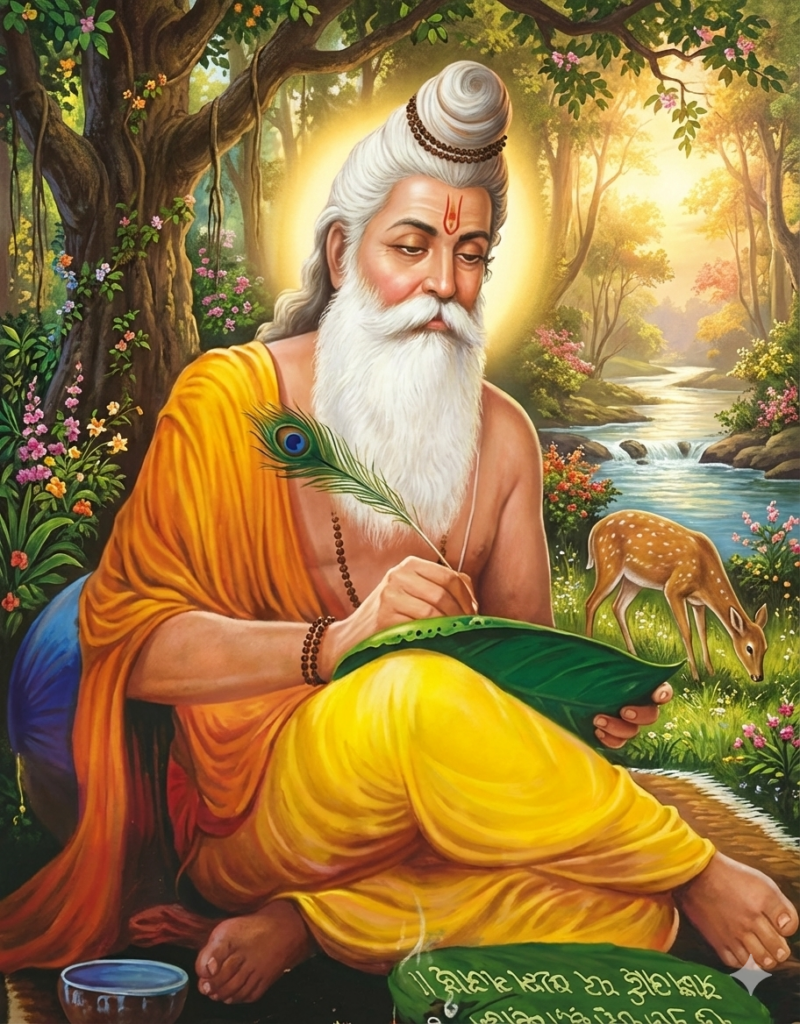
Introduction: The Adi Kavi (First Poet)
Valmiki is revered in Indian culture as the Adi Kavi, or the “First Poet.” He is the author of the Ramayana, one of the two great epics of India (the other being the Mahabharata). His contribution goes beyond just storytelling; he is credited with inventing the Shloka (the standard Sanskrit poetic meter), laying the foundation for all classical Sanskrit literature. His life is a powerful testament to the idea that no matter a person’s past, redemption and greatness are possible through devotion and penance.
Early Life: The Legend of Ratnakara
According to popular legend, Valmiki was not born a sage.
Birth Name: His birth name was Ratnakara.
Occupation: He was a highway robber and a hunter who lived in the forest. He supported his family by looting travelers and killing animals. He was known to be ruthless and cared only for the material well-being of his kin.
Lineage: Some texts describe him as the son of a sage named Pracheta or Sumali who got lost in the forest as a child and was raised by a hunter tribe, explaining his dual nature.
The Transformation: Divine Intervention
The turning point in Ratnakara’s life came through a chance encounter with the great sage Narada (in some versions, the Seven Sages or Saptarishi).
The Encounter: Ratnakara tried to rob Narada as he passed through the forest. Unafraid, Narada played his Veena and asked the robber a simple question.
The Question: Narada asked, “You commit these sins (robbing and killing) to support your family. Will your family share the burden of your sins (Karma) in the afterlife?”
The Realization: Confident, Ratnakara went home to ask his wife and parents. To his shock, they bluntly refused, saying, “The food you bring is our right, but the sin you commit to get it is yours alone.”
The Surrender: Shattered by this truth, Ratnakara realized the futility of his criminal life. He returned to Narada, fell at his feet, and begged for a way to redeem his soul.
The Penance: Birth of “Valmiki”
Narada decided to initiate him into the path of devotion.
The Mantra: Narada asked him to chant the name of God, “Rama.” However, Ratnakara was so steeped in negative karma that he could not pronounce the holy word.
The Solution: Narada told him to chant “Mara” (which means “die” or is the reverse of Rama). As Ratnakara repeated “Mara-Mara-Mara” rapidly, the sound naturally transformed into “Rama-Rama-Rama.”
The Ant-Hill: Ratnakara meditated so deeply and for so many years that he became motionless. An ant-hill (called Valmika in Sanskrit) was built over his body by termites.
Rebirth: When his penance was complete, Narada returned and uncovered him from the mound. Since he emerged from a Valmika, he was given the name Valmiki (“He who is born of the ant-hill”).
The First Shloka: The Birth of Poetry
Valmiki’s transition from a sage to a poet occurred through an incident of intense compassion (Karuna).
The Incident: One day, Valmiki was walking by the river Tamasa. He saw a pair of Krauncha birds (Sarana cranes) mating, lost in love. Suddenly, a hunter shot the male bird.
The Curse: Seeing the female bird cry in agony, Valmiki was filled with grief and anger. He spontaneously uttered a curse at the hunter:
Ma nishada pratishtham tvam agamah sashvatih samah… (“O Hunter, may you find no rest for eternal years, for you killed one of the unsuspecting couple devoted to love.”)
The Discovery: Valmiki realized that his curse had come out in a perfect rhythmic structure: four lines of eight syllables each. This was the invention of the Anushtubh Meter, the first Shloka.
Divine Command: Lord Brahma appeared and commanded Valmiki to use this new meter to write the story of Rama.
Authorship of the Ramayana
Valmiki composed the Ramayana (The Journey of Rama), an epic consisting of approximately 24,000 verses divided into 7 Kandas (Books).
Content: The epic narrates the life of Prince Rama of Ayodhya, his exile, the abduction of his wife Sita by the demon king Ravana, the war to rescue her, and his return to the throne.
Themes: It explores complex themes of Dharma (duty), ideal relationships (ideal king, brother, wife, servant), and the struggle between good and evil.
Role within the Epic
Uniquely, Valmiki is not just the author but also a character in the Ramayana, specifically in the final book, the Uttara Kanda.
Protector of Sita: When a pregnant Sita was banished by Rama due to public gossip, she found refuge in Valmiki’s ashram. He cared for her like a father.
Teacher of Lava and Kusha: Sita gave birth to twin sons, Lava and Kusha, in his ashram. Valmiki educated them and taught them to sing the Ramayana.
Reunion: Valmiki eventually brought Sita and the twins to Rama’s court during a horse sacrifice ceremony, reuniting the family (briefly) and proving Sita’s purity to the world.
Legacy
Valmiki is worshipped as a saint and a literary genius. His work has influenced diverse cultures across Southeast Asia (Thailand, Indonesia, Cambodia) and remains the bedrock of Hindu moral philosophy. He demonstrated that true poetry arises from Karuna (compassion) and that Dharma is the highest goal of human life.
Themes
The Subtlety of Dharma (Righteousness)
This is the central theme of the entire debate. Valin argues based on Warrior Dharma (Kshatriya code), claiming that a warrior must not strike an enemy who is unaware or engaged with another. He sees Dharma as “fair play.” However, Rama counters with Universal Dharma (Sanatana Dharma). He argues that Dharma is “subtle” (sukshma) and difficult to understand. Rama asserts that moral laws (like the prohibition of incest) supersede the rules of combat. The theme highlights that what looks “wrong” on the surface (hiding behind a tree) can be “right” in the deeper context of justice.
Reference: Rama says, “Righteousness is subtle, monkey, and extremely difficult to understand… The self in the heart of all beings knows good and evil.” (Sarga 18, Line 15)
Rajadharma (The Duty of Kings)
The text serves as a treatise on how a King should rule. Valin accuses Rama of lacking the virtues of a king (self-control, patience, fairness). Rama defends himself by defining the King’s primary duty: Danda (Punishment). The theme establishes that a King is not just a ruler but a guardian of the moral order. He has jurisdiction over the entire earth (including forests and animals) and is obligated to punish those who break sacred laws, regardless of who they are.
Reference: Rama explains, “This earth… belongs to the Ikshvakus, as does the right of punishing and rewarding its beasts, birds, and men.” (Sarga 18, Line 6)
The Destructive Nature of Kama (Unchecked Desire)
Valin’s downfall is explicitly attributed to his inability to control his lust (Kama). While Valin is a mighty warrior and a king, he failed to conquer his own senses. The poem illustrates that even the powerful fall if they are enslaved by their passions. By taking his younger brother’s wife, Ruma, Valin allowed desire to override duty. This act of Adharma (sin) stripped him of his legitimacy as a ruler and made his death inevitable.
Reference: Rama accuses, “You are frivolous… You are engrossed in the pursuit of pleasures… Out of lust you committed a sinful deed.” (Sarga 18, Lines 12, 19)
The Sanctity of Brotherhood and Family
The poem defines the ideal family structure according to Vedic tradition. It contrasts the relationship between Rama and Bharata/Lakshmana (based on loyalty and sacrifice) with the relationship between Valin and Sugriva (based on rivalry and abuse). Rama lays down the specific law: An elder brother must be like a father, and a younger brother like a son. Violating these boundaries (as Valin did by taking Ruma) destroys the family unit and society.
Reference: “A younger brother, one’s own son, and also a pupil… these three are to be thought of as one’s sons.” (Sarga 18, Line 14)
Redemption through Punishment (Prayashchitta)
The poem ends on a spiritual note rather than a tragic one. A key theme is that punishment by a righteous King acts as atonement. Rama assures Valin that the pain of death cleanses his soul. Valin transforms from an arrogant accuser into a humble devotee. This theme suggests that justice is not just about retribution, but about liberation. Valin’s death becomes his salvation (Moksha), freeing him from the sin of his actions so he can go to heaven.
Reference: “Therefore, freed from sin by meeting with this punishment, you have returned to your own righteous nature…” (Sarga 18, Line 55)
Word Meaning
| Tough Word | Meaning in English | Meaning in Hindi |
| Harsh | Unpleasantly rough or cruel | कठोर / निष्ठुर |
| Adorned | Decorated or made beautiful | सजा हुआ / अलंकृत |
| Toppled | Overbalanced and fell | गिर गया / लुढ़क गया |
| Flagstaff | A pole on which a flag is raised | ध्वजदंड |
| Released | Set free or unfastened | मुक्त / खुला हुआ |
| Hosts | Large numbers or armies | सेना / समूह |
| Vanishes | Disappears suddenly | गायब होना |
| Majesty | Impressive beauty or dignity | महिमा / राजसी ठाठ |
| Valor | Great courage in danger | वीरता / पराक्रम |
| Studded | Decorated with gems or objects | जड़ा हुआ |
| Sustained | Strengthened or supported | संभाले रखना |
| Lingering | Remaining for a long time | बना हुआ / शेष |
| Splendor | Great brilliance or beauty | वैभव / तेज |
| Unassailable | Unable to be attacked or defeated | अजेय / अभेद्य |
| Irresistible | Too powerful to be resisted | जिसे रोका न जा सके |
| Tawny | Orange-brown or yellowish-brown color | पीला-भूरा |
| Resembling | Looking like something else | सदृश / मिलता-जुलता |
| Yayati | A legendary king who fell due to loss of merit | ययाति (पौराणिक राजा) |
| Exhaustion | The state of being extremely tired or used up | क्षय / अत्यधिक थकान |
| Merit | Spiritual credit for good deeds | पुण्य / योग्यता |
| Civil | Courteous and polite | विनम्र / सभ्य |
| Consistent | Acting in the same way; compatible | संगत / अनुकूल |
| Righteousness | Morally right behavior; Dharma | धर्म / सदाचार |
| Well-born | Coming from a noble family | कुलीन |
| Virtuous | Having high moral standards | गुणी / सदाचारी |
| Compassionate | Feeling or showing sympathy | दयालु |
| Pity | Feeling sorrow for others’ suffering | करुणा / दया |
| Vows | Solemn promises | व्रत / प्रतिज्ञा |
| Lineage | Ancestry or family line | वंश / कुल |
| Exalted | Placed at a high or powerful level | उच्च / श्रेष्ठ |
| Tara | Wife of Valin | तारा (वालिन की पत्नी) |
| Heedless | Showing a reckless lack of care | असावधान / लापरवाह |
| Vicious | Deliberately cruel or violent | दुष्ट / क्रूर |
| Evildoer | A person who does bad things | पापी / कुकर्मी |
| Wicked | Morally bad or evil | दुष्ट / पापी |
| Trappings | Outward signs or dress | बाहरी दिखावा |
| Virtue | Moral goodness | सद्गुण |
| Concealed | Kept secret; hidden | छिपा हुआ |
| Disguise | A false appearance | भेष / छद्मवेश |
| Smoldering | Burning slowly without flame | सुलगता हुआ |
| Conciliation | The act of making peace | सुलह |
| Generosity | Willingness to give | उदारता |
| Forbearance | Patient self-control | सहनशीलता |
| Steadiness | Firmness | स्थिरता |
| Wrongdoers | People who commit crimes | अपराधी |
| Forest-dwelling | Living in forests | वनवासी |
| Conquest | Act of winning control | विजय |
| Statesmanship | Skill in governing | राजनैतिक कुशलता |
| Restraint | Self-control | संयम |
| Capriciously | Acting unpredictably | मनमाने ढंग से |
| Wrathful | Full of anger | क्रोधित |
| Unsteady | Not firm or stable | अस्थिर |
| Reverence | Deep respect | आदर / श्रद्धा |
| Statecraft | Skill of governing | शासन-कला |
| Passions | Strong emotions or desires | वासना |
| Despicable | Deserving hatred | घृणित |
| Atheist | One who denies God | नास्तिक |
| Forbidden | Not allowed | निषिद्ध |
| Clawed creatures | Animals with claws | नखयुक्त जीव |
| Hedgehog | A small spiny animal | सेही |
| Porcupine | A rodent with sharp quills | साही |
| Deceitful | Dishonest | छलपूर्ण |
| Treacherous | Betraying trust | विश्वासघाती |
| Wretch | A miserable person | अभागा |
| Fetters | Chains or restraints | बेड़ियाँ |
| Overstepped | Crossed limits | सीमा लांघी |
| Disregarded | Ignored | उपेक्षा की |
| Goad | A pointed stick | अंकुश |
| Lawfulness | Obedience to law | वैधता |
| Vaivasvata | God of death (Yama) | यमराज |
| Maithili | Another name of Sita | मैथिली (सीता) |
| Underworld | Nether world | पाताल |
| She-mule | A female mule | खच्चरनी |
| Fitting | Appropriate | उपयुक्त |
| Unjustly | Not fairly | अन्यायपूर्वक |
| Radiant | Bright | तेजस्वी |
| Stricken | Seriously affected | आहत |
| Consciousness | Awareness | चेतना |
| Censured | Criticised strongly | निंदा की |
| Unsurpassed | Having no equal | अद्वितीय |
| Distinguished | Highly respected | प्रतिष्ठित |
| Reproach | Blame | दोष देना |
| Frivolousness | Lack of seriousness | तुच्छता |
| Revile | Abuse verbally | अपमान करना |
| Endowed | Provided with | युक्त |
| Iksvakus | Royal dynasty of Rama | इक्ष्वाकु वंश |
| Bharata | Rama’s brother | भरत |
| Chastise | Punish | दंड देना |
| Strays | Goes away from path | भटकता है |
| Condemned | Declared guilty | दोषी ठहराया |
| Engrossed | Deeply involved | तल्लीन |
| Pursuit | Act of following | अनुसरण |
| Bestower | One who gives | दाता |
| Pupil | Student | शिष्य |
| Frivolous | Not serious | हल्का |
| Subtle | Difficult to understand | सूक्ष्म |
| Forsaken | Abandoned | त्याग दिया |
| Lust | Strong sexual desire | कामवासना |
| Deed | An action | कर्म |
| Custom | Tradition | परंपरा |
| Prescribed | Ordered by law | निर्धारित |
| Transgress | Break a law | उल्लंघन करना |
| Sacred | Holy | पवित्र |
| Devoted | Loyal | समर्पित |
| Chastisement | Punishment | दंड |
| Ancestor | Forefather | पूर्वज |
| Mandhatr | Ancient righteous king | मांधाता |
| Inflicted | Imposed | दिया |
| Mendicant | Beggar monk | भिक्षु |
| Atonement | Making amends | प्रायश्चित |
| Taint | Stain | कलंक |
| Arbitrary | Unfair | मनमाना |
| Snares | Traps | फंदे |
| Nooses | Loop traps | फाँसी का फंदा |
| Prosperity | Wealth | समृद्धि |
| Unattainable | Impossible to achieve | अप्राप्य |
| Censure | Strong criticism | निंदा |
| Rebuke | Scold | फटकार |
| Abiding | Following | पालन करने वाला |
| Supplication | Humble request | विनती |
| Lowly | Of low status | तुच्छ |
| Unseemly | Improper | अनुचित |
| Immutable | Unchangeable | अपरिवर्तनीय |
| Flagrant | Shockingly obvious | घोर |
| Violator | Law-breaker | उल्लंघनकारी |
| Distress | Suffering | पीड़ा |
| Eminently | Very greatly | अत्यंत |
| Cherished | Loved deeply | दुलारा |
| Wretched | Miserable | दयनीय |
| Favor | Support | कृपा |
| Obedient | Following orders | आज्ञाकारी |
| Consoled | Gave comfort | सांत्वना दी |
| Inflicts | Causes suffering | देता है |
| Perishes | Dies | नष्ट होता है |
| Prowess | Great skill or strength | पराक्रम |
| Gracious | Kind and polite | कृपालु |
Very Short Answer Questions
To what was Valin compared when he fell to the ground?
A tree cut down or a flagstaff when its ropes are released.
What object sustained Valin’s life and majesty even after he fell?
The golden necklace given to him by Indra.
Who gave Valin the golden necklace?
Sakra (Indra).
How did Valin describe Rama’s concealment of his true nature?
Like a well overgrown with grass or a fire covered in ashes.
What did Valin say his diet consisted of?
Roots and fruit.
Why did Valin argue his death was profitless for Rama?
Because monkeys have no land, gold, or silver to be conquered.
According to Valin, how many five-clawed animals are edible for Kshatriyas?
Five (hedgehog, porcupine, lizard, rabbit, and turtle).
What did Valin say regarding the use of his skin and bones?
They are forbidden and cannot be used by virtuous people.
Who did Valin claim he could have brought to Rama bound by the neck?
Ravana.
What mythological creature did Valin compare retrieving Sita to?
The white she-mule.
How did Valin describe Rama’s act of shooting him while hidden?
Like a snake killing a sleeping man.
Who is the god of death Valin mentioned Rama would have met in a fair fight?
Vaivasvata (Yama).
What did Valin accuse Rama of being addicted to?
Pleasures.
What did Valin call Rama in relation to the Earth?
A deceitful husband to a virtuous wife.
Who did Rama say owns the earth, including its forests and beasts?
The Ikshvakus.
Who is the current ruler of the earth according to Rama?
Bharata.
To whom did Rama compare his friendship with Sugriva?
His brother Lakshmana.
Who are the three people considered as “fathers” in Dharma?
An older brother, a father, and a teacher.
Who are the three people considered as “sons” in Dharma?
A younger brother, one’s own son, and a pupil.
What was the specific sin Valin committed?
Living in sin with his younger brother’s wife, Ruma.
What is the prescribed punishment for approaching a younger brother’s wife?
Death.
Which ancestor did Rama cite as a precedent for severe punishment?
Mandhatr.
How did Rama justify shooting Valin without Valin seeing him?
Men hunt animals with snares and traps whether the animal is attentive or not.
What happens to a sinner punished by a king according to Rama?
They become pure and go to heaven.
How did Rama describe kings in human form?
As gods walking on earth.
Who did Valin grieve for the most as he died?
His son, Angada.
What did Valin request Rama to do for Angada?
Protect him and show him the same affection as he does to Sugriva.
Who is Angada’s mother?
Tara.
What metaphor did Valin use to describe Angada’s potential grief?
Drying up like a pond whose waters have been drunk.
What was Valin’s final emotional state towards Rama?
He was at peace and asked for forgiveness.
Short Answer Questions
Describe the imagery used to depict the fallen Valin in the opening verses of Sarga 17.
The poet employs vivid similes to describe the dying Monkey King. Valin is compared to a massive tree that has been cut down, symbolizing his sudden fall from greatness. He is also likened to the flagstaff of Indra when its ropes are released, signifying a collapse of stability. Despite his fall, he retains a divine glow due to Indra’s golden necklace, resembling a rain cloud edged by evening light. This imagery highlights that even in defeat, Valin retained his majesty, life force, and royal aura.
On what grounds does Valin challenge Rama’s morality regarding the method of the attack?
Valin attacks Rama’s ethics by contrasting Rama’s reputation as a virtuous Kshatriya with his “cowardly” action of shooting from a hiding place. Valin argues that a true warrior fights face-to-face, but Rama struck him while he was engaged with another combatant (Sugriva). He compares Rama to a snake killing a sleeping man or a hunter setting a trap, accusing him of being a hypocrite who wears the “garb of righteousness” but acts without honor or “settled judgment.”
Explain Valin’s argument regarding the lack of political or economic profit in killing a monkey.
Valin argues that wars are typically fought for Artha (material gain), specifically land, gold, or silver. As a “forest-dwelling beast,” Valin possesses none of these; his people live only on roots and fruit, which are of no value to a human prince. He questions the Casus Belli (cause of war), implying that since there is no territorial or treasury gain to be had, Rama’s violence is politically senseless and devoid of the “profit” that usually motivates royal conquests.
How does Rama use the authority of King Bharata to establish jurisdiction over the forest?
Rama counters Valin’s claim that human laws do not apply to monkeys by asserting the global sovereignty of the Ikshvaku dynasty. He states that the entire earth, including its mountains and forests, belongs to his family and is currently ruled by the righteous King Bharata. Rama positions himself not as a rogue wanderer, but as a deputy enforcing Bharata’s law. Therefore, Valin is a subject of the empire, and Rama has the legal right to punish him for crimes committed within imperial territory.
What specific moral transgression did Rama identify as the primary justification for Valin’s execution?
Rama identifies Valin’s crime as a violation of Sanatana Dharma (Eternal Law), specifically the sin of incestuous adultery. By forcefully taking Ruma, the wife of his younger brother Sugriva, while Sugriva was still alive, Valin committed a heinous sin. Rama argues that this was done out of “lust” (Kama) rather than duty. This act stripped Valin of his royal immunity and categorized him as a criminal deserving the death penalty according to the sacred scriptures.
How does Rama define the relationship between brothers to convict Valin of a heinous sin?
Rama cites the Dharmashastras to establish the hierarchy of relationships. He states that an elder brother must be regarded as a father, while a younger brother must be treated as a son. Consequently, the wife of a younger brother is equivalent to a daughter-in-law (Snusha). By sleeping with Ruma, Valin did not just steal a woman; he violated the sanctity of the father-son dynamic, committing a sin equivalent to incest, which justifies the most severe punishment.
How does Rama utilize the “hunting defense” to counter Valin’s accusation of cowardice?
To justify the ambush, Rama shifts the classification of the conflict from a “duel” to a “hunt.” He argues that Valin is, biologically, a monkey (Mriga). Human kings and royal seers have the right to hunt animals for sport or food using snares, traps, and hidden arrows. Rama asserts that a hunter is not obligated to wait for the prey to fight back or even look at him. By categorizing Valin as game, Rama renders the rules of chivalrous combat inapplicable.
What role does the vow of friendship play in Rama’s decision to kill Valin?
Rama emphasizes the sacred nature of his vow to Sugriva, placing it alongside his legal duties. He compares his friendship with Sugriva to his bond with his own brother, Lakshmana. Rama had publicly promised to restore Sugriva’s kingdom and wife, and for a man of the Raghu clan, breaking a promise is impossible. He argues that “a person who keeps righteousness clearly in view must assist his friend,” making the killing of Valin a necessary act to fulfill his word (Satya).
Explain the theological concept of “Redemption through Punishment” that Rama offers to Valin.
Rama comforts the dying king by explaining the spiritual mechanics of Danda (punishment). He states that when a king punishes a sinner, the punishment itself serves as atonement (Prayashchitta). By paying for his crime with his life, Valin’s slate is wiped clean. Rama assures him that he is now “freed from sin” and has returned to his original righteous nature. This implies that Valin will not go to hell, but will attain heaven, transforming the execution into an act of salvation.
In his final moments, how does Valin’s focus shift from political debate to paternal anxiety?
After accepting Rama’s logic, Valin abandons his defense and focuses entirely on the welfare of his son, Angada. He expresses deep fear that the new king, Sugriva, might mistreat Angada out of revenge. Valin describes Angada’s sheltered upbringing and his potential to “wither like a dry pond” without his father. He begs Rama to be Angada’s protector and to ensure that Sugriva treats Angada with the same affection Rama holds for Bharata and Lakshmana.
Essay Type Questions
Analyze Valin’s critique of Rama’s morality. On what specific grounds does the dying king accuse the prince of violating the code of a warrior (Kshatriya Dharma)?
Valin’s critique of Rama is rooted in the perceived disconnect between Rama’s noble appearance and his treacherous actions. Valin begins by acknowledging Rama’s lineage, physical beauty, and reputation as a righteous prince of the Raghu clan. He notes that Rama bears the “visible signs associated with righteousness.” However, Valin uses this observation to highlight the hypocrisy of the situation. He argues that a true Kshatriya, born of a royal family, would never stoop to the level of shooting an enemy from a hiding place. Valin accuses Rama of wearing the “mask of Dharma” to conceal a deceitful nature, comparing him to a “well overgrown with grass” or a “fire covered in ashes”—things that look harmless or dormant on the surface but are dangerous underneath.
The core of Valin’s accusation revolves around the method of combat. In the heroic code of ancient India, warfare was strictly regulated by rules of chivalry. A warrior was expected to announce his presence, challenge his opponent face-to-face, and never strike someone who was unarmed, distracted, or fighting another person. Valin points out that he was engaged in a heated duel with Sugriva and was not looking at Rama when the arrow struck. He uses stinging metaphors to describe this cowardice, comparing Rama to a “snake killing a sleeping man” or a hunter laying a trap. By refusing to show himself, Rama denied Valin the dignity of a warrior’s death and the chance to defend himself properly.
Furthermore, Valin questions the political logic (Artha) behind the attack. Wars are typically fought for tangible gains like land, gold, or silver. Valin argues that as a “forest-dwelling beast” living on roots and fruit, he possesses nothing that a human prince could possibly want. He highlights the absurdity of a great human warrior killing a monkey king who has no treasury or territory that acts as a threat to Ayodhya. This line of reasoning suggests that Rama’s violence was not only immoral but also politically senseless, driven by a lack of “settled judgment” regarding statecraft.
Finally, Valin attacks Rama’s character by accusing him of being ruled by passion (Kama) rather than duty. He claims that Rama is “addicted to pleasures” and has killed Valin solely to please Sugriva, who promised to help Rama find his wife. Valin asserts that he could have retrieved Sita easily—within a day—without any bloodshed. He argues that Rama chose a difficult and bloody path out of ignorance and a desire to satisfy his new ally, proving that Rama has “broken the fetters of good conduct” and acts like a “mad elephant” destroying the jungle laws of fairness.
How does Rama justify his jurisdiction over the forest and the legitimacy of the execution? Explain his arguments regarding the sovereignty of the Ikshvaku dynasty and the “hunting” defense.
Rama’s defense begins by shattering the notion that the forest is a “lawless zone” outside human jurisdiction. Valin had argued that as a monkey, he was not subject to human laws. Rama counters this by asserting the absolute sovereignty of the Ikshvaku dynasty. He declares that “this earth with its mountains, woods, and forests” belongs entirely to his family. He explains that King Bharata currently rules the world, and his mandate extends to “beasts, birds, and men.” Therefore, Valin is not a sovereign king of a foreign nation, but a subject living within the territory of Ayodhya. As Bharata’s deputy patrolling the realm, Rama claims the legal authority to punish any subject who violates the moral order.
To address the specific charge of the “hidden arrow,” Rama deftly shifts the classification of the act from a “duel” to a “hunt.” While Valin sees himself as a warrior deserving of chivalry, Rama classifies him as an animal (Mriga). Rama argues that kings and royal seers have always hunted in the forests for sport or food. In a hunt, the rules of dueling do not apply. A hunter uses snares, traps, and stealth to catch his prey. Rama states bluntly, “Men seeking meat shoot animals that are attentive or inattentive or even facing the other way.” By framing Valin as game, Rama argues that shooting him from behind a tree was not cowardice, but standard hunting practice.
However, Rama does not rely solely on the “animal” argument; he simultaneously treats Valin as a moral agent capable of sin. This creates a dual argument: Valin is an animal when it comes to the method of killing (justifying the trap), but a rational subject when it comes to the reason for killing (justifying the punishment). Rama argues that Valin has “deviated from universal custom” and broken the “eternal laws.” This nuance allows Rama to claim the rights of a hunter while exercising the duties of a judge. He asserts that he is not acting arbitrarily but is enforcing a specific statute of the empire that mandates the removal of those who disrupt the social order.
Rama reinforces this by emphasizing that he is acting under orders. He portrays himself as a humble servant of King Bharata, “honoring Bharata’s command” to seek out and destroy unrighteousness (Adharma). This defense strips the act of any personal malice. Rama argues that if he had walked past Valin’s crime without acting, he would have been the one sinning by neglecting his duty. The execution was a state-sanctioned act of “chastisement” required to maintain the moral integrity of Bharata’s universal dominion.
Discuss the specific moral transgression committed by Valin regarding Ruma. How does Rama use the definitions of family relationships to convict Valin of a capital crime?
The pivot of Rama’s legal case against Valin is the charge of sexual misconduct, specifically involving Ruma, the wife of Sugriva. Rama accuses Valin of being “engrossed in the pursuit of pleasures” and allowing his lust to override his royal duties. In the Dharmic code, a king is expected to be a guardian of virtue; by succumbing to base desires, Valin forfeited his right to rule. Rama argues that this was not merely a political dispute between brothers but a heinous moral crime that disrupted the sanctity of the family structure.
To establish the severity of the crime, Rama clearly defines the hierarchy of family relationships according to the Dharmashastras. He states that an elder brother, a father, and a teacher are legally and morally equivalent; they are all “fathers” to the younger dependent. Conversely, a younger brother, a son, and a pupil are all considered “sons.” This equation is non-negotiable in Rama’s argument. It establishes that the relationship between Valin and Sugriva should have been one of paternal protection, not rivalry.
Based on this definition, Rama deduces the nature of the relationship between Valin and Ruma. If Sugriva is Valin’s “son,” then Sugriva’s wife (Ruma) is Valin’s “daughter-in-law” (Snusha). In all civilized societies depicted in the epic, the daughter-in-law is an object of supreme protection, never sexual desire. Rama declares, “Death is the punishment prescribed for a man who out of lust approaches his daughter, sister, or younger brother’s wife.” By taking Ruma while Sugriva was still alive, Valin committed a sin equivalent to incest.
This reclassification transforms the conflict. It is no longer a territorial war between two monkey chiefs; it is a case of a father-figure abusing his power to sexually exploit a dependent. Rama argues that such a “flagrant violator of righteousness” cannot be allowed to live. The punishment for such a Mahapataka (Great Sin) is death. Rama concludes that by executing Valin, he was merely administering the mandatory sentence prescribed by the holy texts, acting as an impartial judge rather than a biased friend.
Explain the concept of “Redemption through Punishment” as presented by Rama. How does this doctrine transform Valin’s death from a tragedy into a spiritual liberation?
In the final phase of his argument, Rama moves beyond legalities to theology, introducing the doctrine that punishment by a king serves as a form of atonement (Prayashchitta). In ancient Indian thought, sin (Paap) was viewed as a tangible weight on the soul that would lead to suffering in the afterlife or a lower rebirth. A sinner who goes unpunished carries this weight with him. However, Rama explains that the King, as God’s representative on earth, has the power to absolve this sin through the administration of Danda (punishment).
Rama assures Valin, “Neither he who inflicts punishment… nor he who is punished… perishes.” This statement suggests a spiritual transaction. When Rama shoots Valin, the physical pain and the loss of life serve as the payment for Valin’s moral debt. The execution balances the scales of karma. Rama tells Valin explicitly, “Freed from sin by meeting with this punishment, you have returned to your own righteous nature.” This implies that the “evil” Valin who stole Ruma has been destroyed by the arrow, leaving only the “pure” Valin, the son of Indra, to proceed to the next world.
This doctrine fundamentally changes the nature of the scene. It shifts the narrative from a “murder” to a “sacrifice.” Valin is no longer a victim of treachery; he is a beneficiary of Rama’s grace. By killing him, Rama has actually saved him from hell (Naraka). Rama cites the precedent of former kings like Mandhatr to show that this is an established spiritual law: once the King punishes a crime, the “taint is removed,” and the soul becomes pure again.
The effect of this teaching on Valin is profound. It dissolves his anger and fear. Valin realizes that his death is not a senseless ending but a necessary purification. This allows the dialogue to move from a heated debate to a peaceful resolution. Valin accepts his fate with gratitude, believing that he will “go to heaven just as do virtuous men.” The doctrine of redemption through punishment provides the closure needed for Valin to die in peace, entrusting his soul to the very man who killed him.
Trace the evolution of Valin’s character throughout Sarga 17 and 18. How does he transition from an arrogant accuser to a humble devotee, and what triggers this change?
At the beginning of Sarga 17, Valin is depicted as a figure of righteous indignation and confusion. Having been struck down unexpectedly, he is writhing in pain but retains his intellectual sharpness. His initial speech is aggressive and dominating. He lectures Rama—a human prince—on the duties of a king and a warrior. He is sarcastic, calling Rama a “deceitful husband” to the Earth and a “hypocrite.” Valin sees himself as the superior moral agent, an innocent victim of a corrupt political game. He is proud of his strength (“I could have bound Ravana”) and dismissive of Rama’s prowess, comparing the prince to a snake and a sinner.
The transition begins in Sarga 18 as Valin listens to Rama’s defense. As Rama dismantles Valin’s arguments one by one—exposing the sin of incest, asserting the divinity of kings, and explaining the hunting logic—Valin’s demeanor shifts. The text describes him as being “like a darkened sun” or an “extinguished fire.” The realization of his own guilt regarding Ruma strikes him hard. He recognizes that his passion (Kama) had indeed blinded him to Dharma. The moment Rama reveals the spiritual reality—that the King is a god in human form—Valin’s arrogance collapses. He realizes he has been debating a divine being.
The turning point is marked by Valin’s physical gesture: “Joining his palms in supplication.” The warrior who boasted he could kill Rama in a fair fight now begs for forgiveness. He retracts his harsh words, admitting they were spoken out of “delusion” and pain. His focus shifts entirely from his own ego to the welfare of others. He stops arguing for his life and starts pleading for his son, Angada. This marks his maturity; he accepts his death but desperately seeks protection for his lineage.
By the end of the passage, Valin has fully transformed into a devotee. He refers to Rama as the “Best of men” and “Ruler of the earth.” He accepts Rama’s judgment as “immutable” and “correct.” This surrender is total. He finds comfort in Rama’s voice, which he now describes as “sweet and calm.” Valin dies not as a defeated enemy, but as a liberated soul who has made his peace with God. The journey from the angry accusation of “Why did you kill me?” to the humble prayer “Please be gracious” encapsulates the spiritual arc of the episode.
Critical Analysis
Introduction
This text is an excerpt from the Kishkindha Kanda (The Book of Kishkindha) of the epic Ramayana, traditionally ascribed to Maharishi Valmiki. The specific translation is by Rosalind Lefeber, edited by Robert P. Goldman. This section covers one of the most ethically debated and pivotal moments in the entire epic: the Valin Vadh (The Killing of Valin). It is not merely an action sequence but a profound philosophical dialogue that occurs on the battlefield. The introduction of this passage marks a shift in Prince Rama’s character from a passive exile to an active enforcer of imperial law. It sets the stage for the alliance with the monkeys that is crucial for the recovery of Sita.
Central Idea
The central idea of the poem is the Collision of Moral Codes. The text presents a conflict between two interpretations of Dharma (Righteousness):
Valin’s Perspective (The Warrior Code): Morality is defined by the rules of engagement (Chivalry). A fair fight requires facing one’s enemy, warning them, and never striking a distracted opponent. By this standard, Rama is wrong.
Rama’s Perspective (The Universal/Royal Code): Morality is defined by the maintenance of social and cosmic order. Specific sins, like incest (taking a younger brother’s wife), act as a cancer on society. The King has the duty to excise this cancer by any means necessary—whether through open war or execution by stealth. By this standard, Rama is right. The poem ultimately argues that Subtle Dharma (higher moral law) supersedes Conventional Dharma (rules of a duel).
Summary
The Ambush: The plot begins on the battlefield in the forest of Kishkindha. King Valin is locked in a fierce duel with his brother Sugriva. Suddenly, Valin is struck in the chest by a powerful arrow shot by Prince Rama, who is hiding behind a tree. Valin falls to the ground, his life sustaining only due to Indra’s divine golden necklace.
The Accusation (Sarga 17): Though dying, Valin retains his majestic bearing. He confronts Rama and launches a scathing attack on his morality. Valin asks how a prince renowned for virtue could shoot an enemy who was not looking. He argues that Rama has violated the warrior code (Kshatriya Dharma) which forbids striking an unaware opponent. He also mocks Rama for killing a “forest beast” who has no gold or land to offer, calling the act politically senseless and cowardly.
The Defense (Sarga 18): Rama emerges and calmly defends his actions. He asserts that as the representative of the Ikshvaku dynasty (ruled by Bharata), he has jurisdiction over the entire earth, including forests and animals. He charges Valin with the capital crime of incest for forcefully taking Ruma, the wife of his younger brother Sugriva. Furthermore, Rama classifies Valin as a monkey (Mriga), arguing that kings have the right to hunt animals using snares and stealth, regardless of whether the animal is fighting or fleeing.
The Resolution: Overwhelmed by Rama’s logic and realizing the gravity of his sin, Valin undergoes a transformation. He retracts his harsh words and accepts his death as a just punishment. He pleads with Rama not for his own life, but for the safety of his son, Angada, and his wife, Tara. Rama comforts the dying king, assuring him that his death has served as atonement (Prayashchitta) for his sins. Valin dies in peace, believing he will attain heaven.
Structure & Rhyme Scheme
Structure: The poem follows a Dialectical Structure (Thesis-Antithesis-Synthesis).
Thesis: Valin’s argument that the killing was unjust.
Antithesis: Rama’s counter-argument that the killing was a legal necessity.
Synthesis: Valin’s acceptance and spiritual liberation.
Rhyme Scheme:
Original Sanskrit: Written in Anushtubh Meter (shlokas of 32 syllables), relying on rhythmic cadence rather than end-rhyme.
English Translation: Written in Free Verse. There is no rhyme scheme. The translator uses prose-poetry to maintain the legal and philosophical weight of the dialogue without the distraction of forced rhymes.
Theme
The Subtlety of Dharma (Righteousness): The central theme challenges the idea that morality is simple. Valin argues for “Warrior Dharma” (fair fight), while Rama argues for “Universal Dharma” (punishing sin). The poem asserts that righteousness is subtle (sukshma) and that upholding higher moral laws (like family sanctity) sometimes requires breaking conventional rules (like combat etiquette).
The Primacy of Royal Duty (Rajadharma): The poem explores the absolute authority of a King. Rama asserts that the King owns the entire earth—including forests and animals—and has the duty to punish Adharma (unrighteousness) wherever it occurs. A King must prioritize justice over personal reputation or the appearance of fairness.
The Destructive Power of Lust (Kama): Valin serves as a cautionary tale about the dangers of unchecked desire. Despite his immense strength, royal status, and divine protection (Indra’s necklace), he falls because he could not control his lust for his brother’s wife, Ruma. This theme highlights that moral failings can destroy even the most powerful beings.
Redemption through Punishment (Prayashchitta): A unique theological theme is that punishment by a righteous King act as a spiritual cleanser. Rama explains that by paying for his crime with his life, Valin is absolved of his sin. This transforms the killing from an act of violence into an act of salvation (Moksha), allowing Valin to die in peace.
The Sanctity of Brotherhood: The text contrasts the broken relationship of Valin and Sugriva with the ideal brotherhood of Rama and Lakshmana. It establishes strict boundaries for family relationships, stating that an elder brother is like a father and a younger brother like a son. Violating this hierarchy (as Valin did) is treated as a capital offense.
Style
Legalistic: The dialogue resembles a courtroom trial. Valin acts as the prosecutor, citing the “laws of war.” Rama acts as the judge, citing the “laws of family” (Smritis). The tone is logical, citing precedents (Mandhatr) and statutes (punishment for incest).
Elevated & Formal: Despite the hostility, the language remains royal. Epithets like “Tiger among monkeys,” “Best of men,” and “Lord of the earth” are used to maintain the dignity of the characters.
Didactic: The poem is meant to teach. It pauses the narrative to lecture the audience on the duties of a brother, a king, and a friend.
Poetic Devices
Simile
A comparison between two unlike things using “like” or “as.” This is the most frequently used device in these verses to create vivid imagery.
Example: “Valin… fell suddenly like a tree cut down.” (Sarga 17, Line 1)
Effect: It emphasizes the suddenness and magnitude of the King’s fall. A massive tree crashing down is a violent, loud, and earth-shaking event, just like the fall of the mighty Valin.
Example: “…like the flagstaff of the king of gods when its ropes are released.” (Sarga 17, Line 2)
Effect: Compares Valin’s tall, majestic body to a divine banner falling. It highlights his royalty and connection to Indra (King of Gods).
Example: “hiding under a banner of righteousness, like a well overgrown with grass.” (Sarga 17, Line 18)
Effect: Valin accuses Rama of being a hidden trap. A well covered by grass looks safe but kills anyone who steps on it—just as Rama appeared virtuous but acted deceitfully.
Example: “Like an elephant mired in mud, Valin cried out in distress…” (Sarga 18, Line 45)
Effect: Portrays Valin’s helplessness. Just as a powerful elephant cannot escape deep mud, the powerful King cannot escape his fate/death.
2. Metaphor
A direct comparison where one thing is said to be another, without using “like” or “as.”
Example: “Tiger among monkeys” (Sarga 18, Line 33)
Effect: Rama calls Valin a “tiger.” This is not literal; it symbolizes Valin’s ferocity, strength, and dominance in the animal kingdom.
Example: “Lion-chested” (Sarga 17, Line 9)
Effect: Describes the breadth and power of Valin’s physical build.
Example: “dried up… pond whose waters have been drunk.” (Sarga 18, Line 47)
Effect: Angada is compared to a drying pond. The “water” is his father’s presence. Without it, Angada loses his life force.
3. Allusion
A brief reference to a famous historical, mythological, or literary figure or event.
Example: “Like Indra… Sakra…”
Effect: Repeated references to Indra (the King of Gods and Valin’s father) elevate Valin’s status. He is not just a monkey; he is of divine lineage.
Example: “My noble ancestor Mandhatr…” (Sarga 18, Line 31)
Effect: Rama cites a legendary king to provide legal precedent. This lends authority to his argument—he is not making up rules, but following ancient history.
Example: “Like the white she-mule.” (Sarga 17, Line 42)
Effect: A specific mythological reference (likely to the Aswataris) representing something extremely rare or difficult to obtain, which Valin claims he could have found easily.
4. Rhetorical Question
A question asked for dramatic effect or to make a point, rather than to get an answer.
Example: “What possible merit have you gained by killing me when I wasn’t looking?” (Sarga 17, Line 13)
Effect: Valin challenges Rama’s logic. He implies there is no merit, shaming Rama.
Example: “What will you say in the presence of virtuous men, Kakutstha?” (Sarga 17, Line 31)
Effect: Valin forces Rama to think about his reputation and future accountability.
Example: “How can someone like me disregard a promise?” (Sarga 18, Line 27)
Effect: Rama uses this to assert that his integrity is absolute; breaking a vow is impossible for him.
5. Irony
A contrast between expectations and reality.
Situational Irony:
The Scene: Valin, a “sinner” and “beast,” delivers a high-minded lecture on Dharma (righteousness) to Rama, the human “avatar of virtue.”
Effect: It flips the script. The beast sounds like a scholar, and the prince acted like a hunter. This tension drives the drama of the poem.
Verbal Irony:
Example: “With you as her protector… the earth… is like a virtuous young wife with a deceitful husband.” (Sarga 17, Line 36)
Effect: Valin uses sarcasm to attack Rama’s role as a guardian. A “protector” who kills from hiding is actually a danger to his subjects.
6. Imagery
Descriptive language that appeals to the senses (sight, sound).
Visual Imagery: “Rain cloud edged by the glowing light of evening.” (Sarga 17, Line 6)
Effect: Helps the reader visualize the dark skin of Valin contrasted with the shining gold necklace.
Visual Imagery: “Splendor had been broken into three shining parts: his necklace, his body, and the arrow…” (Sarga 17, Line 7)
Effect: Creates a vivid, almost cinematic picture of the fallen king on the battlefield.
Critical Commentary
This passage is critical because it addresses the “moral grayness” of Rama’s character.
The “Hidden Arrow” Controversy: Critics often view Rama’s act of shooting from behind a tree as a breach of chivalry. However, the text defends this by dehumanizing Valin (“You are only a monkey”) while simultaneously holding him to human moral standards (“You sinned with your brother’s wife”). This dual argument is Rama’s way of navigating the complex situation: he uses the rights of a hunter to execute the duties of a king.
The Transformation: The psychological shift in Valin is masterfully written. He moves from Rajas (passion/anger) to Sattva (peace/clarity). This transformation suggests that the physical arrow was also a spiritual instrument, piercing Valin’s ego and allowing him to see the truth.
Patriarchy and Paternalism: The text reinforces a strict patriarchal order. Women (Ruma/Tara) are protected but also treated as subjects of male honor. The bond between men (Rama/Sugriva/Valin) dictates the fate of the kingdom.
Message
No Impunity: No one is above the law. Even a mighty demigod in the deep forest is subject to the moral laws of the universe.
Sin has Consequences: Actions driven by lust (Kama) inevitably lead to destruction, regardless of one’s past merits.
Redemption is Possible: Even in death, acknowledging one’s faults and surrendering to the divine will leads to salvation (Moksha).
Conclusion
The death of Valin is a masterclass in epic storytelling. It moves beyond simple “good vs. evil” combat to explore the nuances of duty, law, and justice. While the method of Valin’s death remains a point of debate, the poem successfully argues that the restoration of moral order (Dharma) sometimes requires harsh and unconventional measures. Ultimately, it elevates Rama from a warrior prince to a cosmic administrator of justice, while granting Valin a dignified and redemptive exit.