
The Old Man and the Sea Summary
The Old Man and the Sea, written by Ernest Hemingway, was first published in Life magazine on September 1, 1952, where it gained immediate acclaim. It was released in book form shortly after, on September 8, 1952, by Charles Scribner’s Sons in New York. The novella won the Pulitzer Prize for Fiction in 1953 and was a major reason Hemingway later received the Nobel Prize in Literature in 1954.
This short novel is considered one of Hemingway’s greatest works and was his last major fiction published during his lifetime.
Santiago is an old Cuban fisherman who has not caught any fish for 84 days. People think he is unlucky. Only a young boy named Manolin believes in him and cares for him. Manolin’s parents have forced him to fish with more successful fishermen, but he still helps Santiago with food and fishing gear.
On the 85th day, Santiago goes far out into the sea, beyond the usual fishing areas. He is determined to catch a big fish and break his unlucky streak. He rows his small boat alone and drops his fishing lines.
Soon, a huge marlin takes the bait. Santiago knows it is the biggest fish he has ever seen. The marlin pulls the boat far into the sea. Santiago refuses to give up and holds on to the fishing line with his hands, even though it cuts and injures him.
The fight between Santiago and the marlin lasts for three days and two nights. Santiago feels pain, hunger, and tiredness but refuses to let go. He respects the marlin for its strength and dignity, calling it his “brother.”
On the third day, the marlin gets tired. Santiago uses all his strength and finally kills the marlin with a harpoon. The fish is bigger than his boat, so Santiago ties it to the side of the skiff and starts sailing back to shore, proud of his hard-earned success.
As Santiago sails back, the blood of the marlin attracts sharks. The first shark, a mako, takes a large bite of the fish. Santiago kills it with the harpoon but loses the harpoon. More sharks come—shovel-nose sharks—and Santiago fights them with a knife tied to an oar. The knife breaks, and he uses a club, then the boat tiller, to fight off the attacking sharks.
By the time Santiago reaches the shore, the sharks have eaten almost all of the marlin, leaving only the skeleton. Santiago feels defeated and exhausted, but also proud that he fought bravely and never gave up.
Santiago reaches home, carries his mast back to his hut, and collapses from tiredness. Manolin finds him the next morning and cries when he sees Santiago’s wounded hands. He promises to fish with Santiago again.
Villagers are amazed to see the huge skeleton of the marlin. Tourists mistake it for a shark. Santiago sleeps peacefully, dreaming about lions, a symbol of his youth, strength, and dreams.
The story shows courage, struggle, respect for nature, loneliness, companionship, defeat, and dignity. Santiago loses the fish but wins in courage, strength, and spirit. A man can be destroyed but not defeated.
Plot
Chapter 1:
Santiago is an old fisherman who lives in a small village near the sea. He has gone 84 days without catching a single fish, and people now call him “salao,” which means the worst kind of unlucky. A young boy named Manolin used to go fishing with him, but after 40 days of no fish, his parents told him to join another boat. That boat was successful, but the boy still loves, respects, and helps Santiago every day.
Santiago is thin and weathered from years of fishing. His hands are full of scars, and his skin is sunburnt, but his blue eyes are bright and full of hope. He may be poor and old, but inside he is strong and undefeated. The boy tries to cheer him up, offers him a beer, and tells him he still believes in him.
Even though Santiago tells the boy to stay with the lucky boat, the boy wants to help in any way he can. He offers to bring sardines and bait for the next day’s fishing trip. Santiago says he will go far out to sea, where he hopes to catch a truly big fish. He feels confident and hopeful about the next day.
Santiago lives alone in a tiny shack made of palm leaves. There’s only one bed, a table, a chair, and a place to cook. On the wall are pictures of the Sacred Heart of Jesus and the Virgin Mary, which belonged to his wife. He once had her photo up, but it made him feel lonely, so he put it away.
The boy knows that the old man has no food, but they both pretend there is a pot of rice and fish. That evening, the boy brings real food—black beans, rice, fried bananas, and stew. Santiago is touched by the boy’s kindness. They eat together and talk about baseball, especially about Joe DiMaggio, Santiago’s hero. They also talk about the past, fishing, and their dreams.
The boy reminds Santiago to rest so he can have energy for tomorrow. Santiago lies on his old bed, using his trousers as a pillow and newspapers as a blanket. The boy promises to wake him early, and they both go to sleep with hope in their hearts that tomorrow will be a better day.
Chapter 2:
In this chapter, Santiago, the old fisherman, wakes up early, before sunrise. He dreams of Africa and the lions on the beach, which always make him happy. He no longer dreams of women or big fish, only about peaceful places and lions. When he wakes, he goes to wake up the boy, Manolin, and they quietly walk to Santiago’s small shack.
On the way, they see other fishermen also going to their boats. The boy helps the old man carry his fishing gear, and they both drink hot coffee before heading to the sea. Santiago doesn’t eat much anymore and plans to only drink water through the day.
At the shore, the boy helps Santiago launch his small skiff (boat), and wishes him good luck. The old man rows out into the open sea, far beyond where the other boats fish. He listens to the sounds of the sea and watches the flying fish and birds. Santiago feels sorry for the small birds, knowing how hard their lives are. He thinks of the sea as a woman, sometimes kind, sometimes cruel, but always beautiful.
As the sun rises, Santiago sets out four fishing lines at different depths using fresh baits, including small tunas given by the boy. He carefully rows to keep the lines straight. Santiago knows luck is important, but believes in being skillful and exact so that when luck comes, he is ready.
Suddenly, Santiago sees a man-of-war bird flying overhead and watches a school of small tunas jumping. He catches a small tuna, happy to have fresh bait for bigger fish. Then, he feels a huge pull on one line—it is a giant marlin eating the sardines. Santiago talks to the fish aloud, encouraging it to eat the bait properly.
Finally, Santiago strikes hard to hook the fish. But instead of rising, the massive marlin pulls the boat away into the sea. The fish is strong and powerful, and Santiago’s small boat is being towed. Even after four hours, the fish keeps swimming farther out, pulling Santiago with it. The old man says to himself, “I wish the boy was here,” but remains patient, strong, and hopeful.
Chapter 3:
In this chapter, Santiago is far away from land, alone in his boat, locked in a long battle with a huge marlin. He can no longer see land but stays calm, thinking about the lights of Havana that will guide him back later. Santiago feels strong and determined, but the fish is also strong and keeps pulling the boat out to sea.
The old man thinks about the boy, Manolin, and wishes the boy was there to help and to see this great fish. He also remembers he must eat the tuna he caught earlier to stay strong. At night, two porpoises swim around his boat, and Santiago talks to them, calling them “brothers”, just like the flying fish. Santiago feels respect and love for the fish he has hooked because it is so powerful, yet he reminds himself that he must kill it to survive.
All night, the battle continues. The fish pulls the boat, sometimes making strong surges that jerk Santiago forward, cutting his face and hands. Santiago eats raw tuna to keep his energy, even though his left hand cramps painfully. He talks to himself, to the fish, to his hand, and to the sea.
Finally, by morning, the fish comes up and jumps out of the water. Santiago sees how massive and beautiful it is—two feet longer than his small boat, with a long sword-like nose and lavender color. The old man is amazed by its size and strength. He knows he must be careful not to break the line or let the fish escape.
Though Santiago feels tired, sore, and hungry, he does not give up. He prays to God, promises to visit the Virgin of Cobre, and keeps holding the line tightly. He reminds himself of the great baseball player DiMaggio, who played through pain. Santiago wants to prove he is a strange, strong old man, able to fight the biggest fish he has ever seen, even alone and far from land.
Chapter 4:
In this chapter, Santiago continues his long and painful battle with the huge marlin. As the second night begins, the old man remembers his younger days, especially a famous arm-wrestling match in Casablanca, where he had beaten the strongest dock worker after a long, hard fight. Remembering his past victory gives him courage and confidence.
That evening, Santiago catches a dolphin (mahi-mahi), which will give him food. He prepares it, though he finds it tasteless when raw and misses salt and limes. Despite cuts on his hands, a sore back, and deep tiredness, Santiago keeps holding the line, knowing the fish is also becoming tired.
During the second night, the fish suddenly jumps several times, pulling out line quickly and causing Santiago more injury. The fish’s powerful jumps make Santiago suffer more, but he refuses to give up, talking to himself, his cramped hands, and the fish.
By the third day, the fish begins to circle around the boat, a sign that it is weakening. Santiago knows this is his chance to pull the marlin close and kill it with his harpoon. However, every time the old man pulls, the fish fights back and swims away again.
Santiago feels extremely weak, dizzy, and faint but keeps encouraging himself. He prays, reminds himself of DiMaggio’s strength, and decides to endure no matter what. He calls the fish his “friend” and “brother”, admiring its strength and nobility.
By the end of the chapter, Santiago is completely exhausted, barely able to hold on, but he refuses to give up, telling himself, “You’re good forever”. The chapter shows Santiago’s deep respect for the fish, his unbreakable determination, and the heroic struggle between man and nature.
Chapter 5:
In this chapter, Santiago finally kills the marlin after a long, painful battle. He drives his harpoon into the fish’s heart and watches it die beautifully, rising out of the water and then sinking back, turning the sea red with blood. Santiago feels proud but also sad, calling the fish his “brother”.
Now, his work is not over. Santiago ties the giant fish to the side of his boat because it is too big to fit inside. He feels happy about his success but is also completely exhausted and in pain.
Soon after, trouble begins. The first shark, a big Mako shark, comes, attracted by the blood in the water. Santiago knows sharks will come but prepares to fight. He kills the Mako with his harpoon but loses the harpoon and a large chunk of the fish’s meat.
The old man feels like the shark attack is destroying his hard-earned victory. He says, “A man can be destroyed but not defeated,” showing his belief in never giving up, even in defeat.
Knowing more sharks will come, Santiago ties his knife to an oar to make a new weapon. Even though he feels hopeless, he doesn’t give up, trying to protect the fish as much as possible.
Santiago reflects on life, pride, and sin, wondering if it was wrong to kill the fish. He tells himself that he killed the marlin out of pride and love for fishing, not just for food. He accepts that life is full of struggles, and everything kills something else to survive.
Chapter 6:
In the last chapter, Santiago fights a hopeless battle against the sharks who attack the marlin tied to his boat. First, two galanos (shovel-nose sharks) come. Santiago kills them with his knife tied to an oar but his hands get badly injured. More sharks come, and Santiago’s knife breaks, leaving him with only a club, tiller, and oars.
As the day passes, more sharks keep attacking. Santiago kills many, but the sharks eat most of the marlin. He feels defeated and guilty for going too far out into the sea.
By midnight, the last group of sharks comes. Santiago fights them desperately with the tiller, but by the end, only the skeleton of the marlin is left. Santiago is exhausted, bleeding, and broken, and his victory feels like a loss.
When he reaches the shore, everyone is asleep. He ties the boat, takes the mast on his shoulder, and struggles back to his small shack. He is so weak that he falls multiple times before reaching home and falls asleep from exhaustion.
The next morning, Manolin (the boy) finds Santiago and cries seeing the old man’s wounded hands. The boy brings him coffee and promises to fish with him again. Santiago tells Manolin, “They beat me.” But the boy says, “The fish didn’t beat you.”
The villagers see the huge 18-feet-long skeleton, amazed by the old man’s courage. Tourists, not knowing the story, mistake it for a shark.
In the end, Santiago lies in his bed dreaming of lions—a symbol of his youth and strength. The boy promises to learn from him, giving hope that life will continue, even after defeat.
Ernest Hemingway
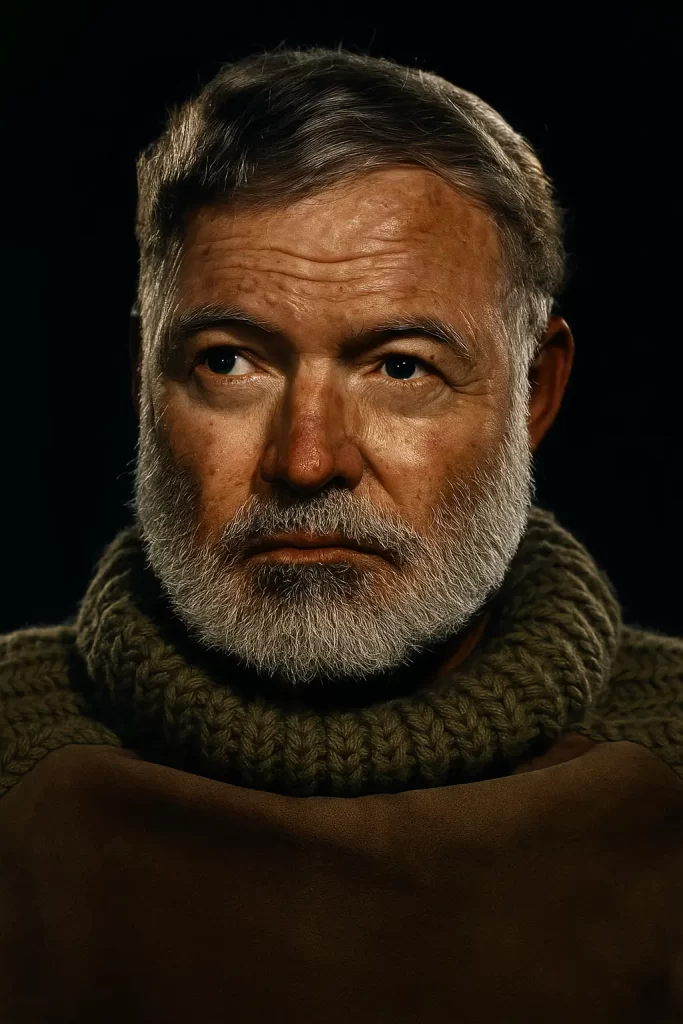
Ernest Hemingway (July 21, 1899 – July 2, 1961) was an American novelist, short story writer, and journalist, widely regarded as one of the most influential authors of the 20th century. Renowned for his minimalist prose, vivid storytelling, and exploration of themes such as courage, loss, masculinity, and human struggle, Hemingway left an indelible mark on modern literature.
Early Life and Background
Birthplace: Oak Park, Illinois, USA
Family: Second of six children born to Clarence Hemingway, a physician, and Grace Hall Hemingway, a music teacher.
Influences: Raised in a middle-class household, Hemingway developed a love for the outdoors, particularly hunting and fishing—experiences that deeply informed his writing.
Education: Attended Oak Park and River Forest High School. Excelled in English and wrote for the school newspaper. Rather than attend college, he entered journalism directly.
Career and Literary Contributions
Journalism and War
Early Journalism: Began at the Kansas City Star in 1917. The paper’s style guide—favoring short, clear, vigorous sentences—shaped his signature prose.
World War I: Volunteered as a Red Cross ambulance driver in Italy (1918), where he was severely wounded. This experience inspired A Farewell to Arms (1929) and formed the basis of his lifelong meditations on war, bravery, and death.
The “Lost Generation” in Paris
1920s Paris: Joined fellow expatriates like F. Scott Fitzgerald and Gertrude Stein. Stein famously called them the “Lost Generation.” This era produced The Sun Also Rises (1926), capturing post-war disillusionment and the aimlessness of American expatriates in Europe.
Major Works
Novels:
The Sun Also Rises (1926)
A Farewell to Arms (1929)
For Whom the Bell Tolls (1940)
The Old Man and the Sea (1952)
Short Stories:
In Our Time (1925), Men Without Women (1927)
Notable stories: The Snows of Kilimanjaro, Hills Like White Elephants
Nonfiction:
Death in the Afternoon (1932) – on bullfighting
Green Hills of Africa (1935) – based on his safari
Style and Technique
Hemingway pioneered the “Iceberg Theory” (or theory of omission), suggesting that the deeper meaning of a story should not be visible on the surface but implied. His concise, restrained prose and sparse dialogue transformed modern narrative fiction.
Achievements and Recognition
Pulitzer Prize (1953) – for The Old Man and the Sea
Nobel Prize in Literature (1954) – for his mastery of modern narrative style and influence on 20th-century fiction
Personal Life
Marriages:
Hadley Richardson (1921–1927)
Pauline Pfeiffer (1927–1940)
Martha Gellhorn (1940–1945)
Mary Welsh (1946–1961)
Adventures:
Hemingway lived a physically bold life—big-game hunting in Africa, deep-sea fishing in the Caribbean, and following bullfights in Spain. He covered the Spanish Civil War and World War II as a journalist.
Residences:
Key West, Florida
Finca Vigía, Cuba – where he wrote The Old Man and the Sea
Ketchum, Idaho – his final home
Health, Decline, and Death
Hemingway faced repeated injuries, including two plane crashes. He suffered from depression, paranoia, alcoholism, and the effects of electroshock therapy. By the late 1950s, his mental and physical health had severely deteriorated.
Death: On July 2, 1961, Hemingway died by suicide at his Idaho home. His father, brother, sister, and later granddaughter also died by suicide—highlighting a tragic family history of mental illness.
Legacy
Literary Influence: Hemingway’s spare prose style reshaped modern literature, influencing authors like Raymond Carver and Cormac McCarthy.
Cultural Impact: He became an icon of masculinity, existential struggle, and individualism—though modern readers often critique his portrayals of gender and race.
Adaptations: Many of his works were adapted into films, notably:
The Old Man and the Sea (1958, starring Spencer Tracy)
A Farewell to Arms (1932 and 1957 versions)
Posthumous Works:
A Moveable Feast (1964) – memoir of his Paris years
Islands in the Stream (1970) – a novel published posthumously
Connection to The Old Man and the Sea
Written in Cuba and published in 1952, The Old Man and the Sea marked a major comeback after the critical failure of Across the River and Into the Trees (1950). The novella is a powerful meditation on resilience, aging, dignity, and struggle, mirroring Hemingway’s own inner battles. Its success won him the Pulitzer and renewed global recognition, reaffirming his place in literary history.
Characters
Role: Protagonist
Character Traits: Santiago is an old, experienced Cuban fisherman. He is humble, patient, and determined. Despite his physical weakness and old age, he demonstrates immense mental strength, endurance, and perseverance. Santiago is portrayed as a tragic hero, battling not only the marlin but also the limitations of age and bad luck. His respect for nature, especially the marlin, shows his deep connection with the natural world. He symbolizes human dignity, pride, and the nobility of struggle. Even after being defeated by the sharks, Santiago retains his inner pride and resilience.
Symbolism: Santiago represents human endurance, the eternal struggle against defeat, and the idea that a man can be destroyed but not defeated.
Role: Santiago’s apprentice and closest companion
Character Traits: Manolin is a young, caring, and devoted boy who loves and respects Santiago. Even though his parents force him to work on another boat, he secretly continues to support the old man by bringing him food, coffee, and bait. Manolin represents youthful hope, loyalty, and the future generation of fishermen. His affection for Santiago shows the strength of human connection beyond material success.
Symbolism: Manolin symbolizes hope, renewal, and the continuation of Santiago’s spirit and knowledge. His devotion balances the old man’s isolation.
Role: Santiago’s greatest opponent and spiritual brother
Character Traits: The marlin is portrayed with majesty, strength, and beauty. Santiago admires the marlin’s dignity, power, and endurance. The fish is noble and fights courageously for its life, making Santiago feel both admiration and sorrow for having to kill it.
Symbolism: The marlin represents the ultimate challenge in life and the natural world’s grandeur. It symbolizes Santiago’s personal battle for pride, respect, and survival.
Role: Antagonistic forces
Character Traits: The sharks are portrayed as ruthless, greedy, and destructive. They are attracted by the marlin’s blood and attack relentlessly, stripping away Santiago’s hard-earned prize. They represent natural predators that do not fight nobly like the marlin but destroy without honor.
Symbolism: The sharks symbolize the inevitable forces of destruction in life — fate, bad luck, or external challenges that diminish human achievements.
Martin: A kind café owner who sends food and drink to Santiago through Manolin, representing kindness and community support.
Pedrico: Another fisherman who helps take care of Santiago’s boat after his return, showing the respect Santiago has in the fishing community.
Tourists and Waiter: They appear at the end and do not understand the significance of the marlin skeleton, symbolizing society’s superficial understanding of individual struggle and achievement.
Themes
Perseverance and Endurance
The novella celebrates the human spirit’s ability to endure hardship. Santiago continues to battle the giant marlin despite extreme exhaustion, injury, and old age. His determination to not give up, even when the odds are against him, reflects Hemingway’s belief in perseverance as a heroic quality.
Pride and Personal Triumph
Santiago’s struggle is not just about catching a fish but about maintaining personal pride and proving his worth to himself. His pride motivates him to sail far out into the sea and fight for days, and it allows him to accept defeat without feeling humiliated. Pride is portrayed as both a driving force and a dignified human trait.
Man vs. Nature
The relationship between man and nature is central to the story. Santiago respects the marlin as a worthy opponent and acknowledges the beauty of the sea and its creatures. However, nature is also indifferent and harsh, with the sharks representing its cruel, destructive side. The theme explores both the harmony and the inevitable struggle between humans and the natural world.
Isolation and Companionship
Santiago’s journey is largely solitary, emphasizing the theme of isolation. Yet, the novella also shows the importance of companionship through his bond with Manolin and his conversations with the fish, birds, and the sea. Even in isolation, Santiago finds connection through respect for nature and love for the boy.
Defeat vs. Victory
A key theme is the distinction between material success and moral victory. Santiago loses the physical prize — the marlin — to sharks, but he achieves a spiritual victory by proving his strength, skill, and resilience. The story suggests that true success lies in the nobility of the struggle rather than in material rewards.
Symbolism
The Marlin (Giant Fish):
The marlin represents the ultimate challenge and a symbol of Santiago’s greatest struggle.
It stands for dignity, pride, and the respect between hunter and prey.
For Santiago, the fish symbolizes personal triumph and the fulfillment of his destiny as a fisherman.
The Lions on the Beach (in Santiago’s Dreams):
Santiago dreams about lions playing on African beaches, symbolizing youth, strength, and hope.
The lions remind him of his younger, more powerful days and give him inner strength even in his old age.
They represent renewal, vitality, and Santiago’s unbroken spirit.
The Sea (La Mar):
The sea is both nurturing and cruel, symbolizing nature itself.
Santiago thinks of it as feminine — something that can provide sustenance but also defeat.
It reflects the unpredictable balance of life, offering both beauty and danger.
The Sharks:
The sharks symbolize destruction, greed, and the inevitable forces that consume human achievement.
They show the harsh reality that no matter how great the victory, nature can take it away.
The sharks also test Santiago’s endurance, making his struggle more meaningful.
Santiago’s Hands:
His wounded, bleeding, and cramped hands symbolize the physical cost of struggle.
They also reflect suffering, sacrifice, and Santiago’s heroic endurance in the face of pain.
The Skiff (Small Boat):
The skiff represents Santiago’s isolation and his smallness against the vastness of the sea.
It is both his battlefield and his world during the journey, symbolizing human vulnerability.
Manolin (The Boy):
Manolin symbolizes hope, continuity, and compassion.
He represents youth, the next generation, and the bond of friendship and loyalty.
Very Short Answer Questions
Who wrote The Old Man and the Sea?
Ernest Hemingway.
Who is the protagonist of the novella?
Santiago, an old fisherman.
What is the name of the boy who helps Santiago?
Manolin.
Where does the story take place?
In a Cuban fishing village and the Gulf Stream.
How many days had Santiago gone without catching a fish?
Eighty-four days.
What giant fish does Santiago hook?
A marlin.
What does Santiago dream about?
Lions on an African beach.
What sport figure inspires Santiago?
Baseball player Joe DiMaggio.
What does Santiago call the sea?
La Mar.
How many sharks attack Santiago’s marlin?
Several, in repeated attacks.
What does Santiago use as a weapon after losing the harpoon?
A knife tied to an oar.
What happens to the marlin at the end?
Sharks eat it, leaving only the skeleton.
How does Santiago feel about the marlin?
He respects and loves it as a worthy opponent.
What do the other fishermen think of Santiago?
They think he is unlucky.
Why does Manolin no longer fish with Santiago?
His parents forced him to join another boat.
What is Santiago’s attitude toward defeat?
“A man can be destroyed but not defeated.”
What prize did The Old Man and the Sea win?
Pulitzer Prize for Fiction in 1953.
Which Nobel Prize did Hemingway win partly due to this book?
Nobel Prize in Literature in 1954.
What symbolizes Santiago’s youth and strength?
The lions in his dreams.
What do Santiago’s hands symbolize?
Pain, struggle, and endurance.
What is the setting of most of the story?
Out in the open sea.
Why does Santiago feel sorry for the marlin?
Because he considers it a noble and worthy opponent.
What kind of fish is a marlin?
A large, powerful, deep-sea fish.
What does the sea symbolize in the story?
Nature’s beauty and cruelty.
Why is Santiago considered heroic?
For his dignity, perseverance, and courage.
What happens to Santiago after returning to shore?
He collapses from exhaustion.
What does Manolin promise Santiago at the end?
To fish with him again.
What reaction do tourists have to the marlin skeleton?
They mistake it for a shark.
How does the story portray nature?
As both beautiful and harsh.
What is a key theme in the novella?
Struggle and human endurance.
Short Answer Questions
Describe Santiago’s relationship with Manolin.
Santiago and Manolin share a deep bond of friendship and respect. Though the boy is forced by his parents to fish on a more successful boat, he remains loyal to Santiago, helping him with supplies and caring for him. Manolin loves and admires Santiago like a father figure, showing devotion even after Santiago’s defeat.
Why is Santiago considered a tragic hero?
Santiago is a tragic hero because, despite his strength, skill, and determination, he ultimately faces defeat. His struggle against nature and the sharks highlights human limitations. However, his dignity, courage, and perseverance in the face of suffering make him heroic and noble, even in failure.
What role do dreams play in Santiago’s life?
Santiago’s dreams of lions symbolize his lost youth, strength, and hope. The dreams comfort him and remind him of better days when he was strong and adventurous. They give him mental strength during his lonely struggle with the marlin, keeping his spirit alive.
Explain the symbolism of the marlin in the story.
The marlin represents Santiago’s ultimate challenge, dignity, and respect for nature. Santiago admires the fish’s beauty, strength, and bravery, viewing it as a worthy opponent. The marlin symbolizes the ideal of achieving greatness through struggle, even when the outcome ends in loss.
How does Hemingway depict the sea in the novella?
Hemingway presents the sea as both beautiful and cruel. Santiago calls it “La Mar,” showing his love and respect for it. The sea provides life through fish but also brings hardships like storms and sharks, symbolizing the unpredictable forces of nature.
Discuss Santiago’s view on defeat.
Santiago believes that man can be physically destroyed but never spiritually defeated. Even after losing the marlin to sharks, he retains his pride and dignity. This outlook reflects the theme of resilience and the belief that the struggle itself is meaningful.
What qualities make Santiago a true fisherman?
Santiago is skilled, patient, and determined. He loves the sea, understands fish behavior, and respects nature. His ability to endure pain, loneliness, and hardship, combined with his discipline and pride in his craft, make him a true fisherman.
Why is The Old Man and the Sea considered an allegory?
The novella is an allegory of human life and struggle. Santiago’s battle with the marlin and sharks represents the universal fight against challenges. Themes of perseverance, dignity, and respect for nature suggest a deeper meaning beyond a simple fishing story.
How does Santiago show endurance during his struggle?
Santiago suffers from hunger, exhaustion, and injured hands but continues to fight for three days. He does not give up despite extreme pain, bad luck, and the overwhelming odds against him. His endurance highlights the strength of the human spirit.
What is the significance of the ending of the story?
The ending shows Santiago returning defeated but with dignity intact. The huge marlin skeleton proves his greatness to others, though he lost the meat to sharks. It reflects the idea that true success lies in effort and courage, not just in physical victory.
Critical Analysis
Introduction
The Old Man and the Sea (1952) is a novella by Ernest Hemingway, regarded as one of his finest works. It tells the simple yet profound story of Santiago, an old Cuban fisherman, and his epic battle with a giant marlin. The novella explores universal themes such as endurance, dignity, and the human struggle against defeat. It revitalized Hemingway’s career, winning him the Pulitzer Prize in 1953 and contributing to his Nobel Prize in 1954.
Plot Summary
The Old Man and the Sea is a short novel about an old Cuban fisherman named Santiago. He has gone 84 days without catching any fish. People call him unlucky. Only a young boy named Manolin, who used to fish with him, still loves and respects him.
On the 85th day, Santiago goes far into the sea and hooks a giant marlin, the biggest fish he has ever seen. The fish is very strong and pulls his boat for three days and nights. Santiago struggles hard, talking to the fish and himself, showing patience and strength.
Finally, after a painful fight, Santiago catches the marlin and ties it to his boat. But while sailing back, hungry sharks attack and eat most of the marlin. Santiago fights them bravely, but by the time he reaches home, only the skeleton of the great fish is left.
In the end, Santiago is tired but proud. People see the huge skeleton and understand his greatness. Manolin promises to fish with him again.
Themes
Perseverance and Endurance: Santiago endures pain, age, and exhaustion to prove the strength of the human spirit.
Pride and Personal Triumph: His pride drives him to test his limits and achieve personal dignity, not just catch a fish.
Man vs. Nature: Santiago both respects and struggles with nature, symbolizing a complex human-nature relationship.
Isolation and Companionship: Though alone at sea, Santiago finds emotional connection through memories and nature.
Defeat vs. Victory: Despite losing the marlin, Santiago emerges victorious in spirit, proving the value of inner strength.
Characters
Santiago: The old fisherman, central to the story, symbolizes resilience, pride, and perseverance.
Manolin: A young boy who cares for Santiago, representing loyalty, hope, and continuity.
The Marlin: A symbol of nature’s majesty and Santiago’s ultimate challenge.
The Sharks: Represent destructive forces that rob Santiago of his prize but not his dignity.
Structure and Style
Hemingway employs a simple, direct narrative style, using clear language and short sentences. The story follows a linear structure without complicated plot twists. His famous “Iceberg Theory” is evident—much of the emotion and meaning lie beneath the surface. The novella is also rich in imagery, especially of the sea, the fish, and Santiago’s inner thoughts, creating a timeless, poetic tone.
Historical Context
Hemingway wrote the novella while living in Cuba in the early 1950s. At the time, Hemingway’s reputation had suffered due to the poor reception of his earlier novel Across the River and Into the Trees. The Old Man and the Sea restored his literary standing. The novella also reflects Hemingway’s love for the sea, fishing, and themes of courage and personal struggle, common in post-war literature.
Critical Reception
The novella received worldwide acclaim upon publication. Critics praised its simplicity, powerful symbolism, and emotional depth. It won the Pulitzer Prize in 1953 and was a significant reason Hemingway received the Nobel Prize in 1954. Some modern critics analyze the book through various lenses, such as masculinity, existentialism, and ecological symbolism, but its universal appeal remains strong.
Conclusion
The Old Man and the Sea is a timeless masterpiece that captures the essence of human endurance, dignity, and the bittersweet nature of life’s struggles. Through a simple story of a fisherman and a fish, Hemingway delivers profound lessons on courage, respect for nature, and the unbreakable human spirit. It remains one of the most important works in modern literature, admired for its clarity, symbolism, and emotional power.