
She Walks in Beauty
She walks in beauty, like the night
Of cloudless climes and starry skies;
And all that’s best of dark and bright
Meet in her aspect and her eyes;
Thus mellowed to that tender light
Which heaven to gaudy day denies.
One shade the more, one ray the less,
Had half impaired the nameless grace
Which waves in every raven tress,
Or softly lightens o’er her face;
Where thoughts serenely sweet express,
How pure, how dear their dwelling-place.
And on that cheek, and o’er that brow,
So soft, so calm, yet eloquent,
The smiles that win, the tints that glow,
But tell of days in goodness spent,
A mind at peace with all below,
A heart whose love is innocent!
She Walks in Beauty: Video Explanation
She Walks in Beauty Analysis
She walks in beauty, like the night
Of cloudless climes and starry skies;
And all that’s best of dark and bright
Meet in her aspect and her eyes;
Thus mellowed to that tender light
Which heaven to gaudy day denies.
Reference to Context
These lines are from the poem She Walks in Beauty by Lord Byron (George Gordon Byron), written in 1814 and published in 1815 in the collection Hebrew Melodies. Byron wrote this poem after being inspired by the stunning beauty of Anne Beatrix Wilmot, his cousin’s wife, whom he saw at a social gathering. The poem praises both the outward appearance and inner goodness of the woman, portraying an idealized vision of beauty.
Explanation
In these opening lines, Byron compares the woman’s beauty to the calm and starry night. He suggests that her appearance is a perfect blend of contrasts—darkness and brightness—which meet in her face and eyes. Unlike the harsh brightness of daytime, her beauty is gentle and soft, as if it possesses a divine quality that daylight cannot offer. The poet’s admiration goes beyond her physical beauty; he sees in her a harmonious balance of nature’s best elements, which make her presence both mesmerizing and peaceful.
Byron’s use of “cloudless climes and starry skies” suggests serenity and clarity, emphasizing that her beauty is pure and untouched. The phrase “mellowed to that tender light” highlights the softness of her beauty, which is neither too dazzling nor too dim, but perfectly balanced. The poet implies that true beauty is not just about physical appearance but also about a calm and kind spirit.
Poetic devices:
Simile: “She walks in beauty, like the night”
The poet compares the woman’s beauty to a calm and starry night, emphasizing its uniqueness and gentleness.
Imagery: “cloudless climes and starry skies”
The poet paints a vivid picture of a peaceful, bright night, symbolizing the woman’s elegant and serene beauty.
Antithesis: “dark and bright”
Byron contrasts darkness and light to show how the woman’s beauty is a perfect blend of these opposing elements.
Personification: “Which heaven to gaudy day denies”
The poet gives “heaven” human-like qualities, suggesting that the divine favors the woman’s soft beauty over the harsh brightness of daylight.
Alliteration: “cloudless climes,” “starry skies,” “dark and bright”
The repetition of consonant sounds creates a musical quality and enhances the lyrical flow of the poem.
Enjambment: The lines flow into each other without a pause, making the poem sound natural and rhythmic, like a song.
One shade the more, one ray the less,
Had half impaired the nameless grace
Which waves in every raven tress,
Or softly lightens o’er her face;
Where thoughts serenely sweet express,
How pure, how dear their dwelling-place.
Reference to Context
These lines are from the second stanza of the poem She Walks in Beauty by Lord Byron. The poem was written in 1814 and published in 1815 in Hebrew Melodies. In this stanza, Byron continues to admire the woman’s beauty, emphasizing that it is not just about her physical appearance but also about her inner purity and grace. He describes how her features are so perfectly balanced that even the slightest change—whether adding more light or darkness—would diminish her unique charm.
Explanation
Byron states that even the smallest change in the balance of light and dark in her beauty—”one shade the more, one ray the less”—would lessen her charm. This means her beauty is in perfect harmony, neither too bright nor too dark. He describes this as a “nameless grace,” meaning it is an indescribable, natural elegance that makes her unique.
The poet then shifts from her overall appearance to specific features. He mentions her “raven tress,” referring to her dark, flowing hair, which moves gracefully. Her face, on the other hand, is softly illuminated, adding to the contrast between her dark hair and fair skin. This interplay of dark and light enhances her beauty, making it even more special.
Finally, Byron focuses on her inner qualities. He states that her thoughts are “serenely sweet,” indicating her gentle and pure mind. Her face reflects the goodness of her heart, showing how beauty is not just external but also a reflection of inner peace and virtue.
Poetic Device:
Antithesis: “One shade the more, one ray the less”
The poet contrasts light and dark to show that her beauty is in perfect balance.
Metaphor: “Had half impaired the nameless grace”
The phrase “nameless grace” suggests an indescribable beauty that goes beyond words.
Imagery: “Which waves in every raven tress”
The poet creates a vivid image of the woman’s flowing dark hair moving gently, adding to her elegance.
Personification: “Where thoughts serenely sweet express”
Byron suggests that her thoughts can express themselves, making her inner goodness visible in her face.
Alliteration: “Had half,”
The repetition of consonant sounds creates a smooth and musical effect in the poem.
Enjambment: The lines flow continuously without a break, creating a natural rhythm and emphasizing the fluidity of her beauty.
And on that cheek, and o’er that brow,
So soft, so calm, yet eloquent,
The smiles that win, the tints that glow,
But tell of days in goodness spent,
A mind at peace with all below,
A heart whose love is innocent!
Reference to Context
These lines are from the final stanza of She Walks in Beauty by Lord Byron. The poem was written in 1814 and published in 1815 in Hebrew Melodies. In this stanza, Byron concludes his admiration of the woman’s beauty, shifting his focus from her external appearance to her inner qualities. He describes how her soft and calm expressions reflect her purity, kindness, and peaceful heart.
Explanation
Byron first describes the woman’s cheek and brow as soft and calm, yet eloquent. This means that her beauty is gentle and peaceful, but at the same time, it expresses emotions and inner goodness. She does not need words to communicate—her face itself tells a story of kindness and virtue.
He then mentions her smiles and the glow of her complexion, which reflect a life spent in goodness and virtue. This suggests that her beauty is not just natural but also a result of her kind and pure-hearted life. Unlike artificial beauty, hers comes from a life of moral integrity and inner peace.
Finally, Byron describes her mind as being at peace with all below, meaning she is content and has no conflicts or troubles. Her heart is filled with innocent love, meaning her emotions and feelings are pure, free from malice or selfishness. This reinforces the idea that true beauty is not just physical—it comes from a good heart and a peaceful mind.
Poetic Device:
Imagery: “On that cheek, and o’er that brow,”
Byron creates a vivid image of the woman’s face and expressions, emphasizing their calmness and beauty.
Alliteration: “So soft, so calm,”
The repetition of consonant sounds enhances the musical quality of the poem.
Contrast: “So soft, so calm, yet eloquent”
Byron contrasts calmness and eloquence to show that her beauty is both peaceful and expressive.
Personification: “A mind at peace with all below”
The mind is given a human quality of being “at peace,” emphasizing her inner serenity.
Metaphor: “A heart whose love is innocent”
Her heart is described as innocent, symbolizing purity and goodness in her emotions.
She Walks in Beauty Summary
She Walks in Beauty was written by Lord Byron (George Gordon Byron) in June 1814. The poem was inspired by a real-life event. Byron attended a party where he saw his cousin’s wife, Anne Beatrix Wilmot, dressed in a black mourning gown with glittering decorations. Her graceful beauty, combined with the contrast of darkness (her dress) and light (her fair complexion), deeply impressed him, leading him to write this poem.
The poem was first published in 1815 as part of Byron’s poetry collection, Hebrew Melodies. This collection featured poems written to be set to music, inspired by Jewish religious themes and traditional melodies.
Lord Byron’s poem She Walks in Beauty is about a woman’s extraordinary beauty, which is not just about her appearance but also about her inner goodness. The poet describes her as walking with grace, like a calm and starry night. Her beauty is a perfect balance of light and dark, making her unique and mesmerizing.
In the first stanza, Byron compares the woman to a beautiful night sky without clouds. Her face and eyes reflect both brightness and darkness in a gentle way that is more pleasing than the bright daylight. This suggests that her beauty is soft, peaceful, and not overwhelming.
In the second stanza, the poet says that even the smallest change in her features—one more shade or one less ray of light—would ruin her perfect balance. Her hair, dark like a raven’s, and her face softly glowing, show a mysterious yet gentle beauty. But beyond her looks, her expression reveals a pure and kind soul.
In the final stanza, Byron praises her calm and peaceful face. Her smile and the soft colors on her cheek show that she has lived a life of kindness and goodness. Her heart is full of love, but it is innocent and pure. The poet admires not only her physical beauty but also her good character and gentle spirit.
Overall, the poem describes an ideal beauty—one that comes from both appearance and a good heart. Byron uses contrasts between light and dark, night and day, to show that true beauty is a perfect harmony of different qualities, both inside and out.
Key Points
1. Author:
The poem She Walks in Beauty was written by Lord Byron (George Gordon Byron) in 1814.
It was inspired by his cousin’s wife, Anne Beatrix Wilmot, whose beauty captivated him at a social event.
The poem was later published in 1815 in his poetry collection Hebrew Melodies.
2. Form and Rhyme Scheme:
The poem consists of three six-line stanzas (sestets) with an ABABAB rhyme scheme.
It follows iambic tetrameter, meaning each line has four stressed syllables.
The structure gives the poem a smooth, rhythmic flow, making it sound musical.
3. Speaker:
The speaker is an unnamed admirer who describes the beauty of a woman.
He praises not just her physical appearance but also her inner purity and grace.
The tone suggests that he sees her as an idealized vision of beauty rather than a real person.
4. Setting:
The poem does not describe a specific location, but the imagery suggests a romantic and peaceful atmosphere.
The comparison of the woman to a calm and starry night gives a sense of serenity and mystery.
5. Theme:
Ideal Beauty: The woman’s beauty is a perfect balance of light and dark, internal and external grace.
Contrast between Light and Dark: Byron emphasizes how beauty is not just brightness but also a mixture of shadows.
Inner Purity: The woman’s calm face, gentle expressions, and innocent heart reflect her virtuous soul.
Harmony in Nature: The comparison to the night and stars suggests that true beauty comes from a natural and divine balance.
6. Plot:
Stanza 1: The poet compares the woman’s beauty to a calm and starry night, highlighting the perfect balance of darkness and brightness in her appearance.
Stanza 2: He describes how her grace is delicate and unique, where even the slightest change would affect her charm. Her hair and face reflect a serene beauty, and her expressions reveal inner goodness.
Stanza 3: The poet moves from her physical beauty to her character, emphasizing that her smile and glow reflect a life of virtue and peace. Her mind and heart are pure and innocent.
7. Tone:
Admiring and Romantic: The speaker is in awe of the woman’s beauty.
Serene and Gentle: The soft, peaceful descriptions reflect an idealized beauty.
Respectful and Reverent: Unlike many romantic poems, there is no lust or passion; instead, the admiration is pure and spiritual.
8. Style:
Lyrical and Melodic: The poem has a flowing, song-like quality due to its rhyme scheme and rhythm.
Descriptive and Visual: Byron uses strong imagery (e.g., “cloudless climes and starry skies”) to paint a vivid picture of the woman.
Contrast and Antithesis: Byron balances light and dark, softness and brightness, and outer beauty with inner goodness.
9. Message:
True beauty is a combination of outer grace and inner virtue.
Physical appearance alone does not define beauty—it is enhanced by a kind and peaceful heart.
Nature’s harmony (light and dark, softness and brightness) reflects the perfect balance of beauty.
Lord Byron
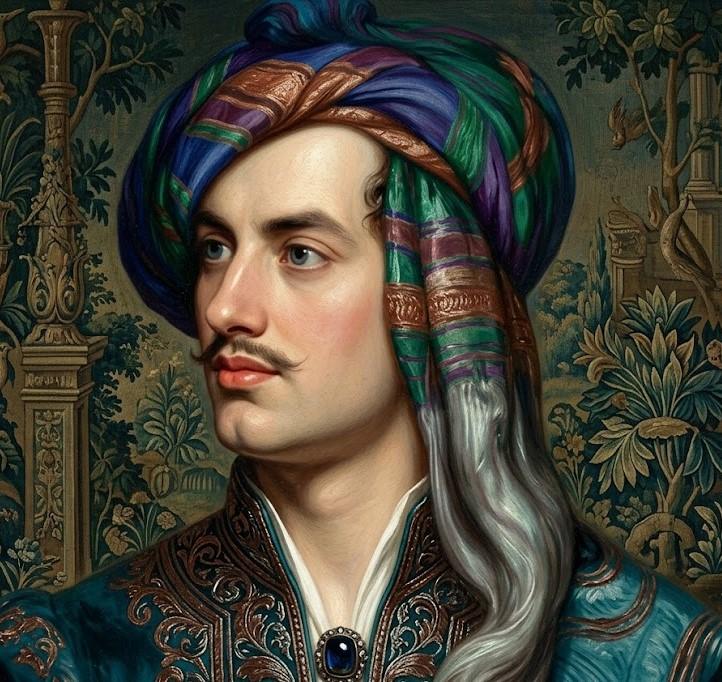
1. Early Life
Full Name: George Gordon Byron, 6th Baron Byron
Born: January 22, 1788, in London, England
Died: April 19, 1824, in Missolonghi, Greece
Family Background:
Born into an aristocratic but troubled family.
Inherited the title “Lord Byron” at the age of 10 after his great-uncle’s death.
Had a deformed right foot, which caused him lifelong pain and insecurity.
2. Education
Studied at Harrow School and later at Trinity College, Cambridge.
Gained a reputation for being charming, rebellious, and highly intellectual.
Developed a deep interest in literature, politics, and adventure.
3. Literary Career
Early Works
His first collection, Hours of Idleness (1807), was harshly criticized, motivating him to write his famous satirical poem English Bards and Scotch Reviewers (1809).
Rise to Fame
His epic poem, Childe Harold’s Pilgrimage (1812), made him an overnight celebrity.
Byron famously remarked: “I awoke one morning and found myself famous.”
Wrote several romantic, adventurous, and philosophical poems, including:
She Walks in Beauty (1814)
The Corsair (1814)
Don Juan (1819-1824, unfinished) – a satirical masterpiece
Key Literary Features of Byron’s Poetry
Romanticism: Focused on emotions, beauty, and nature.
Byronic Hero: Introduced a new type of hero—dark, brooding, rebellious, and passionate.
Satire and Wit: Combined sharp humor with deep emotion.
4. Scandals and Personal Life
Byron was notorious for his romantic affairs, leading to multiple scandals.
Had relationships with many women, including his half-sister Augusta Leigh (rumored incest).
Married Annabella Milbanke in 1815, but the marriage ended after a year.
Lived in exile from England after his scandals, settling in Switzerland, Italy, and Greece.
5. Political Involvement and Death
Byron was passionate about freedom and revolution.
Joined the Greek War of Independence against the Ottoman Empire in 1823.
Died of fever and infection on April 19, 1824, in Missolonghi, Greece, at the age of 36.
Greece considers him a national hero for his efforts in their independence struggle.
6. Legacy
Byron remains one of the greatest Romantic poets.
His works influenced later poets and writers like Shelley, Keats, and Pushkin.
The term “Byronic Hero” (a rebellious, flawed, yet charismatic character) is still used in literature today.
His poetry and adventurous life continue to fascinate readers worldwide.
Word Meaning
| Tough Word | Meaning in English | Meaning in Hindi |
| Climes | Regions with a particular climate | जलवायु वाला क्षेत्र |
| Starry skies | A sky full of stars | तारों से भरा आकाश |
| Mellowed | Softened, made gentle | नरम या कोमल हुआ |
| Tender | Soft, gentle, delicate | कोमल, नाज़ुक |
| Gaudy | Overly bright or showy | भड़कीला, चमकीला |
| Denies | Refuses to give | अस्वीकार करता है |
| Shade | A slight darkness | छाया या हल्का अंधकार |
| Ray | A thin beam of light | किरण |
| Impaired | Weakened, damaged | कमजोर, क्षतिग्रस्त |
| Grace | Elegance, beauty | सुंदरता, गरिमा |
| Raven tress | Dark, black hair | काले घने बाल |
| Serenely | Calmly, peacefully | शांति से, सौम्यता से |
| Dwelling | A place where someone lives | निवास स्थान |
| Eloquent | Expressive, fluent in speech | प्रभावशाली, स्पष्ट वक्ता |
| Tints | Shades of color | हल्का रंग, आभा |
| Tell | Reveal, show | दर्शाना, बताना |
She Walks in Beauty Themes
Ideal Beauty
Byron presents the woman as the perfect embodiment of beauty, both in appearance and character.
Her beauty is not just physical but also a reflection of her inner purity, kindness, and grace.
The poet emphasizes a balance between light and dark, suggesting that true beauty is harmonious and natural.
Contrast Between Light and Dark
Byron contrasts brightness and darkness to highlight the uniqueness of her beauty.
The woman is described as a blend of “cloudless climes” (darkness) and “starry skies” (light), creating a gentle, mysterious charm.
This contrast reflects the Romantic belief that beauty lies in balance and harmony, not extremes.
Inner Purity and Virtue
The woman’s external beauty mirrors her inner goodness.
Byron describes her thoughts as “serenely sweet”, indicating that she has a calm and kind nature.
Her smiles and glowing complexion suggest a life spent in goodness and innocence, reinforcing the idea that moral character enhances physical beauty.
Harmony in Nature
Byron connects the woman’s beauty to nature, particularly the night sky.
Her features are compared to the soft glow of stars and the peacefulness of a cloudless night, showing that true beauty is as natural and effortless as the universe itself.
This theme reflects the Romantic ideal that nature and human emotions are deeply connected.
Romantic Admiration and Emotion
The poem expresses deep admiration and reverence rather than passion or desire.
The soft, calm, and eloquent tone suggests pure appreciation rather than romantic love.
Byron focuses on the spiritual and emotional aspects of beauty, making the poem an idealized tribute rather than a declaration of love.
Very Short Answer Questions
Who wrote the poem She Walks in Beauty?
Lord Byron (George Gordon Byron).
When was She Walks in Beauty written?
In 1814.
When was the poem published?
In 1815, in Hebrew Melodies.
What inspired Byron to write She Walks in Beauty?
The beauty of Anne Beatrix Wilmot, his cousin’s wife.
What is the main theme of the poem?
The harmony of inner and outer beauty.
What is the rhyme scheme of the poem?
ABABAB.
What poetic form does the poem follow?
It consists of three six-line stanzas (sestets).
What type of meter is used in the poem?
Iambic tetrameter.
Which two contrasting elements does Byron use to describe beauty?
Light and dark.
What does Byron compare the woman’s beauty to?
A cloudless, starry night.
What does the phrase “nameless grace” mean in the poem?
An indescribable elegance and charm.
What does Byron say about the woman’s thoughts?
They are serene and pure.
What feature of the woman does Byron emphasize in the second stanza?
Her dark, flowing hair (raven tress).
What do the woman’s smiles and glow represent?
A life spent in goodness and kindness.
What literary device is used in “She walks in beauty, like the night”?
Simile.
What does the phrase “a heart whose love is innocent” suggest?
She is pure-hearted and virtuous.
What is the tone of the poem?
Admiring, calm, and reverent.
What does the poet imply about the woman’s mind?
It is at peace with the world.
How does Byron personify “heaven” in the first stanza?
He says it denies gaudy (excessive) brightness to the day.
What does the poem ultimately celebrate?
The perfect balance of physical beauty and inner goodness.
Short Answer Questions
What is the main idea of She Walks in Beauty?
The poem praises a woman’s beauty, emphasizing that it is a perfect balance of light and dark, external charm and inner goodness. Byron admires her grace, innocence, and peaceful nature, suggesting that true beauty comes from both appearance and character.
How does Byron describe the woman’s beauty in the first stanza?
He compares her beauty to a cloudless, starry night, highlighting the harmony of darkness and brightness. This contrast suggests that her beauty is not overpowering like daylight but soft and mysterious. The phrase “tender light” implies that her beauty is both gentle and divine.
Why does Byron say, “One shade the more, one ray the less” in the second stanza?
Byron suggests that her beauty is so perfectly balanced that even a small change in light or shade could lessen her charm. This line emphasizes the idea that true beauty is a delicate and natural harmony. It also reflects the poem’s recurring theme of contrast and balance.
What role does light and darkness play in the poem?
Light and dark symbolize external beauty and inner virtue. Byron describes the woman as a combination of both, making her beauty unique and harmonious. The contrast reflects the Romantic belief that true beauty is a balance of opposing elements in nature.
What does Byron say about the woman’s thoughts and expressions?
He describes her thoughts as serenely sweet, meaning she has a peaceful and pure mind. Her expressions reflect her inner goodness, and her face glows softly, symbolizing her kindness and innocence. This suggests that her beauty comes from both her appearance and her soul.
What qualities of the woman does Byron admire in the last stanza?
Byron admires her soft, calm expressions, which show her inner peace and virtue. He notes that her smile and glowing face reflect a life lived with kindness and goodness. Her mind is at peace with the world, and her heart is pure and innocent, making her beauty spiritual rather than just physical.
What is the tone of the poem, and how does it affect the reader?
The poem has a calm, admiring, and reverent tone. Byron’s use of soft imagery, contrasts, and smooth rhythm creates a musical and gentle effect. This tone makes the reader feel a sense of peace, admiration, and appreciation for natural beauty.
How does Byron’s use of poetic devices enhance the poem?
Byron uses simile (“She walks in beauty, like the night”) to compare her beauty to a starry night, emphasizing its harmony. Imagery (“raven tress,” “tints that glow”) makes her appearance vivid, while contrast (“dark and bright”) highlights the balance of light and shadow. These devices create a lyrical and elegant effect, reinforcing the poem’s theme.
Why is the poem considered an example of Romantic poetry?
The poem reflects Romantic ideals by focusing on emotion, nature, beauty, and individual experience. Byron compares beauty to natural elements (the night sky), emphasizing the power of emotions and the connection between inner goodness and outer beauty. The admiration of purity and simplicity is also a key Romantic theme.
What message does Byron convey about true beauty?
Byron suggests that true beauty is not just physical but a reflection of inner goodness and harmony. The woman’s beauty is perfect because it combines contrasts (light and dark, appearance and character). Her innocence, virtue, and peaceful mind make her beauty timeless and divine, rather than just superficial.
Critical Analysis
Introduction
She Walks in Beauty is one of Lord Byron’s most famous lyric poems, written in 1814 and published in 1815 in Hebrew Melodies. The poem is a tribute to ideal beauty, inspired by Anne Beatrix Wilmot, the wife of Byron’s cousin, whose grace and charm deeply impressed him. Instead of focusing on passionate love, the poem admires both the physical beauty and the inner purity of the woman, portraying her as a perfect blend of light and darkness, elegance and innocence.
Central Idea
The poem explores the harmonious balance of physical beauty and inner virtue. Byron suggests that true beauty is not just about appearance but also about a calm and pure heart. The woman’s grace is compared to a cloudless, starry night, emphasizing her serenity, mystery, and charm. The poem conveys that real beauty is a combination of both external grace and inner goodness, making it timeless and divine.
Structure and Rhyme Scheme
The poem consists of three sestets (six-line stanzas).
It follows an ABABAB rhyme scheme, which creates a smooth, musical flow.
The meter is iambic tetrameter, meaning each line has four stressed syllables, giving the poem a gentle, rhythmic quality.
The use of enjambment (lines flowing into the next without a pause) enhances the natural, effortless beauty of the poem, much like the woman it describes.
Themes
a. Ideal Beauty
The woman’s beauty is not overpowering but soft and natural, like the night sky.
Byron presents her as an example of perfect, harmonious beauty, where physical and moral qualities are inseparable.
b. Light and Dark Contrast
The poet contrasts light and dark to show how beauty is a balance, not an extreme.
Her dark hair (raven tress) and softly glowing face represent this perfect harmony.
c. Inner Purity and Innocence
Her face reflects her thoughts and goodness, suggesting that beauty is more than just physical appearance.
Her mind is at peace, and her heart is innocent, making her beauty pure and untainted.
d. Romanticism and Nature
Byron uses natural imagery (night, stars, glow) to compare beauty to the harmony found in nature.
This reflects the Romantic ideal that beauty is not artificial but found in the simplicity of nature.
Style
The poem has a lyrical and melodious quality, making it sound like a song.
Byron uses soft, elegant words to create a calm and peaceful tone.
The absence of direct passion or desire makes the poem unique in Romantic poetry, as it focuses on admiration rather than love.
Poetic Devices
a. Simile
“She walks in beauty, like the night”
The woman is compared to a cloudless, starry night, emphasizing mystery and calmness.
b. Imagery
“Cloudless climes and starry skies” – Creates a visual picture of a peaceful, shining night.
“Raven tress” – Highlights her dark, flowing hair, adding a mystical element.
c. Contrast (Antithesis)
“One shade the more, one ray the less”
Shows how her beauty is a delicate balance of light and dark, suggesting that even a slight change would disturb its perfection.
d. Personification
“Where thoughts serenely sweet express”
Her thoughts are given human qualities, showing how her inner goodness is visible on her face.
Critical Commentary
Many literary critics have admired She Walks in Beauty for its elegant simplicity and Romantic imagery.
William Hazlitt, a famous Romantic critic, noted that Byron’s use of contrast (light and dark) makes the poem one of the finest expressions of idealized beauty.
Samuel Rogers, a contemporary of Byron, praised the poem’s musical quality and its ability to capture beauty in both physical and moral dimensions.
Modern critics view the poem as an example of Byron’s softer, more reflective side, in contrast to his usual intense, rebellious themes.
Message of the Poem
True beauty is a combination of both outward charm and inner goodness.
Nature and beauty are deeply connected—just as the stars and night complement each other, beauty exists in balance.
Virtue, kindness, and peace of mind enhance one’s physical beauty, making it timeless and divine.
Conclusion
She Walks in Beauty is a masterpiece of Romantic poetry, showcasing Lord Byron’s lyrical elegance and ability to blend emotion with natural imagery. The poem transcends physical beauty, presenting it as a reflection of virtue, serenity, and perfect harmony. Through simple yet powerful language, contrasting imagery, and musical rhythm, Byron immortalizes a vision of ideal beauty that remains captivating to readers even today.