Birches
(Robert Frost)
When I see birches bend to left and right
Across the lines of straighter darker trees,
I like to think some boy’s been swinging them.
But swinging doesn’t bend them down to stay
As ice-storms do. Often you must have seen them
Loaded with ice a sunny winter morning
After a rain. They click upon themselves
As the breeze rises, and turn many-colored
As the stir cracks and crazes their enamel.
Soon the sun’s warmth makes them shed crystal shells
Shattering and avalanching on the snow-crust—
Such heaps of broken glass to sweep away
You’d think the inner dome of heaven had fallen.
They are dragged to the withered bracken by the load,
And they seem not to break; though once they are bowed
So low for long, they never right themselves:
You may see their trunks arching in the woods
Years afterwards, trailing their leaves on the ground
Like girls on hands and knees that throw their hair
Before them over their heads to dry in the sun.
But I was going to say when Truth broke in
With all her matter-of-fact about the ice-storm
I should prefer to have some boy bend them
As he went out and in to fetch the cows—
Some boy too far from town to learn baseball,
Whose only play was what he found himself,
Summer or winter, and could play alone.
One by one he subdued his father’s trees
By riding them down over and over again
Until he took the stiffness out of them,
And not one but hung limp, not one was left
For him to conquer. He learned all there was
To learn about not launching out too soon
And so not carrying the tree away
Clear to the ground. He always kept his poise
To the top branches, climbing carefully
With the same pains you use to fill a cup
Up to the brim, and even above the brim.
Then he flung outward, feet first, with a swish,
Kicking his way down through the air to the ground.
So was I once myself a swinger of birches.
And so I dream of going back to be.
It’s when I’m weary of considerations,
And life is too much like a pathless wood
Where your face burns and tickles with the cobwebs
Broken across it, and one eye is weeping
From a twig’s having lashed across it open.
I’d like to get away from earth awhile
And then come back to it and begin over.
May no fate willfully misunderstand me
And half grant what I wish and snatch me away
Not to return. Earth’s the right place for love:
I don’t know where it’s likely to go better.
I’d like to go by climbing a birch tree,
And climb black branches up a snow-white trunk
Toward heaven, till the tree could bear no more,
But dipped its top and set me down again.
That would be good both going and coming back.
One could do worse than be a swinger of birches.
Birches by Robert Frost Summary
Robert Frost’s “Birches” first appeared in the August 1915 issue of The Atlantic Monthly, where it was featured alongside “The Road Not Taken” and “The Sound of Trees” under the title “A Group of Poems.”
Originally titled “Swinging Birches” in early drafts, the poem was later included in his third collection, Mountain Interval, published by Henry Holt and Company in 1916.
The poem begins with the speaker walking through the woods and noticing birch trees that are bent over. He knows the real reason for this: heavy ice storms have weighed them down permanently. However, he prefers to imagine a happier reason. He likes to think that a local country boy has been playing on them, climbing to the top and riding them down to the ground. This sets up the main theme of the poem: the difference between the hard facts of the world (“Truth”) and the playful stories we tell ourselves to feel better.
The speaker spends time describing the reality of the ice storms. He vividly pictures the trees covered in ice on a sunny morning, shedding their “crystal shells” like piles of broken glass. He admits that nature is powerful and can permanently change things. The trees are bent so low they never stand up straight again, looking like girls drying their hair in the sun. This represents the burdens and struggles of life that leave permanent marks on us.
Despite the facts, the speaker returns to his daydream about the boy. He imagines a lonely child who lives too far from town to play baseball, so he makes the forest his playground. The boy masters the trees one by one, learning exactly how to climb and swing without breaking them or hurting himself. This section celebrates youth, skill, and the human ability to control one’s environment through play and creativity.
The speaker then reveals that he is actually talking about himself. He is tired of the stress and confusion of adult life, which he compares to getting lost in a “pathless wood” where cobwebs hit his face. He wishes he could “get away from earth awhile” by climbing a birch tree toward heaven. He wants a break from his responsibilities and a chance to see the world from a higher perspective.
However, the speaker is careful to say he does not want to leave forever. He declares that “Earth’s the right place for love,” meaning that human connection and real life can only happen on the ground. His ideal is to be a “swinger of birches”—someone who can climb up toward the sky for a brief escape but always comes back down to earth to live and love. He concludes that this balance between escaping and returning is the best way to live.
Birches by Robert Frost Analysis
When I see birches bend to left and right
Across the lines of straighter darker trees,
I like to think some boy’s been swinging them.
But swinging doesn’t bend them down to stay
As ice-storms do.
Reference to Context:
Poem: “Birches” Poet: Robert Frost Collection: Mountain Interval (1916)
Context: This poem is a famous example of Robert Frost’s writing about nature. The speaker is taking a walk in the woods and notices birch trees that are bent over instead of standing tall. He knows the real scientific reason for this—heavy ice storms weighed them down—but he prefers to imagine a happier reason: that a local boy has been swinging on them for fun. This part of the poem sets up the main conflict: the difference between the hard “Truth” of the real world (the ice storm) and the comforting ideas of our Imagination (the boy playing).
Explanation:
“When I see birches bend to left and right / Across the lines of straighter darker trees,”
The poem begins with a clear picture. The speaker is looking at a specific kind of tree—the birch. These trees are famous for having white bark and being very bendy. Frost compares these curved white trees to the “straighter darker trees” behind them (like pine or oak trees). This creates a strong contrast. You can imagine the dark, straight forest like a background, and the white, bent birches standing out clearly in the front. The fact that they “bend” is the most important part; it grabs the speaker’s attention.
On a simpler level, these trees represent two different ways of being. The “straighter darker trees” are like the strict rules of life. They don’t bend; they stand in perfect “lines” like soldiers, suggesting a serious or rigid world. The birches are different. They bend “left and right,” which suggests they are unpredictable and flexible. They don’t follow the straight lines. This hints that the speaker prefers things that are a little wild or different, rather than things that are perfect and orderly.
By saying “When I see,” the speaker tells us that this is something he is looking at right now, or something he sees often. It grounds the poem in his own eyes. Notice that he focuses on the bent trees, not the straight ones. This tells us about his personality. He is interested in things that have been changed or shaped by the world. He finds the straight path a bit boring and is drawn to the “pathless” or curved way, which hints that he might be tired of his normal, serious life.
“I like to think some boy’s been swinging them.”
This line shows a change in how the speaker is thinking. He moves from just looking at the trees to imagining a story about them. The phrase “I like to think” is very important. It means he knows it might not be true, but he chooses this story because it makes him feel better. He finds the real truth (nature is harsh) to be sad, so he invents a reason that is full of life. This is a way of protecting his mind from the hard reality of the world.
By mentioning “some boy,” the speaker brings a human feeling into the empty woods. Instead of the trees being bent by cold wind, they are bent by a child playing. This turns the woods into a playground. This “boy” (who is really just the speaker imagining his own childhood) represents energy, fun, and control. It suggests that humans can shape the world around them. The boy doesn’t just watch the trees; he uses them to have fun.
The act of “swinging” is the main action of the poem. To swing means to leave the ground for a few seconds, go up into the air, and then come back. The speaker wants to believe the trees are bent by swinging because it implies the bend comes from happiness, not damage. It suggests that the trees remember the fun the boy had. It is a much happier thought than thinking about the trees being crushed by heavy weather.
“But swinging doesn’t bend them down to stay / As ice-storms do.”
Here, the speaker’s logical brain (“Truth”) interrupts his happy daydream. He corrects himself. He admits that while a boy might bend a tree for a moment while swinging, a boy isn’t heavy enough to keep the tree bent forever. This line accepts that humans have limits. We can play with the world, but we rarely leave a mark that lasts forever. Nature is much stronger than we are.
The “ice-storm” is the “bad guy” in this story. While the boy represents summer and fun, the ice storm represents winter and cold, hard facts. The ice storm is the real reason the trees are bent. By admitting this, Frost is saying that the deep, permanent changes in our lives usually come from hard times (storms), not from playing. We can’t ignore the difficult parts of life forever; eventually, we have to look at the truth.
The phrase “bend them down to stay” is quite sad. It means the trees have lost their ability to stand up. Once the ice bends them, they are stuck that way permanently. This is like growing old or going through a tragedy. Some events in life are so heavy that they “bow” us down, and we never fully bounce back to who we were before. The speaker knows that the bent trees are actually a sign of damage, even though he wishes they were a sign of play.
Poetic devices:
Imagery
Lines: “birches bend to left and right / Across the lines of straighter darker trees”
Explanation: Frost creates a strong visual picture by contrasting the white, curved birches against the rigid, black background of the other trees. This appeals to the sense of sight and establishes the scene.
Alliteration
Line: “When I see birches bend…”
Explanation: The repetition of the ‘b’ sound (a plosive consonant) creates a bouncy rhythm. This mimics the flexibility and movement of the trees themselves.
Contrast (Juxtaposition)
Lines: “bend to left and right” vs. “straighter darker trees”
Explanation: The poem places two things side by side to highlight their differences. The flexible, white birches (representing freedom/imagination) are contrasted with the rigid, orderly dark trees (representing strict reality/adulthood).
Enjambment
Lines:
“bend to left and right / Across the lines…”
“bend them down to stay / As ice-storms do.”
Explanation: The sentences run over the end of the line without a pause (no punctuation at the end). This keeps the rhythm flowing smoothly, making the poem sound like a natural conversation or a story being told while walking.
Symbolism
The Boy: Represents the power of Imagination, play, and the human desire to shape the world.
The Ice-Storms: Represent the Reality (“Truth”) and the uncontrollable forces of nature that leave permanent scars.
Often you must have seen them
Loaded with ice a sunny winter morning
After a rain. They click upon themselves
As the breeze rises, and turn many-colored
As the stir cracks and crazes their enamel.
Reference to Context:
Poem: “Birches” Poet: Robert Frost Collection: Mountain Interval (1916)
Context: In this part of the poem, the speaker stops imagining the playful boy and starts describing the real reason the birch trees are bent: an ice storm. He has just admitted that “swinging doesn’t bend them down to stay,” so now he turns his attention to “Truth.” These lines describe the morning after a freezing rainstorm. The speaker paints a vivid picture of the trees covered in heavy ice, glittering in the sun. This scene represents the beautiful but harsh reality of nature that permanently changes the shape of the trees (and our lives)..
Explanation:
“Often you must have seen them / Loaded with ice a sunny winter morning / After a rain.”
The speaker starts by saying “Often you must have seen them.” He is talking directly to us, the readers. This makes the poem feel like a conversation between friends. He assumes that we have also seen this sight in the woods. By doing this, he pulls us into his world. He wants us to remember our own memories of winter so we can truly understand the picture he is painting. It makes the scene feel real and familiar, not just something in his head.
The phrase “Loaded with ice” is very important. It suggests that the ice is extremely heavy. It isn’t just a light dusting of snow; it is a heavy burden that the trees have to carry. This explains why the trees bend—they are being pulled down by a force they cannot control. This connects to the deeper meaning of the poem: just like the trees carry the heavy load of ice, humans carry the heavy load of responsibilities and hardships in life.
After The setting is “a sunny winter morning / After a rain.” This creates a mix of feelings. A storm is usually scary and dark, but the morning after the storm is bright and sunny. The danger has passed, leaving behind something that looks beautiful but is actually very damaging. The sun is shining on the ice, which makes the scene sparkle. Frost is showing us that even difficult things (like the storm that bends the trees) can create a unique kind of beauty.
“They click upon themselves / As the breeze rises, and turn many-colored”
Frost appeals to our sense of hearing with the phrase “click upon themselves.” When the wind blows (“as the breeze rises”), the frozen branches hit against each other. Because they are covered in hard ice, they don’t make a soft rustling sound like leaves; they make a sharp, hard “clicking” sound. This is a great use of sound words (onomatopoeia). It emphasizes how cold and rigid the trees have become. They are no longer soft wood; they have become like glass or stone.
The trees “turn many-colored” because of the science of light. The clear ice on the branches acts like a prism (a crystal that splits light). When the bright morning sunlight hits the ice, it breaks into a rainbow of colors. For a moment, the trees aren’t just white or brown; they are sparkling with red, blue, and green. This highlights the magic of the imagination. Even though the ice is heavy and damaging, the speaker stops to appreciate how amazing and colorful it looks.
Even though the trees are frozen, there is still movement. The “breeze rises” and the trees move. This shows that nature is never totally still. The trees are interacting with the wind and the sun. This mixture of the dangerous weight of the ice and the beautiful, colorful light creates a complex image. It suggests that life can be beautiful and painful at the same time.
“As the stir cracks and crazes their enamel.”
Frost uses two very specific words here: “enamel” and “crazes.” Enamel is a hard, shiny coating usually found on teeth or pottery. By calling the ice “enamel,” he is saying the trees have a hard, protective shell. The word “crazes” is a term used by artists when fine cracks appear in the glaze of a pot or plate. This compares the trees to a piece of fragile art. It suggests they are precious and delicate, liable to break under pressure.
The “stir” refers to the movement of the wind. As the branches move, the hard ice cannot bend, so it “cracks.” This is the beginning of the ice falling off. The image of the ice cracking is violent but also necessary. If the ice doesn’t crack and fall off, the tree might snap. This reflects the tension between holding on and letting go. The “cracking” sound adds to the sensory experience, making us feel the crispness of the cold morning air.
Frost was known for being very accurate about nature. He describes the process perfectly: the sun comes out, the wind blows, the ice expands or moves, and then hairline cracks appear all over the surface. This attention to detail shows his deep respect for the “Truth” of nature. He doesn’t just say “the ice melted”; he describes exactly how it breaks. This contrasts with the earlier fantasy of the boy; the boy was a dream, but this ice is undeniable, physical reality.
Poetic devices:
Imagery (Visual & Auditory)
Visual: “Loaded with ice a sunny winter morning,” “turn many-colored”
Explanation: Frost paints a vivid picture of the scene. He uses the visual of the sun hitting the ice to create a prism effect (“many-colored”).
Auditory: “They click upon themselves”
Explanation: This appeals to the sense of hearing, describing the sharp, crisp sound the frozen branches make when they hit each other.
Onomatopoeia
Words: “click,” “cracks”
Explanation: These words mimic the actual sounds they describe. “Click” sounds like hard objects tapping, and “cracks” sounds like something breaking. This brings the sound of the forest to life for the reader.
Metaphor
Word: “enamel”
Explanation: Frost compares the coating of ice on the trees to “enamel” (the hard, shiny outer layer of teeth or pottery). This suggests that the ice is hard, glossy, and protective, but also brittle and liable to shatter.
Alliteration
Line: “As the stir cracks and crazes their enamel.”
Explanation: The repetition of the hard ‘c’ (or ‘k’) sound emphasizes the violence of the ice breaking. It makes the line sound sharp and brittle, just like the ice itself.
Enjambment
Line: “turn many-colored / As the stir…”
Explanation: The thought continues from one line to the next without a pause. This creates a sense of continuous movement, mimicking the rising breeze and the shifting light.
Soon the sun’s warmth makes them shed crystal shells
Shattering and avalanching on the snow-crust—
Such heaps of broken glass to sweep away
You’d think the inner dome of heaven had fallen.
Reference to Context:
Poem: “Birches” Poet: Robert Frost Collection: Mountain Interval (1916)
Context: In this section, the poem continues describing the realistic aftermath of the ice storm (the “Truth”). The morning sun has risen fully, and its heat begins to melt the ice covering the birch trees. The speaker describes the dramatic moment when the ice loosens and falls to the ground. This scene serves as a bridge between the scientific reality of the storm and a grand, almost religious metaphor, where the fallen ice is compared to the crashing down of the sky itself.
Explanation:
“Soon the sun’s warmth makes them shed crystal shells / Shattering and avalanching on the snow-crust—”
The sun is the active force here. Its “warmth” acts as a catalyst, changing the state of the trees. The word “shed” is very biological, like a snake shedding its skin. It suggests that the trees are alive and are casting off a heavy, dead layer to reveal the living wood underneath. The “crystal shells” is a beautiful metaphor for the ice. It emphasizes that the coating was hard, precious, and fragile, like expensive glassware or jewelry, rather than just frozen water.
Frost uses two powerful verbs: “Shattering” and “avalanching.” “Shattering” implies a loud, sharp noise, reinforcing the idea that the ice is brittle like glass. “Avalanching” is an exaggeration (hyperbole). An avalanche is usually a massive disaster on a mountain, but here Frost uses it to describe ice falling from a tree. This makes the event feel epic and overwhelming. It captures the sheer volume of ice falling—it isn’t just a few drips; it is a cascade that buries the snow below.
The ice falls onto the “snow-crust.” This detail tells us about the conditions on the ground. The old snow has hardened into a crust. When the hard ice hits the hard snow, it doesn’t sink in softy; it skids, piles up, and makes a loud clattering noise. This adds to the sensory experience of the poem—the scene is bright, loud, and chaotic.
“Such heaps of broken glass to sweep away”
Here, the speaker compares the fallen ice to “heaps of broken glass.” This changes the tone from a wild nature scene to something more domestic or human. It sounds like a household accident—like someone dropped a tray of glasses in the kitchen. The phrase “to sweep away” suggests a chore. It implies that the mess is so big that someone needs to come with a broom to clean it up.
“Broken glass” is dangerous; it cuts and hurts. By using this comparison, Frost reminds us that the ice storm isn’t just pretty; it is sharp and destructive. The “heaps” suggest excess—there is too much of it. It creates a picture of the forest floor covered in millions of glittering, sharp shards. It creates a feeling of a beautiful disaster—something that is dazzling to look at but indicates that something has been broken.
“You’d think the inner dome of heaven had fallen.”
This is one of the most famous and powerful lines in the poem. In ancient times, people believed the sky was a solid dome (often called the “firmament”) that separated the Earth from the Heavens. If you looked up, you were looking at the floor of heaven. Frost is referencing this old belief. The “inner dome” suggests the beautiful, crystal-like ceiling of the sky.
The speaker says the pile of ice is so bright and massive that it looks like the sky itself has shattered and crashed to the ground. This is a huge, dramatic comparison. It links the physical world (the ice) with the spiritual world (heaven). It suggests that for a moment, the barrier between earth and heaven has broken down.
When the “dome of heaven” falls, it implies a loss of order or a revelation. It suggests that the “Truth” of the ice storm is so powerful it shatters our normal view of the world. It brings the heavens down to the earth, mixing the divine with the dirt. This foreshadows the poem’s later theme: we don’t need to stay in heaven to find beauty; sometimes, the beauty of heaven comes crashing down to earth, and we find it in the “heaps” of our daily struggles.
Poetic devices:
Metaphor
“Crystal shells”: The coating of ice is directly compared to a shell. This suggests it is a hard, separate layer that the tree is “shedding” like an animal shedding skin.
“Heaps of broken glass”: The fallen ice is compared to shattered glass. This emphasizes the sharpness, the glitter, and the dangerous nature of the debris.
“Inner dome of heaven”: The sky is compared to a physical roof or dome (the firmament). Frost suggests the ice is so bright and vast that it looks like the sky itself has shattered and fallen to earth.
Hyperbole (Exaggeration)
“Avalanching”: An avalanche is usually a massive disaster on a mountain. Frost uses this strong word to describe ice falling from a tree to exaggerate the intensity and volume of the fall.
“You’d think the inner dome of heaven had fallen”: This is a huge exaggeration. He elevates a pile of melting ice to a cosmic event—the destruction of heaven—to show how awe-inspiring the scene is.
Alliteration (and Sibilance)
Lines: ‘Soon the sun’s warmth makes them shed crystal shells”
Explanation: The repetition of the ‘s’ and ‘sh’ sounds (sibilance) creates a hissing, sliding sound. This mimics the actual sound of the ice sliding off the branches and rushing through the air.
Allusion
“Inner dome of heaven”: This alludes to the ancient biblical concept of the “firmament,” where the sky was believed to be a solid dome separating the earth from the heavens.
They are dragged to the withered bracken by the load,
And they seem not to break; though once they are bowed
So low for long, they never right themselves:
You may see their trunks arching in the woods
Years afterwards, trailing their leaves on the ground
Like girls on hands and knees that throw their hair
Before them over their heads to dry in the sun.
Reference to Context:
Poem: “Birches” Poet: Robert Frost Collection: Mountain Interval (1916)
Context: The speaker continues his observation of the birch trees after the ice storm. The ice has melted, but the damage is done. In this section, he describes the permanent effect of the storm on the trees. Unlike the temporary bending caused by a boy swinging, the ice holds the trees down for so long that they lose their ability to stand up straight again. This leads to one of the most famous similes in the poem, where the bent trees are compared to girls drying their hair in the sun, mixing a sad image of defeat with a beautiful image of youth.
Explanation:
“They are dragged to the withered bracken by the load, / And they seem not to break; though once they are bowed / So low for long, they never right themselves:”
The “load” refers to the heavy weight of the ice. It is so heavy that it drags the tops of the trees all the way down to the forest floor. Frost notes that they touch the “withered bracken.” Bracken is a type of large fern. Since it is winter, the ferns are dead and dry (“withered”). This creates a picture of the living tree being forced down into the dead undergrowth. It symbolizes how life’s burdens can force us down into the darker, sadder parts of existence.
Frost notes a specific detail about birch wood: it is very flexible. He says they “seem not to break.” They don’t snap in half like a pine tree might. However, there is a catch. Even though they survive, they are changed forever. Because they were held down (“bowed”) for such a long time by the ice, the wood stiffens in that curved shape. They “never right themselves.” This is a powerful metaphor for human trauma. We might survive a hard time without “breaking,” but we are often permanently changed or “bent” by the experience. We carry the shape of our struggles with us.
“You may see their trunks arching in the woods / Years afterwards, trailing their leaves on the ground”
The speaker shifts the timeline. He is no longer looking at the morning after the storm; he is looking “Years afterwards.” This proves that the change is permanent. The trees are now “arching” (making a bridge shape) in the woods. They have become a permanent part of the landscape’s history. The storm is long gone, but the shape of the tree remains as a memory of that storm.
Trees are supposed to reach for the sky, but these trees are “trailing their leaves on the ground.” Their orientation has been flipped. The leaves, which should be high in the air gathering sunlight, are now dragging in the dirt. This emphasizes the heaviness of reality (“Truth”). The forces of nature have subverted the tree’s natural desire to grow upward, keeping it tethered to the earth.
“Like girls on hands and knees that throw their hair / Before them over their heads to dry in the sun.”
Frost transforms the sad image of the bent, old trees into something beautiful and youthful. He compares the drooping trees to “girls on hands and knees.” Imagine a girl with long hair kneeling down and flipping her hair forward over her head so the sun can dry it. In this comparison, the tree trunk is the girl’s body, and the trailing leaves are her long, wet hair.
This comparison does two things. First, it is visually perfect—the shape of the tree matches the shape of the girl. Second, it softens the blow of reality. The trees are “deformed” by the ice, but the speaker chooses to see them as “girls” drying their hair. He imposes a human, almost playful image onto a scene of destruction. It suggests that even in defeat (being bent down), there is a kind of grace and beauty. It brings the poem back to the theme of youth and vitality, even while looking at the scars of the storm.
Poetic devices:
Simile
Lines: “Like girls on hands and knees that throw their hair / Before them over their heads to dry in the sun.”
Explanation: This is one of the most famous similes in the poem. Frost compares the old, bent birch trees to young girls drying their long hair in the sun.
Effect: It transforms a sad image (a deformed tree) into a beautiful, youthful one. It adds a sense of vitality and grace to the “conquered” trees.
Alliteration
“Low for long”: The repetition of the ‘l’ sound emphasizes the duration of the suffering. It slows down the rhythm, making the weight feel heavier.
“Break; though once they are bowed”: The repetition of the plosive ‘b’ sound stresses the physical strain on the wood.
“Hands… hair… heads”: The repetition of the soft ‘h’ sound in the simile adds a gentle, breathy quality to the image of the girls, contrasting with the hardness of the wood.
Imagery
“Withered bracken”: This creates a visual of dead, brown ferns on the forest floor. It emphasizes the winter setting and the idea of the living tree being forced down into the decay of the earth.
“Trailing their leaves on the ground”: This is an image of inversion. Trees usually reach up; these are dragging down. It paints a clear picture of defeat or submission to gravity.
Personification
“Bowed”: While trees physically bend, saying they are “bowed” gives them a human posture of submission or weariness.
The Simile itself: By comparing the trees to girls, Frost effectively personifies them, giving them human anatomy (trunks become bodies, leaves become hair) and human actions (throwing hair forward).
Assonance
Line: “So low for long”
Explanation: The repetition of the long ‘o’ sound creates a mournful, drawn-out tone. It mimics the feeling of time passing slowly while the tree is held down.
But I was going to say when Truth broke in
With all her matter-of-fact about the ice-storm
I should prefer to have some boy bend them
As he went out and in to fetch the cows—
Some boy too far from town to learn baseball,
Whose only play was what he found himself,
Summer or winter, and could play alone.
Reference to Context:
Poem: “Birches” Poet: Robert Frost Collection: Mountain Interval (1916)
Context: At this point in the poem, the speaker interrupts his own description. He has spent a long time describing the “Truth” about how ice storms bend the trees permanently. Now, he stops himself. He admits that the ice storm story, while true, is not the one he wants to tell. He dismisses the “matter-of-fact” reality and returns to his imagination. He introduces the character of the lonely country boy, who represents the speaker’s ideal version of how to interact with the world—through play and creativity, rather than being crushed by it.
Explanation:
“But I was going to say when Truth broke in / With all her matter-of-fact about the ice-storm”
The speaker treats “Truth” like a rude person who interrupted a conversation. He personifies Truth (calls her “her”), giving reality a personality. He says Truth “broke in” with her “matter-of-fact.” This suggests that facts are sometimes boring or unpoetic. The speaker implies that while the scientific explanation (the ice storm) is correct, it lacks the emotional satisfaction of his own story. He acknowledges that he got sidetracked by describing the ice, but now he wants to get back to what he “was going to say.”
This is a key moment where the poet chooses myth over science. He knows the trees are bent by ice, but he doesn’t care. He creates a boundary between what is real and what is meaningful. The ice storm is just “matter-of-fact”—it is cold data. The story of the boy, however, has heart and human connection. This shows that for Frost, how we interpret the world is just as important as what the world actually is.
“I should prefer to have some boy bend them / As he went out and in to fetch the cows—”
The phrase “I should prefer” is a gentle but firm statement of choice. The speaker prefers a world where human actions (the boy) shape nature, rather than impersonal forces (the weather). He imagines a specific scenario: a boy whose job is to “fetch the cows.” This grounds the poem in a real rural setting. It isn’t a fairy tale prince; it is a farm boy with chores.
The boy bends the trees while he goes “out and in” to do his work. This is a subtle but important detail. The boy doesn’t have a dedicated time for “play.” He has to find moments of joy within his daily responsibilities. He swings on the trees while he is working. This suggests that the best way to survive the “chores” of life is to find little moments of play along the way. The boy makes his work fun by interacting with the trees.
“Some boy too far from town to learn baseball, / Whose only play was what he found himself, / Summer or winter, and could play alone.”
The speaker explains why the boy plays with trees: he is “too far from town to learn baseball.” Baseball is a team sport; it requires other people, rules, and a field. This boy is isolated. He has no teammates. Because he is alone, he has to be creative. He cannot rely on organized games; he has to invent his own fun using what is available (the trees). This makes the boy a symbol for the artist or the poet—someone who works alone and creates meaning out of their surroundings.
The phrase “what he found himself” emphasizes self-reliance. The boy isn’t given toys; he finds them. Whether it is “summer or winter,” he has to entertain himself. This solitude is not presented as sad; it is presented as a source of strength. Because he learns to “play alone,” he develops a deep, personal relationship with the natural world that a city boy playing baseball would never understand. He masters his environment because he is the only one there.
Poetic devices:
Personification
Lines: “When Truth broke in / With all her matter-of-fact…”
Explanation: Frost gives the abstract concept of “Truth” human qualities. He refers to Truth as “her” and describes her as interrupting the speaker (“broke in”) with a blunt, no-nonsense attitude (“matter-of-fact”).
Effect: This sets up “Truth” (reality/science) as an antagonist or an uninvited guest who ruins the speaker’s pleasant daydream.
Alliteration
Line: “I should prefer to have some boy bend them”
Explanation: The repetition of the plosive ‘b’ sound creates a strong, decisive rhythm. It highlights the speaker’s firm preference for his own story over the truth.
Imagery (Pastoral)
Lines: “fetch the cows,” “too far from town to learn baseball”
Explanation: These images establish a specific rural setting. It paints a picture of a life that is isolated and agricultural, far removed from the organized, social world of the city (“town” and “baseball”).
Contrast
Baseball vs. Solitary Play: Frost contrasts organized team sports (baseball) with the boy’s solitary play.
Effect: This highlights the theme of isolation and self-reliance. The boy cannot depend on others for fun; he must create his own joy using “what he found himself” (the trees).
One by one he subdued his father’s trees
By riding them down over and over again
Until he took the stiffness out of them,
And not one but hung limp, not one was left
For him to conquer. He learned all there was
To learn about not launching out too soon
And so not carrying the tree away
Clear to the ground.
Reference to Context:
Poem: “Birches” Poet: Robert Frost Collection: Mountain Interval (1916)
Context: The speaker is now deep inside his imagination. He has pushed aside the “Truth” about the ice storms and is focusing entirely on the story of the lonely country boy. In these lines, he describes how the boy plays with the birch trees. It isn’t just a casual game; it is described like a mission or a conquest. The boy interacts with his father’s forest, mastering the trees one by one. This section highlights themes of persistence, learning through experience, and the specific skills needed to master one’s environment.
Explanation:
“One by one he subdued his father’s trees / By riding them down over and over again / Until he took the stiffness out of them, / And not one but hung limp, not one was left / For him to conquer.”
Frost uses the word “subdued,” which means to defeat or bring under control. This makes the boy sound like a soldier or a knight. He isn’t just playing; he is taming the wild nature around him. The trees are called “his father’s trees,” which reminds us that the boy is living in a world owned by adults. By riding them down, he is taking something that belongs to his father and making it his own. He is asserting his own power in an adult world.
The phrase “over and over again” shows the boy’s dedication. He doesn’t just do it once; he does it until he gets it right. This repetition changes the trees physically. He takes the “stiffness” out of them. Initially, the fresh trees are stiff and hard to bend, but after the boy rides them hundreds of times, they become flexible. This represents how we learn skills. At first, things are hard and “stiff,” but with practice, they become easy and “limp.”
The speaker notes that “not one was left for him to conquer.” The boy is thorough. He doesn’t skip any trees. This creates a picture of a forest where every single birch tree has been bent by this one determined boy. It shows a slightly obsessive, energetic nature. The boy has exhausted his environment; he has used up every opportunity for play that he could find. The word “conquer” again emphasizes that for a child, play is serious business—it is how they gain power over their lives.
“He learned all there was / To learn about not launching out too soon / And so not carrying the tree away / Clear to the ground.”
The poem says “He learned all there was / To learn.” The woods are this boy’s school. He doesn’t learn from books; he learns from physics and trial-and-error. He has become an expert in the specific art of birch-swinging. This respects the intelligence of children. It suggests that “play” actually involves a lot of studying, focus, and understanding of how the world works.
The specific lesson he learns is about timing. Frost explains the technique: “not launching out too soon.” If the boy jumps onto the tree too early (while he is still climbing or while the tree is too stiff), the tree might snap, or he might fall too fast. He has to wait for the perfect moment when his weight and the tree’s flexibility are in balance. This is a life lesson: if you rush into things (“launch out too soon”), you might fail. Patience is key.
The danger is “carrying the tree away / Clear to the ground.” If he messes up the jump, he and the tree will crash to the floor together. The goal of swinging is to dip down and then spring back up—not to smash into the dirt. This connects to the poem’s later theme about balance. The boy wants to get close to the earth but not be crushed by it. He learns to respect the limits of the tree, just as humans must learn to respect the limits of nature.
Poetic devices:
Metaphor
Words: “Subdued,” “Conquer”
Explanation: Frost describes the child’s play using the language of war and battle. The boy isn’t just playing; he is a soldier “subduing” an enemy.
Effect: This elevates the importance of the game. It suggests that for a child, play is a serious mission to gain mastery and control over their environment (“his father’s trees”).
Repetition
Lines: “Over and over again,” “Not one… not one”
Explanation: Frost repeats phrases to emphasize the repetitive nature of the action.
Effect: This mirrors the process of learning a skill. You have to do it repeatedly to “take the stiffness out,” just as the boy has to ride the trees hundreds of times to master them.
He always kept his poise
To the top branches, climbing carefully
With the same pains you use to fill a cup
Up to the brim, and even above the brim.
Then he flung outward, feet first, with a swish,
Kicking his way down through the air to the ground.
So was I once myself a swinger of birches.
And so I dream of going back to be.
Reference to Context:
Poem: “Birches” Poet: Robert Frost Collection: Mountain Interval (1916)
Context: The speaker is finishing his story about the imagined country boy. He has described how the boy conquers the trees; now he explains the specific technique the boy uses to climb and swing. He compares the careful climbing to filling a cup with water, highlighting the tension and balance involved. After describing the thrilling jump to the ground, the speaker suddenly shifts the focus back to himself. He reveals that he used to be that boy, and he wishes he could return to that time of life, moving the poem from a story about a boy to a reflection on the speaker’s own desire for escape.
Explanation:
“He always kept his poise / To the top branches, climbing carefully / With the same pains you use to fill a cup / Up to the brim, and even above the brim.”
Frost describes the boy’s climbing style with the word “poise.” This means perfect balance and focus. The boy doesn’t rush up the tree wildly; he climbs “carefully.” He knows he has to reach the very “top branches” to get enough leverage to bend the tree down. If he stops too low, the tree won’t bend. This shows that even in play, there is a need for discipline and skill. You have to work hard (climb up) before you can enjoy the ride (swing down).
This is a brilliant comparison. Frost compares the careful way the boy climbs to the “pains” (effort) you take when filling a cup of water to the very top. Imagine pouring water until it reaches the rim (“the brim”), and then pouring just a few drops more so the water rises above the glass without spilling. That bubble of water is held together by surface tension.
Why does he use this image? It describes the feeling of tension. Just as the water is trembling and ready to spill, the boy at the top of the tree is trembling and ready to fall. He has pushed the tree to its absolute limit. He climbs until the tree can barely hold him anymore. It captures that exciting, scary moment right before the action happens—the moment of holding your breath before you jump.
“Then he flung outward, feet first, with a swish, / Kicking his way down through the air to the ground.”
After the slow, careful climbing, these lines are full of fast action. The word “Then” marks the change. The boy “flung outward.” He throws his body away from the trunk. This releases all the tension he built up. The phrase “feet first” is important—it shows he is in control. He isn’t falling by accident; he is steering the tree. He uses his weight to pull the top of the tree down toward the earth.
Frost uses sound again with the word “swish.” You can hear the sound of the branches rushing through the air and the leaves rustling. It is a sound of speed and freedom. The boy is “kicking his way down.” This adds to the feeling of struggle and fun. He isn’t just dropping like a stone; he is riding the tree like a wild animal, kicking his legs to guide his path through the air until his feet touch the ground safely.
This action completes the cycle. The boy started on the ground, climbed up toward the sky (heaven), and then rode the tree back down to the ground (earth). This movement represents the ideal way to live: aspiring to go high and dream, but always returning to the solid ground of reality. The “swish” is the satisfying sound of completing that journey.
“So was I once myself a swinger of birches. / And so I dream of going back to be.”
Here, the poem changes completely. The speaker stops talking about “some boy” and says “So was I once myself.” We realize that the boy he was describing was actually a memory of his own childhood. He wasn’t just guessing what the boy felt; he knows because he used to do it. This explains why he described the feelings so perfectly. The “swinger of birches” is not just a kid playing; it is an identity. It is someone who knows how to balance reality and imagination.
He says, “I dream of going back to be.” The speaker is an adult now, and he misses the freedom he had as a child. He doesn’t just want to be young again; he specifically wants to be a “swinger of birches” again. He wants to regain that ability to climb away from the world for a moment and then come back.
This moment is filled with nostalgia (a sad but sweet longing for the past). The speaker admits that his current life lacks something that he had as a boy. As an adult, he is stuck on the ground. He has lost the ability to “climb carefully” and “fling outward.” The rest of the poem will explain why he wants to go back—because his adult life has become difficult and confusing.
Poetic devices:
Onomatopoeia
Word: “Swish”
Explanation: The word “swish” mimics the sound of the branches rushing through the air and the leaves rustling as the boy falls. It brings the sound of speed and movement to life.
Metaphor
“Swinger of birches”:
Explanation: In the line “So was I once myself a swinger of birches,” the act of swinging becomes a metaphor for a lifestyle. It represents someone who knows how to balance between Reality (the ground) and Imagination (the sky)—someone who can escape stress temporarily but always returns to face the world.
Alliteration
Line: “Flung outward, feet first”
Explanation: The repetition of the ‘f’ sound creates a sound of rushing air, reinforcing the speed and force of the jump.
Line: “Climbing carefully”
Explanation: The hard ‘c’ sounds create a slow, deliberate rhythm, mimicking the careful steps of climbing up (which contrasts with the fast “swish” of coming down).
Repetition
Word: “Brim”
Line: “Up to the brim, and even above the brim.”
Explanation: The repetition of “brim” emphasizes the limit. It highlights that the boy is pushing the tree to its absolute breaking point.
It’s when I’m weary of considerations,
And life is too much like a pathless wood
Where your face burns and tickles with the cobwebs
Broken across it, and one eye is weeping
From a twig’s having lashed across it open.
I’d like to get away from earth awhile
And then come back to it and begin over.
Reference to Context:
Poem: “Birches” Poet: Robert Frost Collection: Mountain Interval (1916)
Context: The speaker has just admitted that he wishes he could go back to being a “swinger of birches.” Now, he explains why. He moves away from the physical description of the trees and uses the forest as a metaphor for his adult life. He confesses that he is tired and overwhelmed. He describes life as a confusing, “pathless” forest where he feels lost and battered. This section reveals the deep psychological need for escape that drives the entire poem. He isn’t just admiring trees; he is looking for a way out of his stress.
Explanation:
“It’s when I’m weary of considerations, / And life is too much like a pathless wood”
The phrase “weary of considerations” is the adult counterpart to the boy’s play. “Considerations” refers to the endless decisions, responsibilities, worries, and choices that adults have to make every day. The speaker is tired of thinking. He is mentally exhausted by the complex demands of society and life. He doesn’t want to die; he just wants to stop “considering” things for a while.
Frost uses the “wood” (forest) as a metaphor for life. Earlier, the boy mastered the woods, but for the adult, the woods have become “pathless.” This implies confusion and a lack of direction. In a pathless wood, you don’t know where you are going; you are just wandering. This represents a mid-life crisis or a period of depression where the clear goals of youth have disappeared, and the speaker feels trapped in a confusing maze of obligations.
“Where your face burns and tickles with the cobwebs / Broken across it, and one eye is weeping / From a twig’s having lashed across it open.”
Frost uses incredibly specific sensory details here. He describes walking into spiderwebs (“cobwebs”) that break across the face. This creates a sensation that is “burning” and “tickling.” It isn’t a mortal wound, but it is deeply annoying and uncomfortable. Metaphorically, these cobwebs represent the small, invisible, nagging worries of daily life—the little things that cling to us and irritate us, which we can’t seem to brush away.
The imagery gets more painful with the “twig.” A branch snaps back and hits him in the open eye. This causes the eye to “weep” (tear up) involuntarily. This represents the sharper, more sudden pains of life—unexpected insults or failures that hurt us.
Because one eye is weeping, the speaker’s vision is blurred. He cannot see clearly. This is a symbol for his mental state. When we are overwhelmed by “considerations” and the insults of life, we lose our perspective. We can’t see the beauty of the world anymore because we are too focused on the pain. The “weeping” is physical tearing, but it also hints at emotional crying. The speaker is hurt and confused.
“I’d like to get away from earth awhile / And then come back to it and begin over.”
This is the central thesis of the poem. The speaker says plainly, “I’d like to get away from earth awhile.” “Earth” here stands for reality, responsibility, and the “pathless wood” of his life. He wants a break. He wants to ascend, just like he did on the birch tree, to a place where the cobwebs and twigs can’t reach him.
Crucially, he adds: “And then come back to it and begin over.” He does not want to leave forever. He doesn’t want to quit the game; he just wants a restart. He wants to wipe the slate clean and return to life with fresh energy (“begin over”). This distinguishes the poem from a suicidal wish. It is a wish for refreshment. He values life (“earth”), but he recognizes that sometimes we need to leave it briefly to appreciate it again. The birch tree offers this exact motion: you go up (escape) and come down (return).
Poetic devices:
Simile
Lines: “And life is too much like a pathless wood”
Explanation: Frost uses the word “like” to compare adult life to a forest without a trail.
Effect: This explains the speaker’s confusion. In a “pathless” wood, you don’t know where you are going, just as the speaker feels lost in his daily responsibilities and decisions.
Metaphor
The Woods: The entire description of the walk represents living through a difficult time.
“Cobwebs”: These represent the small, sticky, invisible annoyances of daily life (worries, petty arguments) that cling to you and irritate you (“burn and tickle”).
“The Twig”: The twig that lashes the eye represents a sudden, sharp pain or a specific failure that hurts deeply and blinds you to the good things in life.
Imagery (Tactile and Kinesthetic)
Lines: “Face burns and tickles,” “Lashed across it open”
Explanation: Frost appeals to the sense of touch (tactile imagery). He describes sensations that are uncomfortable—burning, tickling, and the sharp sting of a whip. This makes the reader physically feel the speaker’s frustration and pain.
Synecdoche
Line: “And one eye is weeping”
Explanation: Synecdoche is when a part of something represents the whole. Here, the “weeping eye” represents the speaker’s entire emotional state.
Effect: It emphasizes that his vision is blurred. Because of the pain (the twig), he can’t see clearly. This symbolizes that when we are stressed (“weary of considerations”), we lose our perspective on life.
Enjambment
Lines: “tickles with the cobwebs / Broken across it”
Explanation: The sentence runs over the line break without stopping.
Effect: This mimics the feeling of walking through a tangled forest—you just keep moving forward, stumbling into the next obstacle (the next line) without a break.
May no fate willfully misunderstand me
And half grant what I wish and snatch me away
Not to return. Earth’s the right place for love:
I don’t know where it’s likely to go better.
Reference to Context:
Poem: “Birches” Poet: Robert Frost Collection: Mountain Interval (1916)
Context: This is the philosophical climax of the poem. The speaker has just admitted that he wants to “get away from earth awhile” because he is tired of the stresses of adult life. However, he immediately realizes that this wish sounds dangerous—it sounds like a wish for death. In these lines, he hurriedly corrects himself. He speaks to “Fate” to clarify that he only wants a temporary escape, not a permanent one. He grounds his argument in the idea that despite the pain and confusion of the “pathless wood,” Earth is the only place where human connection and love can exist.
Explanation:
“May no fate willfully misunderstand me / And half grant what I wish and snatch me away / Not to return.”
The speaker personifies “Fate” as a powerful force that might be listening to his thoughts. He is afraid that Fate might “willfully misunderstand” him. This suggests that the universe can be tricky or ironic, giving people exactly what they ask for in the worst possible way. He is anxious that his desire for relief might be interpreted as a desire to die.
The Concept of the “Half Grant” This is a brilliant logical twist. The speaker’s wish has two parts: 1) Go away, and 2) Come back. If Fate only grants half the wish (the “go away” part), that means death. To be “snatched away / Not to return” is the ultimate escape, but it is not what the speaker wants. He emphasizes that the return is just as important as the escape. He wants a pause, not an end. This reveals his deep attachment to life, even though he just complained about how hard it is.
“Earth’s the right place for love: / I don’t know where it’s likely to go better.”
This is arguably the most famous and important statement in the poem. After all the dreaming of heaven and climbing trees, the speaker plants his feet firmly on the ground. He declares, “Earth’s the right place for love.” He realizes that love—whether it is romantic love, family love, or the boy’s love for the trees—requires a physical world. It requires the friction, the “considerations,” and even the pain of the “twig in the eye” to be real.
The speaker admits, “I don’t know where it’s likely to go better.” This implies that while Heaven (the sky) might be peaceful and perfect, he isn’t sure if love exists there in the same way. Love requires overcoming obstacles; it requires two people bridging a gap. In a perfect, spiritual realm where everything is easy, perhaps deep human love cannot exist. Therefore, he accepts the suffering of Earth because it is the price of admission for experiencing love. He chooses the imperfect, painful, beautiful world over the empty perfection of the sky.
Poetic devices:
Personification
Lines: “May no fate willfully misunderstand me”
Explanation: Frost treats “Fate” as if it were a person with a mind and a will. He fears that Fate might listen to his wish (to leave the earth) and interpret it incorrectly as a wish to die.
Effect: This suggests that the universe is not just random, but perhaps tricky or ironic, capable of granting wishes in a way that punishes the wisher.
Enjambment
Lines: “And half grant what I wish and snatch me away / Not to return.”
Explanation: The sentence rushes from one line to the next without a punctuation mark at the end of the line.
Effect: This creates a sense of urgency and fear. It mimics the sudden, violent action of being “snatched away” before the speaker has a chance to object.
Litotes (Understatement)
Line: “I don’t know where it’s likely to go better.”
Explanation: Instead of saying “Earth is definitely the best place for love,” the speaker uses a double negative or a hesitant phrase (“I don’t know where…”).
Effect: This is classic Frost. It makes the statement feel humble and thoughtful rather than arrogant. It suggests that while Heaven might be perfect, he suspects it is too perfect for the messy, difficult work of human love.
Aphorism
Line: “Earth’s the right place for love”
Explanation: An aphorism is a concise, memorable statement of a general truth.
Effect: This line acts as the philosophical anchor of the poem. After all the complex metaphors about trees and ice, this simple statement grounds the reader in the poem’s main lesson: we need the physical world to experience connection.
Metaphor (The “Half Grant”)
Line: “Half grant what I wish”
Explanation: The “wish” is to go away and come back. A “half grant” is a metaphor for death. If Fate only grants the first half (going away) but not the second half (coming back), the result is fatal.
Effect: It highlights the danger of escapism. Wanting to escape reality is fine, but if you take it too far, you lose the ability to return to the things that matter (love).
I’d like to go by climbing a birch tree,
And climb black branches up a snow-white trunk
Toward heaven, till the tree could bear no more,
But dipped its top and set me down again.
That would be good both going and coming back.
One could do worse than be a swinger of birches.
Reference to Context:
Poem: “Birches” Poet: Robert Frost Collection: Mountain Interval (1916)
Context: These are the concluding lines of the poem. The speaker has reconciled his desire to escape with his need to stay on Earth. He has established that while Earth is the place for love, he still needs a temporary break from its stresses. In this final image, he describes the specific mechanism of his ideal escape: climbing a birch tree. He uses the tree’s physical movement—climbing up and being set back down—as a metaphor for a balanced life. The poem ends with an understated but profound affirmation of this way of living.
Explanation:
“I’d like to go by climbing a birch tree, / And climb black branches up a snow-white trunk / Toward heaven, till the tree could bear no more,”
The speaker chooses his exit strategy carefully: “I’d like to go by climbing a birch tree.” He doesn’t want a spaceship or a miracle; he wants a physical, tangible struggle. He wants to climb. This emphasizes that even escape requires effort. You have to work to get away from your worries.
Frost returns to the visual imagery of the tree: “black branches up a snow-white trunk.” The contrast between black and white is stark and beautiful. It represents the duality of life—darkness and light, sorrow and joy. The speaker is embracing the whole tree, both the dark branches and the white trunk, as he ascends.
He climbs “Toward heaven.” Note the preposition “toward.” He does not want to reach heaven; he just wants to go in that direction. He wants the perspective and the peace of the sky, but not the finality of the afterlife. He climbs until the “tree could bear no more.” This creates a moment of perfect suspension—the limit of the physical world. He pushes the earthly vessel (the tree) as far as it can go before it gives way.
“But dipped its top and set me down again.”
This is the crucial turning point. The tree does not break; it dips. It yields to the climber’s weight. The phrase “set me down again” is incredibly gentle. It sounds like a mother placing a child in a crib. It suggests that nature, while sometimes harsh (like the ice storm), can also be supportive. The tree acts as a vehicle that facilitates the speaker’s need for renewal. It allows him to touch the sky and then gently deposits him back on the earth, where he belongs.
“That would be good both going and coming back. / One could do worse than be a swinger of birches.”
The speaker affirms that both directions are essential: “good both going and coming back.” The “going” (escape/imagination) is good because it provides relief and perspective. The “coming back” (return/reality) is good because Earth is the place for love. A complete life involves a constant rhythm of both. You cannot stay in the clouds, and you cannot stay in the mud. You must swing between them.
The poem ends with a classic Frostian understatement: “One could do worse than be a swinger of birches.” He doesn’t say “This is the greatest way to live!” He simply says one could do worse. This modest phrasing makes the point even stronger. It suggests that in a confusing, painful world, finding a way to balance your burdens with your dreams—to be a “swinger of birches”—is a noble and successful way to live. It is a quiet victory over the “pathless wood.”
Poetic devices:
Imagery (Visual & Contrast)
Lines: “And climb black branches up a snow-white trunk”
Explanation: Frost uses high-contrast colors here. He juxtaposes the “black” branches against the “snow-white” trunk.
Effect: This visual duality represents the mixture of elements in life: darkness and light, struggle and purity, earth and heaven. It emphasizes that the climber must embrace the whole tree (the whole of life) to ascend.
Symbolism
“Toward heaven”:
Explanation: Heaven symbolizes the ideal, the spiritual, or the escape from earthly worries. Climbing “toward” it represents human aspiration and the desire for peace.
The Climbing Action:
Explanation: The act of climbing up and being set down symbolizes the ideal balance of life. It isn’t about staying in heaven (death) or staying on the ground (drudgery), but the motion between the two.
Personification
Lines: “Till the tree could bear no more, / But dipped its top and set me down again.”
Explanation: The tree is described as having human limits (“bear no more”) and human gentleness. It doesn’t break or drop him; it “sets him down.”
Effect: This makes the tree feel like a partner or a wise guardian. It suggests a harmonious relationship between the human and nature—the tree supports the speaker’s need for escape and his need for return.
Litotes (Understatement)
Line: “One could do worse than be a swinger of birches.”
Explanation: This is a classic example of litotes, where an affirmative is expressed by the negative of its contrary. Instead of saying “Being a swinger of birches is the best way to live,” he says one “could do worse.”
Effect: This creates a humble, reflective, and wise tone. It avoids being preachy or melodramatic. It suggests that finding a balance between reality and imagination is a quiet, simple, but profound victory.
Alliteration
Lines: “Black branches,” “Tree could bear”
Explanation: The repetition of the ‘b’ sound adds a heaviness and a beat to the lines, emphasizing the physical effort of the climb and the weight the tree must support.
Structure, Form, Rhyme scheme, and Meter
Form and Structure
Form: “Birches” is a lyric poem written as a continuous, single stanza of 59 lines. It is not divided into smaller sections like quatrains or octaves.
Structure: Although it is one long block of text, the poem is structured internally by the shift in the speaker’s thoughts:
Visual Observation: Seeing the bent trees.
Imagination: The story of the boy swinging.
Reality: The description of the ice storm.
Reflection: The speaker’s personal desire to escape adult life and his philosophy on returning.
Effect: The lack of stanza breaks mimics the natural flow of a conversation or a stream of consciousness. It feels like a man talking to you while walking through the woods, letting one thought drift naturally into the next without interruption.
Meter
Meter: The poem is written in Blank Verse.
Definition: Blank verse is unrhymed iambic pentameter.
Iambic: The rhythm consists of an unstressed syllable followed by a stressed syllable (da-DUM).
Pentameter: There are five of these “da-DUM” units (feet) per line, making a total of 10 syllables.
Example from Line 1:
When I | see bir | ches bend | to left | and right (da DUM | da DUM | da DUM | da DUM | da DUM)
Rhyme Scheme
Scheme: There is no rhyme scheme.
Key Points
Author
Name: Robert Frost (1874–1963)
Context: One of the most celebrated American poets, known for his realistic depictions of rural New England life and his command of American colloquial speech.
Publication: Published in the collection Mountain Interval in 1916.
Structure
Stanza: The poem is written as a single, continuous stanza of 59 lines.
Layout: There are no visual breaks (stanzas) to separate ideas. This structure mimics the continuous flow of the speaker’s thoughts—a “stream of consciousness”—as he walks through the woods and lets his mind wander from observation to memory to philosophy.
Form (Rhyme Scheme)
Type: Blank Verse.
Meter: Iambic Pentameter (ten syllables per line, alternating unstressed and stressed beats: da-DUM da-DUM da-DUM da-DUM da-DUM). Frost keeps the rhythm conversational and natural, often breaking the strict meter to sound like a real person talking.
Rhyme Scheme: None. There is no end rhyme (AABB or ABAB). The lack of rhyme makes the poem feel serious, meditative, and grounded in reality rather than song-like.
Speaker
Identity: An older adult man who is familiar with country life. He is likely a projection of Frost himself.
Personality: He is reflective, observant, and admits to being “weary of considerations” (tired of adult responsibilities). He possesses a “double vision,” seeing both the scientific truth of the world and the poetic beauty within it.
Perspective: First-person (“I”).
Setting
Place: A rural wooded area in New England (Northeastern USA).
Time: The poem shifts between a “sunny winter morning” after an ice storm and the summer days of the speaker’s imagined childhood.
Atmosphere: Quiet, isolated, and natural. It is a solitary landscape that encourages deep thinking.
Theme
Imagination vs. Reality: The central conflict between the “Truth” of the ice storm (harsh reality) and the “boy” swinging (playful imagination).
Childhood vs. Adulthood: The contrast between the freedom/play of youth and the “weary considerations” of adult life.
Escape and Return: The desire to take a break from life’s stresses (“get away from earth awhile”) without dying (“snatch me away not to return”).
Nature: Nature is presented as both beautiful/destructive (the ice storm) and a source of wisdom/comfort (the tree).
Plot
Observation: The speaker sees bent birch trees and wishes a boy had bent them while playing.
Reality Check: He acknowledges that ice storms actually bent them, describing the violence and beauty of the ice shattering.
Fantasy: He dismisses the “Truth” and returns to the story of the lonely country boy who masters the trees one by one.
Reflection: The speaker reveals he used to be that boy and wishes to return to that state of mind.
Confession: He explains that adult life feels like a “pathless wood” full of confusion and pain.
Conclusion: He wishes to climb a birch tree toward heaven to escape briefly, but explicitly states he wants to return because “Earth’s the right place for love.”
Tone
Conversational: It sounds like a friend talking to you.
Nostalgic: Filled with a longing for the past and the simplicity of youth.
Philosophical: It deals with deep questions about life, death, and how to live.
Hopeful: Despite the weariness, the poem ends on a positive note about the value of life on Earth.
Style
Colloquial: Frost uses simple, everyday vocabulary (“fetch the cows,” “swish,” “heap of broken glass”).
Metaphorical: The poem is built on extended metaphors (e.g., the “pathless wood” is life; “climbing” is spiritual aspiration).
Sensory: It is rich in visual (colors), auditory (sounds like “click” and “crack”), and tactile (feeling of cobwebs, heat of the sun) imagery.
Message
The poem suggests that the best way to survive the difficulties of adult life is to maintain a balance. We must accept reality (the ice storms) but also keep our imagination alive (the swinging boy). While it is healthy to want to escape our responsibilities occasionally (“climb toward heaven”), we must always return to the ground, because Earth is the only place where we can experience human connection and love.
Robert Frost
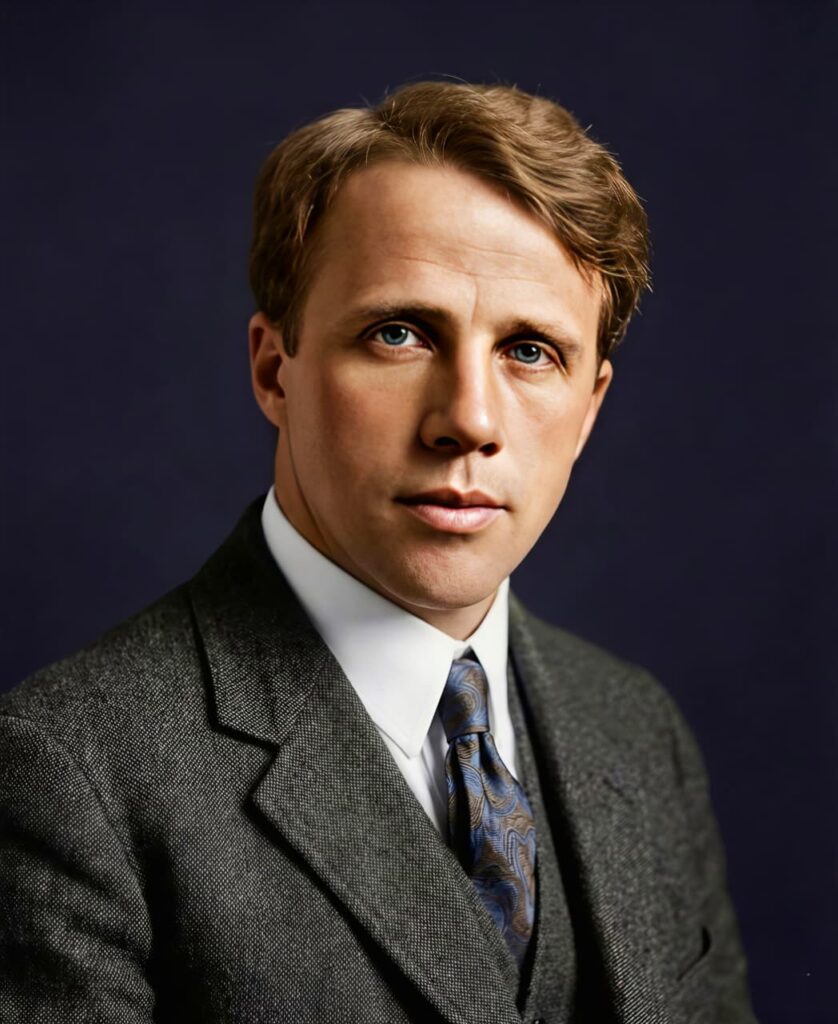
Robert Lee Frost (March 26, 1874 – January 29, 1963) is the most celebrated poet in American history. He is the only writer to have won four Pulitzer Prizes for Poetry. While popular culture often remembers him as a gentle, white-haired rustic philosopher, his actual life was complex, marked by fierce literary ambition and devastating personal tragedy. His work bridged the gap between 19th-century traditional poetry and 20th-century modernism.
Early Life: The Californian Beginnings (1874–1885)
Though inextricably linked with New England, Frost was actually born in San Francisco, California.
Parents: His father, William Prescott Frost Jr., was a journalist with a drinking problem and political ambitions. His mother, Isabelle Moodie, was a Scottish immigrant and a schoolteacher who introduced Robert to literature.
Father’s Death: In 1885, when Robert was 11, his father died of tuberculosis. The family was left destitute.
The Move: Fulfilling his father’s wish to be buried in New England, the family moved across the country to Lawrence, Massachusetts, where they lived with Robert’s grandparents. This move introduced the city-born boy to the rural landscape that would become his primary subject matter.
Education and Courtship (1886–1895)
High School: Frost attended Lawrence High School, where he excelled in classics. In 1892, he graduated as co-valedictorian. The other co-valedictorian was Elinor Miriam White, the woman who would become his wife and muse.
College: He entered Dartmouth College but dropped out after just two months, finding campus life suffocating.
First Publication: In 1894, he sold his first poem, “My Butterfly: An Elegy,” to The Independent for $15. Elated, he proposed to Elinor.
The Rejection: Elinor refused, insisting they finish their education first. Distraught and fearing he had lost her, Frost made a reckless trip to the Great Dismal Swamp in Virginia, contemplating suicide. He eventually returned, and they married in 1895.
The “Dark Years”: Farming and Obscurity (1900–1912)
This decade was characterized by struggle, poverty, and isolation, yet it was the incubator for his genius.
The Derry Farm: In 1900, Frost’s grandfather bought him a farm in Derry, New Hampshire. Frost lived there for nine years. He was not a successful farmer; he often neglected chores to write late into the night. However, the isolation allowed him to develop his unique “voice”—the sound of New England speech set to meter.
Tragedy: The Frosts suffered the crushing loss of their first son, Elliot (age 3), to cholera in 1900. This grief deeply affected their marriage and inspired the poem “Home Burial.”
Teaching: To support his growing family, Frost began teaching at the Pinkerton Academy (1906–1911).
The English Breakthrough (1912–1915)
Frustrated by American editors who rejected his work, Frost took a gamble. In 1912, at age 38, he sold the farm and moved his family to England.
Literary Connections: In London, he met key literary figures like Ezra Pound and Edward Thomas. Pound championed Frost’s work to American editors.
First Books: In England, Frost finally found a publisher.
A Boy’s Will (1913): His debut collection.
North of Boston (1914): This collection became a bestseller. It included masterpieces like “Mending Wall” and “The Death of the Hired Man.”
The American Bard (1915–1960)
Frost returned to America in 1915 as a celebrity. He bought a farm in Franconia, New Hampshire, and began a long career of teaching and writing.
Academic Career: He became a “poet-in-residence” at several universities, most notably Amherst College, University of Michigan, and Harvard. He helped found the Bread Loaf School of English at Middlebury College.
The Pulitzers: He won the Pulitzer Prize for Poetry four times (1924, 1931, 1937, 1943), a record that still stands.
1924: New Hampshire
1931: Collected Poems
1937: A Further Range
1943: A Witness Tree
The Public Persona: He cultivated an image as a folksy, wise farmer-poet, which made him incredibly popular with the general public, even as critics debated the darker, more nihilistic themes hidden in his work.
A Life of Personal Tragedy
Despite his professional success, Frost’s personal life was marred by devastating loss and mental illness.
Mental Health: Depression ran in his family. His sister, Jeanie, died in a mental hospital.
Children: Of his six children, only two outlived him.
Elliot: Died of cholera (1900).
Carol: His son committed suicide in 1940 at age 38.
Marjorie: Died of puerperal fever after childbirth (1934).
Irma: Was institutionalized for mental illness.
Wife’s Death: Elinor died of heart failure in 1938. Frost was crushed; he felt he had dragged her through a difficult life of poverty and artistic struggle.
The Final Years
JFK Inauguration (1961): At age 86, Frost was asked to read at the inauguration of President John F. Kennedy. The glare of the sun on the snow prevented him from reading his prepared poem (“Dedication”), so he recited “The Gift Outright” from memory. It was a defining cultural moment.
Death: Robert Frost died in Boston on January 29, 1963, from complications of prostate surgery.
Epitaph: He is buried in Bennington, Vermont. His gravestone bears the epitaph he chose for himself: “I had a lover’s quarrel with the world.”
Major Works and Collections
1. A Boy’s Will (1913)
His first published book. It contains lyric poems that explore the landscape and the poet’s own subjectivity.
Famous Poem: “Into My Own”
2. North of Boston (1914)
Often called a “book of people,” this collection focuses on dramatic narratives and dialogues between rural characters.
“Mending Wall”: A meditation on boundaries and neighbors (“Good fences make good neighbors”).
“The Death of the Hired Man”: A dialogue about duty, home, and forgiveness.
“Home Burial”: A harrowing dialogue between a husband and wife grieving their dead child.
3. Mountain Interval (1916)
This collection contains some of his most famous nature lyrics.
“The Road Not Taken”: Perhaps the most famous American poem, often misunderstood as a celebration of individualism, but actually a commentary on the inevitability of regret and the way we construct narratives about our choices.
“Birches”: A reflection on the desire to escape reality through imagination but the necessity of returning to earth for love.
“Out, Out—”: A brutal depiction of a boy dying in a farm accident, highlighting the indifference of the universe.
4. New Hampshire (1923)
Won his first Pulitzer Prize.
“Stopping by Woods on a Snowy Evening”: A hypnotic poem about the temptation of death/rest versus the obligations of social life (“But I have promises to keep”).
“Fire and Ice”: A concise, apocalyptic poem comparing desire (fire) and hatred (ice).
“Nothing Gold Can Stay”: A short lyric about the fleeting nature of beauty and innocence.
5. A Witness Tree (1942)
Won his fourth Pulitzer. Written after the death of his wife and the suicide of his son, these poems are darker and more personal.
“The Gift Outright”: A patriotic poem about the history of America, recited at JFK’s inauguration.
Word Meaning
| Tough Word | Meaning in English | Meaning in Hindi |
| Birches | A type of slender, hardy tree with thin, peeling white bark. | भोजपत्र के वृक्ष |
| Swinging | Moving back and forth while suspended; here, holding the tree top and jumping. | झूलना |
| Ice-storms | Storms involving freezing rain that coats surfaces in ice. | बर्फ़ीले तूफ़ान |
| Loaded | Heavily burdened or covered with something (here, ice). | लदा हुआ / भरा हुआ |
| Click | To make a sharp, slight sound. | खटखट की आवाज करना |
| Breeze | A gentle wind. | मंद हवा / समीर |
| Stir | Slight movement or disturbance in the air. | हलचल / हवा का झोंका |
| Crazes | Develops a network of fine cracks on the surface. | दरारें डालना / चटकना |
| Enamel | A hard, glossy coating (here refers to the hard layer of ice). | मीना / ऊपरी सख्त परत |
| Shed | To cast off or let fall (like leaves or skin). | गिराना / झाड़ना |
| Crystal shells | The hard coatings of ice that look like glass/crystal. | बर्फ की कांच जैसी परतें |
| Shattering | Breaking into many small pieces violently. | चकनाचूर होना |
| Avalanching | Falling down in a massive amount (like a snowslide). | हिमस्खलन की तरह गिरना / ढहना |
| Snow-crust | The hard, frozen top layer of snow on the ground. | बर्फ की पपड़ी |
| Heaps | Large piles or mounds of something. | ढेर |
| Inner dome of heaven | The sky (imagined as a solid roof or dome). | आकाश का गुंबद |
| Withered | Dried up, shriveled, or dead (referring to plants). | मुरझाया हुआ / सूखा हुआ |
| Bracken | Large, coarse ferns or scrubby plants found in forests. | फर्न / सूखी झाड़ियां |
| Bowed | Bent downwards due to weight. | झुका हुआ |
| Right themselves | To return to an upright or correct position. | सीधा होना / अपनी स्थिति में आना |
| Arching | Forming a curved shape (like an arch). | मेहराब जैसा आकार बनाना / मुड़ना |
| Trailing | Dragging or hanging down along the ground. | जमीन पर घिसटते हुए |
| Truth broke in | Reality interrupted the imagination. | सच्चाई सामने आ गई (सच्चाई का दखल) |
| Matter-of-fact | Unemotional, strictly sticking to facts; plain reality. | यथार्थ / नीरस तथ्य |
| Fetch | To go and bring something back. | जाकर लाना |
| Subdued | Conquered, tamed, or brought under control. | वश में किया / काबू पाया |
| Stiffness | Rigidity; inability to bend easily. | कड़ापन / सख्ती |
| Limp | Lacking stiffness; hanging loose or flexible. | ढीला / लचीला |
| Conquer | To overcome or master something. | जीतना / विजय प्राप्त करना |
| Launching out | Jumping or leaping forward from the tree. | छलांग लगाना |
| Poise | A state of balance and graceful control. | संतुलन |
| Brim | The very top edge of a cup or container. | कगार / लबालब किनारा |
| Flung | Threw oneself with force (past tense of fling). | जोर से फेंका / झोंका |
| Swish | A hissing or rushing sound made by moving quickly through air. | हवा में सरसराहट की आवाज |
| Weary | Extremely tired or exhausted. | थका हुआ / ऊबा हुआ |
| Considerations | Worries, responsibilities, or deep thoughts that burden the mind. | चिंताएं / जिम्मेदारियां / विचार |
| Pathless wood | A forest with no clear trail (metaphor for a confusing life). | बिना रास्ते का जंगल |
| Burns | Feels hot or stinging pain. | जलन होना |
| Tickles | Causes a light, twitching sensation. | गुदगुदी / सुरसुराहट |
| Cobwebs | Spider webs. | मकड़ी के जाले |
| Lashed | Hit quickly and sharply (like a whip). | कोड़े की तरह लगा / जोर से मारा |
| Fate | Destiny or the power determining events. | किस्मत / नियति |
| Willfully | Intentionally; done on purpose. | जानबूझकर |
| Snatch | To grab or take something away quickly and roughly. | छीन लेना / झपट्टा मारना |
| Dipped | Lowered slightly and then raised again. | नीचे झुका (और फिर ऊपर आया) |
Themes
Reality vs. Imagination
The poem establishes a central conflict between the irrefutable “Truth” of the natural world and the preferred narratives of the human imagination. The speaker acknowledges the scientific reality that heavy ice storms are responsible for permanently bending the birch trees, describing the violent shattering of the ice as a “matter-of-fact” interruption by Truth. Yet, despite knowing this, he explicitly states he would “prefer” to imagine the trees were bent by a playful boy, highlighting the human need to impose a gentler, more manageable story onto harsh realities.
Escape and Renewal
The speaker confesses to being deeply weary of adult responsibilities, described as being “weary of considerations”. He compares his life to getting lost in a “pathless wood” where he is battered by cobwebs and twigs, leading to a profound desire to “get away from earth awhile” by climbing a birch tree toward heaven. Crucially, this desire is not for a permanent escape or death, but for a temporary respite so he can return to reality refreshed and “begin over”.
Childhood vs. Adulthood
The poem contrasts the vibrant, masterful play of youth with the burdened confusion of adulthood. The imagined lonely country boy is depicted “subduing” his father’s trees through persistent play, mastering his environment by riding the trees down “over and over again” until they are limp. This masterful control contrasts sharply with the adult speaker’s experience, who feels lost and battered by life in a confusing forest. The speaker feels deep nostalgia for his own past, dreaming of going back to be a “swinger of birches” once again.
The Necessity of Balance
The physical act of swinging on a birch tree serves as a metaphor for an ideal, balanced life. The speaker wants to climb “Toward heaven” to gain perspective and push to the limits of the physical world—climbing carefully to the very “brim”—but ultimately must be “set down again”. He realizes that an idealized escape is incomplete because a full life requires the rhythm of both the upward climb of aspiration and the downward return to reality; it is “good both going and coming back”.
Grounding in Reality and Love
Despite the intense desire to escape the pains of the “pathless wood,” the speaker firmly concludes that the physical world is essential. He fears that “Fate” might misunderstand his wish for a break and snatch him away permanently, emphasizing that the return is vital. He famously declares that “Earth’s the right place for love,” asserting that human connection and real existence can only happen on the ground, not in an abstract heaven.
Very Short Answer Questions
Who is the author of the poem?
Robert Frost
What two things cause the birch trees to bend?
Ice storms and swinging boys
Which explanation for the bent trees does the speaker prefer?
The boy swinging them
Which explanation is the “Truth”?
The ice storms
What covers the trees after an ice storm?
A crystal shell of ice
What does the sun’s warmth do to the ice?
Makes it shatter and fall
What does the speaker compare the fallen ice to?
Heaps of broken glass
What human posture are the permanently bent trees compared to?
Girls drying their hair in the sun on their hands and knees
Where does the speaker imagine the boy lives?
Too far from town to learn baseball
How many of his father’s trees did the boy subdue?
Every single one
What lesson did the boy learn about climbing?
Not to launch out too soon
What did the boy do after climbing to the top?
Flung himself outward, feet first, to ride the tree down
Was the speaker himself a “swinger of birches”?
Yes, as a child
When does the speaker wish to be a swinger of birches again?
When he is “weary of considerations”
What metaphor does the speaker use for a confusing adult life?
A pathless wood
What is the speaker afraid “Fate” might do?
Misunderstand his wish and not let him return to Earth
According to the speaker, Earth is the right place for what?
Love
What colors are the birch trees described as having?
Black branches on a snow-white trunk
Where does the speaker want to climb toward?
Heaven
What does the tree do when it can “bear no more”?
It dips its top and sets the climber down again
Short Answer Questions
How does Robert Frost use the image of the bent birch trees to establish the main conflict of the poem between reality and imagination?
Frost introduces the conflict by presenting two different explanations for why the birch trees are bent. He acknowledges the “Truth” that heavy ice storms are responsible for permanently bowing the trees toward the ground, describing this reality with harsh, vivid imagery of breaking ice. However, he explicitly states that he would “prefer” to imagine a different cause: a local country boy swinging on them in play. This preference highlights the human desire to impose a playful, manageable narrative onto the harsher, uncontrollable facts of nature and life.
Describe the vivid imagery and similes Frost uses to portray the effects of the ice storm on the birch trees.
Frost uses rich sensory details to describe the aftermath of the ice storm. He appeals to the eye and ear, noting how the ice-loaded branches “click upon themselves” in the breeze and turn “many-colored” in the sun like enamel. As the day warms, the ice sheds in “crystal shells,” crashing down like “heaps of broken glass” so vast one might think the “inner dome of heaven had fallen.” Finally, he uses a striking simile, comparing the permanently bent trees trailing their leaves to girls on their hands and knees throwing their hair forward to dry in the sun.
What is the significance of the boy’s technique in swinging the birches, and what does it represent?
The boy’s swinging is depicted not just as casual play, but as a disciplined form of mastery and conquest over “his father’s trees.” He repeatedly rides them down to take their “stiffness” out, learning precisely how to balance and climb “carefully” to the top branches. Frost compares this tension to filling a cup “up to the brim, and even above the brim.” This careful ascent followed by the thrilling “swish” of kicking his way down represents the ideal balance of youthful energy, skill, and the ability to navigate between the ground and the sky.
Why does the adult speaker say life is “too much like a pathless wood,” and what does this metaphor reveal about his state of mind?
The speaker uses the extended metaphor of a “pathless wood” to describe his mid-life weariness and confusion. Being “weary of considerations” (adult responsibilities), he feels lost, as if wandering in a forest with no clear direction. The daily annoyances and sudden pains of life are compared to spiderwebs that burn and tickle the face, or a twig lashing an eye open, causing it to weep. This imagery reveals a state of being overwhelmed, disoriented, and painfully sensitive to the friction of everyday existence, prompting his desire for a temporary escape.
How does the speaker resolve his desire to escape with his commitment to reality in the final lines of the poem?
After expressing a wish to “get away from earth awhile” by climbing a birch tree toward heaven, the speaker quickly clarifies his intent to “Fate.” He fears being snatched away permanently because he realizes that “Earth’s the right place for love,” and he is unsure if love exists in a perfect heaven. He concludes that the ideal life involves a balance: climbing up for a brief respite and perspective, but always relying on the tree to “dip its top” and set him back down on the ground where life and love are lived.
Essay Type Questions
Analyze how Robert Frost utilizes the contrasting imagery of the ice storm and the swinging boy to explore the tension between harsh reality and the human desire for imaginative escape in “Birches.”
Robert Frost establishes the central conflict of “Birches” immediately by presenting two distinct explanations for the bent nature of the trees: a harsh, scientific reality versus a playful, imaginative preference. The poem opens with the speaker observing the birches bent against the straight, dark background of the woods. While he admits he would “prefer to have some boy bend them” through play, he concedes that “swinging doesn’t bend them down to stay / As ice-storms do”. This sets up a duality where the ice storm represents the immutable, sometimes destructive “Truth” of nature, while the swinging boy represents the human desire to impose a happier narrative onto the world.
Frost uses vivid, somewhat violent imagery to describe the reality of the ice storms. He details how the trees are “loaded with ice” following a winter rain, and how this ice coating cracks and “crazes their enamel” as the breeze rises. When the sun comes out, the scene becomes chaotic and brilliant; the trees “shed crystal shells,” creating an image of “shattering and avalanching on the snow-crust” with such volume that it looks like “heaps of broken glass” or as if the “inner dome of heaven had fallen”. This natural force is permanent and overwhelming. The trees are dragged down to the bracken and never right themselves, a condition Frost poignantly compares in a simile to girls on their hands and knees throwing their hair over their heads to dry.
In direct contrast to this heavy, freezing reality is the speaker’s preferred vision of the lonely country boy. This image is characterized by warmth, activity, and human agency. Unlike the ice storm which simply crushes the trees, the boy “subdued his father’s trees” one by one through persistence, riding them “over and over again / Until he took the stiffness out of them”. The boy’s interaction with nature is a skilled conquest, a type of solitary play born of isolation because he was “too far from town to learn baseball”. He learns the physics of the trees, mastering the poise required to climb to the top branches and the timing needed to launch outward feet first, “kicking his way down through the air to the ground” without breaking the tree or himself.
Ultimately, Frost explores the tension between these two visions without completely dismissing either. The speaker acknowledges that “Truth broke in / With all her matter-of-fact about the ice-storm,” interrupting his daydream. Yet, he still asserts, “I should prefer to have some boy bend them”. The poem suggests that while we must acknowledge the hard, permanent realities of life (the ice storms), we also need the imaginative capacity to see the world playfully (the swinging boy) in order to endure it. The ability to envision the boy’s conquest is a necessary psychological escape from the rigid “matter-of-fact” world.
Trace the speaker’s psychological journey from observing the trees to confessing his own weariness. How does the central metaphor of “swinging birches” resolve his conflict between the burdens of adulthood and the need for renewal?
The poem’s structure follows the speaker’s psychological movement from external observation to internal reflection, shifting from a description of nature to a confession of personal weariness. The turning point occurs halfway through when the speaker abandons the objective description of the trees and reveals his personal connection to the image: “So was I once myself a swinger of birches. / And so I dream of going back to be”. This admission transforms the poem from a scenic description into a meditation on nostalgia and the desire to recapture the resilience of youth.
The speaker’s desire to return to childhood swinging is rooted in his exhaustion with adult life. He describes his current state as being “weary of considerations,” burdened by the endless responsibilities and decisions of adulthood. He uses a striking extended metaphor to describe this state, comparing life to a “pathless wood” where one is lost and confused. In this wood, the speaker is battered by his environment; his face “burns and tickles with the cobwebs” he breaks through, and his vision is blurred because one eye is weeping from a twig having “lashed across it open”. This imagery powerfully conveys a sense of being trapped, pained, and unable to see clearly due to the accumulated stresses of daily existence.
Driven by this weariness, the speaker expresses a profound desire for escape. He admits, “I’d like to get away from earth awhile / And then come back to it and begin over”. The birch tree becomes the ideal vehicle for this escape because of its unique physical properties. The act of climbing the tree, “up to the brim, and even above the brim,” represents pushing away from the solid ground of reality toward the “heaven” of imagination and peace. It is a necessary, temporary transcendence of the “pathless wood.”
However, the metaphor of swinging is crucial because it is a two-way motion; it is not just an escape, but a return. The speaker realizes that the motion “would be good both going and coming back”. He does not want a permanent departure; he wants to be refreshed and “begin over”. The birch tree resolves his conflict because it allows him to climb until it can “bear no more,” offering a brief respite in the sky, but then it gently “dipped its top and set me down again”. The swing allows him to cope with the burdens of adulthood by offering a temporary release that makes the return to reality bearable.
Evaluate the philosophical significance of the speaker’s declaration that “Earth’s the right place for love.” How does the poem leads to this conclusion about the necessity of balancing spiritual aspiration with earthly connection?
The speaker’s declaration that “Earth’s the right place for love” is the philosophical anchor of the entire poem, grounding the preceding flights of imagination in a mature acceptance of reality. After expressing an intense desire to “get away from earth awhile” because he is weary of adult cares, the speaker feels a sudden need to clarify his wish to “Fate”. He fears that Fate might “willfully misunderstand” him and grant only half his wish—snatching him away “not to return,” which is a metaphor for death.
This fear of permanent escape forces the speaker to articulate why the return to earth is so vital. Despite the pain of the “pathless wood,” with its cobwebs and lashing twigs, he asserts that the physical world is essential for human experience. By stating, “Earth’s the right place for love: / I don’t know where it’s likely to go better,” the speaker suggests that love itself requires the conditions of earth. The poem implies that an idealized “heaven” or permanent escape might offer peace, but it would lack the friction, reality, and connection necessary for love to exist. Love is presented not as an abstract spiritual ideal, but as something rooted in the imperfect, tangible world.
The poem leads to this conclusion through the central image of the birch tree itself, which bridges the gap between earth and sky. The speaker describes his ideal escape not as flying away, but as climbing a birch tree, moving up “black branches up a snow-white trunk / Toward heaven”. This visual contrast of black and white suggests that the journey involves embracing the dualities of life—darkness and light, struggle and purity. He wants to climb toward the ideal of heaven for perspective, but only until the tree can “bear no more”.
Ultimately, the poem champions a dynamic balance over static perfection. The speaker concludes that the ideal existence is one that includes both “going and coming back”. The act of being a “swinger of birches” becomes a metaphor for a life lived well—one that aspires toward higher things and seeks relief through imagination, but always consents to be “set down again” on the ground. The final understated line, “One could do worse than be a swinger of birches,” affirms that this difficult balance between escaping reality and embracing it is a noble and necessary way to live.
Birches by Robert Frost Critical Analysis
Introduction
“Birches” is one of the most widely read and admired poems by Robert Frost, originally published in the August 1915 issue of The Atlantic Monthly and later included in his 1916 collection, Mountain Interval. The poem is a quintessential example of Frost’s ability to blend realistic rural imagery with deep metaphysical speculation. While on the surface it appears to be a nostalgic recollection of childhood play, it serves as a sophisticated vessel for exploring the human condition, the burdens of adulthood, and the delicate balance between the desire for transcendent escape and the necessity of earthly engagement. It stands alongside “The Road Not Taken” and “Stopping by Woods on a Snowy Evening” as a cornerstone of 20th-century American poetry.
Central Idea
The central idea of “Birches” revolves around the conflict between Reality (Truth) and Imagination (Fiction). Frost contrasts the harsh, irreversible reality of nature—represented by the ice storms that permanently bend the trees—with the pliable, restorative power of the human imagination—represented by the boy who bends the trees in play. The poem posits that while we are often forced to confront the hard facts of existence (“Truth breaking in”), we possess the unique ability to create our own narratives to make life bearable. Ultimately, the poem argues for a “middle way”: acknowledging the pains of reality while using imagination as a temporary respite, not a permanent exit.
Summary
The poem begins with a speaker walking through a wooded area and observing birch trees that are bent over. He knows the scientific reason for this: ice storms have coated the branches, weighing them down until they are permanently bowed. He describes the aftermath of such storms vividly—the sun coming out, the ice “clicking” and cracking, and then shattering like “crystal shells” or “broken glass” on the snow. He notes that once the trees are bent this low for too long, they never fully stand up straight again, comparing them to girls drying their hair in the sun.
However, the speaker admits he would “prefer” a different explanation. He wishes the trees had been bent by a country boy swinging on them. He imagines a solitary boy, living too far from town to play baseball, who finds his fun by conquering his father’s birch trees one by one. The boy learns the physics of the trees—climbing carefully to the top and then kicking out to ride the flexible tree down to the ground, landing safely.
The poem then shifts to the speaker’s own life. He reveals he was once such a boy and wishes to return to those days. He is currently “weary of considerations” (tired of adult responsibilities) and feels lost in life, which he compares to a “pathless wood” where he is hurt by cobwebs and twigs. He wants to escape “toward heaven” by climbing a birch tree—getting away from earth for a while—but he explicitly states he wants to come back. He fears “Fate” might misunderstand him and take him away forever (death). He affirms that “Earth’s the right place for love” and concludes that the ideal life is a balance: climbing up for spiritual relief and returning down for earthly connection.
Structure & Rhyme Scheme
Structure: The poem is composed of 59 lines in a single, continuous stanza. This monolithic structure mirrors the poem’s content: a continuous stream of thought that flows naturally from observation to memory to philosophy without artificial breaks. It allows the reader to follow the speaker’s wandering mind as if they are walking alongside him.
Meter: The poem is written in Blank Verse, which is unrhymed iambic pentameter (ten syllables per line with alternating stresses). Frost famously called writing free verse “playing tennis with the net down,” and here he uses the strict meter to give the poem a backbone while varying the rhythm to capture the sound of natural speech.
Rhyme Scheme: There is no fixed rhyme scheme. The absence of end-rhymes (like AABB) prevents the poem from sounding like a nursery rhyme or a song. Instead, it sounds like a serious, intimate conversation or a dramatic monologue, characteristic of Frost’s “sound of sense” theory.
Theme
Reality vs. Imagination The poem contrasts the harsh scientific “Truth” that ice storms permanently bend trees with the speaker’s preferred, playful fiction of a boy swinging on them. This highlights the human need to use imagination to soften the hard facts of reality.
Escape and Renewal Feeling “weary of considerations,” the speaker desires a temporary break from the burdens of adulthood. He wishes to “get away from earth awhile” to recharge and “begin over,” seeking a brief respite rather than a permanent escape like death.
Childhood vs. Adulthood Frost contrasts the mastery of the imagined boy, who skillfully conquers trees, with the confusion of the adult speaker, who feels lost in a “pathless wood.” The poem evokes a deep nostalgia for the resilience and freedom of youth compared to the struggles of adult life.
The Necessity of Balance The act of swinging serves as a metaphor for a balanced life. The speaker believes one must climb toward “heaven” for perspective but always return to the ground. A fulfilling life requires a rhythm of aspiring for more (“going”) and accepting reality (“coming back”).
Grounding in Reality and Love Despite the desire to escape pain, the speaker affirms that “Earth’s the right place for love.” He rejects permanent transcendence, concluding that real human connection and love can only exist in the physical world, not in an abstract heaven.
Style
Frost’s style is defined by his “Yankee realism.” He employs a conversational, vernacular tone that sounds deceptively simple. He uses common words (“heaps,” “cows,” “cracks”) to describe profound ideas, a technique that makes the poem accessible while hiding its complexity. The tone is contemplative and wistful, moving from objective description to subjective confession. Frost avoids high-flown, flowery poetic language in favor of a grounded, earthy vocabulary that reflects the New England setting.
Poetic Devices
Metaphor:
“Pathless wood”: Represents the confusion and lack of direction in adult life.
“Swinger of birches”: Represents someone who can navigate between the demands of reality and the freedom of imagination.
“Cup”: The tension of filling a cup to the brim represents the careful balance needed when climbing the tree.
Simile:
“Like girls on hands and knees that throw their hair / Before them over their heads to dry in the sun”: This compares the drooping trees to a human posture, adding a sense of vitality and grace to the “dead” wood.
“Life is too much like a pathless wood”: Explicitly connects the forest setting to the speaker’s state of mind.
Imagery:
Visual: “Climb black branches up a snow-white trunk,” “heaps of broken glass.”
Auditory: “Click upon themselves,” “swish” of the branches.
Tactile: “Face burns and tickles,” “cobwebs broken across it,” the “stiffness” of the trees.
Personification:
“Truth broken in / With all her matter-of-fact”: Truth is treated as a blunt, interruption-prone person.
The Tree: Described as having “pains,” and it “dipped its top and set me down,” acting like a gentle guardian.
Alliteration:
“Birches bend to left and right”
“Climbing carefully”
“Shed crystal shells”
Synecdoche:
“One eye is weeping”: A part (the eye) represents the whole (the speaker’s emotional and physical pain).
Enjambment:
Many lines run into the next without punctuation (e.g., “I should prefer to have some boy bend them / As he went out and in to fetch the cows”). This mimics the flow of natural speech and the continuous motion of swinging.
Critical Commentary
Critics often analyze “Birches” as a poem about the temptation of death. The speaker’s wish to “get away from earth” is a dark admission of existential fatigue. However, Frost distinguishes himself from Romantic poets (who might romanticize death/transcendence) by his pragmatic refusal to leave permanently. He creates a theology of the “middle state”—the suspension between earth and heaven. The poem argues that the “swinger” is the ideal human: someone who is not grounded so firmly that they cannot dream, but not so untethered that they lose touch with humanity. The “pathless wood” section is particularly critical, as it provides the motivation for the swinging; without the pain of adulthood, the escape would have no meaning.
Message
The enduring message of “Birches” is that life is a struggle that requires resilience. We cannot avoid the “ice storms” or the “cobwebs” of duty and confusion. However, we can cope with them by maintaining our capacity for wonder and play. The poem teaches that escapism is healthy only if it is temporary. We should climb toward our ideals (“heaven”) to recharge, but we must accept that our ultimate place is on Earth, accepting its imperfections because that is the only place where we can love and be loved.
Conclusion
“Birches” concludes with a quiet but powerful affirmation of life: “One could do worse than be a swinger of birches.” This understatement encapsulates Frost’s philosophy. He acknowledges that life is difficult and often painful, but he rejects the nihilistic view that it is meaningless. By intertwining the beauty of nature with the complexity of the human mind, Frost provides a roadmap for endurance—suggesting that the rhythm of “going and coming back” is the secret to sustaining a life of value and love.
Free Full PDF Download Now
More Poems by Robert Frost: Easy Literary Lessons
After Apple-Picking by Robert Frost Summary and Analysis