Anglo Saxon Period
Anglo-Saxon Period (450–1066) marks the true beginning of English history, language, and literature. Before this time, Britain was inhabited by Celtic tribes and later ruled by the Romans, but there was no English nation or English literature. Everything changed in the middle of the fifth century when new groups of people entered Britain and began shaping its future.
This period starts with the arrival of Germanic tribes and ends with the Norman Conquest in 1066. During these centuries, England slowly developed its identity, its language, and its early literary tradition. That is why this period is often called the foundation stage of English culture.
Historical Context
The Arrival of the Anglo-Saxons
Around 450 A.D., after the Romans left Britain, the island became weak and unprotected. Taking advantage of this situation, three Germanic tribes—the Angles, Saxons, and Jutes—migrated from regions near the North Sea and settled in Britain. The first leaders of this movement were Hengist and Horsa, who are believed to have arrived around 449 A.D.
These tribes did not come as peaceful settlers; they came as warriors. They fought against the native Celtic people and gradually took control of the land. The Celts were pushed to distant regions like Wales, Scotland, and Cornwall. Over time, the Anglo-Saxons established their own kingdoms and culture in Britain.
The name “England” itself comes from the Angles. Their land was first called “Anglalond,” which later changed into “Englelond” and finally “England.” The term “Saxon” comes from the word seax, meaning a short sword, which reflects their warlike nature. Although we now use the term “Anglo-Saxon” for all these tribes together, the people of that time simply called themselves “Englisc.”
Life of the Anglo-Saxons
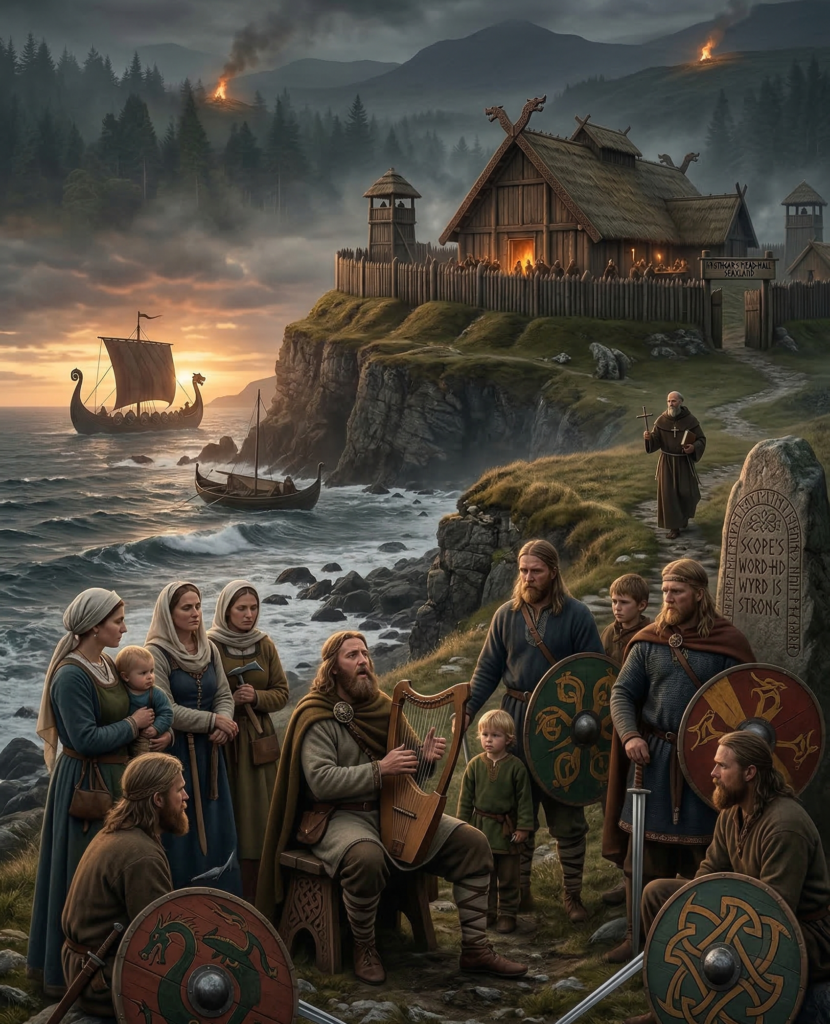
The life of the Anglo-Saxons was harsh and full of challenges. They lived in a world surrounded by dangers. Behind them were dark forests filled with wild animals and imagined monsters, and in front of them lay the cold and stormy sea. Their survival depended on strength, courage, and unity.
They spent their days fighting battles, hunting animals, farming land, and sailing across dangerous waters. Despite this hard life, they also had moments of rest and celebration. After work or battle, they gathered in large halls known as mead-halls. These halls were not just places for eating and drinking; they were the center of social and cultural life. Here, people listened to stories, shared experiences, and celebrated heroic deeds.
The sea played a very important role in their lives. It was both feared and admired. It brought danger, but also adventure and opportunity. This deep connection with the sea is clearly reflected in their poetry. Instead of simply calling it the sea, they used imaginative expressions like “whale-road” or “swan-road,” showing their creativity and emotional attachment to nature.
Inner Life: Thoughts, Beliefs, and Emotions
Although the Anglo-Saxons were strong warriors, they were also thoughtful and emotional people. They often reflected on life, death, and the uncertainty of human existence. One of their most important beliefs was in Wyrd, or fate. They believed that fate controlled everything and that no one could escape their destiny.
At the same time, they valued loyalty, friendship, and family bonds. The relationship between a lord and his warriors was especially important. A warrior was expected to remain loyal to his lord, even at the cost of his life. Honor and reputation meant everything to them.
They also showed respect for women and valued home life. Along with bravery and strength, these softer qualities were also part of their character. This combination of courage and emotional depth is clearly seen in their literature.
Scop (Poet)
In Anglo-Saxon society, the scop (poet) held a special and respected position. He was not just an entertainer but also a historian and storyteller. Since there were no written records in the early period, the scop preserved history through songs and stories.
In the mead-hall, after a feast or a battle, the scop would sing about heroes, wars, and great deeds. These songs helped to keep the memory of brave warriors alive. For the Anglo-Saxons, being remembered in poetry was the highest form of honor. Unlike other civilizations that built monuments of stone, they built their memory through words.
The Arrival of Christianity
A major turning point in this period was the arrival of Christianity in 597 A.D., when St. Augustine came to England as a missionary. Before this, the Anglo-Saxons followed pagan beliefs, worshipping nature and believing in fate.
Christianity brought new ideas, new values, and new learning. It also introduced the Latin language and encouraged education. Monks began to write down the oral poems that had previously been passed by memory. They also composed new religious works.
As a result, Old English literature became a mixture of pagan and Christian elements. For example, a poem might show belief in fate (a pagan idea) along with faith in God (a Christian idea). This blending of two belief systems is one of the most interesting features of this period.
Northumbria: A Center of Learning
During this time, the northern region of Northumbria became an important center of culture and education. Monasteries such as Jarrow and Whitby developed into great learning centers. Scholars and monks studied, wrote, and preserved important texts.
Famous figures like the Venerable Bede, Cædmon, and Cynewulf belonged to this period. Their works played an important role in shaping early English literature.
The Viking Invasions
This period of growth was seriously damaged by the Viking invasions. From the late eighth century, the Vikings attacked England, destroying monasteries, burning libraries, and killing scholars. Much of the early literature was lost during this time.
This destruction slowed down the progress of education and culture. England faced a period of crisis and uncertainty.
King Alfred the Great and Cultural Revival
The revival of English culture was made possible by King Alfred the Great. After defeating the Vikings and establishing peace through the Treaty of Wedmore in 878 A.D., he turned his attention to education and learning.
Alfred believed that knowledge should be available to all people. He translated important Latin books into English so that ordinary people could read them. He also encouraged education and helped preserve earlier works.
One of his greatest contributions was the development of the Anglo-Saxon Chronicle, a historical record of England written in English. Because of his efforts, much of the Old English literary tradition was saved.
End of the Period
After Alfred’s death, literary development slowed down again. The Anglo-Saxon society remained divided and lacked strong unity. Finally, in 1066, the Norman Conquest brought this period to an end.
With the arrival of the Normans, French and Latin influences entered England, and a new phase of language and literature began.
The language
The language of the Old English Period, also called Anglo-Saxon, is the earliest form of the English language. The earliest form of the English language can be found in ancient poems such as Widsith and Deor’s Lament. These early songs represent the first stage of English speech and give us a glimpse into the beginnings of the language.
It was brought to Britain by the Angles, Saxons, and Jutes when they settled there in the fifth century. At first glance, Old English looks completely different from modern English and may even seem like a foreign language. This is mainly because of its unusual spelling, different letters, and pronunciation.
At first sight, Old English appears extremely strange and difficult to understand. To a modern reader, it may seem like a completely foreign language. This is mainly because of unfamiliar spelling, unusual letters, and different pronunciation. However, this difficulty is often misleading. When we carefully examine Old English, we begin to notice that many of its root words are actually familiar to us. These words have survived in modern English, though their forms may have slightly changed over time.
Old English and Modern English: Basic Similarity
Although Old English looks difficult, its structure and vocabulary are not entirely unfamiliar. The similarity is more noticeable in Old English prose. A good example is found in the Anglo-Saxon Chronicle, which records early historical events in England.
One such passage reads:
“Her Hengest and Æsc his sunu gefuhton with Bryttas, on thaere stowe the is gecweden Creccanford, and thær ofslogon feower thusenda wera. And tha Bryttas tha forleton Cent-lond, and mid myclum ege flugon to Lundenbyrig.”
In modern English, this can be translated as:
“Here [In this year] Hengest and Æsc his son fought against the Britons at the place which is called Crayford, and there slew four thousand men. And the Britons then abandoned Kent-land, and with great fear fled to London.”
If we compare the words:
Her → Here
his → same word today
sunu → son
gefuhton → fought
When we read the Old English passage aloud, it becomes easier to recognize its connection to our present language. Not only the words, but even the sentence structure shows a clear resemblance.
Inflected Language
One important feature of Old English is that it was a highly inflected language. This means that words changed their endings to show their role in a sentence.
For example, the word stān (stone) could appear in different forms:
stān → stone
stānes → of the stone
stāne → to the stone
Instead of relying on word order (like modern English), Old English used these endings to show meaning. Because of this, the language was more complex and flexible.
Germanic Roots
The Old English language belongs to the Teutonic (Germanic) group of languages, which is part of the larger Indo-European (Aryan) family. This means that English shares its roots with many other languages such as Sanskrit, Persian, Greek, Latin, and Celtic languages.
According to scholars, these language groups developed from a common origin. The early ancestors of these people likely lived in central Europe and gradually spread out in different directions. As they moved, they established civilizations in places like India, Persia, Greece, and Rome, while others developed the cultures of the Celts and Germanic tribes.
Because of this shared origin, many languages still have similar basic words. For example:
father (English) – pater (Latin)
mother (English) – mater (Latin)
brother (English) – frater (Latin)
These similarities show that languages are connected at a deep level. They also reflect shared human experiences and ideas such as family, religion, and daily life. Words are not just sounds; they represent the thoughts, values, and culture of a people. Through language, we can understand the emotional and cultural life of our ancestors.
Core Vocabulary from Old English
Many everyday English words come directly from Old English. These words are usually short, simple, and commonly used in daily life.
Examples include:
house (hus)
water (wæter)
earth (eorthe)
bread (brēad)
sleep (slæpan)
These words form the core of modern English vocabulary, especially in simple and natural speech. This is why English feels direct and easy in everyday use.
Poetic Language: Alliteration and Kennings
Old English was not only a practical language but also a highly poetic and imaginative language. Poetry did not use rhyme; instead, it used alliteration, which means repeating the same sound at the beginning of words.
For example:
“The bold warrior broke the battle-line.”
Another important feature is the use of kennings, which are imaginative compound expressions used to describe things.
Examples:
whale-road → sea
bone-house → body
ring-giver → king
These expressions made the language rich and vivid, even without borrowing many words from other languages.
The Dual Nature of English Language
One of the most interesting features of English is its dual character, which means it has two main types of vocabulary.
1. Native Words (The Stem and Branches)
The first group of words consists of simple, everyday terms that form the foundation of the language. These words come directly from Old English and are still widely used today. They include words related to basic human life such as:
man, home, food, love, child, water, bread
These words are short, direct, and powerful. They give English its strength, simplicity, and clarity. Just like the trunk and branches of a tree support its structure, these native words form the core of the language.
For example:
“The man eats bread at home.”
This sentence is simple, clear, and strong because it uses native English words.
2. Foreign Words (The Leaves and Blossoms)
The second group of words consists of those borrowed from other languages over time, especially from Latin, French, and Greek. These words entered English through contact with other cultures, particularly after events like the Norman Conquest.
Examples include:
justice, beauty, government, religion, culture
These words add richness, variety, and elegance to the language. They allow English to express complex and abstract ideas.
For example:
“The government provides justice and protection.”
This sentence sounds more formal and sophisticated because it uses borrowed vocabulary.
If we combine both types:
Native words provide strength and simplicity
Foreign words provide beauty and expression
This combination makes English both powerful and flexible. It can be simple and direct in everyday use, or rich and expressive in literature and academic writing.
Influence of Christianity and Latin
With the arrival of Christianity, many Latin words entered English. These words were related to religion, education, and culture.
Examples include:
angel
priest
candle
school
This influence helped expand the vocabulary and made the language more suitable for intellectual and religious expression.
The language of the Old English Period is the foundation of modern English. Although it appears difficult at first, it becomes easier with examples and comparison. Many of its words, structures, and expressions still exist today.
Because of its strong Germanic base and later additions from other languages, English developed into a powerful, flexible, and expressive language. Old English may be ancient, but it continues to live within the language we speak today.
Characteristics of Literature
The main characteristics of Old English literature can be understood under the following headings:
Structural and Metrical Form
The structure of Old English poetry is one of its most distinctive features. Unlike modern poetry, which depends on rhyme and regular patterns, Old English poetry is based on rhythm, stress, and sound patterns. This gives it a strong, musical, and dramatic quality.
- Accent and Alliteration
The most important poetic device is alliteration, which means the repetition of the same sound at the beginning of important words in a line. This repetition creates rhythm and binds the line together.
For example:
“The bold warrior broke the battle-line.”
Here, the repetition of the “b” sound connects the words and produces a musical effect. In Old English poetry, alliteration replaces rhyme and becomes the central organizing principle of verse.
2. The Broken Line (Caesura)
Old English poetry does not have continuous flowing lines like modern poetry. Instead, each line is divided into two halves, separated by a pause known as a caesura.
This pause:
Creates a natural rhythm
Adds dramatic effect
Helps in oral recitation
The structure makes the poetry easier to understand when spoken aloud.
3. Four Accents (Stress Pattern)
Each line of Old English poetry usually contains four strong stresses, with two stresses in each half-line. Instead of counting syllables, poets focused on stressed words.
Out of these four stressed words, usually three begin with the same sound, forming the alliterative pattern. This system gives the poetry a firm structure and musical quality.
4. Musical and Oral Nature
Old English poetry was designed to be heard rather than read silently. It was performed in mead-halls in front of warriors and nobles.
The scop (poet) recited the poem, while the gleeman (musician) accompanied him with a harp. This combination of poetry and music created a powerful emotional experience.
Because of this oral nature, Old English poetry is highly rhythmic, memorable, and expressive.
Earnest and Somber Tone
The tone is often melancholic (sad and reflective) because people lived in constant fear of:
- War and violence
- Death and destruction
- Loss of family and home
Poetry expresses:
- The uncertainty of life
- The pain of exile
- The inevitability of death
However, this sadness is not weak. It is strong, controlled, and thoughtful, showing courage and acceptance of life’s hardships.
Use of Kennings and Imagery
Old English literature is rich in imagery and figurative language, especially through the use of kennings. Kennings are compound expressions used to describe things in a creative and poetic way.
For example:
“whale-road” → sea
“bone-house” → human body
“ring-giver” → king
These expressions make the language vivid and imaginative. Instead of using simple words, poets created powerful images that helped listeners visualize the scene.
Nature is also described in strong and dramatic ways. The sea, storms, darkness, and cold are common images, showing the harsh environment in which people lived.
Heroic Ideals and Values
Old English literature strongly reflects the heroic culture of the Anglo-Saxons. The main focus is on bravery, loyalty, honor, and the desire for fame.
A central idea is the bond between a lord and his warriors, known as comitatus. A warrior was expected to remain loyal to his lord, even if it meant dying in battle. This loyalty was considered the highest virtue.
Another important idea is the desire for glory and fame. Since life was uncertain and short, people believed that the only way to achieve immortality was through heroic deeds that would be remembered in poetry.
These values are clearly seen in works like Beowulf, where the hero risks his life to protect others and gain honor.
Belief in Fate (Wyrd)
A major theme in Old English literature is the belief in Wyrd, or fate. The Anglo-Saxons believed that human life was controlled by fate and that no one could escape their destiny.
This belief creates a sense of seriousness and acceptance in literature. Even the greatest heroes cannot avoid death, but they can choose how bravely they face it. This idea gives Old English literature its strong and thoughtful character.
Oral Tradition and Role of the Scop
Old English literature began as an oral tradition. Before writing became common, stories were passed from one generation to another through spoken words.
The central figure in this tradition was the scop, or poet. The scop performed in mead-halls, singing stories of heroes, battles, and history. These performances were not just for entertainment but also for preserving cultural memory.
The scop played an important role in society because he ensured that the deeds of great warriors were remembered. In this way, literature became a means of achieving immortality.
Mixture of Pagan and Christian Elements
One of the most interesting features of Old English literature is the blending of pagan and Christian beliefs. The early Anglo-Saxons were pagans who believed in fate, warrior values, and natural forces. Later, with the arrival of Christianity, new ideas about God, morality, and salvation were introduced.
When monks wrote down the old oral poems, they often added Christian elements. As a result, many works show both belief in fate and faith in God.
For example, in Beowulf, the hero sometimes speaks of fate but also thanks God for his victories. This mixture reflects a society that is slowly changing from old beliefs to new ones.
Symbolism and Reflection on Life
Old English literature often uses symbolism to express deeper meanings. Nature is not just described for beauty but also represents ideas like struggle, danger, and uncertainty.
The sea, for example, often symbolizes life’s hardships. Darkness may represent fear or death. These symbols help express the emotional and philosophical depth of the literature.
There is also a strong focus on the idea that life is temporary. Wealth, power, and happiness do not last forever. This idea gives Old English poetry its reflective and sometimes sorrowful tone.
Phases of Anglo Saxon Period
The Old English (Anglo-Saxon) Period did not produce one uniform type of literature. Instead, it developed gradually through different historical and cultural stages. These stages were shaped by important events such as the migration of Germanic tribes, the arrival of Christianity, and the destruction caused by Viking invasions.
As a result, the literature of this period can be divided into three main phases. Each phase reflects a different stage in the development of English society and literature—from oral pagan poetry to written Christian works and finally to prose and historical writing.
1. The Early / Pagan Period (Prehistoric Old English (450–650))
The first phase of Old English literature represents the earliest roots of Anglo-Saxon culture. This period existed before the Anglo-Saxons settled fully in England and before Christianity had any influence on their lives.
The literature of this stage was not originally written in England. It consisted of oral stories, heroic songs, and legends that the Angles, Saxons, and Jutes brought with them from their original homes in Northern Europe. These stories were preserved through memory and performance, as there were no written books at that time.
The main figures responsible for preserving this literature were the scop (tribal poet) and the gleeman (musician). They performed in mead-halls, singing heroic tales to the accompaniment of a harp. In this way, literature became a living tradition, passed from one generation to another.
The themes of this period are strongly pagan and heroic. The poetry celebrates bravery, loyalty, and the desire for fame. It also reflects a deep connection with nature, especially the sea, which was both feared and admired. A central belief was in Wyrd (fate), which was seen as an unavoidable force controlling human life.
The greatest work associated with this phase is Beowulf, which is considered the masterpiece of Old English literature. Other important works include Widsith, Deor’s Lament, and The Seafarer. Although these works belong to the pagan tradition, they were written down later by Christian monks, who sometimes added religious elements.
2. The Northumbrian Period (Early Old English 650–900)
The second phase begins in the 7th century, when the cultural and literary center of England shifted to the northern kingdom of Northumbria. This period marks a major transformation in English literature due to the arrival of Christianity.
Christianity entered England through two main routes. One came from Rome in the south, led by Saint Augustine, and the other came from Ireland in the north, led by Saint Aidan. The Irish missionaries played a more important role in literary development. They established great monasteries such as Jarrow and Whitby, which became centers of education, learning, and writing.
During this period, literature changed from an oral tradition to a written form. The pagan scop was gradually replaced by the monk, who recorded earlier oral poems and also created new religious works. For the first time, literature was preserved in written manuscripts.
The literature of this phase shows a blend of pagan and Christian ideas. While the heroic spirit of the Anglo-Saxons continued, it was now combined with Christian values such as faith, hope, and salvation.
Some important figures of this period include The Venerable Bede, who is known as the “father of English learning.” He wrote Ecclesiastical History of the English People in Latin, which provides valuable information about early English history.
Another important figure is Cædmon, the first known English poet. According to legend, he received the gift of poetry through divine inspiration and composed religious verses based on biblical themes. Cynewulf, another great poet, wrote deeply spiritual and reflective Christian poetry, such as The Christ.
This period is often called the Golden Age of Old English poetry because of its rich literary output and the blending of old and new traditions.
3. The West-Saxon Period 900-1066 (Late Old English 900–1150)
The final phase of Old English literature developed after the Viking (Danish) invasions in the late 8th century. These invasions caused widespread destruction, especially in Northumbria. Monasteries were burned, libraries were destroyed, and many scholars were killed. As a result, much of the earlier literature was lost.
The center of learning then shifted to the southern kingdom of Wessex, where King Alfred the Great played a crucial role in preserving English culture and literature. After defeating the Vikings and establishing peace through the Treaty of Wedmore in 878 A.D., Alfred focused on rebuilding education and learning.
King Alfred believed that knowledge should be available to all people, not just scholars. He encouraged the translation of important Latin books into English so that ordinary people could understand them. He himself translated several important works and supported scholars in their efforts.
This period is known as the Age of Prose, because prose writing became more important than poetry. One of the greatest achievements of this period is the development of the Anglo-Saxon Chronicle, which became the first continuous historical record written in English.
Alfred’s scholars also collected and preserved earlier literary works that had survived the Viking invasions. Many Old English texts, including Beowulf, survive today because they were written down and preserved during this period in the West-Saxon dialect.
After Alfred’s death, literary development slowed down. The Anglo Saxon Period finally came to an end in 1066 with the Norman Conquest, which introduced French and Latin influences and brought major changes to the English language and literature.
Major Authors and Works
The major authors and works of the Old English period can be divided into three main groups. These groups reflect the different stages in the development of literature during this time. The first group includes the anonymous poetry of the early pagan period, the second consists of the Christian writers of Northumbria, and the third includes the prose writers of the West-Saxon period.
1. The Great Anonymous Poetry (Prehistoric Old English)
The earliest literature of the Old English period belongs to the pagan age and was passed down through oral tradition. Since these poems were preserved by memory and later written down by monks, the original authors remain unknown. These works reflect the heroic life, beliefs, and values of Anglo-Saxon society.
Beowulf – The Greatest Epic
Beowulf is the earliest and greatest epic of English literature. It begins with a brief account of Scyld, the legendary king of the Danes, whose mysterious arrival and grand sea-burial set the heroic tone of the poem.
The main story focuses on King Hrothgar, who builds a magnificent hall called Heorot, where his warriors gather. However, this hall is attacked by a terrible monster named Grendel, who kills and terrorizes the people for twelve long years.
At this point, Beowulf, a young and brave hero from the Geats, arrives with his companions to help the Danes. Showing great courage, he decides to fight Grendel without weapons. In a fierce battle, Beowulf tears off the monster’s arm, causing Grendel to flee and die.
Soon after, Grendel’s mother comes to avenge her son. Beowulf follows her into a dark and dangerous lake and kills her in an underwater cave using a magical sword.
The poem then moves forward fifty years. Beowulf is now an old king. When a fire-breathing dragon begins to destroy his kingdom, he fights it bravely with the help of his loyal follower Wiglaf. Although Beowulf kills the dragon, he is fatally wounded.
In the end, he is given a grand funeral, and his body is buried in a mound near the sea, along with treasure, as a symbol of honor and remembrance.
The poem reflects key Anglo-Saxon values such as heroism, loyalty, bravery, and the desire for fame. It also shows belief in Wyrd (fate) and contains both pagan and Christian elements. Because of its richness and depth, Beowulf is considered the foundation of English epic poetry.
Widsith (“The Far Traveler”)
Widsith is one of the oldest poems in the English language. The title means “far traveler,” and the poem describes the life of a wandering poet who travels across different lands and courts.
The poem gives a picture of the early gleeman’s life, where the poet moves from one place to another, singing songs in exchange for rewards and hospitality. This shows that poetry was not only an art but also a profession.
It also contains references to various tribes, kings, and places, making it an important source of information about early Germanic history and culture. The wandering nature of the poet can be compared to later poets like Oliver Goldsmith, who also traveled and earned through their art.
Deor’s Lament – A Poem of Suffering
Deor’s Lament is considered one of the finest lyrical poems of the Old English period. Unlike heroic poetry, it focuses on personal suffering and emotional experience.
The speaker, a poet named Deor, has lost his position and been replaced by another poet. Instead of expressing anger, he reflects calmly on his situation and remembers other people who suffered even more.
Each stanza ends with the repeated line:
“His sorrow passed away; so will mine.”
This refrain gives the poem a philosophical tone, showing acceptance of suffering and hope for the future. It reflects the Anglo-Saxon belief that hardships are temporary and must be endured with courage.
The Seafarer – Life and Struggle at Sea
The Seafarer is one of the most powerful and reflective poems of the Old English period. It is often seen as having two parts.
The first part describes the harsh life of a sailor, including the cold, loneliness, hunger, and constant danger of the sea. It presents a realistic and painful picture of life on the ocean.
At the same time, the poem also expresses a deep attraction toward the sea. The sailor feels drawn to it, despite its hardships, showing a complex emotional relationship.
In the second part, the poem becomes more religious and philosophical. The sea is used as a symbol of life, and the struggles of the sailor represent the struggles of human existence. The poem suggests that true peace can only be found in faith in God, not in worldly life.
2. The Northumbrian Christian Writers (Early Old English)
With the coming of Christianity, literature became more religious, educational, and written. Monasteries became centers of learning, and for the first time, we have named authors whose works were preserved.
The Venerable Bede (673–735) – Father of English Learning
Bede is one of the most important scholars of the Old English period and is known as the “Father of English Learning.” He wrote mainly in Latin and produced more than forty works covering history, science, religion, and education.
His most famous work is the Ecclesiastical History of the English People, which is the most valuable historical record of early England. In this book, Bede carefully collected information from records and sources, making it highly reliable.
At the same time, his work also includes stories of miracles and religious beliefs, showing the mindset of his time. Without Bede, much of early English history would have been lost.
Cædmon – The First English Poet
Cædmon is the first known English poet. According to Bede, he was an uneducated man who could not sing and felt ashamed during feasts. One night, he had a divine vision in which he was commanded to sing about creation.
After this, he began composing religious poetry. His most famous work is Cædmon’s Hymn, which praises God as the creator of the world.
He is also associated with a larger work called the Paraphrase, which retells biblical stories such as Genesis and Exodus in poetic form. His style adapts these stories in a way that resembles Anglo-Saxon heroic poetry, making them more relatable to his audience.
Cynewulf – The Signed Poet
Cynewulf is one of the greatest poets of the Old English period. He is unique because he signed his poems using runic letters, hidden within the text.
His major works include The Christ, Elene, Juliana, and The Fates of the Apostles. Among these, The Christ is especially important, as it describes the life of Christ in three parts: the Nativity, the Ascension, and the Last Judgment.
His poetry reflects strong Christian beliefs and focuses on themes such as salvation, faith, and divine judgment. It also shows deep respect for religious figures, especially the Virgin Mary.
3. The West-Saxon Prose Writers (Late Old English)
After the Viking invasions destroyed much of the earlier literary culture, the center of learning moved to Wessex. This period is known for the development of prose writing, mainly due to the efforts of one great king.
King Alfred the Great – Father of English Prose
King Alfred the Great played a major role in saving English culture during a time of crisis. After defeating the Vikings and establishing peace through the Treaty of Wedmore (878), he focused on rebuilding education and learning.
He believed that knowledge should be available in English, so he learned Latin himself and translated important books. These include:
- Orosius’s Universal History
- Bede’s History
- Pope Gregory’s Pastoral Care
- Boethius’s Consolation of Philosophy
Through these efforts, he made learning accessible to ordinary people and helped revive English literature. Because of his contribution, he is known as the “Father of English Prose.”
The Anglo-Saxon Chronicle – First English History
The Anglo-Saxon Chronicle is one of the most important works of this period. It began as a simple record of events but was expanded under King Alfred into a detailed historical narrative.
It starts from early history, including Roman times, and continues year by year, recording important events in England. It is considered the oldest continuous history of any modern nation written in its own language.
The Chronicle was continued for more than two centuries, making it an invaluable source of historical and cultural information.