The Apple Cart by George Bernard Shaw
Publication: The Apple Cart was written by George Bernard Shaw in 1928. Interestingly, the play’s first performance was not in English. Its world premiere was staged in Polish at the Polish Theatre in Warsaw on 14 June 1929. A few months later, the play received its first English performance at the Malvern Drama Festival on 19 August 1929, where it was introduced to English-speaking audiences.
The play was first published in book form in 1930. The first edition was published in London, England, by Constable and Company Ltd.. As was his usual practice, Shaw included a long and important Preface with the publication. In this introduction, he clearly explained his political ideas, criticized the weaknesses of modern democracy, and warned about the growing influence of large corporations and monopolies. The Preface therefore serves not only as an introduction to the play but also as an essay that helps readers understand the deeper political themes of The Apple Cart.
The Summary
The Setup: A Power Struggle
The play takes place in an imagined future version of England. At the center of the story is King Magnus, a thoughtful, intelligent, and widely respected monarch. Although he is a constitutional king, he does not remain silent about political matters. Instead, he sometimes expresses his opinions, makes speeches, and carefully influences public discussion.
The government of the country is controlled by the Cabinet, which is led by the highly emotional Prime Minister, Joe Proteus. Proteus and his fellow ministers are increasingly irritated with the King’s involvement in politics. In their opinion, a modern constitutional monarch should simply approve whatever decisions the elected government makes.
The Cabinet believes that the King should behave like a silent “rubber stamp,” signing laws without questioning them. However, King Magnus refuses to reduce himself to such a passive role. He reminds the public that he still possesses the power of the royal veto, which allows him to reject laws that he believes may harm the nation.
Act I: The Ultimatum
The story truly begins when the Cabinet decides that the King’s independence must end. Prime Minister Proteus and his constantly arguing ministers arrive in the King’s office with a clear and serious demand.
They present Magnus with an ultimatum. According to this demand, the King must stop making political speeches, stop influencing newspapers and public opinion, and never again refer to the royal veto. If he refuses to accept these conditions, the entire Cabinet will resign. Their resignation would cause a serious political crisis that might weaken or even destroy the monarchy.
During this tense meeting, two important ideas become clear.
First, the King’s political intelligence is revealed. A new and aggressive politician named Bill Boanerges arrives expecting to dominate the King with his loud behavior. Instead, Magnus calmly flatters and charms him. By the end of their conversation, Boanerges secretly admires the King rather than challenging him.
Second, the play reveals a deeper truth about power. A determined female minister named Lysistrata explains that the politicians themselves do not truly control the country. A massive corporation called Breakages, Limited secretly dominates the economy. This company buys revolutionary inventions and destroys them because its profits depend on repairing broken goods. The politicians are too frightened of this corporation to oppose it. This discovery supports Magnus’s argument that a monarch may still be necessary to protect the public from the influence of greedy corporations.
Realizing that the Cabinet will not change its position, King Magnus asks for a few hours to consider his decision before giving them his final answer.
The Interlude: The Mistress
In order to escape the tension of the political conflict, King Magnus briefly visits the private rooms of Orinthia, his romantic companion. Orinthia is extremely beautiful, imaginative, and emotional.
She passionately demands that Magnus divorce his practical and responsible wife, Queen Jemima, and marry her instead. Orinthia believes that her beauty and charm make her more suitable to be Queen of England.
Magnus refuses this request in a calm but firm manner. He explains that being a queen is not merely a romantic position but a serious responsibility. Queen Jemima shares the burdens of government with him and supports him in his difficult duties. Orinthia, he says, belongs to a world of romance and fantasy rather than political responsibility.
Angry and jealous, Orinthia tries to prevent the King from leaving when he announces that he must go to drink tea with his wife. In her frustration she physically grabs him, and the calm monarch finds himself involved in a ridiculous wrestling match with his mistress. The scene becomes even more embarrassing when his secretary unexpectedly enters the room and witnesses the struggle.
Act II: The Climax and the Master Plan
Later that afternoon the action moves to the terrace of the royal palace. Before meeting the Cabinet again, King Magnus receives surprising news from the American Ambassador.
The ambassador announces that the United States plans to cancel the Declaration of Independence and reunite with the British Empire. The Americans even wish to make Magnus the Emperor of a vast new political union.
Instead of celebrating this proposal, Magnus is deeply disturbed by it. He realizes that the plan would allow powerful American businesses to dominate Britain. Because the United States is far larger and richer, England might lose its independence and become little more than a cultural attraction under American economic control.
Before he can fully consider this enormous international problem, the Cabinet arrives for their important five-o’clock meeting to hear the King’s final response to their ultimatum.
Magnus begins by surprising them. He calmly admits that the Cabinet is correct about one thing: the era of powerful monarchs has passed, and the country should be governed mainly by elected representatives. However, he explains that his personality will never allow him to behave like a silent rubber stamp.
Therefore, he announces that he has decided to abdicate the throne.
The politicians initially feel delighted. They assume that Magnus’s son, the quiet and scholarly Prince of Wales, will replace him and remain completely obedient to the government.
But then Magnus reveals the second part of his plan. By giving up the throne, he will become an ordinary citizen. As a private individual he will gain the democratic right to vote and to stand for election. He cheerfully declares that he intends to run for Parliament in his district of Windsor, create his own political party, and challenge the current government.
The Conclusion: The Cabinet members suddenly realize the danger. King Magnus is extremely popular with the public and far more intelligent than the ministers themselves. If he runs in a democratic election, he will almost certainly defeat them and possibly become the next Prime Minister.
Prime Minister Proteus becomes furious when he understands that the King has cleverly turned their own strategy against them. In anger he tears up the written ultimatum and cancels the entire plan. He declares that there will be no abdication, no election, and no political crisis.
The ministers leave the terrace in frustration, having achieved nothing at all.
The play ends quietly, almost exactly where it began. The political system remains unchanged, and the “apple cart” of government has not been overturned. Queen Jemima returns to the terrace and calmly tells her husband that it is time for dinner, bringing the dramatic political struggle back to the simple routines of everyday life.
Plot
Act 1:
Part 1
The play begins on a pleasant summer morning in the royal palace. Two private secretaries of King Magnus, Sempronius and Pamphilius, are sitting at desks facing each other and doing their daily work. Sempronius is opening and arranging the King’s letters, while Pamphilius is reading the morning newspapers. While working, they start talking to pass the time, and their discussion gradually becomes serious and philosophical. The subject of their conversation is Sempronius’s late father. At first this talk may appear to be casual or unimportant, but in reality George Bernard Shaw uses it to introduce one of the central ideas of the play: the difference between how politics appears on the surface and how it actually works in reality.
Sempronius explains that his father was a “Ritualist.” By this he means that his father earned his living by organizing grand public ceremonies such as coronations, parades, and official celebrations. These events were filled with costumes, music, decorations, and royal symbols. His father loved these elaborate spectacles so much that he believed completely in their importance. Real, simple nature meant very little to him. A natural sunset or a peaceful field with a horse grazing in it did not interest him at all. What fascinated him was nature that had been turned into a dramatic display with robes, jewels, banners, and formal ceremony. His life revolved around the pageantry of power and prestige. Unfortunately, this strange attachment to ceremony eventually led to tragedy.
Sempronius tells Pamphilius that his father was once shipwrecked and stranded on a beautiful island where no one else lived. The island had everything that nature could offer—clear skies, sunlight, trees, and peaceful surroundings. However, because there were no people, no society, and no ceremonial events to organize, his father could not bear the isolation. Without an audience, uniforms, or formal rituals, he felt that life had lost all meaning. Gradually he became mentally unstable and finally died alone on the island. Through this story Shaw suggests that many people value the outward show of politics more than its real purpose. For them, the ceremonies, titles, speeches, and official appearances of government are more important than the actual work of governing a country.
The quiet and thoughtful atmosphere of the office suddenly changes when Bill Boanerges enters the room. Boanerges has just been appointed President of the Board of Trade. He is a large, powerful man with a loud voice and an aggressive personality. He likes to present himself as a champion of ordinary working people and takes pride in calling himself a “man of the people.” To show how different he is from the traditional aristocratic politicians, he deliberately dresses in a Russian peasant blouse and a simple peaked cap. His clothing is meant to send a message that he rejects royal luxury and represents common citizens instead. He behaves in a bold and commanding manner and demands to see the King at once, as if he has come to challenge the authority of the monarchy. In politics, when someone new gains power, they often try to show strength immediately. Boanerges clearly represents this kind of energetic but somewhat arrogant political newcomer.
Soon King Magnus enters the room. He is calm, thoughtful, and dignified, a man in his middle forties who appears scholarly and composed. Instead of reacting angrily to Boanerges’s rude tone and impatient behavior, the King treats him with perfect courtesy and politeness. Boanerges continues to speak bluntly and tries to appear strong. He tells the King directly that real power lies with the Cabinet and not with the monarch. According to him, the King’s role is merely symbolic. He describes the monarch as nothing more than an “indiarubber stamp” whose only duty is to sign whatever decisions the Cabinet makes.
King Magnus listens quietly and does not show any anger. Instead of arguing loudly, he calmly explains why Boanerges’s view is too simple. He admits that in many cases he must approve the Cabinet’s decisions, perhaps nineteen times out of twenty. However, he reminds Boanerges that he is still a living human being with intelligence and judgment. A rubber stamp has no mind or conscience, but a human ruler does. In moments of crisis or national emergency, a thinking person can act wisely in ways that a mere symbol cannot. Magnus then changes the tone of the conversation by praising Boanerges. He compliments his intelligence, his strong personality, and the remarkable journey he has made from poverty to high political office. The King even suggests that if England ever became a republic, a powerful figure like Boanerges would probably become the first President because people often look for a strong and confident leader. This clever praise flatters Boanerges deeply. By the end of their discussion he begins to feel admiration for the King and secretly thinks that Magnus is a sensible and agreeable ruler.
Their conversation is briefly interrupted when Princess Alice, the King’s eldest daughter, enters the room in a hurry. She immediately notices Boanerges’s unusual clothing and openly criticizes it. Without hesitation she asks him why he has chosen to wear such unattractive clothes and remarks that he actually looks as though he naturally belongs to the wealthy governing class anyway. Surprisingly, instead of feeling offended, Boanerges takes this remark as a compliment. He seems pleased that someone from the royal family recognizes his importance. When the King and Princess step out of the room for a moment, Boanerges proudly tells the two secretaries that the King is not foolish at all, especially if one knows the proper way to deal with him. Boanerges believes that he has successfully dominated the conversation and made the King accept his authority. However, the audience clearly understands the truth: King Magnus has quietly and skillfully handled the situation and has already won over the Cabinet’s loudest and most aggressive new minister.
Part 2
The calm atmosphere in the King’s office suddenly disappears when the rest of the Cabinet members enter the room together. Their arrival is noisy and energetic. Unlike Boanerges, who is dressed in plain working-class clothing, the other ministers appear in bright and elaborate diplomatic uniforms that look almost theatrical. Their dress reflects the importance and status they like to display. The group includes Prime Minister Joe Proteus, who is often nervous and easily irritated; Pliny, the friendly and good-humoured Chancellor of the Exchequer; Nicobar, the sharp and somewhat cynical Foreign Secretary; Crassus, the worried Colonial Secretary; and Balbus, the blunt and ill-mannered Home Secretary. The moment they notice Boanerges wearing his peasant blouse, they begin laughing loudly and teasing him. Boanerges reacts angrily, and within seconds the room fills with loud arguments and childish quarrels among the politicians.
Prime Minister Proteus tries to bring some order to the situation. He is clearly under great pressure and repeatedly complains about his weak nerves and poor health. According to him, the Cabinet is supposed to control the government, but in reality King Magnus still dominates everything because he is far more intelligent and politically skilled than the ministers. Proteus accuses the King of cleverly influencing public opinion by making impressive speeches and quietly using the newspapers to strengthen his position. He urges the Cabinet members to remain united and oppose the King firmly. Unfortunately, the ministers cannot even agree with one another for more than a few moments. Their arguments continue until Proteus becomes so frustrated that he suddenly threatens to resign from his position as Prime Minister. This dramatic reaction frightens the others, who quickly try to persuade him to remain in office. It soon becomes clear that this threat of resignation is a method Proteus often uses to control his colleagues and force them to cooperate.
After restoring some order, Proteus finally presents the Cabinet’s real plan. He takes a paper from his pocket and shows it to the ministers. The document is an ultimatum, containing a list of firm demands that the King must accept. The Cabinet intends to present this paper to King Magnus and require his signature. If he refuses to sign it, they will all resign together from the government. Such a collective resignation would cause a serious political crisis, and the ministers believe that the King would not be able to handle the resulting chaos. They are convinced that this threat will pressure him into surrendering the little power he still possesses. Their goal is to reduce the monarch to a purely ceremonial figure who simply approves whatever the Cabinet decides.
At the moment when they are finalizing this plan, King Magnus enters the room again. He does not come alone. With him are the two female members of the Cabinet: Amanda, the cheerful and lively Postmistress General, and Lysistrata, the firm and serious Powermistress General. The sight of them immediately irritates Prime Minister Proteus. He becomes angry and complains loudly that the two women had been speaking privately with the King just before this important confrontation. In his opinion this is completely improper. He suspects that the King is once again using his charm to influence certain ministers and weaken the unity of the Cabinet.
However, Amanda and Lysistrata are not frightened by Proteus’s anger. Lysistrata calmly tells the Prime Minister that he should not interfere in matters that do not concern him. Amanda behaves in a lighter and more playful manner. Instead of arguing seriously, she treats Proteus almost like a moody child, gently calming him and asking him not to create unnecessary drama. Even Boanerges begins to feel uncomfortable about the lack of seriousness in the room. He complains that everyone is addressing each other with familiar nicknames such as Joe, Bill, and Lizzie rather than behaving like responsible leaders of a nation. Throughout this entire noisy exchange, King Magnus remains relaxed and observant. He watches the ministers argue with quiet amusement. Finally, with perfect politeness, he asks why they have all come to meet him, pretending that he does not already understand that they are preparing for a confrontation with him.
Part 3
King Magnus calmly asks the Prime Minister to explain what the Cabinet’s complaint is. Proteus, trying to speak with authority, says that the King has been making public speeches that express his own personal views rather than the official opinions of the Cabinet. According to Proteus, this behavior is completely unacceptable in a modern democratic government. The matter becomes even more serious because the King recently reminded the public that he still possesses the power of the royal veto, which allows him to refuse approval of a law passed by Parliament. Proteus is extremely angry about this. What upset him most was that Magnus told the people that the royal veto could serve as their last protection against dishonest politicians and powerful business interests. The Cabinet believes that statements like this make the public distrust the government. Therefore, they want the King to stop praising good laws as if they were his achievement, stop criticizing harmful policies, and generally remain silent. In their view, the monarch should simply approve whatever decisions the Cabinet makes without offering any opinion of his own.
Magnus responds in a calm and slightly ironic way. He asks whether the Cabinet really expects him to remain silent even if he sees the government making dangerous mistakes that could harm the country. The ministers quickly reply that protecting the nation from bad decisions is their responsibility, not his. They argue that in a democratic system the people have placed their trust in the elected government, and therefore there is no reason for the King to interfere. The Cabinet members proudly point to the country’s great economic prosperity as proof that their policies are successful. They claim that poverty has practically disappeared and that workers are earning higher wages than ever before. According to them, the factories and industries of the nation are producing enormous quantities of goods. They mention products such as chocolate sweets, Christmas crackers, golf equipment, and expensive racing boats. In their opinion, as long as the citizens are comfortable, well paid, and able to enjoy luxury items, the government must be doing an excellent job.
King Magnus, however, is not impressed by these arguments. He warns the ministers that this apparent prosperity is unstable and misleading. In his opinion the country is no longer producing goods that are truly necessary or valuable for long-term strength. Instead, the nation is mainly manufacturing luxury items and trivial products that people buy for amusement rather than necessity. At the same time, much of the country’s wealth comes from money invested in poorer foreign nations. Magnus compares this situation to people sitting on top of a volcano. Everything may appear calm and prosperous for the moment, but the situation could suddenly become dangerous if those foreign countries decide to stop paying profits. The King believes that the Cabinet has neglected its duty to guide the nation wisely. Instead of providing real leadership, the ministers seem content to allow large business interests to control the economy as long as voters remain satisfied with good wages and comfortable living conditions.
At this point Lysistrata, the Powermistress General, suddenly breaks her usual calm manner and openly supports the King’s criticism. She is one of the few ministers who genuinely wants to improve the country rather than simply maintain political power. With visible anger she explains that she once developed a detailed and practical plan to provide cheap and efficient electric power for the entire nation. However, the other Cabinet members carelessly allowed the project to fall into the hands of private capitalists who now control it for their own profit. Lysistrata is furious that her colleagues spend so much time arguing among themselves while failing to protect the interests of the public. In her view, their carelessness and selfishness have allowed greedy corporations to take advantage of the country without anyone in the government seriously stopping them.
Part 4
Prime Minister Proteus becomes increasingly irritated as he watches his Cabinet members argue among themselves and unknowingly help the King maintain control of the situation. Realizing that their disagreements are only strengthening Magnus’s position, Proteus decides to use a more aggressive and unfair method. He warns King Magnus that if he refuses to sign the ultimatum, the Cabinet will attack his public reputation. Proteus openly threatens to start a campaign of damaging rumors. He says they will spread stories that the King is a freethinker who does not believe in religion and that he is a libertine involved in improper relationships with women. The Prime Minister makes it clear that if the King tries to criticize the Cabinet’s weaknesses—such as exposing Crassus for corruption or describing Balbus as a bully—the ministers will respond by spreading scandalous personal stories about the King. They believe that the public is always fascinated by royal scandals and will eagerly believe such rumors.
When faced with this harsh threat, King Magnus appears to accept defeat. Instead of arguing, he smiles politely and begins to flatter Proteus. He even compliments the Prime Minister, saying that despite his temper and dramatic behavior, he is truly a clever and skilled politician. The Cabinet members quickly relax when they hear this. They believe the King has finally surrendered and that their strategy has succeeded. Their mood becomes so cheerful that Boanerges stands up and begins singing the old song “Auld Lang Syne” as if they are celebrating a friendly victory. However, their happiness does not last long. Amanda, the Postmistress General, suddenly bursts into loud laughter. Her reaction makes Proteus suspicious. He quickly realizes that the King has not surrendered at all but has simply been pretending. As Proteus angrily explains, the situation was like a game of tug-of-war. The Cabinet members were pulling hard on the rope, expecting resistance, but the King suddenly let go. As a result, they lost their balance and fell backward while he calmly watched their embarrassment.
King Magnus then explains calmly why their threat of blackmail will not succeed. He tells them that the public already expects a king to have a romantic and slightly scandalous personal life. If the Cabinet spreads stories describing him as a passionate and adventurous lover, it may actually increase his popularity instead of damaging it. With this realization, the threat loses its power. Proteus, now more irritated than before, decides to return to the real purpose of their meeting. He firmly presents the Cabinet’s ultimatum once again. According to these demands, the King must never make another political speech. He must stop secretly influencing newspapers or public opinion. In addition, the royal veto must be treated as completely abolished and must never again be mentioned. In other words, the monarch must remove himself entirely from political discussion and become silent and invisible in national affairs.
Magnus does not respond with anger. Instead, he quietly exposes the hypocrisy of the Prime Minister’s demands. He reminds Proteus that the Prime Minister himself often writes anonymous articles in newspapers criticizing the monarchy. After making this point, Magnus gives a strong and thoughtful defense of the institution of monarchy. He argues that elected politicians are trapped by many pressures. They fear hostile newspapers, depend on wealthy supporters for financial backing, and must constantly try to please voters in order to remain in power. Because they are afraid of losing their positions, they often sacrifice honest leadership. The King, however, is not dependent on elections. Since he does not need to win votes or satisfy political groups, he has the freedom to act according to his conscience. This independence allows him to protect the interests of the country’s future generations and to stand between the ordinary people and the powerful corporations that secretly influence politics.
Lysistrata strongly supports the King’s argument and joins the discussion with passion. She reveals disturbing information about “Breakages, Limited,” the largest industrial corporation in the country. According to her explanation, this powerful company has a frightening business strategy. Whenever a brilliant new invention appears—such as glass that cannot break or metal that never wears out—the corporation buys the invention and then deliberately destroys it. The reason for this strange behavior is simple. The company earns enormous profits by repairing damaged goods. Their business depends on accidents, breakdowns, and waste. If products became too strong and durable, the corporation would lose its main source of income. Lysistrata admits sadly that she cannot stop them. If she attempts to challenge their power, the corporation will use its influence over newspapers to destroy her political reputation or even encourage angry crowds to attack her home. Her confession perfectly supports King Magnus’s argument. It shows that the democratic government is deeply influenced by large corporations, while the politicians themselves are too frightened or dependent to resist that control.
Part 5
After Lysistrata openly admits that even she cannot defeat the powerful company Breakages, Limited, Prime Minister Proteus begins to feel confident that the King has lost the argument. He points out that if even the King’s strongest supporters inside the Cabinet are admitting their helplessness, then Magnus has no real allies left. According to Proteus, this proves that the King’s criticism of the political system changes nothing, because even the ministers who agree with him are powerless against the industrial corporations that dominate the country.
At that moment, however, Amanda, the cheerful Postmistress General, suddenly interrupts the discussion. She quickly stands up and declares that she is not frightened of the corporation at all. Unlike Lysistrata, she claims that the leaders of Breakages, Limited never dare to interfere in her department. Her confident statement surprises everyone in the room. When King Magnus jokingly suggests that she must be charming and persuading the businessmen in a gentle way, Amanda laughs loudly and replies that she does nothing of the sort. Instead of charming them, she says that she simply frightens and humiliates them.
Amanda then explains her unusual and rather ridiculous way of dealing with both powerful businessmen and ordinary voters. She tells the Cabinet about a past election in which the Chairman of Breakages, Limited tried to defeat her politically. The Chairman delivered a serious and impressive speech before a large audience of five thousand people, speaking in a proud and dignified manner as if he were a great statesman. Instead of responding with logical arguments or complicated policies, Amanda used a completely different strategy. A week later she appeared before the same audience and perfectly copied the Chairman’s pompous voice and exaggerated manner of speaking. Her imitation was so funny that the entire crowd burst into uncontrollable laughter. After that, she encouraged the audience to sing silly and childish songs together, including one about a teddy bear. The crowd enjoyed this absurd entertainment so much that they later gathered outside the Chairman’s hotel and sang the ridiculous songs loudly under his window until he finally became so embarrassed that he left the town altogether. Amanda proudly explains that this event proves she understands how politics truly works. In her opinion, popularity and entertainment often matter more than serious ideas or responsible leadership. She jokingly claims that this ability to entertain the public makes her the real ruler of England. Because this talent is her own personal gift and not something that belongs to the monarchy, she playfully refuses to support the King.
Realizing that even the women in the Cabinet are unwilling to defend him, King Magnus looks around the room and asks whether any minister will stand with him in refusing to sign the ultimatum. No one answers him. The room becomes completely silent. In that moment the King understands that he has no political allies left among the ministers. Still, he makes one final attempt to argue philosophically. He compares the situation to the Home Secretary’s alcoholic brother-in-law. Magnus asks Proteus how they can be certain that even if he signs a document promising to remain silent, his natural character as a leader will not eventually force him to break that promise. In other words, he suggests that a man’s true nature cannot easily be suppressed by a written agreement.
Prime Minister Proteus, however, has no patience left for further discussion. Irritated and exhausted, he tells the King to stop speaking like a condemned prisoner trying to delay his execution with long prayers. From his point of view the matter is already settled. Seeing that the Cabinet is united against him, King Magnus remains calm and asks for a few hours to consider the situation. He promises that he will give his final answer at five o’clock that evening. If by that time he cannot discover any other solution, he will quietly sign the ultimatum without further protest. With this dramatic statement, he politely excuses himself and leaves the room.
As soon as the King departs, the Cabinet ministers begin celebrating what they believe is their complete victory. The tense political struggle seems finished, and their mood becomes cheerful. Prime Minister Proteus announces that he is extremely hungry and invites all the ministers to join him for a large and luxurious lunch at the famous Ritz hotel. At the end of this discussion, a final ironic detail appears that confirms the King’s earlier criticism of the political system. Crassus casually mentions that the ministers do not need to worry about paying for their expensive meal because Breakages, Limited maintains a permanent account at the hotel to cover the politicians’ expenses. This revelation shows that the powerful corporation is quietly supporting the very politicians who claim to govern independently. Only the newcomer Boanerges refuses to accept this questionable generosity. Determined to remain honest, he leaves the group and goes out to buy a simple meal with his own money. The act ends quietly as the two secretaries return to their desks, yawning after the long and chaotic morning, while the busy political drama of the palace temporarily comes to an end.
Act 1 Analysis
The Myth of Democracy (Are the Politicians Really in Charge?)
In many political stories, democracy is presented as the perfect system, while monarchy is shown as outdated or dangerous. However, in this play, George Bernard Shaw challenges that traditional idea. Through the behavior of the Cabinet ministers in Act I, Shaw suggests that democracy may not always work as ideally as people believe.
The ministers constantly talk about representing the “will of the people.” Yet their actions show that their real concern is staying in power and winning the next election. Instead of solving serious national problems, they try to keep voters happy by offering comfort and small pleasures, such as high wages or popular consumer goods. By doing this, they avoid dealing with deeper economic and social challenges.
The opening conversation between the two secretaries about the “Ritualist” father prepares the audience for this theme. The father loved ceremonies, costumes, and grand events more than real life. Shaw uses this story as a symbol. Just as the Ritualist was fascinated by appearances, ordinary people are often distracted by the visible show of politics—parliamentary speeches, uniforms, elections, and public ceremonies. While the public watches this performance, the real problems of governing remain unsolved.
Through this idea, Shaw questions whether democracy truly gives power to the people or whether it sometimes becomes a dramatic performance that hides deeper weaknesses.
Brains vs. Brawn (King Magnus vs. the Cabinet)
Act I can also be seen as a strategic contest between King Magnus and the Cabinet. The ministers arrive with a strong political weapon—the ultimatum—which they believe will force the King to obey them completely.
However, Shaw demonstrates that real authority does not come simply from official titles or political documents. True influence comes from intelligence, calm thinking, and emotional control.
The Cabinet members behave in a chaotic and disorganized way. They argue among themselves, become distracted by personal quarrels, and struggle to maintain unity. Prime Minister Proteus often loses his patience and even threatens to resign in order to control his colleagues. These emotional outbursts show that the ministers lack stability and discipline.
In contrast, King Magnus remains calm and confident throughout the confrontation. He never raises his voice or shows anger. Instead, he listens carefully and responds politely. By keeping his emotions under control, he is able to guide the conversation and expose the weaknesses of his opponents.
A good example of this is his interaction with Bill Boanerges, the loud new politician who tries to challenge him aggressively. Instead of arguing with Boanerges, the King uses praise and charm to win him over. In this way Shaw presents Magnus as an ideal ruler—someone who governs through intelligence and thoughtful strategy rather than through anger or personal pride.
The Real Enemy: Plutocracy (Rule by the Rich)
One of the most significant moments in Act I occurs when Lysistrata, the Powermistress General, speaks passionately about the influence of the corporation Breakages, Limited. Her speech reveals that the struggle between the King and the Cabinet may not be the most important political conflict after all.
Lysistrata explains that this enormous corporation secretly controls much of the country’s economic life. The company even buys new inventions and destroys them because its profits depend on repairing broken products. This shocking practice shows how powerful and selfish large businesses can become.
Through this revelation Shaw introduces the idea of plutocracy, a system in which wealth and powerful corporations control society rather than elected leaders. The politicians are afraid to oppose Breakages, Limited because the company influences newspapers, public opinion, and financial resources.
King Magnus, however, stands in a different position. Because he does not need campaign money or public approval to remain in office, he is less dependent on wealthy corporations. Shaw suggests that this independence might allow the monarch to act as a protector of the public interest when politicians are too weak or fearful to resist economic power.
The Power of Popularity and Distraction
Another weakness of modern politics appears in the story told by Amanda, the Postmistress General. Her experience in a previous election shows how easily public opinion can be influenced by entertainment rather than serious political discussion.
Instead of defeating her opponent through logical arguments or policy debates, Amanda wins by entertaining the crowd. She imitates the pompous voice of a corporate leader and encourages thousands of people to sing childish songs about teddy bears. The audience finds this so amusing that they support her instead of the more serious candidate.
Through this example Shaw criticizes the way political campaigns can become similar to public performances. If a leader can make the audience laugh or provide entertainment, voters may ignore important issues and simply follow the most amusing personality.
This scene highlights a troubling reality: political success sometimes depends more on popularity and spectacle than on wisdom or responsible leadership.
Act I of The Apple Cart reveals the central political ideas of the play. Shaw questions the perfection of democratic government, exposes the weaknesses of politicians, and warns about the hidden power of wealthy corporations. At the same time, he presents King Magnus as a thoughtful and independent ruler who may be better equipped than elected politicians to protect the long-term interests of the nation.
By the end of Act I, the audience begins to understand that the political struggle between the King and the Cabinet is not simply about personal power. It represents a deeper debate about how modern societies should be governed and who truly controls political decisions.
The Interlude
Part 1
The Interlude takes place in the elegant private apartments of Orinthia, a woman who is both extremely beautiful and highly ambitious. She is known to be the romantic companion of King Magnus. When the scene begins, Orinthia is sitting at her desk writing. At that moment King Magnus enters the room. Instead of greeting him warmly, she behaves in a childish and irritated way. She refuses even to look at him and begins complaining that he has offended her in some way. In her anger she even threatens to leave the palace and move somewhere else simply to punish him for what she believes is a personal insult.
King Magnus reacts to her emotional behavior with the same calm patience that he uses when dealing with his quarrelling Cabinet ministers. He does not become angry or upset. Instead, he speaks gently and tries to calm her. At one point Orinthia throws a book of poetry at him. She accuses him of stealing the romantic name “Orinthia” from an old song rather than inventing the name especially for her. Instead of arguing, Magnus cleverly flatters her and praises her charm until her anger begins to fade.
This early exchange quickly shows the nature of their relationship. Orinthia is dramatic, emotional, and eager to be adored completely. She wants constant attention and admiration. Magnus, on the other hand, enjoys her company but always keeps his thoughts and emotions under control. To him she is a pleasant escape from the burdens of ruling the country, almost like a charming figure from a fantasy world. However, Orinthia does not want to remain a simple distraction. She hopes to become far more important in the King’s life.
Orinthia strongly dislikes the King’s political responsibilities. She complains angrily about the people involved in government, describing them as dull and unattractive individuals who constantly disturb the King with serious matters. She especially criticizes women like Amanda and Lysistrata, whom she considers boring and ordinary. In her opinion the King wastes his time dealing with trade departments, official reports, and political problems. She believes that a truly noble life should be devoted to beauty, romance, art, and pleasure—and above all to her.
Eventually Orinthia reveals her real ambition. She wants King Magnus to divorce his wife, Queen Jemima, and marry her instead. In her mind she is far superior to the present Queen. She proudly claims that Queen Jemima is nothing more than a “cabbage,” while she herself is like a beautiful “rose.” Orinthia sees herself as a special and superior being, almost like a goddess. She believes that her beauty and elegance naturally qualify her to rule the country. Because of this belief she looks down on ordinary people who work hard. Politicians, workers, and servants all appear to her as dull laborers whose purpose is simply to maintain society so that she can shine like a brilliant star above them.
King Magnus listens to her speech with amusement. Instead of being offended, he actually finds her bold arrogance strangely impressive and entertaining. Nevertheless, he firmly rejects her proposal. He explains that his relationship with Queen Jemima is based on real life and shared responsibility. Jemima is not merely a royal decoration but a partner who helps him manage the serious duties of ruling the country. To Magnus, being both a wife and a queen requires dedication, strength, and practical ability. It is a demanding position rather than a romantic fantasy. For this reason he tells Orinthia honestly that she is not suited for such a role. He even jokes bluntly that he would rather “marry the devil” than make her Queen of England.
Part 2
Although King Magnus firmly refuses Orinthia’s demand to become Queen, he still tries to explain his feelings in a calm and thoughtful way. He shares his personal view about relationships by comparing human beings to stars in the sky. According to Magnus, every star follows its own path or orbit. If two stars move too close to each other, they do not peacefully join together; instead they collide and destroy one another. By using this comparison, Magnus suggests that people also need a certain distance in order to keep their relationships stable and healthy.
He explains that his wife, Queen Jemima, is his true partner in the real world. She shares the serious duties and responsibilities that come with ruling a country. However, because they are husband and wife, there are naturally some matters that they cannot easily talk about. Their life together is closely connected with work, responsibility, and public duty. For this reason Magnus sometimes visits Orinthia. He tells her that he comes to her rooms because they offer him a brief escape from the heavy pressures of being a king, a father, and a husband. With Orinthia he can step into a kind of “fairyland,” a place where he can forget politics and responsibility for a short time. He makes it clear, however, that he does not want to marry her or make her Queen.
Orinthia becomes irritated by this explanation. She does not want to remain only a pleasant escape in the King’s life. In her frustration she begins to challenge his pride and courage. She reminds him of the serious political confrontation that is going to take place later that afternoon with Prime Minister Proteus. Mockingly she calls Magnus a coward and even uses the word “mollycoddle,” suggesting that he is weak and overly protected. In her opinion he should behave like a powerful and ruthless ruler who simply crushes the politicians and forces them to obey him.
Magnus remains calm and refuses to accept her criticism. He quietly explains that a man who enjoys fighting and dominating others would actually become a cruel and dangerous king. Instead of using brute force, he prefers to defeat his opponents through intelligence and clever strategy. His goal is not to rule by fear but to outthink those who challenge him.
During this conversation Magnus suddenly checks his watch and realizes that the time is almost 4:30 in the afternoon. He immediately says that he must leave because he has an important daily appointment: taking tea with his wife, Queen Jemima. This announcement makes Orinthia extremely angry. Jealous and desperate to show that she has greater influence over him than the Queen, she refuses to allow him to go. When Magnus rises from the sofa to leave, she grabs his arm and pulls him back down, determined to delay him.
Magnus tries to free himself and warns her that she is behaving foolishly. He insists that he does not want to hurt her, but he must go. Orinthia, however, is both strong and determined. Her goal is simply to make him miss his tea appointment so that the Queen will be annoyed. What begins as a tense argument quickly turns into an absurd and undignified struggle. Orinthia wraps her arms around the King’s waist and pulls him off the sofa. Soon the two of them are rolling on the floor, wrestling in a rather childish and embarrassing manner.
At that very moment the King’s secretary, Sempronius, opens the door to the room. He is shocked to see the King struggling on the floor with his mistress. Embarrassed by the unexpected sight, Sempronius quickly steps back outside. To warn them politely, he loudly clears his throat and blows his nose before knocking on the door again and entering properly. When he returns, he behaves with perfect formality and announces that the Queen is waiting for the King to join her for tea.
Magnus immediately jumps to his feet, thanks the secretary, and quickly leaves the room to meet his wife. Orinthia remains behind, breathing heavily and feeling somewhat embarrassed that the secretary witnessed the scene. At the same time, however, she feels a certain satisfaction. Even though she could not persuade Magnus to make her Queen, she has at least managed to disturb the calm and controlled King and make him lose his usual dignity for a moment.
The Interlude Analysis
A Different Kind of Power Struggle
While Act I focuses on the political conflict between King Magnus and the Cabinet, the Interlude presents a completely different kind of struggle. Instead of politics, the scene centers on an emotional and personal confrontation between the King and his mistress, Orinthia.
Orinthia has little interest in government or political responsibilities. She considers politics dull and unimportant. What she truly desires is emotional dominance and social power. Her ambition is to replace Queen Jemima and become the new Queen of England.
In this way, the conflict in the Interlude closely resembles the earlier political struggle. Just as Prime Minister Proteus attempted to force the King to submit through an ultimatum, Orinthia attempts to control him through emotional pressure. She uses dramatic accusations, jealousy, romantic arguments, and finally even physical force to stop him from leaving.
However, King Magnus responds in exactly the same way he dealt with the Cabinet. He remains calm, logical, and emotionally controlled. By refusing to react to her dramatic behavior, he gradually neutralizes her attempts to manipulate him. The scene therefore shows that Magnus is not only skilled in politics but also disciplined in his personal life.
Reality vs. Fantasy (Cabbages vs. Roses)
One of the most memorable ideas in this scene is the comparison between a rose and a cabbage.
Orinthia describes herself as a rose—beautiful, elegant, and extraordinary. She believes that her beauty and charm naturally make her worthy of becoming Queen. In her imagination, life should revolve around romance, admiration, and artistic beauty.
Queen Jemima, however, is mockingly described by Orinthia as a cabbage, something plain and ordinary. She uses this comparison to suggest that the Queen lacks glamour and excitement.
King Magnus completely reverses this judgment. Instead of feeling ashamed of the comparison, he proudly defends his “cabbage.” A cabbage may not be beautiful, but it is practical, nourishing, and essential for daily life. Through this metaphor Shaw presents an important contrast.
- The rose symbolizes fantasy, beauty, and emotional excitement.
- The cabbage symbolizes practicality, stability, and real usefulness.
Shaw suggests that while people may dream about romantic beauty, successful relationships and stable societies depend on practical effort and cooperation. The Queen represents the reliable partnership needed for real responsibilities, while Orinthia represents an attractive but unrealistic dream.
Why the King Needs an Escape
The Interlude also raises an interesting question: if King Magnus truly respects and values his wife, why does he maintain a relationship with Orinthia at all?
Shaw uses this situation to explore the psychological pressure experienced by leaders. Magnus explains that even the strongest partnerships have limitations. Because he and Queen Jemima share serious responsibilities—such as governing the nation and managing family duties—there are naturally moments of stress and difficulty in their relationship.
Orinthia represents something entirely different. She is not connected with his duties or responsibilities. When Magnus visits her, he temporarily escapes from the burdens of politics, leadership, and family obligations. She becomes a kind of imaginative world or “fairyland” where he can relax and forget his problems for a short time.
Through this idea Shaw suggests that even powerful leaders remain human. They sometimes require emotional relief from the heavy responsibilities they carry.
The Importance of Distance
During the conversation Magnus explains his philosophy of relationships using the image of stars in the sky.
Each star follows its own orbit. When stars remain at a respectful distance from one another, they shine beautifully in the night sky. But if two stars move too close and collide, the result is destruction.
By using this metaphor, Magnus argues that healthy relationships require boundaries. Individuals must maintain their independence and respect each other’s personal space.
Orinthia, however, refuses to accept this idea. She wants to possess the King completely and eliminate any distance between them. Magnus understands that such complete emotional control would eventually destroy both their relationship and his ability to perform his duties as king.
Through this idea Shaw suggests that balance, restraint, and respect are necessary not only in personal relationships but also in social and political life.
The Ridiculous Physical Fight
The Interlude ends with a surprising and humorous moment. The dignified King and the elegant Orinthia end up wrestling on the floor when she physically tries to prevent him from leaving.
This scene introduces physical comedy into an otherwise serious discussion. Shaw deliberately reduces the powerful monarch and his dramatic mistress to an almost childish struggle. The moment reminds the audience that beneath titles, prestige, and romantic language, human beings can behave in very foolish ways.
Orinthia resorts to physical force because she realizes that she has lost the intellectual and emotional argument. She cannot defeat the King through reasoning, so she attempts to control him through sheer stubbornness.
The Interlude provides an important contrast to the political debates of Act I. It shows that the conflicts in The Apple Cart are not limited to government and politics but also extend to personal relationships and human emotions.
Through the scene, Shaw demonstrates that King Magnus possesses not only political intelligence but also strong self-control. Although he enjoys beauty, romance, and imagination, he refuses to allow fantasy to interfere with his real responsibilities as a husband and a ruler.
In this way, the Interlude deepens our understanding of Magnus’s character. He is not merely a clever political strategist; he is also a disciplined individual who understands the difference between temporary pleasure and lasting duty.
Act 2
Part 1
Act II takes place later the same afternoon on the terrace of the royal palace. King Magnus and Queen Jemima are sitting together quietly, enjoying a peaceful moment before the political conflict begins again. This scene shows a calm and simple side of their life, very different from the noisy arguments of the Cabinet. The King tells the Queen that he has chosen the open terrace as the place for the Cabinet meeting. He believes that the quiet evening atmosphere and the natural light will calm the ministers. In the fresh air, he thinks, they will be less likely to shout loudly or make dramatic political speeches like they usually do inside closed rooms.
During this conversation they briefly talk about Boanerges, the loud and aggressive new minister who caused so much disturbance earlier in the day. The Queen asks whether the King has managed to control him. Magnus replies that he has not exactly “tamed” Boanerges. Instead, he has simply shown him how to behave properly. The King understands that many politicians act loudly and dramatically at first in order to impress others. However, when serious work begins, they usually drop these exaggerated attitudes and behave more sensibly. This quiet conversation between the King and the Queen also highlights an important contrast. Their relationship appears steady and practical, while the political world around them often looks theatrical and foolish.
Before the Cabinet members arrive for their meeting, the peaceful scene is suddenly interrupted by the American Ambassador, Mr. Vanhattan. He enters in a state of great excitement, bringing what he believes is astonishing news. According to him, the United States has decided to cancel the Declaration of Independence and reunite with the British Empire. Vanhattan happily explains that America wishes to combine its power with Britain, forming one enormous united empire. In this new arrangement they would like King Magnus to become the Emperor of this vast political union.
Queen Jemima is immediately delighted by this proposal. She imagines that such a union would allow Britain to guide and refine American society. In her mind the British people would naturally help civilize the Americans, and she feels that Magnus would make an excellent emperor of this powerful empire.
King Magnus, however, reacts in the opposite way. Instead of excitement, he feels alarmed and suspicious. He quickly realizes that this proposal may not be a friendly reunion at all. Because the United States is far larger and wealthier than Britain, the union could actually mean that England would be dominated by American power, culture, and business interests. In other words, it might be less like a partnership and more like a takeover.
Mr. Vanhattan cheerfully confirms some of these fears without even realizing the danger. He proudly mentions that wealthy Americans have already been purchasing many historic British objects and buildings, including castles and even ancient cathedrals, and transporting them to places like New Jersey. To him this is simply a sign of admiration for British history. To King Magnus, however, it is a warning sign. He suspects that powerful companies such as Breakages, Limited and other large corporations may be planning this union in order to gain even greater economic control. In his view, England might end up becoming nothing more than a charming historical attraction—a kind of museum or tourist destination under American influence.
Before this surprising international proposal can be discussed further, the Cabinet ministers arrive for their important meeting at five o’clock. Their arrival forces the King to postpone thinking about this enormous global issue. Instead, he must first deal with the immediate political problem: the confrontation with his own rebellious Cabinet.
Part 2
The Cabinet ministers soon arrive on the palace terrace, prepared for the final confrontation with the King. Prime Minister Proteus immediately asks King Magnus for his final decision regarding the ultimatum that the Cabinet had presented earlier. All the ministers wait anxiously for his answer. Magnus begins his reply in a calm and thoughtful manner. At first he seems to agree with the Cabinet. He admits that the age of absolute monarchy has passed and that a constitutional monarchy, where elected ministers hold most of the political power, is indeed a sensible system for modern times.
Hearing this, the ministers feel extremely pleased. They believe the King has finally accepted their demands and admitted defeat. For a brief moment they think the political struggle is over and that they have successfully forced the monarch to become a powerless figurehead. However, Magnus continues speaking and adds an unexpected twist to his statement. Although he agrees that the political system should be constitutional, he explains that he personally cannot behave like a silent “rubber stamp.” His character and intelligence will not allow him to remain quiet when he believes the country is being poorly governed. Because of this, he says he cannot honestly promise to follow the Cabinet’s demands. Therefore, instead of pretending to obey them, he calmly announces that he will abdicate the throne.
At first the politicians are shocked by this sudden declaration. Abdication seems like a dramatic and dangerous step. But after thinking for a moment, they begin to see an advantage in the situation. If Magnus gives up the throne, his son—the Prince of Wales—will become the next king. The Prince is known to be a quiet and scholarly man who has little interest in politics. The ministers believe he will not interfere with their decisions. This thought quickly reassures them. Prime Minister Proteus becomes so pleased that he even delivers an emotional farewell speech. Pretending to be deeply sad, he speaks about how painful it is to lose such a dear “friend,” though it is clear that he is secretly delighted by the outcome.
Just when the Cabinet begins celebrating their apparent victory, King Magnus reveals the final and most surprising part of his plan. He explains that once he abdicates the throne he will no longer be a king but an ordinary citizen. As a common man he will finally possess the democratic rights that ordinary people enjoy, including the right to vote and to stand for election. Magnus then cheerfully announces his intention to run for Parliament in his local district of Windsor. He plans to form his own political party and openly campaign against the current government.
This announcement completely terrifies the Cabinet ministers. They suddenly realize the danger of the situation. King Magnus is extremely popular among the people, highly intelligent, and now free to criticize the government openly. If he becomes a candidate, he will almost certainly win the election. In fact, he might easily gather enough support to form a new government and become the next Prime Minister. What they believed was their victory suddenly appears to be a brilliant trap created by the King.
Prime Minister Proteus becomes furious when he understands what has happened. His carefully planned strategy has turned against him. In anger he tears the written ultimatum into pieces and announces that the entire matter is cancelled. There will be no abdication, no election, and no political crisis. Everything, he declares, will continue exactly as it was before. With this frustrated decision Proteus storms away from the terrace, and the other ministers quickly follow him, embarrassed and defeated. In their confusion they completely forget about the serious international issue involving the American Ambassador that Magnus had mentioned earlier.
The play concludes in a surprisingly simple and domestic way. King Magnus remains on the terrace, now thinking anxiously about the possible American corporate takeover of England that had been proposed earlier. While he is worried about this enormous political problem, Queen Jemima returns. She pays little attention to his serious concerns and calmly reminds him that it is time for dinner. With gentle authority she leads him away so that he can change his clothes and prepare for the evening meal. In this quiet moment she treats the clever and victorious King almost like a well-behaved child, ensuring that the ordinary routine of daily life continues smoothly and that the “apple cart” of their household is not upset.
Act 2 Analysis
The Threat of “Americanization” and Global Corporations
One of the most striking moments in Act II is the arrival of the American Ambassador, who announces that the United States wishes to cancel the Declaration of Independence and unite again with the British Empire. At first glance, this proposal sounds like a sign of friendship and admiration. Queen Jemima even welcomes the idea warmly, believing it would strengthen Britain’s global influence.
King Magnus, however, immediately sees the deeper danger behind the proposal. To him, the union is not a political reunion but a form of economic domination. The United States represents enormous wealth, powerful industries, and expanding corporations. If Britain joins such a powerful nation, Magnus fears that England will gradually lose its independence and cultural identity.
Through this situation, George Bernard Shaw warns about the growing power of global capitalism. The threat does not come from military conquest but from economic control. Wealthy corporations can gradually purchase national resources, historical treasures, and political influence. In the play, Magnus even observes that Americans have already begun buying British castles and historical objects.
Shaw therefore suggests that the real danger to national freedom may come not from kings or dictators, but from international monopolies and corporate power.
The Hypocrisy of the Politicians
When the Cabinet arrives on the terrace to hear the King’s final answer to their ultimatum, Shaw exposes the contradiction in their political behavior. Throughout the play the ministers claim to defend democracy and the rights of ordinary citizens. They present themselves as protectors of the people against royal authority.
However, their reaction to Magnus’s announcement reveals a very different attitude. When the King declares that he will abdicate the throne and become an ordinary citizen, the ministers initially feel pleased because they believe they have removed his political influence.
But when Magnus adds that he intends to stand for election as a Member of Parliament, the politicians become terrified. In theory, a democratic government should welcome any citizen who wishes to participate in elections. Yet the Cabinet members immediately panic because they know Magnus is more intelligent, more popular, and more respected than they are.
This moment exposes their hypocrisy. Their commitment to democracy is not genuine. They support democratic principles only when those principles protect their own positions. When democracy threatens their personal power, they abandon it instantly.
The King’s Brilliant Trap (The Power of the Individual)
King Magnus’s plan to run for Parliament represents one of the most clever political strategies in the play. Instead of confronting the Cabinet with force or anger, he turns their own system against them.
The Cabinet had tried to reduce him to a powerless symbol by forcing him to remain silent. Magnus responds by accepting their logic and taking it even further. If the monarchy is no longer allowed to influence politics, then he will simply step down and participate as an ordinary citizen.
This move places the politicians in a difficult position. They cannot openly oppose his participation in elections without exposing their fear of competition.
Through this situation Shaw highlights the power of an intelligent individual. Magnus’s authority does not depend only on his royal title. His real strength lies in his intelligence, self-control, and ability to understand political reality more clearly than his opponents.
Shaw suggests that a thoughtful and capable leader can challenge an entire political system simply by understanding its weaknesses.
Why the “Apple Cart” Does Not Tip Over
The title of the play comes from the phrase “to upset the apple cart,” which means to disrupt an established arrangement or destroy an existing plan.
Throughout the play it seems possible that the political system of England may collapse. The Cabinet threatens resignation, the King threatens abdication, and there are even hints of international political change.
However, in the final moments nothing actually changes. Prime Minister Proteus tears up the ultimatum and cancels the entire confrontation. The King remains on the throne, the Cabinet keeps its power, and the political system continues exactly as before.
Shaw ends the play this way to illustrate a realistic observation about politics. Major systems rarely change dramatically. Politicians fear losing their positions, and the public often becomes distracted by everyday concerns.
The closing moment, when Queen Jemima calmly reminds the King that it is time for dinner, symbolizes the return to ordinary life. After all the dramatic arguments and political threats, daily routine quietly restores stability.
Act II reveals the deeper political message of The Apple Cart. Shaw criticizes both the weakness of politicians and the growing influence of powerful corporations. At the same time, he presents King Magnus as a leader who wins not through force but through intelligence and strategic thinking.
By turning democratic principles against the politicians themselves, Magnus exposes their fear and hypocrisy. The act therefore shows that genuine leadership depends on wisdom, independence, and clarity of thought rather than on political titles or empty slogans.
Characters
King Magnus is the central figure and protagonist of the play. Unlike the traditional image of a proud or tyrannical monarch, Magnus is calm, thoughtful, and highly intelligent. He does not believe in ruling through divine right or personal authority. Instead, he sees his position as a practical necessity for protecting the nation from two major dangers: the short-sighted decisions of politicians and the growing influence of powerful corporations. His greatest strength lies in his “Shavian” wit—his ability to defeat opponents through logic, irony, and calm reasoning rather than anger or force.
In politics, Magnus represents the idea of the “Great Individual.” He understands that democracy is a noble system in theory, but in practice it often becomes a spectacle of speeches, popularity contests, and corporate influence. Throughout the play he remains composed while the Cabinet ministers lose their temper and argue among themselves. This contrast shows that real authority comes not from official titles but from intelligence, self-control, and long-term vision. Magnus is the only character who thinks seriously about the future of the country, recognizing dangers such as the cultural and economic threat posed by American corporate expansion.
The Interlude also reveals Magnus’s personal side. Although he is a brilliant ruler, he remains a human being who values stability and emotional balance. He prefers the dependable “cabbage” of a practical marriage with Queen Jemima rather than the romantic “rose” represented by his mistress Orinthia. He enjoys Orinthia’s beauty and charm but never allows himself to be controlled by her illusions. His final strategy—threatening to abdicate and compete in democratic politics—shows his confidence and intelligence. Magnus is willing to abandon the throne entirely because he knows that his true strength lies in his character and intellect.
Joe Proteus, the Prime Minister, is the main antagonist of King Magnus. He represents the typical career politician, skilled in managing appearances and public drama. Proteus frequently uses emotional displays—such as angry outbursts, nervous complaints, and threats of resignation—to control his fellow ministers. These theatrical tactics help him maintain authority over a Cabinet that is constantly arguing among itself.
Proteus is not necessarily evil, but he is deeply shaped by the political system he serves. His main concern is protecting his own position and the authority of the elected government. He believes that the King’s intelligence and independence threaten the power of the Cabinet. As a result, he becomes obsessed with forcing Magnus to behave like a silent constitutional figurehead.
Shaw presents Proteus as a type of demagogue—a leader who relies more on emotional appeals and political performance than on rational argument. His authority depends on public opinion, newspaper support, and the loyalty of fellow politicians. Because of this unstable position, he is constantly anxious and defensive. Unlike Magnus, who is secure in his identity, Proteus must constantly adjust his behavior to maintain political advantage.
By the end of the play, his hypocrisy becomes clear. Although he constantly praises democracy and the “will of the people,” he becomes terrified when Magnus proposes to enter democratic politics as an ordinary citizen. Realizing that he cannot defeat the King in a fair election, Proteus destroys his own ultimatum. His actions reveal that his political ideals matter less to him than preserving his own power.
Bill Boanerges represents the loud and energetic political leader who claims to speak for the working class. When he first appears in the play, he dresses in simple worker’s clothing and speaks boldly, presenting himself as a fearless defender of ordinary people. His behavior suggests the image of a “Strong Man” leader who challenges the traditional authority of the monarchy.
However, Shaw quickly shows that much of Boanerges’s strength is superficial. Although he appears confident and rebellious, he is easily influenced by praise and attention. When King Magnus flatters him and treats him as an important thinker, Boanerges quickly becomes sympathetic toward the King. This reaction reveals that his confidence depends heavily on public admiration.
Boanerges also represents the way popular leaders can gradually become part of the very establishment they once opposed. By the second act, his radical image begins to disappear, and he adopts the comfortable lifestyle and appearance of the political elite. His character suggests that even leaders who claim to represent the people may be tempted by power and prestige.
Although he is somewhat vain and easily influenced, Boanerges is not completely foolish. He understands that democracy sometimes requires strong leadership to defend ordinary citizens against wealthy interests. Yet he fails to recognize that he himself has become part of a political system that he originally wanted to challenge.
Lysistrata is one of the most serious and morally committed members of the Cabinet. Formerly a schoolmistress, she approaches government with a sense of duty and responsibility. Unlike many of the other ministers, she is less interested in political drama and more concerned with making her department efficient and useful for the nation.
Her character represents the technocrat—a person who believes that science, technology, and careful planning can improve society. Lysistrata wants to introduce modern innovations that would provide cheap and efficient energy for the country. However, she becomes deeply frustrated because her plans are constantly blocked by powerful business interests.
Through Lysistrata, the audience learns about the enormous influence of the corporation Breakages, Limited. This company destroys useful inventions because its profits depend on repairing broken products. Lysistrata is deeply troubled by the fact that the government cannot challenge such corporations. She recognizes that political leaders are often powerless against the combined influence of money and media.
Because of her honesty and dedication, Lysistrata becomes the moral voice of the Cabinet. While other ministers treat politics as a game or a source of personal advantage, she is genuinely worried about the future of the country. She also understands the seriousness of the American corporate takeover proposed later in the play, recognizing that it could destroy the national character of England.
Amanda provides a completely different perspective on politics. She is lively, humorous, and playful, treating political life almost like a form of entertainment. Unlike the serious Lysistrata, Amanda understands that democratic politics often operates as a popularity contest rather than a serious intellectual debate.
Amanda’s greatest strength is her ability to entertain and connect with the public. She uses mimicry, humor, and theatrical performances to gain popular support. In one famous example, she defeats a powerful political opponent not through logical debate but by amusing a crowd with comic imitation and humorous songs. Her success demonstrates how easily public opinion can be influenced by entertainment.
Through Amanda, Shaw highlights the “circus” element of democracy. Political leaders sometimes succeed not because they have the best ideas but because they are more entertaining and relatable than their opponents. Amanda represents the power of the “common touch”—the ability to make ordinary people laugh and feel comfortable.
Despite her playful attitude, Amanda is surprisingly independent. She is not intimidated by corporations like Breakages, Limited because she knows that her popularity with voters protects her political position. Her character reminds the audience that in a democratic system, public approval can be a powerful shield against economic pressure.
Orinthia represents romantic fantasy and emotional illusion. She is extremely beautiful and believes herself to be naturally superior to others. In her imagination, she is almost a goddess who deserves admiration and devotion from everyone around her.
Unlike the political characters, Orinthia has little interest in government or social responsibility. She despises what she considers the dull realities of political life. Instead, she dreams of becoming Queen through beauty and romantic charm rather than through hard work or practical ability.
Orinthia serves as a contrast to Queen Jemima, who represents stability and responsibility. Magnus describes this contrast through the metaphor of the “rose” and the “cabbage.” Orinthia is the rose—beautiful and attractive but ultimately impractical. Jemima is the cabbage—plain but nourishing and dependable.
Although Orinthia appears glamorous, her character reveals a deeper loneliness. She desires complete devotion and becomes frustrated when she cannot control Magnus. When her emotional arguments fail, she even resorts to physical force, leading to the comic wrestling scene with the King. This moment exposes the childish side of her personality.
In the end, Orinthia remains a diversion rather than a serious partner for Magnus. She represents the seductive but unrealistic dream of rule based on beauty and emotion rather than responsibility and intelligence.
Significance of the Title: The Apple Cart
The title of the play The Apple Cart by George Bernard Shaw comes from the well-known English idiom “to upset the apple cart.” In everyday language, this expression means to disturb an existing arrangement, ruin a carefully prepared plan, or create a sudden disruption in a stable situation.
In the play, the Prime Minister Proteus and the Cabinet ministers believe they have designed a perfect strategy to reduce King Magnus to a powerless figure. Their plan is to force him to sign an ultimatum that will stop him from making political speeches, influencing the press, or using his royal veto. This plan represents their “apple cart”—a comfortable political system in which the ministers hold power, maintain their authority, and avoid serious opposition while powerful corporations such as Breakages, Limited influence the government from behind the scenes.
King Magnus threatens to completely upset this arrangement. He cleverly announces that instead of accepting the Cabinet’s demands, he will abdicate the throne, become an ordinary citizen, and then contest elections for Parliament. Since Magnus is highly intelligent and extremely popular among the public, the ministers realize that he could easily win an election, form a new political party, and replace them in government.
However, the true irony of the title appears at the end of the play. The Cabinet becomes terrified of the consequences of Magnus entering democratic politics. In panic, Prime Minister Proteus tears up the ultimatum, cancelling the entire conflict. As a result, the political system remains exactly as it was before. The “apple cart” is never actually upset.
Through this title, Shaw makes a satirical comment on modern politics. Despite dramatic speeches and apparent conflicts, politicians often prefer to protect their own comfortable positions rather than allow real change. The system continues unchanged because those in power are unwilling to risk the uncertainty that genuine reform might bring.
George Bernard Shaw
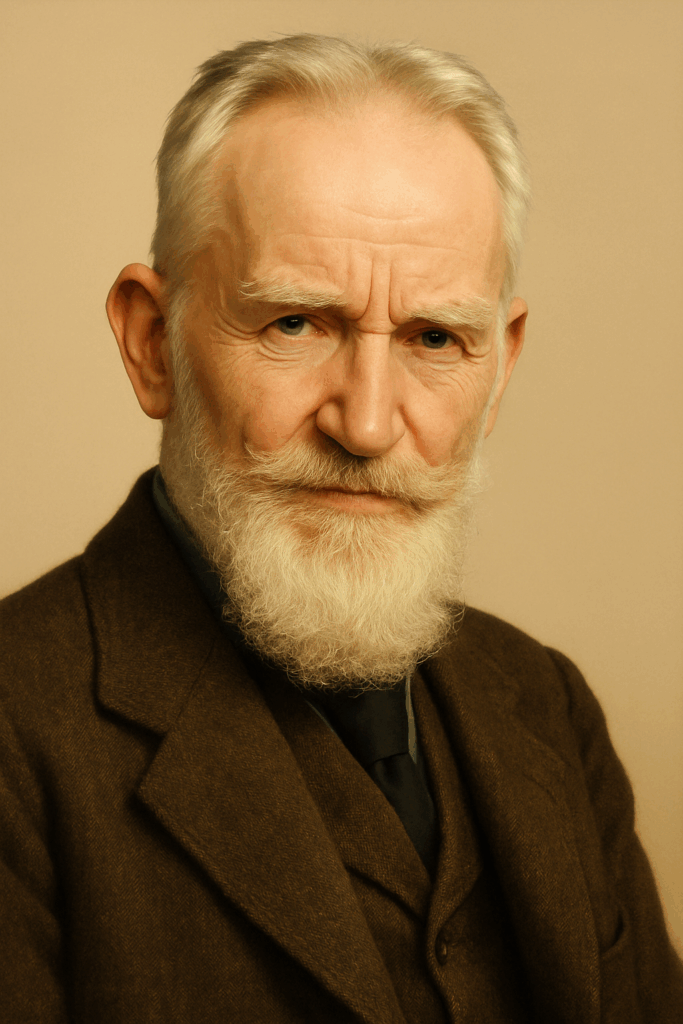
George Bernard Shaw was one of the greatest dramatists and thinkers of modern literature. Born in Dublin, Ireland, he became famous not only as a playwright but also as a critic, political thinker, and social reformer. Shaw was known for his sharp wit, bold opinions, and plays that discussed serious social and political issues. For many years he held a unique distinction in cultural history—he won both the Nobel Prize in Literature and an Academy Award for Best Adapted Screenplay.
Dublin Origins and Early Struggles (1856–1876)
Birth: Shaw was born on 26 July 1856 in Dublin.
Family Background: His father, George Carr Shaw, was an unsuccessful grain merchant who struggled with alcoholism. His mother, Lucinda Elizabeth Shaw, was a talented singer who later moved to London to pursue her musical career. Growing up in such a troubled family environment made Shaw strongly opposed to alcohol, and he remained a lifelong teetotaler.
Education: Shaw disliked formal education and often described schools as “prisons.” Instead of traditional schooling, he educated himself by reading widely and visiting the National Gallery of Ireland.
Early Work: At the age of 15 he began working as a clerk, but he felt the job limited his intellectual growth.
The London Years and Self-Education (1876–1884)
Move to London: In 1876, Shaw moved to London to live with his mother.
Struggling Writer: For nearly ten years he lived in poverty while trying to become a writer. During this period he depended mostly on his mother’s small income.
Early Novels: Shaw wrote several novels such as Cashel Byron’s Profession and An Unsocial Socialist, but publishers rejected them all.
Self-Education: Much of his time was spent studying in the British Museum Reading Room, where he read books on economics, philosophy, politics, and music. This intense self-education helped him develop into one of the most intellectually informed writers of his generation.
Political Activism and the Fabian Society
Socialist Ideas: In 1882, Shaw attended a lecture by Henry George, which inspired him to study the economic ideas of Karl Marx.
Fabian Society: In 1884, Shaw joined the Fabian Society, which supported gradual social reform rather than violent revolution.
Public Speaking: To overcome his natural shyness, Shaw began speaking at public meetings and street corners. Over time he became a powerful and witty public speaker known for his red beard and brilliant debating skills.
The Critic and the Playwright (1885–1900)
Journalism: Shaw first earned recognition as a critic. Writing under the pen name “Corno di Bassetto,” he became a well-known music critic and later a respected drama critic.
Influence of Ibsen: Shaw greatly admired the Norwegian playwright Henrik Ibsen. In his book The Quintessence of Ibsenism, he argued that theatre should challenge social values rather than simply entertain audiences.
Early Plays: Shaw began writing plays in the 1890s to demonstrate his ideas about drama. Important works include:
- Widowers’ Houses (1892) – a criticism of slum landlords.
- Mrs. Warren’s Profession (1893) – a play about social hypocrisy surrounding prostitution; it was banned for many years.
- Arms and the Man (1894) – a humorous attack on romantic ideas about war.
Peak Fame and “Shavian” Philosophy (1900–1925)
During the early twentieth century, Shaw became internationally famous. His plays were often called “Plays of Ideas,” because they combined dramatic action with intelligent debates about social and moral questions.
Some of his greatest works include:
- Man and Superman (1903), which introduced Shaw’s concept of the Life Force, suggesting that humanity is evolving toward a higher form of human being.
- Major Barbara (1905), which examines the relationship between religion, poverty, and the arms industry.
- Pygmalion (1913), a popular play about language, class, and identity that later inspired the musical My Fair Lady.
- Saint Joan (1923), a powerful historical drama about Joan of Arc, written after her canonization.
These works established Shaw as one of the most important playwrights of the modern era.
Later Years and Controversies
Nobel Prize: Shaw received the Nobel Prize in Literature in 1925 for his outstanding contributions to drama. Although he accepted the honor, he humorously criticized the prize system and used the prize money to support translations of Swedish literature into English.
Political Views: In later life Shaw sometimes made controversial comments expressing admiration for certain authoritarian leaders, including Benito Mussolini and Joseph Stalin, which damaged his reputation among some critics.
Vegetarian Lifestyle: Shaw was also famous for being a committed vegetarian. He often joked that people looked older because they ate meat.
Death and Legacy
Shaw continued writing and speaking well into his nineties. He died on 2 November 1950 at the age of 94 after complications from a fall while pruning a tree at his home, Shaw’s Corner.
Shaw left behind more than 60 plays and numerous essays and political writings. His work transformed modern theatre by showing that plays could be both entertaining and intellectually challenging. The term “Shavian” is now used to describe writing that uses wit, paradox, and humor to question social conventions.
For many decades, Shaw was the only person in history to win both a Nobel Prize and an Academy Award. However, in 2016 the American musician Bob Dylan also received the Nobel Prize in Literature.
While both George Bernard Shaw and Bob Dylan won both a Nobel Prize in Literature and an Academy Award, Shaw’s achievement is often considered more directly connected with traditional literature in both cases. Shaw received the Nobel Prize in Literature in 1925 for his outstanding contributions to drama and literary criticism, and he later won an Academy Award in 1938 for Best Adapted Screenplay for the film version of his play Pygmalion. In this case, Shaw essentially transformed his own literary work into a screenplay.
Bob Dylan, on the other hand, received the Nobel Prize in Literature in 2016 for creating new poetic expressions within the tradition of American songwriting. However, his Academy Award in 2001 was for Best Original Song, “Things Have Changed,” written for the film Wonder Boys. Therefore, although both figures share the rare distinction of winning both awards, Shaw’s achievements are often viewed as more directly rooted in conventional literary forms such as drama and screenwriting.
Themes
The Illusion of Democracy
One of the most important themes in The Apple Cart is Shaw’s questioning of the effectiveness of democracy. George Bernard Shaw suggests that what appears to be a fair and representative political system may actually be a performance. Politicians often present themselves as defenders of the people, but in reality they may care more about maintaining their popularity and securing their next election victory.
Through the constant quarrelling of the Cabinet ministers, Shaw shows how political leaders frequently waste time on arguments, personal rivalries, and public appearances instead of focusing on serious national problems. Their concern with public image and political advantage often replaces genuine leadership.
King Magnus argues that a constitutional monarch can sometimes act more responsibly than elected politicians. Because he does not depend on votes or popularity, he can think about the long-term future of the nation. In contrast, politicians must constantly worry about pleasing voters and the press. Shaw therefore raises the possibility that democracy may sometimes allow incompetent leaders to remain in power simply because they know how to entertain or persuade the public.
Plutocracy and Corporate Power
Another major theme in the play is the growing influence of large corporations over political life. Shaw introduces the powerful company Breakages, Limited, which symbolizes the dangerous side of capitalism.
This corporation profits from inefficiency and waste. It deliberately prevents the use of inventions that would make products stronger or more durable because its profits depend on repairing broken goods. Through this example Shaw illustrates how economic interests can sometimes oppose technological progress and social improvement.
The character Lysistrata reveals that the government itself is largely powerless against such corporations. Because big businesses control newspapers, wealth, and employment, politicians fear confronting them. This situation creates what Shaw calls plutocracy, a system in which the wealthy effectively control political decisions.
Through this theme Shaw suggests that debates between kings and ministers may hide a deeper reality: the real rulers of society may actually be powerful corporations rather than elected officials.
The “Great Individual” vs. the System
Shaw also explores the role of the exceptional individual within society. King Magnus represents the idea that a single intelligent and disciplined person can challenge a flawed political system.
Magnus is not presented as superior because of his royal birth. Instead, his strength lies in his intelligence, self-control, and ability to think clearly while others lose their temper. Throughout the play, the Cabinet ministers behave emotionally and argue among themselves, while Magnus calmly analyzes the situation and outmaneuvers them.
Shaw contrasts Magnus’s quiet authority with the dramatic and theatrical behavior of the politicians. The play suggests that the success of a nation depends less on its political structures and more on the character and intelligence of its leaders.
Magnus’s final strategy—threatening to abdicate and compete in democratic elections—demonstrates this idea perfectly. By using logic and imagination, he turns the Cabinet’s own political system against them.
Reality vs. Romantic Illusion
This theme appears clearly in the contrast between Queen Jemima and Orinthia, the King’s mistress. Magnus explains this difference through the famous metaphor of the “cabbage” and the “rose.”
Queen Jemima represents the cabbage: she may appear plain and unexciting, but she provides stability, nourishment, and practical support. She symbolizes the everyday responsibilities and steady partnership that allow a person to function effectively in life.
Orinthia, on the other hand, represents the rose. She is beautiful, dramatic, and romantic, but she lives in a world of fantasy and emotional illusion. She wants Magnus to abandon his responsibilities and devote himself entirely to passion and admiration.
Through this contrast Shaw suggests that while beauty and romance are attractive, real life requires practicality, discipline, and responsibility. A stable society and a successful relationship depend more on reliability than on romantic dreams.
The Fragility of National Identity
In the final act Shaw expands the play’s focus from domestic politics to international affairs. The American ambassador proposes that the United States should reunite with the British Empire. At first the idea appears flattering and friendly.
However, King Magnus quickly recognizes the hidden danger. Because America is economically stronger and wealthier, such a union could lead to Britain losing its independence and cultural identity. Instead of being an equal partner, England might gradually become dominated by American business and influence.
Through this situation Shaw explores the vulnerability of national identity in a world shaped by international trade and powerful global corporations. Magnus fears that England’s traditions and cultural character could disappear if economic power determines political relationships.
Shaw therefore raises a difficult question for the audience: is it better for a nation to remain independent with its own challenges, or to become part of a larger and wealthier power at the cost of losing its unique identity?
Style
Shavian Wit and the “Play of Ideas”
The style of The Apple Cart reflects the distinctive dramatic method of George Bernard Shaw, often described as “Shavian.” Shaw’s plays are known for combining intellectual debate with sharp humor. Instead of relying on dramatic action, romantic intrigue, or sudden plot twists, Shaw focuses mainly on dialogue and ideas. In this play, most of the action happens through conversation. Characters engage in long discussions, witty arguments, and philosophical debates that drive the entire drama.
Shaw deliberately moved away from the traditional “well-made play,” which usually depends on suspenseful events or hidden secrets. In The Apple Cart, the central conflict develops through verbal exchanges between the King and the Cabinet ministers. Shaw uses the theatre as a place where audiences can think critically about social and political questions. His goal was to transform the stage into what he called a “factory of thought,” where drama encourages reflection on society rather than simple entertainment.
One important technique Shaw uses is the inversion of ideas. He takes a widely accepted belief—such as the idea that democracy is always superior to monarchy—and reverses it. In the play, the King is often the most logical and thoughtful character, while the elected politicians appear confused and self-interested. By presenting the strongest arguments through the monarch, Shaw forces the audience to reconsider their assumptions. Although these debates involve serious political ideas, Shaw balances them with humor, irony, and clever dialogue, which makes the discussion lively and engaging.
The Use of Satire and Paradox
Another key feature of Shaw’s style is political satire. Through satire, he humorously criticizes the weaknesses of modern government and leadership. The Cabinet ministers in the play are not portrayed as cruel villains but as somewhat foolish and ineffective figures. They quarrel with each other, become distracted by personal issues, and often behave like actors performing in a political drama. Their behavior highlights the contrast between their supposed authority and their actual incompetence.
Satire allows Shaw to criticize political institutions without sounding overly serious or moralizing. By making the audience laugh at the ministers’ behavior, Shaw indirectly reveals the weaknesses of the political system. At the same time, the calm and intelligent responses of King Magnus appear even more impressive when compared with the ministers’ emotional reactions.
Shaw’s dialogue also relies heavily on paradox, a statement that appears contradictory but reveals a deeper truth. For example, King Magnus argues that in order to serve the people properly he must remain independent from political pressure. He even suggests that by threatening to abdicate the throne he can actually protect the monarchy. These surprising ideas challenge conventional thinking and encourage the audience to reconsider familiar political beliefs.
The structure of the play itself reflects this paradoxical style. In the middle of a serious political crisis, Shaw inserts a romantic Interlude involving the King and his mistress. This unexpected shift reminds the audience that political leaders are also ordinary human beings with personal relationships and emotions. By combining political debate, satire, paradox, and comedy, Shaw creates a distinctive dramatic style that stimulates both laughter and thoughtful reflection.
Symbolism
The Apple Cart: A Symbol of Political Stability
The most important symbol in the play appears in its title: the “apple cart.” In everyday English, the phrase “to upset the apple cart” means to disturb an established arrangement or ruin a carefully planned system. In the play, the apple cart represents the fragile but stable balance of power between the King, the Cabinet ministers, and the corporate forces that influence the government.
The politicians are afraid of upsetting this arrangement because they benefit from it. They are comfortable within the existing system, enjoying authority, influence, and security. For them, stability is more important than genuine reform. The apple cart therefore symbolizes a political structure that continues to function even though it may be inefficient or corrupt.
King Magnus’s threat to abdicate the throne and enter democratic politics represents the greatest possible danger to this system. By becoming an ordinary citizen and running for Parliament, he threatens to expose the hidden problems of the government, including political incompetence and corporate manipulation. Symbolically, this act would spill the “apples” of the system—revealing the secrets and weaknesses that politicians prefer to keep hidden.
However, by the end of the play the apple cart remains standing. The Prime Minister withdraws the ultimatum, and the political system continues unchanged. This outcome reflects Shaw’s somewhat cynical view that political institutions usually prefer stability and self-preservation rather than dramatic reform.
The Cabbage and the Rose
During the Interlude, Shaw introduces two contrasting symbols: the cabbage and the rose. These symbols represent two opposing ways of thinking about life, relationships, and leadership.
The rose, represented by Orinthia, symbolizes beauty, romance, and illusion. Orinthia believes that her charm and elegance make her worthy of becoming Queen. She lives in a world of emotional drama and imagination, where admiration and passion are more important than responsibility. Like a rose, she is attractive and exciting, but her beauty is temporary and not practically useful.
The cabbage, represented by Queen Jemima, symbolizes practicality, stability, and everyday responsibility. Although a cabbage may appear plain and ordinary, it is nourishing and essential for survival. In the same way, Jemima represents the reliable partnership that supports the King in his duties.
King Magnus’s preference for the cabbage over the rose reflects his understanding of leadership. He recognizes that although romantic beauty may be appealing, a successful life and a stable government depend on practical effort, cooperation, and responsibility. The cabbage therefore symbolizes the unglamorous but necessary work that sustains society.
The Indiarubber Stamp
Another important symbol in the play is the “indiarubber stamp,” often called the rubber stamp. The Cabinet ministers want King Magnus to behave like such a stamp—simply approving laws without questioning them. To them, this represents the ideal role of a constitutional monarch who does not interfere in political decisions.
In this sense, the rubber stamp symbolizes a leader who has no independent thought or authority. It represents a mechanical form of leadership in which decisions are made entirely by politicians while the monarch merely confirms them.
King Magnus challenges this idea by reminding the ministers that he is a human being with intelligence and judgment. He argues that a rubber stamp may work in ordinary situations, but in times of crisis it cannot think or act wisely. Through this symbol Shaw suggests that leadership should involve human understanding and responsibility rather than automatic approval of political decisions.
Breakages, Limited
The fictional corporation Breakages, Limited serves as a powerful symbol of the darker side of modern capitalism. In the play, this company deliberately prevents the development of inventions that would create stronger or more durable products. Its profits depend on repairing broken goods, so it benefits from inefficiency and waste.
As a symbol, Breakages, Limited represents the influence of wealthy corporations over society. It demonstrates how economic power can secretly control political decisions. While politicians argue publicly about authority and government policy, companies like Breakages, Limited quietly influence events behind the scenes.
This symbol also represents the concept of plutocracy, a system in which the wealthy hold the real power. Shaw suggests that as long as economic profit becomes the main goal of society, technological progress and social improvement may be deliberately suppressed.
Historical Context
Post-War Britain and the Crisis of Democracy
The Apple Cart was written and first staged in 1929, a period of major political and social change in Britain. The country was still recovering from the devastation of World War I, which had shaken confidence in traditional political systems. Many intellectuals felt that parliamentary democracy was too slow and inefficient to deal with urgent problems such as unemployment, poverty, and economic instability. During this period, debates about leadership and political authority became increasingly intense.
Across Europe, strong authoritarian leaders were rising to power, such as Benito Mussolini in Italy. Some thinkers began to question whether a decisive individual leader might be more effective than committees of politicians who constantly argued among themselves. The character of King Magnus reflects this debate. Shaw presents him as a thoughtful and capable individual who contrasts sharply with the quarrelling Cabinet ministers.
The political climate of Britain in 1929 also influenced the play. The 1929 United Kingdom general election resulted in a Hung Parliament, meaning that no single political party had a clear majority. This led to the formation of a minority Labour government, making political leadership unstable and uncertain. Shaw reflects this instability in the play by portraying the Prime Minister as a nervous figure whose authority depends on fragile alliances and constant political maneuvering.
The Rise of Corporate Monopolies and Globalization
Another important historical background for the play is the growing power of large corporations during the early twentieth century. By the 1920s, international businesses and industrial monopolies were expanding rapidly. Shaw represents this economic reality through the fictional company Breakages, Limited, which symbolizes corporations that place profit above social progress.
During this period, the global economy was increasingly controlled by large trusts and industrial groups. Wealth and economic power were becoming concentrated in the hands of a few corporations capable of influencing national governments. Shaw, who was an active member of the Fabian Society, was deeply concerned about this development. His play therefore presents a socialist critique of capitalism, suggesting that corporate interests could suppress technological innovation and manipulate political decisions.
The international aspect of the play also reflects changing global power structures. After the First World War, the United States emerged as the world’s strongest financial power, while the British Empire began a gradual decline. In Act II, the American proposal to reunite with the British Empire symbolizes this shift in global influence.
Shaw uses this plot element to explore the fear of “Americanization.” Many Europeans worried that American culture, business practices, and financial influence might overwhelm older national traditions. The play reflects these anxieties by suggesting that economic power could reshape political relationships, turning nations into dependent partners within a larger global system.
Very Short Answer Questions
Who is the protagonist of The Apple Cart?
King Magnus is the central protagonist of the play.
What is the subtitle of the play?
The subtitle is “A Political Extravaganza.”
In what year was the play first published?
It was first published in book form in 1930.
Who is the Prime Minister of England in the play?
The Prime Minister is Joseph (Joe) Proteus.
What does the “Apple Cart” symbolize in the title?
It symbolizes the status quo or the established political arrangement of the government.
What is the “ultimatum” presented to King Magnus?
It is a demand that the King stop making speeches and influencing public opinion.
Who is the “Strong Man” of Labor who joins the Cabinet?
Bill Boanerges is the self-proclaimed strong man and President of the Board of Trade.
What is “Breakages, Limited”?
It is a giant, corrupt monopoly that profits from inefficiency and destruction.
Who is the romantic interest of King Magnus in the Interlude?
Orinthia is the King’s beautiful and dramatic mistress.
What is King Magnus’s final masterstroke to defeat the Cabinet?
He threatens to abdicate his throne and run for a seat in Parliament.
Who is the Powermistress General?
Lysistrata is the serious and capable Powermistress General.
Who is the Postmistress General known for her mimicry?
Amanda is the Postmistress General who uses humor to stay popular.
What metaphor does Orinthia use to describe herself vs. the Queen?
She describes herself as a “rose” and the Queen as a “cabbage.”
What does the “rubber stamp” symbolize?
It symbolizes a monarch with no real power who only signs what the Cabinet dictates.
Which country proposes to “rejoin” the British Empire in Act II?
The United States of America makes the proposal.
Who is the American Ambassador?
Mr. Vanhattan is the excitable American Ambassador.
What is the name of King Magnus’s wife?
Her name is Queen Jemima.
Why does Magnus prefer the “cabbage” to the “rose”?
He values practical, domestic stability over romantic but useless fantasy.
What happens at the end of the wrestling match in the Interlude?
The King’s secretary, Sempronius, enters and sees them rolling on the floor.
Who is the “only Englishman left in politics” according to Magnus?
Magnus jokingly refers to himself as the last true Englishman in politics.
What is the primary setting of Act II?
Act II takes place on the terrace of the royal palace.
Does King Magnus actually abdicate at the end?
No, the Prime Minister tears up the ultimatum, so the King remains on the throne.
What is Shaw’s view of democracy as shown in the play?
Shaw portrays it as a “great game” or an illusion that masks the rule of the wealthy.
Who is Mick O’Rafferty?
He is the President of the Irish Free State mentioned by the American Ambassador.
What does the King compare people to in his “orbit” speech?
He compares people to stars in the sky that must maintain a respectful distance.
What is the “Ritualist” profession of Sempronius’s father?
He was an artist who organized grand public ceremonies and pageants.
What is the name of the King’s son who would succeed him?
The Prince of Wales, whose name is Robert.
How does Amanda defeat the Chairman of Breakages, Limited?
She mimics his voice and gets the crowd to sing a song about a Teddy bear.
What is the main conflict of the play?
The conflict is a power struggle between a clever King and his elected Cabinet.
What is the “Shavian” style?
It is a style of drama focused on intellectual debate, wit, and the clashing of ideas.
Short Answer Questions
Explain the significance of the play’s title, The Apple Cart.
The title of the play The Apple Cart by George Bernard Shaw is taken from the English idiom “to upset the apple cart.” This phrase means to spoil a carefully arranged plan or disturb an existing system. In the play, the “apple cart” symbolizes the comfortable political arrangement between the King and the Cabinet. The ministers want to maintain this arrangement because it allows them to hold power without serious opposition.
When King Magnus threatens to abdicate the throne and run for Parliament, he effectively threatens to overturn this political structure. His plan would expose the weakness and incompetence of the ministers. However, in the end, the crisis is avoided when Prime Minister Proteus withdraws the ultimatum. As a result, the political system remains unchanged, and the “apple cart” is not upset.
Describe the character of Bill Boanerges and his transformation.
Bill Boanerges is introduced as a bold and aggressive politician who claims to represent the working class. He deliberately dresses in a simple laborer’s blouse to show his rejection of aristocratic tradition. At first, he appears confident and determined to challenge the authority of the King.
However, King Magnus skillfully handles him through politeness and strategic flattery. By treating Boanerges with respect and admiration, Magnus gradually wins his goodwill. By the second act, Boanerges has abandoned his rough working-class appearance and adopted a luxurious official uniform. This transformation symbolizes how easily populist leaders can become absorbed into the political establishment they once opposed.
What is “Breakages, Limited,” and what does it represent in the play?
Breakages, Limited is a fictional corporation that symbolizes the power of large monopolies in modern society. According to the play, this company deliberately suppresses inventions that would produce stronger and longer-lasting products. Its profits depend on repairing broken goods, so technological progress threatens its business.
Through this company, Shaw criticizes the influence of corporate wealth on politics. Breakages, Limited represents plutocracy, a system in which economic power controls political decisions. The play suggests that politicians and governments often become powerless when confronted with the influence of powerful corporations.
Analyze the contrast between the “Rose” and the “Cabbage” in the Interlude.
The metaphors of the rose and the cabbage appear during King Magnus’s conversation with his mistress, Orinthia. Orinthia describes herself as the rose, representing beauty, romance, and emotional excitement. She believes that her charm makes her superior to the King’s wife, Queen Jemima.
Magnus responds by defending the cabbage, which symbolizes practicality, stability, and nourishment. Although the cabbage may appear plain and uninteresting, it provides the essential support needed for everyday life. Through this contrast, Shaw suggests that romantic illusion may be attractive but that real life and responsible leadership depend on practical partnership and hard work.
How does King Magnus use “Shavian wit” to outmaneuver the Cabinet?
King Magnus never relies on anger or force during his confrontation with the Cabinet. Instead, he uses calm reasoning, humor, and irony—qualities often described as Shavian wit. When the ministers present their ultimatum, Magnus remains polite and logical while they become emotional and argumentative.
By maintaining his composure, Magnus exposes the weaknesses of the ministers’ arguments. He also uses the technique of inversion, turning their ideas against them. Ultimately, his clever strategy of threatening to abdicate and run for Parliament forces the Cabinet to withdraw their demands.
Explain Lysistrata’s frustration as the Powermistress General.
Lysistrata is one of the most serious and dedicated members of the Cabinet. As Powermistress General, she wants to introduce modern technology that would provide cheap and efficient energy for the country. However, her plans are constantly blocked by powerful corporate interests.
The company Breakages, Limited opposes her reforms because technological progress would reduce its profits. Lysistrata’s frustration illustrates Shaw’s criticism of a political system in which even capable and honest officials are powerless against corporate influence.
Discuss the theme of “Americanization” in Act II.
In Act II, the American ambassador proposes that the United States should reunite with the British Empire. At first this proposal appears flattering, but King Magnus quickly realizes the danger.
Because the United States possesses greater economic power, such a union could lead to Britain losing its independence and cultural identity. Shaw uses this situation to explore fears that smaller nations may be dominated by stronger economic powers in a globalized world.
What is the significance of the “Rubber Stamp” metaphor?
The Cabinet wants King Magnus to behave like an “indiarubber stamp,” meaning a ruler who simply approves laws without questioning them. In this view, the monarch should have no independent influence on political decisions.
Magnus rejects this idea by pointing out that a leader is a “living soul” with intelligence and judgment. Shaw uses this metaphor to criticize political systems that attempt to turn leaders into passive figures. In moments of crisis, a nation needs thoughtful leadership rather than mechanical approval.
Why does Prime Minister Proteus use “theatrics” to lead?
Prime Minister Joe Proteus often relies on dramatic emotional displays to control his Cabinet. He uses exaggerated anger, complaints about his health, and threats of resignation to influence the ministers.
This behavior reflects Shaw’s satirical view of modern politics. According to Shaw, political leadership often resembles theatrical performance. Leaders may succeed not because of wisdom but because they can persuade or manipulate others through dramatic behavior.
Summarize the conclusion of the play and its cynical message.
The play ends without any major political change. King Magnus does not abdicate, and the Cabinet withdraws its ultimatum. The conflict ends in a stalemate, leaving the political system exactly as it was before.
In the final scene, Queen Jemima calmly calls Magnus away to dinner, bringing the dramatic political struggle back to ordinary domestic life. Shaw’s conclusion suggests that political systems are often resistant to change. Even when serious problems are revealed, those in power may prefer stability and routine rather than risking genuine reform.
Long Answer Questions
Discuss The Apple Cart as a “Play of Ideas.” How does Shaw use dialogue to drive the conflict?
The Apple Cart by George Bernard Shaw is one of the best examples of what critics call a “Play of Ideas.” In such plays, the main focus is not action, adventure, or romance but intellectual debate and philosophical discussion. Shaw believed that theatre should make audiences think about social and political issues rather than simply entertain them.
In many traditional plays, the plot moves forward through dramatic actions such as fights, secret plots, or emotional conflicts. However, in The Apple Cart, the most important events happen through conversation and argument. Characters spend much of the play discussing political theories, leadership, democracy, and the influence of corporations. The drama lies in whose argument is stronger, not in who wins a physical struggle.
The main conflict of the play occurs between King Magnus and the Cabinet ministers led by Prime Minister Joe Proteus. The Cabinet wants the King to behave like a ceremonial ruler who simply signs laws passed by Parliament. Magnus strongly disagrees. Instead of responding with anger or force, he answers their demands through logical arguments, wit, and clever reasoning. This creates a battle of ideas between the monarch and the democratic government.
Shaw also uses long speeches and sharp verbal exchanges to present different viewpoints. Each character represents a particular political philosophy. For example, Proteus represents the democratic politician who must please voters and maintain political power. Magnus represents the thoughtful leader who believes in long-term responsibility rather than short-term popularity.
Another important technique Shaw uses is the inversion of ideas. He deliberately reverses common beliefs. Normally, people assume that monarchy represents tyranny while democracy represents freedom. However, Shaw presents the opposite situation. In the play, the King appears rational, honest, and concerned about the nation’s future, while the elected politicians appear petty, emotional, and self-interested.
Through this inversion, Shaw encourages the audience to question their assumptions about politics. He suggests that the effectiveness of leadership does not depend on the political system alone but on the intelligence and character of the leader.
The final example of the play as a “Play of Ideas” appears in Magnus’s brilliant strategy at the end. When he announces that he will abdicate and run for Parliament, he uses the principles of democracy against the politicians themselves. This intellectual move defeats the Cabinet without violence or rebellion. The victory is purely a triumph of reasoning and strategy.
Therefore, The Apple Cart is a true “Play of Ideas” because its drama arises from philosophical debate, political arguments, and intellectual conflict rather than physical action. Shaw transforms the theatre into a space where ideas compete, forcing the audience to reconsider their views on democracy, leadership, and power.
Critically analyze the role and significance of “Breakages, Limited” in the play’s political landscape.
In The Apple Cart, Breakages, Limited is one of the most important symbols in the entire play, even though the company never appears directly on stage. Through this fictional corporation, George Bernard Shaw presents a powerful criticism of modern capitalism and the hidden influence of corporations in politics.
Breakages, Limited is described as a massive industrial monopoly that earns money by repairing broken machines, tools, and equipment. Because its profits depend on things breaking, the company has a strange and disturbing interest: it does not want durable inventions to exist. If new technologies create strong materials such as unbreakable glass or indestructible steel, people would not need repairs, and the company would lose money. Therefore, Breakages, Limited secretly buys up these inventions and suppresses them so that products will continue to break and require repairs.
This idea is revealed mainly through the character of Lysistrata, the Powermistress General. She explains that many brilliant technological discoveries have been deliberately destroyed or hidden by the company. Her frustration shows that even talented and hardworking government officials cannot bring progress to society because corporate interests control the economic system. Her situation represents the tragedy of the technocrat, a capable expert whose ideas are blocked by powerful business interests.
Through Breakages, Limited, Shaw introduces the concept of plutocracy, which means rule by the wealthy. In theory, the country is governed by democratic institutions such as Parliament and the Cabinet. However, Shaw suggests that these institutions are largely powerless because corporations control the economy, the press, and public opinion. If any politician tries to oppose the company, it can destroy that person’s career by influencing newspapers and public perception.
This situation makes the political conflict between King Magnus and the Cabinet appear almost superficial. While they argue about constitutional authority and political power, the real authority lies elsewhere. Shaw implies that the government is like a driver holding a steering wheel while the engine of the car is controlled by someone else. In other words, the political leaders appear powerful, but the economic system is actually controlled by corporations.
Breakages, Limited also symbolizes a larger criticism of modern industrial society. Shaw warns that when profit becomes the most important goal, progress may be deliberately slowed or stopped. Instead of encouraging innovation that benefits society, companies may protect their financial interests by preventing technological improvements.
This symbol is remarkably prophetic because it anticipates later debates about corporate monopolies, lobbying, and corporate influence in politics. Shaw suggests that democracy can become meaningless if economic power dominates political decision-making.
Therefore, Breakages, Limited is not just a fictional company in the play. It represents the hidden power structure of modern society, where corporations influence politics, suppress innovation, and shape public opinion. Through this symbol, Shaw exposes the weaknesses of democratic systems that are unable to resist the influence of economic wealth.
Compare and contrast the characters of King Magnus and Prime Minister Joe Proteus as political leaders.
In The Apple Cart, King Magnus and Joe Proteus represent two completely different models of political leadership. Through these two characters, George Bernard Shaw examines the strengths and weaknesses of monarchy and democratic politics. Although both men are intelligent and politically skilled, their personalities, leadership styles, and political goals are very different.
First, King Magnus represents the ideal of the rational and independent leader. He is calm, thoughtful, and highly self-controlled. Magnus rarely loses his temper or raises his voice. Instead of reacting emotionally, he carefully observes situations and responds with logical arguments and strategic thinking. Because he is a hereditary monarch, he does not depend on elections or public approval to maintain his position. This allows him to think about the long-term interests of the nation, including the welfare of future generations.
Magnus also demonstrates a deep understanding of human psychology. Rather than confronting his opponents aggressively, he often uses politeness, humor, and flattery to influence them. For example, when the aggressive minister Bill Boanerges enters the palace ready to challenge him, Magnus does not argue or threaten him. Instead, he praises Boanerges and treats him with respect. This approach gradually disarms the minister and turns him into an admirer rather than an enemy.
In contrast, Joe Proteus represents the typical democratic politician who must constantly struggle to maintain power. As Prime Minister, his authority depends on public opinion, party support, and the cooperation of his Cabinet ministers. Because his position is insecure, he often behaves in a dramatic and emotional manner. Proteus frequently complains about his health, threatens to resign, or displays exaggerated anger in order to control his colleagues.
Proteus’s leadership style can therefore be described as theatrical. He understands that politics often functions like a performance, where appearances and emotional displays can influence people more effectively than calm reasoning. By staging dramatic outbursts, he forces his ministers to rally behind him and maintain unity within the government.
Another major difference between the two leaders lies in their political priorities. Magnus thinks in terms of the nation’s history and future. He believes that a ruler should protect the traditions of the past while also safeguarding the welfare of generations that have not yet been born. Proteus, on the other hand, is primarily concerned with short-term political survival. His main goal is to win elections, maintain his government, and prevent political instability.
Despite these differences, Magnus and Proteus also share some similarities. Both men are experienced politicians who understand how to manage people and situations. They recognize each other’s intelligence and show a certain degree of mutual respect. Neither of them is naïve about the realities of politics.
However, Magnus ultimately proves to be the more effective strategist. His brilliant decision to threaten abdication and run for Parliament completely overturns the Cabinet’s plan. By using the democratic system against the politicians themselves, he forces them to withdraw their ultimatum. This move demonstrates that Magnus’s true strength lies not in his royal title but in his superior intelligence and strategic thinking.
Through this comparison, Shaw suggests that the quality of leadership depends more on character and intellect than on political institutions. While Proteus represents the noisy and competitive nature of democratic politics, Magnus represents the possibility of wise and thoughtful leadership that rises above political games.
Analyze the “Interlude” between Magnus and Orinthia. What is its purpose in a political play?.
The Interlude in The Apple Cart is a short but very important scene placed between the two political acts of the play. At first glance, it appears unusual because it shifts the focus away from politics and shows a private conversation between King Magnus and his mistress, Orinthia. However, this scene serves several important dramatic and thematic purposes in the play written by George Bernard Shaw.
First, the Interlude explores the contrast between romantic illusion and practical reality. Orinthia represents beauty, passion, and emotional excitement. She believes that Magnus should abandon his political responsibilities and live a life of romance and personal glory with her. In her view, a king should behave like a heroic ruler who dominates the world and lives dramatically.
King Magnus strongly disagrees with this idea. During their conversation, he explains his philosophy using the famous metaphor of the “rose” and the “cabbage.” Orinthia is compared to the rose because she is beautiful and charming. However, Magnus points out that a rose is only decorative; it cannot sustain life. In contrast, the cabbage represents his wife, Queen Jemima, who is practical, dependable, and essential for everyday life. Although a cabbage may seem ordinary, it provides nourishment and stability.
Through this metaphor, Shaw emphasizes an important idea: a stable life and a stable society depend on practical responsibility rather than romantic fantasy. Magnus chooses the cabbage over the rose because he understands that leadership requires discipline, duty, and reliability rather than emotional excitement.
The Interlude also serves to humanize King Magnus. In the political scenes, Magnus appears calm, intelligent, and almost perfect in his reasoning. However, the Interlude reveals a more personal side of his character. His playful arguments with Orinthia and the humorous wrestling scene show that he is still a human being with emotions and weaknesses.
This moment of comedy is important because it prevents the King from appearing too idealized. Shaw reminds the audience that even the most intelligent leader has a private life and moments of foolishness.
Another purpose of the Interlude is to illustrate the psychological pressure of leadership. Magnus carries the heavy responsibility of ruling a nation and dealing with political crises. Orinthia provides him with a temporary escape from these burdens. With her, he can forget about government departments, Cabinet meetings, and national problems for a short time.
In this sense, Orinthia represents a kind of “fairyland” escape from the harsh realities of politics. However, Magnus never allows this escape to dominate his life. When it is time for his tea with Queen Jemima and his political responsibilities, he firmly decides to leave Orinthia.
Finally, the Interlude strengthens one of Shaw’s major themes: the conflict between emotion and reason. Orinthia represents emotional impulse and romantic fantasy, while Magnus represents reason, self-control, and responsibility. Their conversation demonstrates Magnus’s ability to enjoy beauty and romance while still maintaining his commitment to duty.
Therefore, the Interlude is not merely a romantic interruption in a political drama. It deepens the characterization of King Magnus, illustrates Shaw’s philosophical ideas about life and leadership, and reminds the audience that political leaders are also ordinary human beings who must balance personal desires with public responsibilities.
Discuss the significance of Act II’s “American Annexation” plot. What is Shaw’s warning about the future of Britain?
One of the most striking moments in Act II of The Apple Cart occurs when the American ambassador announces that the United States wants to reunite with the British Empire. At first, this proposal appears to be a historic and flattering event. It sounds as if America wishes to return to the British imperial family, suggesting a great expansion of British power and influence. However, King Magnus quickly recognizes that this situation is far more complicated and potentially dangerous.
Magnus understands that the United States has become economically stronger and more powerful than Britain. Therefore, the proposal is not really about America joining the empire as a junior partner. Instead, it represents a situation where Britain could become overshadowed or dominated by American wealth and corporate influence. In other words, what appears to be a reunion may actually be a corporate takeover in disguise.
Through this idea, George Bernard Shaw introduces a theme that was becoming increasingly important in the twentieth century: globalization and economic imperialism. In earlier centuries, nations expanded their power through military conquest. However, Shaw suggests that in the modern world, economic power may be a far more effective tool of domination than armies or wars.
Magnus fears that if such a union takes place, England might lose its cultural identity and political independence. The country could become merely a small part of a much larger economic system controlled by American corporations and financial interests. He humorously imagines England turning into a kind of historical museum or tourist destination where wealthy Americans come to admire ancient castles and traditions.
This fear reflects a real historical concern of the early twentieth century. After World War I, the United States emerged as one of the strongest financial powers in the world, while Britain’s economic dominance began to decline. Many intellectuals worried that American business culture, entertainment, and economic influence might overwhelm older European traditions.
Another important aspect of this plot is the reaction of the Cabinet ministers. While Magnus carefully considers the long-term consequences of the American proposal, the politicians appear distracted by their own immediate concerns. Some are excited by the idea of increased wealth or prestige, while others remain focused on their internal political conflict with the King. Their inability to recognize the seriousness of the situation highlights Shaw’s criticism of democratic politicians who often focus on short-term political advantage rather than long-term national interests.
The American annexation plot therefore serves several purposes in the play. It expands the political conflict beyond domestic politics and introduces a global dimension. It also reinforces Shaw’s argument that true leadership requires foresight and the ability to recognize hidden dangers. Magnus appears as the only character capable of understanding the broader implications of the proposal.
Ultimately, Shaw’s warning is that a nation’s independence can be lost not only through war but also through economic dependency and cultural influence. If a country becomes too dependent on the wealth and power of another nation, it may gradually lose control over its own future. Through the figure of King Magnus, Shaw suggests that wise leadership must remain alert to these subtle but powerful forces shaping the modern world.
Critical Analysis
Introduction
The Apple Cart: A Political Extravaganza (1929) is one of the most intellectually provocative plays written by George Bernard Shaw. Shaw described the play as a “political extravaganza”, meaning that it combines political debate, satire, comedy, and philosophical reflection. Written when Shaw was in his seventies, the play reflects his mature political thinking and his skepticism about the effectiveness of modern democratic institutions.
The drama is set in a future England (which Shaw originally imagined to be the 1960s). The story revolves around a constitutional crisis between the monarch and the elected government. At first glance, the Cabinet ministers appear to represent democratic authority, while the King appears to be an outdated figure. However, as the play develops, Shaw reverses this expectation. The elected politicians prove to be short-sighted, emotional, and self-interested, while the King emerges as the most rational and capable political thinker in the country.
Through satire and debate, Shaw explores questions about leadership, democracy, political power, and the influence of corporate wealth.
Central Idea
The central idea of The Apple Cart is the paradox of modern political leadership. Shaw argues that democratic systems, although theoretically designed to represent the people, can become distorted by popularity contests, media influence, and economic pressure.
Politicians in a democratic system must constantly worry about elections, newspapers, and public approval. As a result, they may avoid difficult decisions that could threaten their popularity. Instead of thinking about the nation’s long-term future, they often focus on short-term political survival.
In contrast, Shaw presents the monarch as someone who is free from these pressures. Because the King does not depend on elections, he can make decisions based on reason and long-term national interest rather than public approval.
Through this contrast, Shaw invites the audience to reconsider the assumption that democracy always produces better leadership. His argument is not that monarchy is perfect, but that true leadership depends more on intelligence and character than on political systems.
Plot Summary
Act I
The play opens in the royal palace, where the Cabinet ministers arrive to confront King Magnus. The government is led by Prime Minister Joe Proteus, an emotional and ambitious politician who feels threatened by the King’s political influence.
The Cabinet is angry because the King has been making speeches and expressing opinions about government policies. According to the ministers, a constitutional monarch should remain silent and simply approve laws passed by Parliament.
They present Magnus with an ultimatum. He must stop interfering in politics, stop influencing the press, and abandon the idea of using the royal veto. In other words, he must become a purely symbolic ruler—a “rubber stamp.”
Magnus does not react with anger. Instead, he calmly challenges the ministers’ arguments. Using humor and intelligence, he exposes their weaknesses and contradictions.
During the discussion, it becomes clear that the government itself is afraid of a powerful corporate monopoly called Breakages, Limited. This company controls major industries and suppresses technological inventions that would threaten its profits. The ministers admit that they cannot challenge such economic power.
Realizing that the Cabinet will not withdraw its ultimatum, Magnus asks for time to consider his decision.
The Interlude
Between the two political acts, Shaw inserts a personal scene involving the King and his mistress, Orinthia.
Orinthia represents beauty, romance, and emotional passion. She criticizes the King for spending his life dealing with dull political responsibilities and mocks his marriage to Queen Jemima, whom she calls a “cabbage.”
Magnus responds by explaining his philosophy of life. He argues that while Orinthia is beautiful like a rose, she cannot support the practical responsibilities of ruling a nation. Queen Jemima, though plain like a cabbage, represents stability, reliability, and partnership.
This scene illustrates the contrast between romantic fantasy and practical reality.
The argument becomes comically intense when Orinthia physically tries to prevent Magnus from leaving to attend his daily tea with the Queen. The King and his mistress end up wrestling on the floor, exposing the childish side of human passion beneath social dignity.
Act II
The final act takes place on the terrace of the palace.
Before the Cabinet arrives, the American Ambassador announces a surprising proposal. The United States wishes to reunite with the British Empire.
While others consider this flattering, Magnus recognizes the danger. Because the United States is economically stronger, such a union would effectively allow American corporations to dominate Britain.
Soon afterward the Cabinet returns to hear the King’s decision about their ultimatum.
Magnus calmly announces that he will abdicate the throne. The ministers are delighted, believing they have successfully removed his influence.
However, Magnus immediately reveals the second part of his plan: once he abdicates, he will become an ordinary citizen and run for election to the House of Commons.
Because he is extremely popular and intelligent, the ministers realize that he would easily win an election and possibly become Prime Minister. This would allow him to dismiss them from power.
Terrified by this possibility, Proteus tears up the ultimatum and withdraws the entire challenge.
The political crisis ends without any real change.
Major Themes
- The Illusion of Democracy
Shaw questions the effectiveness of democratic politics. The Cabinet ministers appear more concerned with popularity and elections than with solving national problems. King Magnus suggests that a thoughtful and independent leader may serve the people better than politicians who constantly seek public approval.
- Plutocracy and Corporate Power
The play emphasizes that real authority lies not with the government but with powerful corporations such as Breakages, Limited. This monopoly profits from waste and inefficiency, deliberately suppressing innovation to maintain its profits. Shaw portrays politicians as powerless against such financial influence.
- The “Great Individual” vs. the System
King Magnus represents Shaw’s belief in the power of exceptional individuals. His intelligence, self-control, and strategic thinking allow him to outmaneuver the entire Cabinet. Shaw suggests that progress often depends on visionary leaders rather than rigid political systems.
- Reality vs. Romantic Illusion
The contrast between Queen Jemima and Orinthia symbolizes the conflict between practical responsibility and romantic fantasy. Jemima represents stability and everyday duty, while Orinthia represents beauty and emotional drama. Magnus chooses the practical “cabbage” over the romantic “rose.”
- The Fragility of National Identity
The American proposal to merge with the British Empire symbolizes the danger of cultural and economic domination by stronger nations. Shaw warns that globalization and corporate power may erase national traditions and independence.
Characters
- King Magnus: A calm and intelligent ruler who defeats his opponents through wit and logic. He represents Shaw’s ideal of the thoughtful and independent leader.
- Joe Proteus: The Prime Minister and Magnus’s main opponent. He relies on political theatrics and emotional manipulation to maintain authority.
- Lysistrata: The Powermistress General and one of the few serious members of the Cabinet. She represents expertise and integrity but is frustrated by corporate influence.
- Amanda: The Postmistress General, who understands the entertainment-driven nature of democratic politics. Her humor and popularity make her politically successful.
- Orinthia: Magnus’s mistress, symbolizing romantic illusion and emotional power rather than practical responsibility.
Structure and Style
The play is a classic example of Shaw’s “Play of Ideas.”
Instead of dramatic events, the plot develops through debates and intellectual arguments. Shaw frequently uses paradox, satire, and irony to challenge common political beliefs.
For example, the play reverses the traditional assumption that monarchy represents tyranny while democracy represents freedom.
Historical Context
When Shaw wrote the play in 1929, Britain faced economic difficulties and political instability. At the same time, new authoritarian leaders were emerging in Europe.
Meanwhile, the United States had become the dominant economic power after World War I. Many Europeans feared that American economic influence might overshadow older national cultures.
Shaw incorporated these anxieties into the play’s political satire.
Critical Commentary
Many critics consider The Apple Cart a prophetic political satire. Shaw anticipated several modern political developments, including media-driven politics and the growing influence of corporate lobbying.
Although some readers accuse Shaw of criticizing democracy too harshly, others believe that his intention was to expose weaknesses in order to encourage political reform.
Conclusion
At the end of the play, the political system remains unchanged. The King stays on the throne, the ministers keep their positions, and the crisis disappears.
The “apple cart” remains standing, but the audience now understands how unstable and fragile it truly is.
Shaw’s message is clear: political systems often survive not because they function perfectly, but because those in power prefer stability to genuine reform.
Famous Quotes
“Punctuality is the politeness of kings.”
This remark is spoken by King Magnus at the beginning of the play when he meets the loud and self-assertive politician Bill Boanerges. The statement emphasizes the King’s belief in discipline, order, and refined manners. While Boanerges attempts to dominate the meeting with a rough and aggressive tone, Magnus calmly asserts his authority through courtesy and composure. By correcting Boanerges politely, the King subtly demonstrates that genuine authority is rooted in self-control rather than loudness or intimidation.
At a deeper level, the quotation reveals one of the central ideas of the play. Magnus uses politeness as a political strategy rather than merely a social habit. His calm and courteous behavior makes the ministers appear rude and uncivilized by comparison, which weakens their authority. Shaw suggests that leadership based on dignity and intelligence can be more powerful than leadership based on aggression or popularity.
“To me you have always been an Enigma.”
King Magnus says this line to Bill Boanerges when the latter enters the palace expecting a confrontation with the monarch. Instead of opposing him directly, Magnus praises Boanerges by describing him as mysterious and intellectually fascinating. This statement immediately changes the tone of the conversation, because Boanerges begins to feel admired rather than challenged. The King therefore transforms a potential enemy into someone who becomes curious and receptive to his ideas.
This moment illustrates Magnus’s deep understanding of human psychology. Rather than using power or authority to dominate others, he uses flattery and diplomacy to influence them. Shaw uses this interaction to show that effective leadership often depends on insight into human nature. Magnus’s strategy proves that subtle persuasion can be more effective than open confrontation in political situations.
“The indiarubber stamp theory will not work… because no king or minister is the very least little bit like a stamp: he is a living soul.”
This statement appears during the debate between King Magnus and the Cabinet about the role of the monarch in a constitutional government. The ministers want Magnus to behave like a rubber stamp who automatically approves laws without questioning them. According to their view, a modern king should simply perform ceremonial duties and leave real political decisions to the elected government. Magnus challenges this idea by arguing that leaders are human beings with intelligence and moral responsibility.
Shaw uses this argument to criticize political systems that attempt to reduce leadership to mechanical procedures. A ruler cannot behave like a lifeless object because he possesses thoughts, emotions, and ethical judgment. Magnus suggests that in moments of crisis, a country needs thoughtful individuals who can make wise decisions. Through this quotation, Shaw emphasizes the importance of human judgment in politics.
“I am a king because I was the nephew of my uncle… if I had been the stupidest man in the country I should still be its king.”
With this ironic remark, Magnus openly admits that monarchy is based on inheritance rather than merit. He explains that his position depends simply on family relationships rather than personal achievement. At first glance, the statement seems to criticize the monarchy as an outdated institution. By presenting himself in such a modest and humorous way, Magnus appears less threatening to the politicians who pride themselves on being self-made leaders.
However, Shaw uses this statement to create a powerful irony within the play. Although Magnus inherited the throne by chance, he turns out to be the most intelligent and capable person in the political system. The elected ministers, who supposedly gained power through merit, appear confused and incompetent by comparison. Shaw therefore challenges the assumption that democratic elections always produce the most capable leaders.
“The King is working the Press against us. The King is making speeches. Things have come to a head.”
This line is spoken by Prime Minister Joe Proteus when he explains the Cabinet’s growing anxiety about the King’s influence. Even though the ministers possess official political authority, they are worried about Magnus’s ability to communicate directly with the public. Through speeches and media influence, the King can shape public opinion and challenge the government’s decisions. Proteus believes that this situation threatens the power of the elected Cabinet.
The quotation highlights Shaw’s awareness of the increasing importance of the press in modern politics. Control over public opinion can sometimes be more powerful than formal political authority. Shaw suggests that political leaders must compete not only for votes but also for influence over the media. The ministers’ fear of the King demonstrates how fragile political authority can become when public opinion shifts.
“God help England if she had no Scots to think for her!”
This humorous remark is made by Prime Minister Joe Proteus, who is himself Scottish. The line reflects the playful rivalry that has historically existed between different regions of the United Kingdom, especially between Scotland and England. By suggesting that England needs Scots to think for it, Proteus humorously praises the intellectual ability of his own people while teasing the English members of the Cabinet.
At the same time, the quote reveals the fragmented nature of the government in the play. The ministers are not united by a shared vision for the country but are divided by personal pride, regional loyalties, and political rivalries. Shaw uses this humor to suggest that political leaders sometimes behave like ordinary quarrelling individuals rather than responsible statesmen who are supposed to guide the nation.
“A demagogue may steal a horse where a king dare not look over a hedge.”
In this statement, King Magnus criticizes the hypocrisy that can exist in democratic politics. A demagogue is a politician who gains support by appealing to emotions and popular prejudices rather than rational arguments. Magnus suggests that such politicians may commit serious wrongs while claiming that they represent the will of the people. Because they speak in the name of democracy, their actions are often tolerated or overlooked.
In contrast, a monarch is constantly watched and criticized by the public. Even a small action by the King may be judged harshly by politicians and newspapers. Shaw uses this contrast to highlight the complicated relationship between power and responsibility. He suggests that democratic leaders may sometimes escape accountability more easily than traditional rulers who are always under scrutiny.
“I stand for the future and the past, for the posterity that has no vote and the tradition that never had any.”
This quotation forms one of King Magnus’s strongest arguments in defense of the monarchy. He explains that politicians often focus only on the needs of the present moment, especially the desires of voters who can influence the next election. Because their careers depend on public approval, democratic leaders may avoid making difficult decisions that might be unpopular with voters.
Magnus argues that a monarch must think beyond immediate political pressures. He represents both the traditions of the past and the interests of future generations who cannot yet vote. Shaw uses this idea to suggest that good leadership requires a long-term perspective. The King’s role is therefore to protect the continuity and stability of the nation across time.
“Every new invention is bought up and suppressed by Breakages, Limited.”
This statement is made by Lysistrata, the Powermistress General, who is deeply frustrated with the influence of a giant corporation called Breakages, Limited. According to her explanation, the company earns money by repairing broken machines and equipment. Because its profits depend on things breaking, it secretly purchases new inventions that would produce stronger or more durable products and prevents them from being used.
Through this example, Shaw criticizes the power of monopolies and corporate interests in modern society. If a company profits from inefficiency, it may deliberately block progress that could benefit the public. The quotation therefore highlights Shaw’s warning that economic power can sometimes dominate political authority and prevent technological innovation.
“That makes me the real queen of England.”
This line is spoken by Amanda, the Postmistress General, while explaining her political success. She admits that she wins elections not by presenting detailed policies or serious arguments but by entertaining the public. She mimics her opponents, makes humorous speeches, and turns political events into performances that attract large crowds.
Shaw uses Amanda’s remark to satirize democratic politics. In a system where popularity determines success, the most entertaining figure may gain the most influence. The statement suggests that political leadership can sometimes resemble theatrical performance rather than responsible governance. Through Amanda’s character, Shaw humorously questions whether voters always choose leaders based on wisdom and competence.
“I have no conscience when you are concerned.”
This line is spoken by King Magnus to Orinthia during their private conversation in the Interlude. In the political scenes, Magnus appears calm, rational, and morally responsible as he deals with national affairs and government ministers. However, in his relationship with Orinthia he allows himself to behave differently. The remark suggests that in her presence he temporarily forgets the strict moral standards that guide his public life.
The quotation highlights the contrast between public duty and private emotion. Shaw uses Orinthia as a symbol of escape from responsibility. With her, Magnus can relax and step outside the serious world of politics and governance. This moment reminds the audience that even the most disciplined leader is still a human being who occasionally seeks relief from the heavy burdens of power.
“Heaven is offering you a rose; and you cling to a cabbage.”
Orinthia says this to Magnus when she complains about his loyalty to his wife, Queen Jemima. She compares herself to a beautiful rose and describes the Queen as a dull cabbage. In her opinion, Magnus is foolish to remain attached to a practical and ordinary partner when he could choose someone as charming and romantic as herself.
The metaphor reveals Shaw’s contrast between romantic illusion and practical reality. While a rose is beautiful and attractive, it cannot sustain life. A cabbage, though plain and unexciting, provides nourishment and stability. Magnus ultimately chooses the cabbage because he understands that a successful life and a stable kingdom depend on reliability and responsibility rather than on fleeting romantic excitement.
“I should like to kick you sometimes… but I should be afraid of hurting you.”
King Magnus speaks this line to Orinthia when she becomes excessively dramatic and argumentative. The statement is partly humorous but also reveals the King’s honesty about his feelings. He admits that her behavior sometimes irritates him, yet he immediately adds that he would never act on such impulses because he would not want to hurt her.
This moment emphasizes Magnus’s self-control and civilized nature. Even in private situations where he feels frustrated, he chooses restraint instead of aggression. Shaw presents Magnus as a leader who believes that reason and gentleness are superior to violence. The quotation therefore reinforces the image of the King as a thoughtful and disciplined individual.
“Every star has its own orbit… there is not only attraction but an infinite distance.”
In this poetic metaphor, Magnus explains his philosophy of relationships to Orinthia. He compares human beings to stars in the universe, each moving in its own orbit. Although stars are attracted to one another, they also maintain a certain distance that prevents them from colliding and destroying each other.
The idea reflects Shaw’s belief in individual independence and mutual respect. Magnus suggests that healthy relationships require boundaries and self-restraint. If two people attempt to dominate or possess each other completely, their individuality may be destroyed. The metaphor therefore illustrates Magnus’s balanced approach to both personal relationships and political leadership.
“A real man would just delight in beating him to a jelly.”
Orinthia makes this remark when she criticizes Magnus for refusing to confront his political rival, Prime Minister Proteus, with violence. She believes that a strong leader should defeat his enemies through physical power and aggressive action. In her view, heroic masculinity is associated with domination and force.
Magnus rejects this idea completely. He believes that intelligence, patience, and strategy are far more effective than brute strength. Shaw uses this contrast to show the difference between primitive notions of power and modern intellectual leadership. The scene highlights Magnus’s belief that true strength lies in reason rather than violence.
“The frontier no longer exists… The Atlantic Ocean has been submerged in the British Empire.”
This dramatic statement is made by the American ambassador when he announces the proposal that the United States might rejoin the British Empire. His words suggest that political and economic alliances have become so powerful that traditional geographical boundaries no longer matter. The Atlantic Ocean, once a symbol of separation between Britain and America, is described as if it has disappeared within a single political system.
Shaw uses this exaggerated language to comment on the growing influence of globalization and economic cooperation between nations. The speech reveals how modern political power may depend less on territory and more on financial and cultural influence. At the same time, it foreshadows Magnus’s fear that such alliances could lead to the loss of national independence and identity.
“The rascal! Jemima: we shall have to live in Dublin. That is the end of England.”
King Magnus says this humorously after hearing the proposal that America might reunite with the British Empire. Although his tone is playful, the remark reflects a deeper concern about the consequences of such a union. Magnus understands that the United States possesses greater economic power, and he fears that Britain might lose its influence within the new political arrangement.
The reference to Dublin adds an ironic touch, suggesting that England itself could become politically insignificant if American power dominates the empire. Shaw uses humor here to express a serious warning about cultural and national identity. The quotation suggests that a nation may lose its independence gradually through economic influence rather than through military conquest.
“Moscow is built on English history, written in London by Karl Marx.”
This observation by Boanerges refers to the revolutionary ideas of Karl Marx, whose political theories influenced socialist and communist movements around the world. By pointing out that Marx wrote many of his works in London, Boanerges suggests that ideas developed in one country can shape political events in another.
Shaw uses this remark to emphasize the power of ideas in shaping history. Political revolutions and social changes are often driven by intellectual theories rather than by armies or governments alone. The quotation reminds the audience that books, philosophies, and economic theories can influence entire nations and alter the course of world history.
“You can’t upset the apple cart like this.”
This line refers directly to the title of the play, The Apple Cart. The expression “to upset the apple cart” means to ruin an established arrangement or disturb a comfortable situation. In the play, the ministers use this phrase when King Magnus threatens to abdicate the throne and run for Parliament, which would completely disrupt their political plans.
The “apple cart” therefore symbolizes the existing political system that benefits the Cabinet ministers. They fear Magnus’s plan because it could expose their weaknesses and threaten their positions. Shaw uses this metaphor to illustrate how political leaders often resist change, preferring to preserve familiar systems even when those systems are flawed or ineffective.
“The kingdom and the power and the glory will pass from us and leave us naked, face to face with our real selves at last.”
This reflective statement appears near the end of the play when Magnus contemplates the future of Britain and the possible decline of its imperial power. The words suggest that political prestige, national glory, and imperial authority are temporary. Eventually, every nation must confront its true identity once these external symbols of power disappear.
Shaw ends the play with this philosophical observation to encourage the audience to think about the deeper meaning of national identity. When the illusions of greatness fade, societies must examine their values and character honestly. The quotation suggests that self-understanding and moral strength are more important than political power or imperial ambition.
Free Full PDF Download Now
Related Posts

Arms and the Man by George Bernard Shaw Summary and Analysis

King Lear by William Shakespeare Summary and Analysis

The Merchant of Venice by William Shakespeare

The Tempest by William Shakespeare Summary and Analysis

The Little Clay Cart by Shudraka | Mṛcchakaṭika | The Clay Toy Cart