Batter my heart
(John Donne)
Batter my heart, three-person’d God, for you
As yet but knock, breathe, shine, and seek to mend;
That I may rise and stand, o’erthrow me, and bend
Your force to break, blow, burn, and make me new.
I, like an usurp’d town to another due,
Labor to admit you, but oh, to no end;
Reason, your viceroy in me, me should defend,
But is captiv’d, and proves weak or untrue.
Yet dearly I love you, and would be lov’d fain,
But am betroth’d unto your enemy;
Divorce me, untie or break that knot again,
Take me to you, imprison me, for I,
Except you enthrall me, never shall be free,
Nor ever chaste, except you ravish me.
Summary
“Batter my heart, three-person’d God” was not published during John Donne’s lifetime, as his poetry was primarily circulated in private handwritten manuscripts among friends rather than printed for the public.
It first appeared in print posthumously in 1633, two years after the poet’s death, in the collection titled Poems, by J.D. with Elegies on the Authors Death. In this first edition, the poem was designated as Sonnet X because the volume contained only twelve of the Holy Sonnets.
The designation Sonnet XIV, by which it is universally known today, was established much later by the scholar Herbert Grierson in his authoritative 1912 edition; Grierson based this order on the Westmoreland Manuscript (c. 1620) to create the complete sequence of nineteen sonnets.
Although published in the 1630s, scholars estimate Donne actually composed the poem decades earlier, likely around 1609 or 1610, during a period of intense personal and spiritual crisis prior to his ordination as an Anglican priest.
The poem begins with a startling request: the speaker asks God to attack him violently. He feels that God has been too gentle so far, merely knocking on the door of his heart or trying to shine a light on him. The speaker compares himself to a damaged piece of metal or a broken vessel that cannot simply be repaired; instead, it must be completely destroyed and remade. He begs God to “batter” him and to use force to break, blow, and burn him so that he can be created anew.
Next, the speaker shifts his description and compares himself to a town that has been captured by an enemy. He desperately wants to let God in, but he feels unable to do so because the enemy forces are too strong. He mentions that his “Reason”—which acts like the town’s governor or leader—should be helping him defend the town for God. However, his reason has been taken prisoner by the enemy and is now too weak or unfaithful to fight back, leaving the speaker helpless.
In the final section, the speaker describes his spiritual struggle as a complicated marriage. He admits that he loves God, but he is currently “betrothed” (engaged) to God’s enemy, Satan. He pleads with God to step in and forcefully break this engagement, asking for a spiritual “divorce” from his sins. He feels he is tied into a knot that only God can untie.
The poem ends with two famous contradictions. The speaker tells God that he will never be truly free unless God imprisons him, and he will never be truly pure (chaste) unless God overwhelms and “ravishes” him. Ultimately, the speaker believes he is too weak to save himself, so he invites God to overpower him completely to ensure his salvation.
Batter my heart Analysis
Batter my heart, three-person’d God, for you
As yet but knock, breathe, shine, and seek to mend;
That I may rise and stand, o’erthrow me, and bend
Your force to break, blow, burn, and make me new.
Reference to Context:
Poem: “Batter my heart, three-person’d God” (Holy Sonnet XIV) Poet: John Donne (1572–1631) Period: 17th Century (Metaphysical Poetry)
Context: This poem is one of John Donne’s “Holy Sonnets,” a series of poems written during a time of intense personal and spiritual anguish. Donne, a convert from Catholicism to Anglicanism who eventually became a Dean of St Paul’s Cathedral, frequently struggled with his faith and his past sins. In this sonnet, the speaker feels completely overwhelmed by sin and unable to reach God through his own free will. He uses the conceit (extended metaphor) of a blacksmith or a besieging army to argue that gentle grace is not enough; he needs God to violently destroy his old self to save him.
Explanation:
Line 1: “Batter my heart, three-person’d God, for you”
The Request for Violence: The poem begins with a shocking and violent demand. The word “Batter” means to hit something repeatedly with heavy blows, like using a battering ram to break down a castle gate. The speaker is not asking God to be gentle or kind; he is asking God to attack him. He feels that his heart is closed off and hard, so he wants God to smash through his defenses to get inside.
The Three-Person’d God: The speaker addresses the “three-person’d God,” which refers to the Christian Trinity: the Father, the Son (Jesus), and the Holy Spirit. He uses this specific title because he feels his problem is so big that he needs the full, combined power of God to save him. He isn’t just praying to one aspect of God; he is calling upon the Creator, the Savior, and the Spirit all at once to do this heavy work.
The Desperation: This line sets a tone of total desperation. Usually, people pray for peace or comfort, but this speaker prays for pain and force. The phrase “for you” (which continues into the next line) suggests that the speaker knows he belongs to God, but he feels separated from Him. He realizes that unless God takes drastic action to “batter” him, he will remain lost in his sins forever.
Line 2: “As yet but knock, breathe, shine, and seek to mend;”
The Complaint: Here, the speaker explains why he is frustrated. He feels that up until now (“As yet”), God has been too polite and gentle. God has only been “knocking” on the door, “breathing” soft air, and “shining” a light. The speaker argues that these gentle methods are not working because he is too stubborn and sinful to respond to mere politeness.
The Three Gentle Actions: The three verbs correspond to the three persons of God mentioned in the first line. The Father “knocks” (seeking entry), the Holy Spirit “breathes” (inspiration), and the Son “shines” (showing truth). While these are good things, the speaker feels they are too weak. A polite knock is easy to ignore, and a soft breath is barely felt. He is saying, “You are treating me like a friend, but I need you to treat me like a conquest.”
The Failed Repair: The phrase “seek to mend” uses the metaphor of a repairman or a tinkerer. If you have a broken pot, you might try to patch it up or glue it back together (“mend” it). The speaker is telling God, “Stop trying to just fix me or patch me up.” He believes he is too broken for a simple repair. He implies that “mending” is a half-measure that won’t solve the deep corruption in his soul.
Line 3: “That I may rise and stand, o’erthrow me, and bend”
The Paradox of Rising: This line contains a famous contradiction (paradox). The speaker says that the only way he can “rise” and “stand” upright is if God knocks him down (“o’erthrow me”). In his view, his current “standing” is actually false pride or sin. He needs to be completely defeated by God before he can be truly saved and stand up as a righteous person.
The Wrestling Match: The word “o’erthrow” comes from wrestling or warfare. It means to tackle someone to the ground. The speaker views himself as an enemy combatant or a stubborn wrestler who is fighting against God. He knows he cannot stop fighting on his own, so he is begging God to win the match, pin him to the ground, and defeat his ego.
The Transition to Metalwork: The line ends with the word “bend,” which shifts the image from wrestling to blacksmithing (working with metal). When a metalworker wants to shape a piece of iron, he has to apply force to “bend” it. The speaker admits that his heart is stiff and crooked. He needs God to apply forceful pressure to bend him back into the correct shape, because he cannot straighten himself out.
Line 4: “Your force to break, blow, burn, and make me new.”
The Escalation of Force: In this line, the gentle verbs from line 2 are replaced by violent ones. Instead of “knocking,” the speaker wants God to break him. Instead of “breathing,” he wants God to blow (like using bellows to stoke a huge fire). Instead of “shining,” he wants God to burn him. He is asking for the intensity to be turned up to the maximum level.
The Blacksmith Metaphor: These actions describe the work of a blacksmith. To repurpose an old, useless piece of metal, a blacksmith must smash it (“break”), pump air into the fire to make it white-hot (“blow”), and melt the metal down in the flames (“burn”). The speaker is comparing himself to scrap metal that needs to be completely melted down in God’s furnace.
The Ultimate Goal: The final phrase, “make me new,” explains the purpose of all this violence. The speaker doesn’t want pain for the sake of pain; he wants regeneration. He realizes that his old self is beyond repair (it cannot be “mended”). Therefore, the only solution is to be destroyed and re-created from scratch. He wants to be melted down so God can forge him into a completely new, pure vessel.
Poetic devices:
Metaphor
The Blacksmith/Metalworker: The central metaphor compares God to a blacksmith and the speaker to a damaged metal object. The speaker argues that gentle tinkering (“seek to mend”) is not enough; he needs God to treat him like raw iron in a forge—to “break, blow, and burn” him—so he can be melted down and remade.
Apostrophe
“Batter my heart, three-person’d God”: An apostrophe is when a speaker addresses an entity that cannot respond literally in the moment. Here, the speaker addresses God directly. This establishes the poem as an intense, personal prayer.
Alliteration
Donne uses heavy alliteration, specifically plosive sounds, to mimic the violence he is describing.
“b” sounds: bend, break, blow, burn.
Effect: These hard “b” sounds create a percussive rhythm. The poem literally sounds like a hammer striking an anvil.
Paradox
“That I may rise and stand, o’erthrow me”: A paradox is a contradictory statement that reveals a deeper truth.
Meaning: Logically, if you are overthrown, you fall down. Spiritually, however, the speaker believes his sinful pride must be knocked down by God before he can truly “stand” upright as a righteous person.
Tricolon (The Rule of Three)
Donne groups his verbs into sets of three to correspond with the “three-person’d God” (The Trinity):
Set 1 (Gentle): Knock, breathe, shine.
Set 2 (Violent): Break, blow, burn.
Correspondence:
Father (Power): Knock Break
Holy Spirit (Breath/Wind): Breathe Blow
Son (Light): Shine Burn
I, like an usurp’d town to another due,
Labor to admit you, but oh, to no end;
Reason, your viceroy in me, me should defend,
But is captiv’d, and proves weak or untrue.
Reference to Context:
Poem: “Batter my heart, three-person’d God” (Holy Sonnet XIV) Poet: John Donne
Context: In the first quatrain (lines 1–4), the speaker used the metaphor of a blacksmith/metalworker, asking God to break and reshape him. Now, in the second quatrain (lines 5–8), the metaphor shifts from craftsmanship to warfare. The speaker imagines his soul as a besieged city. This section explores the failure of human intellect (“Reason”) to lead the soul to God. It reflects the theological belief that after the Fall of Man, human reason is flawed and cannot achieve salvation on its own without divine grace.
Explanation:
Line 5: “I, like an usurp’d town to another due,”
The Besieged City: In this line, the speaker shifts his description from a broken pot to a captured city. He says, “I am like a town that has been usurped.” To “usurp” means to take power by force illegally. The speaker imagines his soul as a fortress that has been invaded and occupied by an enemy army. In the context of the poem, this “enemy” is Satan or the force of Sin.
Rightful Ownership: The phrase “to another due” is very important. It means that even though the enemy is currently sitting on the throne, the town actually belongs to someone else. It is “due” (owed) to God. The speaker is acknowledging that God is his true King and lawful owner, but he is currently under the control of a tyrant (the Devil).
The Conflict of Loyalty: This creates a picture of a tragic political situation. The citizens of the town (the speaker’s desires and soul) want to serve their true King, but they are being held hostage. The speaker is not a willing rebel; he is a victim of occupation. He establishes that he wants to be with God, but he has lost control over his own territory.
Line 6: “Labor to admit you, but oh, to no end;”
The Struggle from Within: The word “Labor” means hard, physical work. The speaker is trying to say that he is not just sitting around waiting; he is fighting to open the city gates from the inside to let God (the liberating army) in. He is struggling against the enemy forces that are holding the gates shut. It portrays the spiritual life as a grueling physical effort.
The Failure of Effort: The phrase “but oh, to no end” signifies total failure. Despite his sweat and struggle (“labor”), he cannot get the gates open. The enemy occupying his soul is too strong for him to defeat alone. This reflects the theological idea that a sinner cannot save himself through good works alone; he needs divine intervention because his own strength is insufficient.
The Cry of Despair: The small word “oh” adds a deep emotional layer to the line. It sounds like a sigh of exhaustion or desperation. After trying his hardest to be good and to let God into his life, he realizes it is useless (“to no end”). This moment of realization is why he returns to the demand in the first line for God to “batter” the doors down, since he cannot open them from the inside.
Line 7: “Reason, your viceroy in me, me should defend,”
Personifying Reason: Donne treats his human intellect (“Reason”) as if it were a person. He calls Reason God’s “viceroy.” A viceroy is a governor or deputy who rules a province on behalf of a distant King. God (the King) gave humans the gift of Reason to rule over their bodies and emotions, helping them make good choices and stay loyal to God.
The Duty of Defense: The speaker says that Reason “me should defend.” It is the governor’s job to organize the defense of the town against enemies. In a spiritual sense, our logic and understanding should help us reject sin and defend our faith. The speaker expects his mind to help him fight off the devil and open the gates to God.
The Expectation vs. Reality: This line sets up an expectation of how things should work. A good governor protects the city. However, the tone suggests that something has gone wrong. By identifying Reason as the leader responsible for his defense, the speaker is pinpointing exactly where his internal failure is happening—his mind is not doing its job.
Line 8: “But is captiv’d, and proves weak or untrue.”
The Captive Leader: The speaker reveals why he cannot open the gates: his leader, Reason, has been “captiv’d” (captured). The enemy (Sin) has taken control of his mind. When people are deep in sin or addiction, they often cannot think clearly or logically. Their “Reason” is tied up and imprisoned, unable to guide them correctly.
Weakness vs. Betrayal: Donne offers two possibilities for why Reason failed. First, it might be “weak”—meaning it wants to do the right thing but is simply overpowered by strong emotions or temptations. Second, it might be “untrue”—meaning it has become a traitor. This suggests that his intellect might be rationalizing his sins, actually helping the enemy instead of fighting for God.
Total Helplessness: This line concludes the section by confirming the speaker’s hopelessness. If the “governor” of the town is tied up or has switched sides, there is no one left to organize the resistance. This explains why the speaker feels so helpless and why he needs God to invade him from the outside. He cannot think his way out of this problem because his “thinker” (Reason) is broken.
Poetic devices:
Simile
“I, like an usurp’d town to another due”
Explanation: The speaker explicitly compares himself using the word “like” to a town that has been captured (“usurped”) by enemy forces. This sets up the imagery of warfare and siege that dominates these lines.
Extended Metaphor (Conceit)
The Besieged City: This section uses a “conceit”—an elaborate, extended metaphor typical of Metaphysical poetry.
The Soul: The town.
God: The rightful King outside the walls.
Satan/Sin: The “usurper” (enemy) occupying the town.
Reason: The town governor trying to manage the city.
Personification
“Reason, your viceroy in me”
Explanation: Donne gives human qualities to the abstract concept of Reason (intellect). He portrays Reason as a “viceroy”—a governor appointed by the King (God) to rule the town.
The Narrative: Reason is not just a mental faculty here; he is a character who has been “captiv’d” (imprisoned) or turned traitor (“untrue”), explaining why the speaker cannot make logical decisions to follow God.
Caesura
“Labor to admit you, || but oh, || to no end;”
Explanation: A caesura is a strong pause within a line of verse.
Effect: The pauses around “but oh” isolate the sigh of despair. It emphasizes the sheer exhaustion of the speaker—he is trying hard (“labor”), but the pause forces the reader to feel the failure that follows.
Inversion (Hyperbaton)
“me should defend” (Instead of “should defend me”)
Explanation: Donne changes the normal word order.
Effect: By placing “me” before the verb, he emphasizes the subject (himself) who is in desperate need of protection. It highlights his vulnerability.
Yet dearly I love you, and would be lov’d fain,
But am betroth’d unto your enemy;
Divorce me, untie or break that knot again,
Take me to you, imprison me, for I,
Except you enthrall me, never shall be free,
Nor ever chaste, except you ravish me.
Reference to Context:
Poem: “Batter my heart, three-person’d God” (Holy Sonnet XIV) Poet: John Donne
Context: This is the final section (the sestet) of the sonnet. In the first eight lines, the speaker used metaphors of a metalworker and a besieged city to describe his spiritual struggle. Now, at line 9, there is a “volta” (a shift in tone and imagery). The metaphor changes to one of marriage and romantic love. The speaker admits he is tied to Satan and presents the poem’s most shocking paradoxes: that he can only be free if God imprisons him, and only pure if God “ravishes” him.
Explanation:
Line 9: “Yet dearly I love you, and would be lov’d fain,”
The Volta (The Turning Point): This line marks the “volta” or the turning point of the sonnet. In the first eight lines, the speaker used harsh military images (war, sieges, battering rams). Now, he suddenly shifts to the language of love and relationships. He stops shouting about fighting and starts confessing his feelings. It changes the mood from a battlefield to a personal, emotional plea.
The Confession of Love: The speaker admits, “Yet dearly I love you.” Despite being a sinner and feeling trapped by the devil, his true desire is for God. He wants God to know that his rebellion isn’t because he hates Him, but because he is weak. Deep down, his heart belongs to God, and he holds that love “dearly” (closely and with high value).
The Meaning of “Fain”: The phrase “would be lov’d fain” uses the old word “fain,” which means “gladly” or “eagerly.” The speaker is saying, “I want to be loved by you very much.” He is desperate for God to return his love. It shows a vulnerability; he is like a lover who is unsure if his affection is returned because he has been unfaithful. He is begging for a reciprocal relationship.
Line 10: “But am betroth’d unto your enemy;”
The Marriage Metaphor: Here, the speaker explains why he cannot simply run to God. He is “betroth’d” (engaged to be married) to someone else. In the 17th century, a betrothal was a binding legal contract, almost as strong as a marriage. He feels that his sins have created a legal bond between him and the Devil. He isn’t just flirting with sin; he is committed to it.
The Enemy: The “enemy” refers to Satan or Sin. The speaker is describing a spiritual love triangle. He loves God, but he is legally bound to the Devil. This metaphor explains his helplessness: just as a person in a binding contract cannot simply walk away, the speaker feels he cannot break his connection to sin on his own. He is trapped in a bad relationship.
The Sense of Trapped Loyalty: This line adds a layer of tragedy. The speaker is caught between his heart (which loves God) and his legal status (which belongs to the enemy). He feels like an unfaithful partner who wants to leave a bad marriage but is afraid of the consequences or lacks the power to annul the contract.
Line 11: “Divorce me, untie or break that knot again,”
The Request for Divorce: Because the speaker feels legally bound to the enemy, he asks God to “Divorce me.” He is asking God to step in as a higher authority and dissolve the marriage contract with Satan. He wants a complete legal separation from his sinful past so that he is free to marry God instead.
The Knot Imagery: The “knot” represents the betrothal or the bond of sin. Knots symbolize things that bind or hold things together. The speaker feels tied up. This imagery connects back to the idea of being a prisoner, but here it is a prisoner of a relationship he no longer wants.
Untie vs. Break: The speaker gives God two options: “untie or break.” To “untie” a knot takes patience and gentle fingers. To “break” a knot implies grabbing a sword and slashing through the rope (like the famous Gordian Knot). By offering both, but emphasizing “break,” the speaker reiterates that he doesn’t care how it happens—he just wants to be free. If the sin is too tight to untie, he wants God to snap the rope by force.
Line 12: “Take me to you, imprison me, for I,”
The Plea for Possession: After asking for a divorce from the Enemy, the speaker says, “Take me to you.” He doesn’t want to be single; he wants to belong to God immediately. He fears that if he is left alone, he might drift back to his old ways. He wants God to claim him right now.
The Prison Metaphor: The speaker asks God to “imprison me.” This seems strange—usually, people want freedom. But the speaker knows that his own “freedom” only leads him to trouble. He believes the only way to be safe from the Devil is to be locked up by God. He wants to be put in “protective custody” where the Enemy cannot reach him.
Protective Slavery: This request acknowledges that the speaker cannot trust himself. He is asking God to take away his free will because he keeps misusing it. He is saying, “Lock me up in your love so I can never leave you again.” It is a surrender of autonomy for the sake of safety.
Line 13: “Except you enthrall me, never shall be free,”
The Paradox of Freedom: This line contains the first of the poem’s two great paradoxes: “I will never be free unless you enslave me.” To “enthrall” means to make someone a thrall (a slave). The speaker argues that true freedom is not doing whatever you want; true freedom is being ruled by the right Master.
Slavery to Sin vs. Slavery to God: The logic is that humans are always serving something. If they aren’t serving God, they are serving their own base desires and the Devil (which is a miserable slavery). By becoming God’s slave, the speaker is liberated from the tyranny of sin. He views service to God as the only form of true liberty.
The Absolute Necessity: The word “Except” (meaning “Unless”) shows that there is no other way. The speaker is adamant. He has tried other methods of being free, and they failed. He is convinced that total submission to God’s will is the only path to liberation. He must be bound to God to be free from the world.
Line 14: “Nor ever chaste, except you ravish me.”
The Paradox of Chastity: The final line delivers the most shocking paradox of all. “Chaste” means sexually pure or virginal. “Ravish” means to rape or violently seize. The speaker claims he will never be pure unless God ravishes him. This turns the normal definition of purity upside down.
The Spiritual Climax: The speaker feels that his soul is like a prostitute to sin. He is so deeply corrupted that he cannot just “decide” to be pure. He needs an experience of God that is so overwhelming and forceful—like a ravishment—that it drives out all other impurities. He needs God’s love to be a consuming fire that leaves no room for anything else.
Violent Grace: This ending summarizes the whole poem’s theme: Salvation through Destruction. The speaker wants a love that is fierce, jealous, and overwhelming. He believes that the only way to be restored to spiritual innocence is to be utterly conquered by God. It is a desperate, passionate cry for a relationship that consumes him completely.
Poetic devices:
Volta (The Turn)
“Yet dearly I love you…”
Explanation: A volta is the dramatic shift in tone or argument characteristic of a sonnet. In line 9, the poem shifts from the violent imagery of warfare and sieges to the emotional imagery of marriage and love. The speaker stops analyzing his “Reason” and starts confessing his heart’s desire.
Metaphor (The Unfaithful Wife)
“But am betroth’d unto your enemy”
Explanation: The speaker uses the metaphor of an arranged marriage. He describes himself as a woman who is engaged (“betroth’d”) to Satan (“your enemy”). This highlights the binding nature of sin—it is not just a bad habit, but a legal contract that the speaker cannot break on his own.
“Untie or break that knot”: The “knot” is a metaphor for the marriage bond (the “nuptial knot”).
Paradox
This section contains the poem’s most famous and complex paradoxes (contradictory statements that reveal a truth).
Paradox 1: “Imprison me, for I / … never shall be free”
Meaning: The speaker argues that total submission to God is the only true liberty. If he is “free” to do what he wants, he will only sin (which is a form of slavery). He needs to be God’s prisoner to be safe.
Paradox 2: “Nor ever chaste, except you ravish me”
Meaning: “Chaste” means sexually pure; “ravish” means to violate or rape. The speaker claims he can only be pure if God violently overwhelms him. It suggests that spiritual purity isn’t something humans achieve by abstinence, but something God forces upon them by driving out sin.
Erotic Imagery / Mysticism
“Ravish me”
Explanation: Donne uses highly sexual language to describe a spiritual experience. This is common in mystical tradition (like the Song of Solomon). He equates the intensity of divine love with the physical intensity of sexual union, shocking the reader to emphasize how desperate he is for God’s presence.
Structure, Form, Rhyme scheme, and Meter
1. Form: The Petrarchan Sonnet
The poem is written as a Petrarchan (Italian) Sonnet, which typically consists of two main parts: an Octave (first 8 lines) and a Sestet (last 6 lines).
The Octave (Lines 1–8):
Function: It presents the problem or the conflict.
Content: The speaker describes his helpless state using the metaphors of a damaged object needing repair (Quatrain 1) and a besieged town needing liberation (Quatrain 2).
The Volta (Line 9):
The “turn” or shift in the poem happens at the start of line 9 (“Yet dearly I love you…”). The tone changes from violent desperation to a confession of love.
The Sestet (Lines 9–14):
Function: It provides the resolution or the final plea.
Content: The metaphor shifts to marriage. The speaker asks God to “divorce” him from Satan and “ravish” him to ensure his salvation.
2. Rhyme Scheme
Donne uses a variation of the standard Petrarchan rhyme scheme.
Octave Scheme: A B B A — A B B A
A: you / new / due / untrue
B: mend / bend / end / defend
Note: The enclosed rhymes (ABBA) create a sense of tightness or entrapment, mirroring the speaker’s feeling of being trapped by sin.
Sestet Scheme: C D C D — E E
C: fain / again
D: enemy / I
E: free / me
Note: While the Octave is strictly Petrarchan, the Sestet ends with a couplet (EE) (“free/me”). Ending with a couplet is actually a feature of the Shakespearean sonnet. Donne blends the two traditions, using the couplet to give the poem a decisive, punchy conclusion.
Meter: Iambic Pentameter (with variations)
The basic meter of the poem is Iambic Pentameter (five beats per line, alternating unstressed/stressed: da-DUM da-DUM).
Key Points
Author
John Donne (1572–1631) was the preeminent metaphysical poet of the 17th century. Born into a Catholic family during a time of anti-Catholic persecution in England, he later converted to Anglicanism and became the Dean of St. Paul’s Cathedral. His poetry is famous for its intellectual complexity, use of “conceits” (elaborate metaphors), and the fusion of religious and erotic imagery.
Structure
The poem is a Petrarchan (Italian) Sonnet, consisting of fourteen lines divided into two distinct parts:
The Octave (Lines 1–8): The first eight lines present the problem. Here, the speaker describes his hardened heart and his inability to let God in due to his sin and weak reason.
The Sestet (Lines 9–14): The final six lines present the resolution. The speaker shifts from the problem of his “Reason” to the solution: a passionate, paradoxical marriage to God.
The Volta: The “turn” or shift in argument occurs at line 9 (“Yet dearly I love you…”).
Form (Rhyme Scheme)
The poem follows a variation of the Petrarchan rhyme scheme:
Scheme: ABBA ABBA CDCD EE
Analysis: The ABBA structure in the octave creates a sense of enclosure or entrapment, mirroring the speaker’s trapped spiritual state. The ending couplet (EE) is actually typical of Shakespearean sonnets, giving the poem a final, punchy conclusion.
Meter: Iambic Pentameter (five beats per line). However, Donne deliberately breaks the rhythm with spondees (stressed syllables side-by-side like “blow, burn”) to mimic the violence he is describing.
Speaker
The speaker is a desperate sinner who is acutely aware of his own spiritual failure. He loves God but feels powerless to act on that love because he is “betrothed” to Satan. He is self-aware, acknowledging that his “Reason” (intellect) has failed him. The voice is likely Donne himself, reflecting his own intense spiritual struggles.
Setting
There is no physical setting. The poem takes place entirely within the internal landscape of the speaker’s soul. The imagery transforms this internal space into a blacksmith’s forge, a besieged city, and finally a wedding chamber.
Theme
Divine Violence vs. Grace: The central theme is that sometimes gentle grace is not enough; violent intervention is necessary for salvation.
The Paradox of Faith: Salvation requires destruction; freedom requires imprisonment; chastity requires ravishment.
Human Weakness: The poem emphasizes that human reason and will are too weak to overcome sin without God’s overwhelming force.
Plot
Beginning: The speaker demands that God attack him like a blacksmith attacking metal, rather than just gently knocking.
Middle: He explains why this violence is needed: he is like a captured town. He wants to let God in, but his governor (“Reason”) is held captive by the enemy (Sin).
End: He admits he is engaged to the enemy (Satan). He pleads with God to break that engagement, imprison him, and “ravish” him, arguing that he can only be free and pure if God completely overpowers him.
Tone
The tone is urgent, violent, and desperate. It is not a quiet, meditative prayer; it is a shout. The use of strong verbs (batter, break, blow, burn, ravish) creates an atmosphere of intense emotional turmoil and passion.
Style
The poem is a classic example of Metaphysical Poetry.
Conceits: It uses extended, shocking metaphors (God as a blacksmith, the soul as a usurped town, salvation as sexual ravishment).
Paradox: It relies heavily on contradictions to explain spiritual truths (e.g., “imprison me” to make me “free”).
Intellectual Rigor: It treats faith as a complex logical argument rather than just a simple feeling.
Message
The poem conveys the message that surrender to God must be total. The speaker believes that a half-hearted effort to be good is useless. To be truly saved, one must abandon all claims to self-control and allow God to aggressively reconstruct their heart and will.
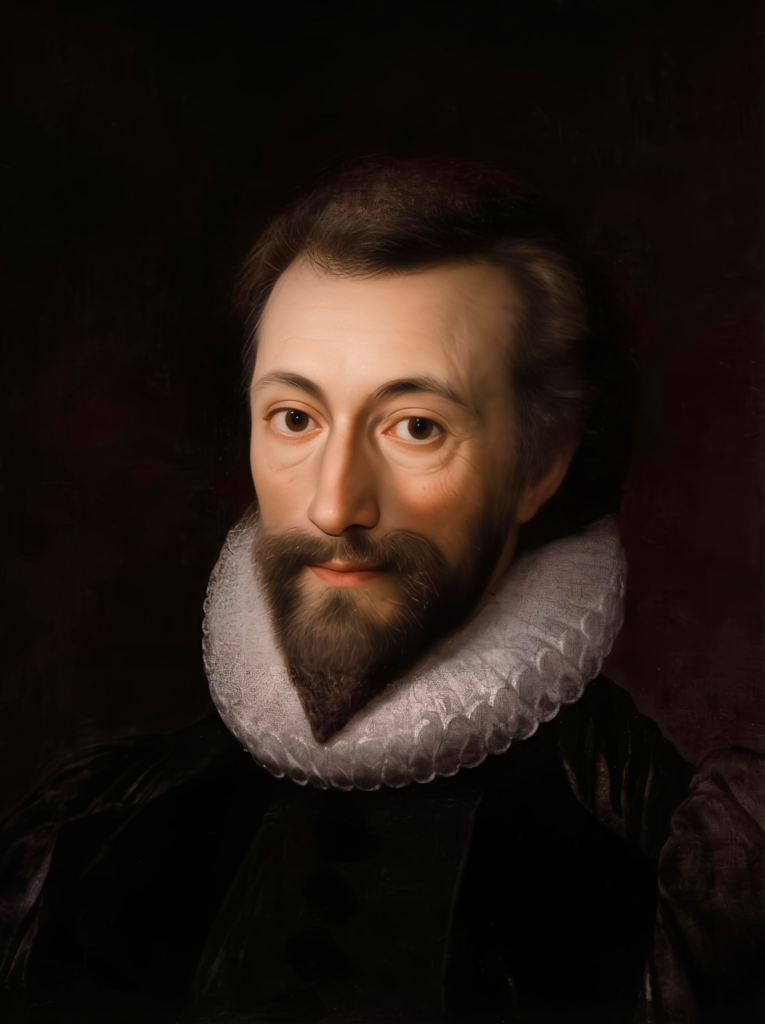
John Donne
Early Life and Education (1572–1590s)
Birth: John Donne was born in London in 1572 into a prominent Roman Catholic family. This was a dangerous time to be Catholic in England, as Queen Elizabeth I had outlawed the practice, and Catholics faced persecution.
Family Tragedy: His father (a wealthy ironmonger) died when Donne was only four. His mother was the great-niece of the martyr Sir Thomas More. The trauma of persecution shaped his early life; his brother Henry died in prison in 1593 for harbouring a Catholic priest.
Education: Donne studied at both Oxford (Hart Hall) and Cambridge, but he could not receive a degree from either because he refused to take the Oath of Supremacy (which acknowledged the Queen as the head of the Church, contradicting his Catholic faith).
Law School: In the 1590s, he studied law at Lincoln’s Inn in London. During this time, he lived a wild life as a “man about town,” spending his inheritance on women, theatre, and travel. This is the period of his erotic poetry (Songs and Sonnets) and Satires.
The Soldier and The Secretary (1596–1601)
Military Service: Seeking adventure, Donne joined the naval expeditions of the Earl of Essex and Sir Walter Raleigh against Spain in Cadiz (1596) and the Azores (1597).
Political Rise: Upon returning, he became the private secretary to Sir Thomas Egerton, the Lord Keeper of the Great Seal. This was a highly prestigious position that set him on the path to a powerful career at court. He was viewed as a brilliant young diplomat.
The Secret Marriage and Ruin (1601)
The Scandal: In 1601, Donne secretly married Anne More, the 17-year-old niece of his boss, Sir Thomas Egerton, and the daughter of the wealthy Sir George More. They married without her father’s permission.
The Consequences: When Sir George More found out, he was furious. He had Donne fired and imprisoned in Fleet Prison for a short time.
“John Donne, Anne Donne, Undone”: This famous pun, attributed to Donne, summarized their situation. His promising political career was instantly destroyed.
The Years of Poverty and Struggle (1601–1615)
Isolation: For the next decade, Donne and Anne lived in rural poverty (in Mitcham, Surrey). They had 12 children, 7 of whom survived infancy. The financial strain was immense, and Donne suffered from depression and illness (likely typhus).
Spiritual Crisis: During this time, Donne worked as a lawyer and pamphleteer. He struggled with his faith, slowly transitioning from Catholicism to Anglicanism. He wrote anti-Catholic polemics to please King James I, such as Pseudo-Martyr (1610).
The King’s Ultimatum: King James I recognized Donne’s genius but refused to give him a secular (political) job. The King told him: “Mr. Donne, I know you to be a learned man… I will not employ you in the state, but I will employ you in the Church.”
“Dr. Donne”: The Priest and Dean (1615–1631)
Ordination: In 1615, at the age of 43, Donne finally gave in to the King’s pressure and was ordained as a priest in the Church of England.
Tragedy Strikes: Just two years later, in 1617, his beloved wife Anne died while giving birth to their 12th child. Donne was devastated and vowed never to marry again. This heartbreak deepened his religious devotion and profoundly influenced his Holy Sonnets (including “Batter my heart”).
Dean of St. Paul’s: In 1621, he was appointed Dean of St. Paul’s Cathedral in London, the most prestigious clerical position in England.
The Great Preacher: He became the most famous preacher of his age. Huge crowds gathered to hear his sermons, which were known for their dramatic power, intellectual wit, and obsession with death.
Death and Legacy (1631)
The Final Sermon: In early 1631, Donne fell arguably ill (stomach cancer). He delivered his own funeral sermon, titled “Death’s Duel,” just a few weeks before he died.
The Shroud: Before dying, he famously posed for a portrait wrapped in his burial shroud, which he kept by his bedside as a reminder of mortality.
Death: He died on March 31, 1631.
Legacy: After his death, his poetry fell out of fashion for centuries, considered too “rough” and “intellectual.” He was rediscovered in the early 20th century by modernist poets like T.S. Eliot, who praised the way Donne’s poetry fused thought and feeling (“the dissociation of sensibility”). Today, he is considered the greatest of the Metaphysical poets.
Famous Works
His writing career effectively mirrors his biography, shifting from the erotic and cynical wit of “Jack Donne” to the profound spiritual anguish of “Dr. Donne.”
- The “Jack Donne” Phase: Love Poetry & Satires (1590s–1601)
Written during his wild years as a law student and “man about town,” these poems are famous for their wit, sexual playfulness, and cynicism. They were not published but circulated in manuscripts among friends.
“The Flea”
Theme: Seduction.
Famous For: Its outrageous “conceit” (metaphor). The speaker argues that since a flea has bitten both him and the woman, their blood is already mixed, so having sex would be no different. It turns a tiny insect into a marriage bed.
“The Sun Rising”
Theme: The power of love vs. the outside world.
Famous For: The speaker insults the sun (“Busy old fool, unruly sun”) for waking him and his lover up. He claims their bed is the center of the universe, and kings/wealth are nothing compared to their love.
“A Valediction: Forbidding Mourning
Theme: True love and separation.
Famous For: Written for his wife Anne before he left for a trip. It contains the famous compass conceit: their souls are like the two legs of a drawing compass. She is the fixed foot that leans but stays firm, while he roams; her firmness makes his circle perfect.
“The Canonization”
Theme: Love as a religion.
Famous For: The line “For God’s sake hold your tongue, and let me love.” The speaker argues that he and his lover are “saints” of love.
“To His Mistress Going to Bed” (Elegy XIX)
Theme: Eroticism.
Famous For: It is a striptease poem where the speaker compares exploring the woman’s body to discovering “America, my new-found-land.”
2. The Crisis Phase: The Holy Sonnets (c. 1609–1617)
Written during his years of poverty, illness, and the loss of his wife, these poems track his conversion and intense struggle with faith.
“Death, be not proud” (Holy Sonnet X)
Theme: The powerlessness of death.
Famous For: The speaker mocks Death, calling it a “slave to fate, chance, kings, and desperate men.” It ends with the paradox: “One short sleep past, we wake eternally / And death shall be no more; Death, thou shalt die.”
“Batter my heart, three-person’d God” (Holy Sonnet XIV)
Theme: The need for violent grace.
Famous For: The violent and erotic imagery used to ask God to overwhelm the sinful soul.
“A Hymn to God the Father”
Theme: Sin and forgiveness.
Famous For: A pun on his own name. He confesses his sins but fears he has more. The refrain is “When thou hast done, thou hast not done / For I have more.” (Playing on “Donne” vs. “Done”).
3. The “Dr. Donne” Phase: Prose and Sermons (1615–1631)
As the Dean of St. Paul’s, Donne wrote powerful meditations on sickness, death, and community.
“Devotions upon Emergent Occasions” (Meditation XVII)
Context: Written while Donne was recovering from a near-fatal illness (likely Typhus) in 1623. He heard a church bell tolling for a funeral and realized it could be his own.
“Death’s Duel”
Context: His final sermon, delivered before King Charles I just weeks before Donne died.
Theme: The horror of decay and the hope of resurrection. It is often called his own funeral sermon.
Themes
The Paradox of Salvation
This is the poem’s governing theme. Donne builds the entire sonnet around the idea that spiritual life operates on logic that contradicts worldly logic. In the physical world, to be “overthrown” is to lose; in the spiritual world, it is the only way to win.
Destruction as Creation: The speaker argues that he cannot simply be improved or “mended” like a slightly broken pot. He must be melted down completely. The paradox “That I may rise and stand, o’erthrow me” suggests that human pride is the obstacle to salvation; only when God knocks the sinner down can the sinner truly stand upright in faith.
Freedom through Bondage: The poem ends with the famous contradiction: “Except you enthrall [enslave] me, never shall be free.” The theme here is that “free will” has only led the speaker into the slavery of sin. Therefore, the only true freedom is to be “enslaved” by God, where he is protected from his own self-destructive choices.
The Weakness of Human Reason
Donne addresses a major theological debate of his time: the role of intellect in faith.
Reason as a Traitor: He personifies Reason as God’s “viceroy” (a governor appointed by the King). Ideally, our logic and intellect should guide us toward God (the King). However, the speaker admits that his Reason is “captiv’d, and proves weak or untrue.”
The Limit of Logic: The theme emphasizes that while humans are rational beings, logic alone is not enough to break the cycle of sin. Rationalization often leads us away from God (making excuses for sin). The speaker realizes he cannot “think” his way out of this problem; he needs an external force (Grace) to bypass his intellect and seize his heart directly.
The Struggle Between Flesh and Spirit
The poem illustrates the internal civil war within a believer—the battle between what the soul wants (God) and what the flesh craves (Sin).
The Betrothal to the Enemy: The speaker admits, “I… am betroth’d unto your enemy.” This is a powerful metaphor for addiction to sin. It suggests that sin is not just a casual mistake, but a binding legal contract or a marriage that he has entered into.
Helplessness: The theme highlights the human inability to break this attachment alone. He tries to “labor to admit” God, but fails. This reflects the Christian doctrine of “Total Depravity”—the idea that without divine intervention, humans are naturally inclined toward the “enemy” (flesh/Satan) and cannot sever that tie by themselves.
God’s Overwhelming Power
This theme challenges the traditional image of God as a gentle, passive comforter. Donne presents a God of violence and aggression.
The Blacksmith God: By asking God to “break, blow, burn,” the speaker is asking for a God who acts with the intensity of a metalworker. He does not want a God who politely “knocks” at the door; he wants a God who batters it down.
The Trinity in Action: The address to the “three-person’d God” indicates that the entire force of the universe is needed. He needs the Father’s power to break him, the Spirit’s breath to blow the fire, and the Son’s light to burn away impurities. The theme asserts that salvation is a violent, radical intervention, not a gentle evolution.
Spiritual Eroticism (Divine Love as Passion)
Donne uses the language of sexual passion to describe religious devotion, a hallmark of his Metaphysical style.
The Soul as a Bride: The poem concludes with marriage imagery. The speaker views his soul as the “Bride of Christ,” but a bride who has been unfaithful.
Purity through Ravishment: The final line, “Nor ever chaste, except you ravish me,” is the most shocking use of this theme. “Ravish” implies violent sexual seizure. The theme suggests that God’s love must be so consuming and overpowering that it feels like a violation of the self. Paradoxically, this “violation” is the only thing that restores the speaker’s virginity (purity). It frames the relationship with God not as a polite friendship, but as a passionate, all-consuming union.
Word Meaning
| Tough Word | Meaning in English | Meaning in Hindi |
| Batter | To strike repeatedly with hard blows; to damage or break. | ज़ोर से प्रहार करना / तोड़ना |
| Three-person’d | Refers to the Holy Trinity (Father, Son, Holy Spirit). | त्रिमूर्ति (ईसाई धर्म में पिता, पुत्र और पवित्र आत्मा) |
| As yet | Until now; so far. | अब तक |
| Mend | To repair or fix something that is broken. | मरम्मत करना / सुधारना |
| O’erthrow | (Overthrow) To knock down or defeat completely. | उखाड़ फेंकना / पराजित करना |
| Make me new | To regenerate or spiritually rebirth. | नवजीवन देना / नया बनाना |
| Usurp’d | Taken over by force illegally (like a captured city). | हड़पा हुआ / अवैध रूप से कब्जा किया हुआ |
| Due | Belonging to someone by right; owed to someone. | जिसका अधिकार हो / जिसे सौंपा जाना चाहिए |
| Labor | To work hard; to struggle intensely. | कड़ा परिश्रम करना / संघर्ष करना |
| To no end | Without success; futile; useless. | व्यर्थ / बिना किसी परिणाम के |
| Viceroy | A governor or ruler who acts on behalf of a King. | वायसराय / राजा का प्रतिनिधि शासक |
| Captiv’d | (Captive) Imprisoned or taken prisoner. | बंदी बनाया हुआ / कैद किया हुआ |
| Untrue | Unfaithful; disloyal; false. | बेवफा / असत्य / विश्वासघाती |
| Fain | Gladly; eagerly; with pleasure. | खुशी से / उत्सुकता से |
| Betroth’d | Engaged to be married. | सगाई की हुई / मंगनी की हुई |
| Divorce | To legally separate or end a marriage. | विवाह-विच्छेद करना / तलाक देना |
| Knot | The marriage bond (nuptial knot). | विवाह का बंधन / गाँठ |
| Enthrall | To enslave; to put in chains (metaphorically). | गुलाम बनाना / अधीन करना |
| Chaste | Pure; virginal; free from sin. | पवित्र / सती / शुद्ध |
| Ravish | To violate or overpower forcefully (sexual imagery used here for spiritual overwhelming). | बलपूर्वक अधिकार करना / पूरी तरह से अभिभूत करना |
Very Short Answer Questions
Who is the speaker directly addressing in the poem?
The “three-person’d God” (the Christian Trinity).
What mild actions does the speaker say God is currently using on him?
Knocking, breathing, shining, and seeking to mend.
What forceful verbs does the speaker want God to use instead?
Break, blow, and burn.
What is the speaker’s ultimate goal in asking God to “batter” his heart?
To be made spiritually new.
What simile does the speaker use to describe his current state in line 5?
He compares himself to a “usurp’d town”.
To whom does this “usurp’d town” rightfully belong?
It is “to another due,” meaning it belongs to God.
What does the speaker attempt to do, but to “no end”?
He labors to admit God into his heart.
Which human faculty is personified as God’s “viceroy” within the speaker?
Reason.
Why does the speaker’s reason fail to defend him?
It is captive and proves weak or untrue.
Despite his struggles, what is the speaker’s feeling toward God?
He loves God dearly.
To whom is the speaker currently “betroth’d”?
To God’s enemy (Satan or sin).
What two things does the speaker want God to do to the “knot” binding him to the enemy?
Untie it or break it again.
What legal metaphor does the speaker use to ask for separation from the enemy?
Divorce.
According to the paradox in line 13, what must happen for the speaker to be free?
God must enthral (imprison) him.
According to the final line, what is the only way the speaker will ever be “chaste”?
Unless God “ravishes” him.
What is the central paradox of the speaker’s request for salvation?
He needs God to destroy his current self in order to save him.
What two metaphors are used to describe the speaker’s relationship with God in the first and last sections?
A damaged object needing a craftsman and an unfaithful spouse needing rescue.
What is the “enemy” in the poem representative of?
Sin or Satan.
What is the overall tone of the speaker’s plea?
Desperate and urgent.
What literary form does this poem take?
It is a sonnet.
Short Answer Questions
Explain the significance of the opening metaphor where the speaker compares God to a craftsman.
The poem opens with an intense conceit where the speaker compares himself to a damaged object and God to a metalworker or blacksmith. The speaker argues that gentle actions like knocking, breathing, or shining are insufficient to repair his hardened, sinful heart. Instead, he demands that the “three-person’d God” use violent force to “batter” him. He needs to be treated like raw iron in a forge, asking God to “break, blow, burn, and make me new.” This emphasizes that his salvation requires the complete destruction of his old self rather than just a simple repair.
Analyze the role of “Reason” in the second stanza and why it fails the speaker.
In lines 5–8, the speaker uses the metaphor of a “usurp’d town” besieged by an enemy (sin/Satan) to describe his soul. He personifies his intellect, or “Reason,” as God’s “viceroy”—the governor meant to rule the town and defend it for the rightful King. However, the speaker laments that his Reason is “captiv’d, and proves weak or untrue.” This illustrates the theological concept that human intellect is corrupted by sin and is incapable of leading the soul to salvation on its own. Because his internal guide is imprisoned, the speaker cannot open the gates to God himself and requires external, forceful intervention.
Discuss the shift in metaphor that occurs at the “volta” (line 9) of the sonnet.
Following the structure of a Petrarchan sonnet, the poem experiences a “volta,” or dramatic turn, at the beginning of the sestet in line 9. The imagery shifts abruptly from the violent, martial metaphors of battering rams and besieged cities to the emotional realm of marriage and romance. The speaker confesses, “Yet dearly I love you,” and describes himself as an unfaithful spouse “betroth’d unto your enemy.” This shift moves the poem from a physical battleground to a relational crisis, setting up the final, shocking paradoxes involving love, divorce, and spiritual ravishment.
Explain the paradox of freedom presented in lines 12–13: “imprison me, for I, / Except you enthrall me, never shall be free.”
This paradox is central to the poem’s theological message. The speaker argues that untethered human free will has only led him into bondage to sin and Satan. Therefore, what humans usually consider “freedom” is actually a form of spiritual slavery. Conversely, true liberation can only be found in total submission to God’s will. By asking God to “imprison” and “enthrall” (enslave) him, the speaker is paradoxically seeking the only true freedom he recognizes: being protected from his own self-destructive nature by being locked securely in God’s possession.
Why does the speaker use such violent and erotic imagery, culminating in the word “ravish,” to describe salvation?
The speaker uses shocking imagery, such as “batter,” “burn,” and finally “ravish” (to violate sexually), to express the sheer desperation of his spiritual state. He feels so deeply entrenched in sin (“betroth’d” to the enemy) that conventional, gentle grace is ineffective. He uses erotic mysticism to equate the overwhelming power of divine love with physical violation, arguing that he cannot make himself spiritually pure (“chaste”). He believes the only way to be saved is if God forcibly overpowers his will and takes complete, irresistible possession of his soul.
Essay Type Questions
Discuss how Donne uses the “three-person’d God” to structure the imagery and metaphors in the first quatrain.
John Donne’s opening address to the “three-person’d God” serves as more than just a theological reference to the Trinity; it provides the structural framework for the imagery in the first four lines of the poem. The speaker is not addressing a generic deity but specifically invoking the Father, Son, and Holy Spirit, assigning distinct actions to each. This structure reveals the speaker’s belief that he needs the full, multifaceted power of the Godhead to rescue him. He organizes the gentle verbs “knock, breathe, shine” and the violent verbs “break, blow, burn” to correspond to the specific attributes of the three persons of the Trinity.
The first pair of verbs, “knock” and “break,” is associated with God the Father. In Christian theology, the Father is often seen as the Creator and the source of power. “Knocking” implies a polite request for entry, suggesting God’s respect for human free will. However, the speaker feels that this gentle approach is insufficient because his heart is too hardened. Therefore, he asks the Father to escalate from knocking to “breaking”—to use his omnipotence to smash the vessel of the speaker’s heart so it can be remade. This shifts the metaphor from a visitor at the door to a potter or blacksmith destroying a flawed creation.
The second pair, “breathe” and “blow,” corresponds to the Holy Spirit. The word “spirit” comes from the Latin spiritus, meaning breath or wind. The speaker acknowledges that the Spirit has been gently “breathing” life or inspiration into him, but this soft wind has failed to reignite his spiritual fervor. Consequently, he demands that the Spirit “blow” with the force of a bellows. This intensifies the blacksmith imagery, where a bellows is used to superheat the fire. He needs a spiritual gale to fan the dying embers of his faith into a consuming fire.
The final pair, “shine” and “burn,” relates to the Son (Jesus), often described as the Light of the World. “Shining” suggests a guiding light or revelation, attempting to show the speaker the right path. Yet, the speaker suggests that mere illumination is not enough to purge his sin. He asks the Son to transform that light into a “burning” fire. This completes the alchemical or metallurgical metaphor: the Father breaks the metal, the Spirit blows the fire, and the Son burns away the impurities. By invoking the Trinity in this way, Donne argues that his salvation requires a coordinated, violent intervention from every aspect of the divine nature.
Analyze the central paradoxes of the poem and how they relate to the theme of spiritual liberation.
“Batter my heart” is constructed around a series of profound paradoxes that challenge conventional logic to reveal deeper spiritual truths. The central theme of the poem is that true spiritual liberation can only be achieved through total submission and even destruction of the self. The speaker finds himself in a “Catch-22” where his autonomy has led to slavery to sin. Therefore, he must ask God to violate his free will in order to restore it. This is most evident in the paradox “That I may rise and stand, o’erthrow me.” Logically, being overthrown means falling down, but spiritually, the speaker argues that his pride and sinful nature must be toppled before he can stand upright in righteousness.
The second major paradox occurs in the sestet with the plea, “imprison me, for I, / Except you enthrall me, never shall be free.” Here, Donne plays with the concept of freedom. He realizes that when left to his own devices (“freedom” in the worldly sense), he becomes a slave to his passions and to Satan. He is too weak to maintain his own liberty. Therefore, the only way to be free from the tyranny of sin is to become a prisoner of God. He views servitude to God not as bondage, but as the only state in which a human being can be truly liberated from the chaotic and destructive forces of the “enemy.”
The final and most shocking paradox is found in the closing couplet: “Nor ever chaste, except you ravish me.” The speaker desires chastity (purity), yet he uses the language of sexual violence (“ravish”) to ask for it. This subverts the normal definition of chastity, which usually implies protecting oneself from violation. The speaker argues that he is already spiritually “adulterous,” betrothed to Satan. He cannot wash himself clean. The only way to restore his purity is for God to forcefully overwhelm him, driving out the sin that has penetrated his heart. In this context, the “ravishment” is a cleansing act, suggesting that divine love must be an consuming, overwhelming force that leaves no room for anything else.
Through these paradoxes, Donne expresses the complexity of the conversion experience. He moves beyond simple piety to explore the violent struggle of the soul. The poem suggests that salvation is not a passive receipt of grace, but a radical reconstruction of the self. The paradoxes serve to highlight the infinite gap between human effort and divine power; because the speaker cannot save himself, he must demand that God do the impossible—make him free by imprisoning him and make him pure by ravishing him.
Explore the use of military and romantic imagery in the poem and how they complement each other.
In “Batter my heart,” Donne seamlessly blends two seemingly disparate fields of imagery: warfare and romance. This combination reflects the dual nature of the speaker’s crisis—it is both a battle for his soul and a struggle for his heart. The poem begins with the imagery of a siege. The speaker compares himself to a “usurp’d town” that owes its allegiance to God but has been captured by an enemy. This military metaphor establishes the high stakes of the poem: it is a war zone where “Reason,” the town’s governor, has been taken prisoner. The request to “batter,” “break,” and “o’erthrow” belongs to the language of sieges, battering rams, and conquest.
However, at the volta (line 9), the poem shifts abruptly to the language of love and marriage. The “usurp’d town” becomes a woman who is “betroth’d unto your enemy.” This transitions the conflict from a political struggle to an intimate, personal one. The “enemy” is no longer just an occupying army, but an illicit lover. The speaker admits, “Dearly I love you,” framing his relationship with God as a frustrated romance. He wants to be faithful to God, but he is legally bound (“betroth’d”) to Satan. This shift allows Donne to explore the emotional dimension of his faith, moving from the need for a commander to the need for a lover.
These two strands of imagery complement each other because they both address the issue of possession. In warfare, a town is possessed by a ruler; in marriage (particularly in the 17th-century context), a spouse is “possessed” by their partner. Donne fuses them to argue that he belongs to God by right (as a King) and by love (as a Husband). The violence of the military imagery (“batter,” “o’erthrow”) bleeds into the romantic imagery (“ravish”). By the end of the poem, God is depicted as a warrior-lover who must storm the fortress of the heart to rescue his beloved.
Ultimately, the blending of these images intensifies the speaker’s desperate plea. If he were just a town, he would need liberation; if he were just a lover, he would need divorce. By being both, he needs a “ravishment” that is both a military conquest and a consummation of love. The military imagery highlights God’s power, while the romantic imagery highlights God’s love. Together, they paint a picture of a God who is passionate enough to fight for the soul of the believer, breaking down the walls of sin to claim what is His.
Critical Analysis
Introduction
“Batter my heart, three-person’d God” (Holy Sonnet XIV) is one of the most famous and explosive poems in the English language. Written by John Donne (1572–1631) likely around 1609–1610, the poem belongs to his series of Holy Sonnets (also known as Divine Meditations). These poems were written during a tumultuous period in Donne’s life, marked by his conversion from Catholicism to Anglicanism, severe financial poverty, and intense spiritual struggle.
The poem is a quintessential example of Metaphysical Poetry, a 17th-century style known for its intellectual wit, argumentative tone, and the use of “conceits” (elaborate, shocking metaphors). Unlike the serene prayers of other religious poets, Donne’s sonnet is a violent, desperate demand for God to overwhelm him. It challenges the traditional boundary between sacred devotion and profane (sexual) passion, making it a masterpiece of psychological and theological complexity.
Central Idea
The central idea of the poem is the paradox of forceful grace. The speaker argues that he is so deeply ensnared by sin and his own weak will that “gentle” grace is useless. He believes that:
Destruction is necessary for Construction: He must be broken to be fixed.
Imprisonment is necessary for Liberty: He must be enslaved by God to escape the slavery of Sin.
Violation is necessary for Purity: He must be spiritually “ravished” to become chaste. The poem asserts that total submission to God requires the complete demolition of the human ego.
Summary
The poem is an address to the Trinity (Father, Son, and Holy Spirit).
Quatrain 1 (The Blacksmith): The speaker tells God that His current methods—knocking, breathing, and shining—are too polite. Comparing himself to a damaged metal vessel, he asks God to escalate His methods to “break, blow, and burn” so the speaker can be melted down and remade.
Quatrain 2 (The Captured Town): The metaphor shifts to warfare. The speaker is a town that belongs to God but has been “usurped” (captured) by the Devil. He tries to open the gates to God, but his “Reason” (God’s appointed governor inside him) has been taken prisoner and is now either too weak or has turned traitor.
Sestet (The Unfaithful Wife): The metaphor shifts to marriage. The speaker admits he loves God but is “betrothed” (engaged) to God’s enemy, Satan. He begs God to intervene like a jealous lover/warrior: to “divorce” him from Satan, “imprison” him to keep him safe, and “ravish” him to make him pure.
Structure & Rhyme Scheme
Form: The poem is a Petrarchan (Italian) Sonnet, consisting of an Octave (first 8 lines) and a Sestet (last 6 lines).
The Octave: Presents the problem (the speaker’s hardness of heart and captivity).
The Sestet: Presents the resolution (the plea for God to seize him forcefully).
The Volta: The “turn” occurs at line 9 (“Yet dearly I love you…”), shifting from the intellectual problem of “Reason” to the emotional problem of “Love.”
Rhyme Scheme: ABBA ABBA CDCD EE.
The octave uses the enclosed ABBA rhyme, creating a sonic sense of entrapment or tightness.
The sestet ends with a couplet (free/me). This is a variation where Donne borrows the “clinching” couplet typical of Shakespearean sonnets to give the final prayer a decisive, punchy finish.
Meter: Iambic Pentameter, but highly irregular.
Themes
The Paradox of Salvation: The poem argues that spiritual renewal requires destruction. The speaker claims he can only “rise and stand” if God first overthrows him, and can only be free if God imprisons him.
The Weakness of Reason: The speaker laments that his intellect (“Reason”), which should guide him to God, has been captured by sin (“captiv’d”) and is too weak to help him.
Divine Violence: The speaker believes gentle grace is insufficient for his hardened heart. He demands that God use aggressive force (break, blow, burn) to conquer his sinful nature.
Spiritual Eroticism: The poem uses intense sexual imagery to describe religious experience. The speaker equates spiritual purity (“chaste”) with being “ravished” (violently overwhelmed) by God.
The Battle of Flesh vs. Spirit: The speaker feels torn between his love for God and his “betrothal” to Satan, highlighting the intense internal struggle between his soul and his sinful desires.
Style
Argumentative Tone: The speaker is not just praying; he is arguing with God. He uses logical connectors like “for,” “but,” “yet,” and “except” to construct a legalistic case for why God must attack him.
Dramatic Immediacy: The poem uses the imperative mood (commands). He orders God to “Batter,” “o’erthrow,” “bend,” and “divorce.” This creates a tone of desperate urgency, as if the speaker is on the brink of damnation.
Metaphysical Wit: The ability to combine dissimilar ideas (God and a blacksmith; rape and purity) into a single, cohesive thought.
Poetic Devices
Apostrophe: The poem begins with a direct address to an absent or divine entity who cannot literally respond in the moment (“Batter my heart, three-person’d God”).
Conceit (Extended Metaphor): Donne uses three major extended metaphors to describe his relationship with God:
The Blacksmith: God is a craftsman; the speaker is damaged metal that needs to be “broken, blown, and burned.”
The Besieged Town: The speaker is a captured city; Reason is the captive governor; God is the liberating army.
The Marriage: The speaker is an unfaithful wife betrothed to the enemy (Satan) who needs God to “divorce” and “ravish” him.
Paradox: The poem relies on contradictions to convey spiritual truth:
“That I may rise and stand, o’erthrow me” (Rising requires falling).
“Except you enthrall me, never shall be free” (Freedom requires slavery).
“Nor ever chaste, except you ravish me” (Purity requires violation).
Alliteration: The use of strong, plosive ‘b’ sounds (“break, blow, burn”) mimics the sound of heavy blows or a heartbeat.
Personification: The abstract concept of “Reason” is given human qualities, described as God’s “viceroy” (governor) who has been “captiv’d” and made weak.
Oxymoron: The phrase “chaste… ravish” combines two opposing ideas (purity and sexual violation) to describe the intensity of divine love.
Critical Commentary
The Theological Perspective: Critics often debate whether the poem reflects a Catholic reliance on meditation or a Protestant/Calvinist reliance on irresistible grace. The speaker’s helplessness suggests he believes he cannot contribute to his own salvation—God must do everything.
The Psychoanalytic Perspective: The poem is deeply psychological. It reveals a speaker who is afraid of his own independence. He equates his own freedom with sin/failure, so he desires a “benevolent dictator” (God) to take that terrifying freedom away.
The Gender Dynamic: Though Donne was a man, the speaker adopts a traditionally “female” position in the metaphors (the besieged town waiting to be penetrated; the bride waiting to be ravished). This submission emphasizes the power imbalance between the human soul and the Divine.
Message
The ultimate message of “Batter my heart” is that partial surrender is impossible. The speaker realizes that he cannot “let God in” a little bit while keeping the rest of his life for himself. Because he is weak and tied to sin, he requires a total revolution of the self. He acknowledges that God’s love, to be effective, must be as overwhelming and consuming as a fire or a conquering army.
Conclusion
“Batter my heart, three-person’d God” stands as a monumental work of religious literature because it is so human. It admits what few religious texts do: that faith is often a struggle, not a comfort. By using the shocking language of violence and sexuality, Donne strips away the politeness of prayer to reveal the raw, desperate hunger of the soul for connection with the Divine. It remains a powerful testament to the complexity of the human condition—caught between the desire for autonomy and the desperate need for salvation.