The Pilgrim of the Night
(Sri Aurobindo)
I made an assignation with the Night;
In the abyss was fixed our rendezvous:
In my breast carrying God’s deathless light
I came her dark and dangerous heart to woo.
I left the glory of the illumined Mind
And the calm rapture of the divinised soul
And travelled through a vastness dim and blind
To the grey shore where her ignorant waters roll.
I walk by the chill wave through the dull slime
And still that weary journeying knows no end;
Lost is the lustrous godhead beyond Time,
There comes no voice of the celestial Friend.
And yet I know my footprints’ track shall be
A pathway towards Immortality.
The Pilgrim of the Night Summary
“The Pilgrim of the Night” was published posthumously as part of Sri Aurobindo’s significant collection titled Last Poems in 1952, two years after his passing.
The poem was originally composed on July 26, 1938, during a period of intense yogic concentration, and was later revised by the poet on March 18, 1944, to ensure the language perfectly captured the spiritual vibration he intended. This sonnet, along with the other 47 poems in the collection, was released by the Sri Aurobindo Ashram in Pondicherry.
It has since been included in major anthologies, most notably in the Collected Poems (Volume 5 of the Sri Aurobindo Birth Centenary Library, 1972) and later in Volume 2 of the Complete Works of Sri Aurobindo (2009).
This poem is about a brave spiritual traveler (the Pilgrim) who goes on a difficult mission. Instead of climbing up to Heaven to find peace, he chooses to come down into the darkness of the world to change it.
The poet says he made a planned meeting (“assignation”) with the “Night.” Here, the Night represents ignorance, evil, and the unconscious parts of the world. He goes into this deep, dangerous place (“abyss”) not to fight it, but to “woo” it—to embrace it with love and heal it. He is not afraid because he carries “God’s deathless light” inside his heart.
To take this journey, the Pilgrim had to make a big sacrifice. He was already living in a state of perfect happiness and wisdom (“illumined Mind”). He was safe and peaceful. However, he chose to leave that glorious state behind. He traveled down into the “dim and blind” world, arriving at a gloomy place where life is full of ignorance (“ignorant waters”).
The journey is very hard. The poet describes walking through cold waves and “dull slime” (mud). This shows that life in the ignorant world is messy and difficult. The struggle feels endless. The worst part is his loneliness: he has lost contact with the bright divine world he came from. He cannot hear the voice of God (“the celestial Friend”) anymore. He feels completely alone in the dark.
Even though he is suffering and lonely, the poet does not give up. He says, “And yet I know…” He realizes that his pain has a purpose. By walking through this darkness, his footprints are creating a road. This road will become a “pathway towards Immortality” for others to follow. He is a pioneer clearing the way so that humanity can eventually reach the Divine.
Message
The poem teaches that a true spiritual hero doesn’t just run away to find peace in heaven. A true hero sacrifices their own happiness to come down into the darkness, making a path for the rest of the world to find the Light.
The Pilgrim of the Night Analysis
I made an assignation with the Night;
In the abyss was fixed our rendezvous:
In my breast carrying God’s deathless light
I came her dark and dangerous heart to woo.
Reference to Context:
Poem: The Pilgrim of the Night Poet: Sri Aurobindo Collection: Last Poems (Published posthumously, 1952)
Context: This extract constitutes the first quatrain (lines 1–4) of the sonnet The Pilgrim of the Night. Written during the later phase of Sri Aurobindo’s life (composed in 1938, revised in 1944), this poem reflects a core tenet of his Integral Yoga: the necessity of “descent.” Unlike traditional paths that seek to ascend to heaven and leave the world behind, the speaker here voluntarily descends into the darkness (“the Night”) to transform it. These lines set the scene for a dangerous spiritual mission where the Light enters the Darkness not to destroy it, but to heal it.
Explanation:
“I made an assignation with the Night;”
This opening line sets the scene by telling us that the poet is going on a very specific, secret mission. He uses the word “assignation,” which is a fancy term for a romantic appointment or a secret date. By using this word, the speaker makes it clear that he did not fall into the darkness by accident, nor is he being punished. He has deliberately planned to meet the darkness at a specific time and place, showing that he is in total control of his actions.
The poet also treats the “Night” as if it were a person, which is why he capitalizes the letter N. In this poem, the Night is not just the time when the sun goes down; it represents all the ignorance, sadness, and unconsciousness in the world. By saying he has a date with her, he suggests that he has a relationship with this darkness. He is not running away from the scary parts of life; he is stepping forward to meet them face-to-face.
This line creates a surprising mood for a spiritual poem. Usually, we expect a holy person to look for light and avoid darkness. However, this Pilgrim acts like a lover going to meet his beloved in secret. This implies that his method of dealing with the evil in the world will not be through hatred or fear, but through a kind of intimate connection and engagement.
“In the abyss was fixed our rendezvous:”
The speaker now tells us exactly where this meeting is going to happen, and the location is terrifying. He calls it the “abyss,” which refers to a bottomless pit or the deepest, darkest canyon imaginable. This symbol shows that the poet isn’t looking for God in the clouds or the heavens; he is diving down into the lowest roots of human existence. He believes that the real spiritual work has to be done in the messy, dark basement of the world, not in the sky.
The phrase “fixed our rendezvous” adds a sense of strong determination and destiny to the line. A rendezvous is a meeting place, and saying it was “fixed” means it was unchangeable and destined to happen. It shows that the poet had a firm plan to go to this dangerous place. He wasn’t wandering around aimlessly; he went straight to the heart of the darkness because that is where he was needed most.
This creates a powerful image of a “Descent.” In Sri Aurobindo’s philosophy, a Yogi must descend into the subconscious—the parts of our mind that hold fear, anger, and old habits—to clean them up. By fixing the meeting in the abyss, the speaker acknowledges that he cannot stay safe on the mountain top of peace. He has to go down into the mud of life to transform it, even though it is a deep and scary place.
“In my breast carrying God’s deathless light”
This line explains how the Pilgrim protects himself while walking through such a dark place. He describes himself as carrying a special light inside his chest (“in my breast”). This suggests that he has realized God within his own heart. He is like a walking lantern in a pitch-black cave. The darkness is all around him on the outside, but the light is safe and warm on the inside, guiding his way so he doesn’t get lost.
The poet calls this light “deathless,” which means it is immortal and can never be extinguished. This is a very important description because the abyss is a place of death and destruction. Ordinary lights might flicker and go out in such a harsh environment, but the light of God is stronger than any darkness. It assures the reader that the Pilgrim is invincible because he carries a power that lasts forever.
This also highlights the difference between the Pilgrim and a normal person. A normal person might be swallowed up by depression or fear if they entered the abyss. But the Pilgrim is a “Siddha” or a realized soul. He brings his own atmosphere with him. He doesn’t need to find light down there; he brings the light with him to share it with the darkness.
“I came her dark and dangerous heart to woo.”
This final line of the stanza provides the most important twist in the poem. The speaker says his goal is to “woo” the Night. To woo someone means to try to win their love, usually with the hope of marrying them. This changes the whole meaning of the journey. He is not a soldier coming to kill a monster; he is a lover coming to court a woman. He wants to embrace the darkness so that through his love, she might change into light.
However, he is not naive about the risks involved. He clearly admits that her heart is “dark and dangerous.” He knows that the ignorance of the world is hostile and could destroy him. It is a risky romance. The Night is resistant and wild, but the Pilgrim is brave enough to face that danger. He believes that love is a stronger force than war, and that even the most dangerous darkness can be healed if it is touched by the right kind of love.
Ultimately, this line summarizes the entire method of Sri Aurobindo’s yoga. It teaches that we cannot fix the world by rejecting it or hating its bad parts. We must “woo” the world—meaning we must bring the Divine Consciousness down to touch the resistant parts of life. It is a mission of transformation where the goal is to turn the “Night” into “Day” by uniting it with the truth.
Poetic devices:
Personification
The poet gives human qualities to the abstract concept of “Night.”
Lines: “I made an assignation with the Night… I came her dark and dangerous heart to woo.”
Explanation: The “Night” is portrayed not as a time of day, but as a woman with a “heart” whom the speaker intends to court. Words like “assignation” (a secret meeting between lovers) and “woo” imply a romantic relationship, turning a spiritual battle into a union of love.
Metaphor
The entire stanza relies on an extended metaphor comparing the spiritual descent to a lover’s tryst.
“Assignation” / “Rendezvous”: These words describe the speaker’s deliberate decision to enter the subconscious/inconscient realm. It is not an accidental fall, but a planned meeting.
“Night”: A metaphor for the Inconscient—the state of ignorance and spiritual darkness.
“Light”: A metaphor for the Supermind or higher divine consciousness.
Alliteration
The repetition of consonant sounds at the beginning of adjacent words creates rhythm and emphasis.
Line 4: “I came her dark and dangerous heart to woo.”
Effect: The repetition of the hard ‘d’ sound emphasizes the heaviness, threat, and severity of the darkness the Pilgrim is entering.
Contrast (Juxtaposition)
The poet places two opposing ideas side by side to highlight the conflict.
Line 3 vs. Line 4: “God’s deathless light” vs. “dark and dangerous heart.”
Effect: This sharp contrast between the “deathless light” (immortality/knowledge) and the “dark heart” (ignorance/danger) creates dramatic tension.
Inversion (Anastrophe)
The normal word order is changed for poetic effect and emphasis.
Line 2: “In the abyss was fixed our rendezvous” (Normal order: “Our rendezvous was fixed in the abyss”).
Line 3: “In my breast carrying God’s deathless light” (Normal order: “Carrying God’s deathless light in my breast”).
Symbolism
Abyss: Symbolizes the deepest, most chaotic layers of existence (the subconscious) where the divine light has not yet reached.
I left the glory of the illumined Mind
And the calm rapture of the divinised soul
And travelled through a vastness dim and blind
To the grey shore where her ignorant waters roll.
Reference to Context:
Poem: The Pilgrim of the Night Poet: Sri Aurobindo Collection: Last Poems (1952)
Context: This extract forms the second quatrain of the sonnet. Having established his mission to meet the “Night” in the first stanza, the speaker now describes the sacrifice required to undertake this journey. Here, Sri Aurobindo illustrates the movement of Descent. The speaker explains that he did not start from a place of ignorance; rather, he attained the highest spiritual summits (“Illumined Mind”) and voluntarily abandoned that state of bliss to plunge into the world’s suffering.
Explanation:
“I left the glory of the illumined Mind”
This line describes the start of the sacrifice. The “Illumined Mind” is a very high level of spiritual consciousness where the mind is full of light and truth. It is a state where there is no confusion, only clear knowledge. By saying he “left” this glory, the poet tells us that he had already achieved enlightenment. He was safe at the top of the spiritual mountain, enjoying the view and the light.
The use of the word “glory” emphasizes how beautiful and majestic that state was. Most people practice yoga or pray to reach this exact spot. They want to escape their problems and find this glory. However, the Pilgrim does the exact opposite. He voluntarily turns his back on this perfection. He walks away from the light that everyone else is chasing because his mission is elsewhere.
This establishes the Pilgrim as a savior figure, similar to a Bodhisattva in Buddhism. He is not traveling because he is lost; he is traveling because he wants to help. He is willing to give up his own prize—the glory of enlightenment—so that he can bring that light down to the dark places that have never seen it. It is an act of supreme generosity.
“And the calm rapture of the divinised soul”
The poet continues to list what he has sacrificed, moving from the mind to the soul. He describes a state of “calm rapture.” Rapture means intense joy or ecstasy, but usually, excitement makes us restless. Here, the joy is “calm,” meaning it is a deep, stable peace that cannot be disturbed. His soul was “divinised,” meaning it had already become one with God.
Giving up this state is the hardest part of his journey. It is one thing to give up physical comfort or money, but it is much harder to give up spiritual peace. Imagine feeling the most perfect happiness you have ever felt, and then choosing to walk away from it to enter a place of pain. This shows the immense emotional cost of his mission.
By mentioning the “divinised soul,” the poet confirms that he was already a “Siddha” or a perfected being. He didn’t have any personal karma or sins to wash away. He was pure. This makes his descent into the darkness even more striking because he is trading the purity of heaven for the dirt of the earth, solely for the sake of the work he has to do.
“And travelled through a vastness dim and blind”
This line describes the journey between the high spiritual world and the low material world. The poet travels through a “vastness,” which means a huge, empty space. This space is “dim and blind,” suggesting a twilight zone where the light of God is fading, but the darkness of the earth hasn’t fully started yet. It is a lonely, foggy bridge between the two worlds.
The words “dim and blind” create a feeling of confusion and loss of direction. In the “Illumined Mind,” he could see everything clearly. Now, he is entering a zone where vision is blocked. It represents the psychological state where a person feels disconnected from the clear guidance of the spirit. He has to keep walking even though he cannot see the path ahead clearly.
This “vastness” also suggests that the distance between God and the material world is huge. It is not a short trip. The soul feels small and isolated in this giant, empty space. It serves as a transition period, preparing the Pilgrim for the harsh reality he is about to face when he finally lands on the ground.
“To the grey shore where her ignorant waters roll.”
Finally, the Pilgrim arrives at his destination. He lands on a “grey shore.” The color grey is very important here. It contrasts with the “glory” and “light” mentioned earlier. Grey represents something dull, lifeless, and obscure. It is the border of the material world (the Inconscient), a place that lacks the vibrant colors of the spirit. It feels cold and uninviting.
He sees “ignorant waters” rolling on this shore. Water usually represents the flow of life or consciousness. Here, the waters are called “ignorant” because they move blindly. This refers to the way life happens in the physical world—people live out of habit, instinct, and routine, without really knowing who they are or why they are here. The ocean of human life is vast, but it is unaware of the Divine.
The image of the “rolling” waters suggests a repetitive, mechanical movement that never ends. It paints a picture of a bleak and sad world that is stuck in a loop of ignorance. This is the “Night” he has come to woo. He has landed on this depressing beach not to judge the water for being ignorant, but to step into it and change it with the light he carries.
Poetic devices:
Antithesis (Contrast)
The entire stanza is built on a sharp contrast between the world the speaker left behind and the world he entered.
The Contrast:
Lines 5–6: “Glory,” “Illumined Mind,” “Calm rapture,” “Divinised soul” (Light, Bliss, Order).
Lines 7–8: “Vastness dim,” “Blind,” “Grey shore,” “Ignorant waters” (Darkness, Confusion, Chaos).
Effect: This highlights the magnitude of the Descent. It emphasizes that the speaker did not fall from grace due to sin, but voluntarily exchanged the highest light for the deepest darkness.
Metaphor and Symbolism
Sri Aurobindo uses specific metaphors that map directly to his spiritual philosophy (Integral Yoga).
“Illumined Mind”: This is not just a metaphor for intelligence. In Sri Aurobindo’s cartography of the soul, the Illumined Mind is a specific spiritual plane above the intellect, characterized by a flood of inner light.
“Grey Shore”: A metaphor for the border of the Inconscient (the sub-conscious or unconscious material world). It is “grey” because it is a twilight zone where the light of the soul fades.
“Ignorant Waters”: Water usually symbolizes the stream of consciousness. Here, “ignorant waters” symbolize the collective unconscious of the world—the mechanical, repetitive habits of life that lack divine awareness.
Personification
Abstract concepts are given human traits to make the spiritual struggle feel alive and physical.
“Vastness dim and blind”: A physical space cannot be “blind.” The poet attributes blindness to the “vastness” to show that this realm of existence has no vision or direction; it acts randomly.
“Her ignorant waters”: The waters are described as “ignorant” (a human quality). The word “Her” refers back to the “Night” in the first stanza, continuing the personification of the Darkness as a female force (the Dark Mother or Avidya) whom the Pilgrim has come to woo.
Polysyndeton
The repetition of the conjunction “And” at the beginning of lines 6 and 7.
“And the calm rapture… And travelled through…”
Effect: This creates a sense of continuous movement and accumulation. It slows down the rhythm, emphasizing the long, weary nature of the journey from the heights to the depths.
I walk by the chill wave through the dull slime
And still that weary journeying knows no end;
Lost is the lustrous godhead beyond Time,
There comes no voice of the celestial Friend.
Reference to Context:
Poem: The Pilgrim of the Night Poet: Sri Aurobindo Collection: Last Poems (1952)
Context: This extract forms the third quatrain of the sonnet. After describing his voluntary descent from the “Illumined Mind” in the previous stanza, the speaker now details the actual experience of the journey through the “Night.” This section depicts the harsh reality of the “Inconscient”—a state of spiritual darkness where the Pilgrim feels isolated, cold, and separated from the Divine presence he once knew.
Explanation:
“I walk by the chill wave through the dull slime”
This line describes the physical and emotional reality of the “abyss” the Pilgrim has entered. He is no longer flying through the sky; he is walking through “slime.” Slime is thick, sticky mud. It represents the heavy resistance of the material world. It suggests that spiritual progress here is not easy or smooth; it is a messy, slow struggle against old habits and deep unconsciousness that try to pull him down like quicksand.
The poet also mentions the “chill wave.” The word “chill” means cold and freezing. In poetry, warmth usually symbolizes love and life, while coldness symbolizes death and indifference. By walking next to this cold wave, the Pilgrim feels the total lack of spiritual warmth in this world. He is surrounded by an environment that does not care about him, making him feel physically and emotionally frozen.
This creates a very strong contrast with the “glory” he left behind in the previous stanza. He went from a place of light and bliss to a place of cold mud. This sensory description helps us feel the sacrifice he has made. He is not just looking at the darkness from a distance; he is trudging through the dirt of it, getting his hands and feet dirty to do the work of transformation.
“And still that weary journeying knows no end,”
This line emphasizes the sheer exhaustion of the task. The word “weary” tells us that the Pilgrim is tired. He is not a superhero who never feels pain; he is a soul who feels the weight of the burden he is carrying. The journey is long, difficult, and draining. It shows that transforming the world is not a quick magic trick, but a long, hard labor that takes a massive toll on the worker.
The phrase “knows no end” suggests that the mission feels infinite. He has been walking for what feels like forever, and he still cannot see the finish line. In the darkness of the Inconscient, time seems to stretch out endlessly. It captures the feeling of hopelessness that can arise when you work hard but don’t see immediate results. The darkness is vast, and his progress seems tiny in comparison.
However, the word “still” at the beginning of the line is the key to his character. Despite being tired, and despite the journey seemingly having no end, he still keeps walking. He does not stop or turn back. This highlights his incredible perseverance (grit). He accepts the endless nature of the work without complaining, continuing to move forward simply because it is his duty.
“Lost is the lustrous godhead beyond Time,”
This line describes the “Dark Night of the Soul.” The Pilgrim feels that he has lost his connection to God. The “lustrous godhead” refers to the shining, brilliant presence of the Divine that exists “beyond Time” (in eternity). Before this journey, he could always feel that presence. But now that he has descended into the time-bound, heavy world of matter, that connection seems to have snapped.
The word “Lost” is very heavy here. It doesn’t mean God is actually gone, but it feels that way to the Pilgrim. When a soul dives into total darkness, the light of the spirit gets obscured. It is a terrifying experience for a Yogi to feel cut off from the source of his power. He is left feeling abandoned, stripping him of the spiritual security he once had.
This loss is the price he pays for his mission. To save the world, he has to become like the world—trapped in time and darkness. He cannot hold onto the bliss of heaven while standing in the mud of earth. He has to let go of the “lustrous” (shining) connection to fully identify with the suffering of the Inconscient he is trying to heal.
“There comes no voice of the celestial Friend,”
The isolation gets even worse in this line. The “celestial Friend” refers to the personal aspect of God—the inner Guide or the comforter who usually speaks to the soul, giving advice and reassurance. Usually, a spiritual seeker hears this inner voice telling them, “You are doing well,” or “Go this way.” But here, there is only silence.
The phrase “comes no voice” signifies total spiritual loneliness. The Pilgrim is walking through the dangerous slime, and when he calls out for help or comfort, nobody answers. The Friend has gone silent. This is the ultimate test of faith. He has to keep walking based on his own inner strength and conviction, without any external or internal validation from God.
This silence is necessary for the transformation. If the Pilgrim were constantly comforted by God’s voice, he wouldn’t truly understand the reality of the “Night,” which is a place where God seems absent. To transform the darkness, he must experience its absolute reality—the feeling of being completely alone—and yet maintain his light and purpose despite that abandonment.
Poetic devices:
Sensory Imagery (Tactile and Visual)
The poet shifts from abstract spiritual terms (“glory,” “mind”) to concrete, unpleasant physical sensations to describe the reality of the Inconscient.
“Chill wave”: Appeals to the sense of touch. It suggests the cold indifference and lack of life-force or warmth in this lower realm.
“Dull slime”: Appeals to sight and touch. “Slime” represents the primitive, muddy, and viscous nature of the material unconscious. It is difficult to walk through, symbolizing how hard it is to make spiritual progress in a world resistant to change.
Alliteration
The repetition of consonant sounds links key words together for emphasis.
Line 11: “Lost is the lustrous godhead…”
Effect: The soft ‘l’ sound connects the loss with the light. It creates a melancholic, lingering rhythm that emphasizes the sadness of the separation.
Metaphor
“The Celestial Friend”: This is a metaphor for the Divine Guide (often associated with Krishna or the inner Psychic Being/Soul). In Yoga, the “inner voice” usually guides the seeker. Here, the silence of the Friend represents the “Dark Night of the Soul”—a stage where the seeker feels completely abandoned by God to test their faith and endurance.
“Beyond Time”: A metaphor for the Eternal or the Transcendent. The “godhead” exists outside the timeline of human suffering; the Pilgrim, having entered “Time,” loses sight of that Eternity.
Symbolism
“Dull Slime”: This symbolizes the Inconscient—the lowest evolutionary stage (matter without consciousness). It is the mud from which life evolved, representing the heavy, obscure, and resistant habits of the earth that the Pilgrim is trying to transform.
And yet I know my footprints’ track shall be
A pathway towards Immortality.
Reference to Context:
Poem: The Pilgrim of the Night Poet: Sri Aurobindo Collection: Last Poems (1952)
Context: These are the closing lines (the couplet) of the sonnet. Throughout the previous twelve lines, the speaker has described a harrowing descent from spiritual bliss into the “dull slime” of the unconscious world, enduring isolation and the silence of God. In these final two lines, the tone shifts dramatically from suffering to triumph. The speaker reveals the ultimate purpose of his ordeal: he is a pioneer clearing a road for the rest of existence.
Explanation:
“And yet I know my footprints’ track shall be”
This line marks the “Volta” or the turning point of the poem. The phrase “And yet” signals a sudden shift from the sadness and loneliness of the previous lines to a tone of certainty and hope. Despite the silence of God, the slime, and the cold, the Pilgrim suddenly asserts his inner knowledge. He stops focusing on how he feels (tired/lost) and focuses on what he knows to be true.
He speaks about his “footprints’ track.” This is a beautiful metaphor. It means that his struggle is not invisible or wasted. Every step he takes in the mud leaves a mark. He realizes that he is a pioneer or a pathfinder. By walking through this difficult territory first, he is creating a trail. He is flattening the grass and clearing the stones so that a path exists where there was no path before.
The word “shall be” is a promise. It is future-oriented. He is not looking at his current suffering; he is looking at the future result of that suffering. He understands that his personal pain has a collective purpose. He is not just walking for himself; he is walking to create a map for others. This realization gives him the strength to keep going even without the “voice of the Friend.”
“A pathway towards Immortality.”
This final line reveals the ultimate goal of the entire journey. The “track” he is leaving behind will become a “pathway.” This means his individual struggle will turn into a permanent road for humanity. Because he survived the darkness, others will be able to travel through it safely. He has built a bridge between the dark world of Ignorance and the world of Truth.
The destination of this pathway is “Immortality.” In Sri Aurobindo’s view, this doesn’t just mean living forever. It means a “Divine Life” on earth—a life free from death, ignorance, and suffering. The Pilgrim has descended into the abyss to build a road that leads out of it, towards a new, perfect existence. He has turned the “dangerous heart” of the Night into a road to God.
This ending transforms the poem from a tragedy into a victory. The Pilgrim has sacrificed his personal “glory” and “rapture,” but in exchange, he has given the world a gift. He has opened the door for the Supramental Light to come down and change the earth. The poem ends on a triumphant note of service and hope: the weary journey was worth it because it created a way for everyone else to reach the Divine.
Poetic devices:
Metaphor
The central image of the couplet is a powerful metaphor describing spiritual evolution as road-building.
“Footprints’ track”: This is a metaphor for the personal spiritual experiences and struggles of the Pilgrim. His individual suffering is not just pain; it is a “mark” left on the earth.
“A pathway”: The track transforms into a “pathway.” This implies that the Pilgrim is a pioneer. By walking through the “slime” (the resistance of the world), he has paved a road that others can follow.
Key Points
Introduction
“The Pilgrim of the Night” is one of the most significant sonnets from Sri Aurobindo’s posthumous collection, Last Poems (1952). Written in the later years of his life, this poem serves as a poetic record of his Integral Yoga. Unlike traditional spiritual poetry, which often celebrates the ascent of the soul toward heaven to escape earthly suffering, this poem describes a courageous descent. The speaker, having already achieved enlightenment, voluntarily plunges back into the darkness of the world to transform it. It is a poem about the sacrifice of the spiritual pioneer who endures the “Night” so that humanity may eventually find the “Light.”
The Author
Sri Aurobindo (1872–1950) was a revolutionary Indian nationalist, philosopher, and spiritual master. His life’s work was dedicated to the concept of “The Life Divine”—the idea that the purpose of human existence is not to abandon the world for Nirvana, but to bring the Divine Consciousness (Supermind) down into the physical world to transform life on Earth. This poem is autobiographical in a spiritual sense, documenting the harsh realities he faced while trying to change the unconscious habits of humanity.
Structure and Form
The poem is written as a Shakespearean Sonnet, consisting of fourteen lines divided into three quatrains (four lines each) and a final concluding couplet (two lines). The rhyme scheme follows the strict pattern of ABAB CDCD EFEF GG. This rigid structure provides a sense of containment and order, reflecting the disciplined will of the Yogi who remains steady even when surrounded by chaos. The meter is Iambic Pentameter (five beats per line), which gives the poem a walking rhythm, mirroring the “weary journeying” of the Pilgrim as he trudges through the darkness.
Speaker and Setting
The speaker of the poem is a “Pilgrim,” but not in the conventional sense. A typical pilgrim travels toward a holy shrine or light; this pilgrim travels into the darkness. He is a Savior-figure who acts as a bridge between the Divine and the earthly. The setting is symbolic: the “Abyss” or the “Night.” This is not merely the physical night, but the Inconscient—the deepest, darkest layer of existence in Sri Aurobindo’s cosmology. It is a realm of ignorance, inertia, and suffering (“dull slime,” “chill wave”) where the light of the spirit is completely absent.
Plot and Narrative Arc
The poem follows a clear narrative trajectory of Descent, Ordeal, and Resolution.
The journey begins with a deliberate choice. In the first stanza, the speaker declares that he has made an “assignation” (a lovers’ meeting) with the Night. He does not fall into darkness by accident or sin; he goes to “woo” her dangerous heart. He enters the abyss armed only with the “deathless light” of God in his breast, intending to transform the darkness through love rather than force.
The second stanza describes the immense sacrifice this journey entails. The Pilgrim reveals that he left behind the “glory of the illumined Mind” and the “calm rapture of the divinised soul.” These lines indicate that he had already achieved the highest state of spiritual liberation (Moksha) but chose to abandon that peace. He leaves the realm of Light to travel through a “vastness dim and blind” to reach the “grey shore” of the world’s ignorance.
The third stanza depicts the suffering of the descent. The environment becomes hostile and physical; the Pilgrim walks through “chill waves” and “dull slime,” representing the cold indifference and muddy resistance of the material world. The most painful aspect of this ordeal is the “Dark Night of the Soul.” The Pilgrim feels completely isolated. He has lost contact with the “lustrous godhead” he once knew, and the “voice of the celestial Friend” (the inner Divine Guide) has fallen silent. He is left to walk alone without reassurance.
The poem concludes with a powerful shift in tone, marked by the phrase “And yet.” despite the slime, the darkness, and the silence of God, the Pilgrim’s inner knowledge remains unshaken. He asserts, “I know my footprints’ track shall be / A pathway towards Immortality.” This reveals the ultimate purpose of his suffering. He is not just wandering; he is constructing a road. By pressing his footprints into the mud of the Inconscient, he is forging a path that will make it easier for the rest of humanity to follow him toward the Divine.
Tone and Style
The tone of the poem is solemn, heroic, and deeply melancholic, yet ultimately triumphant. Sri Aurobindo uses a high, mystical style with capitalized abstract nouns (Night, Light, Mind, Time) to indicate that these are cosmic forces. The imagery is stark and tactile; the contrast between the “lustrous godhead” and the “dull slime” creates a vivid picture of the gap between the Spirit and Matter that the Pilgrim is trying to bridge.
Theme and Message The central theme of “The Pilgrim of the Night” is the necessity of the Descent. Sri Aurobindo conveys that true spirituality is not about escaping to a distant heaven while the earth remains in suffering. A true spiritual hero must be willing to descend into the darkest parts of existence to heal them. The message is one of selfless service: the Pilgrim endures the agony of the “Night” to ensure that the “pathway towards Immortality” is opened for all mankind.
Sri Aurobindo
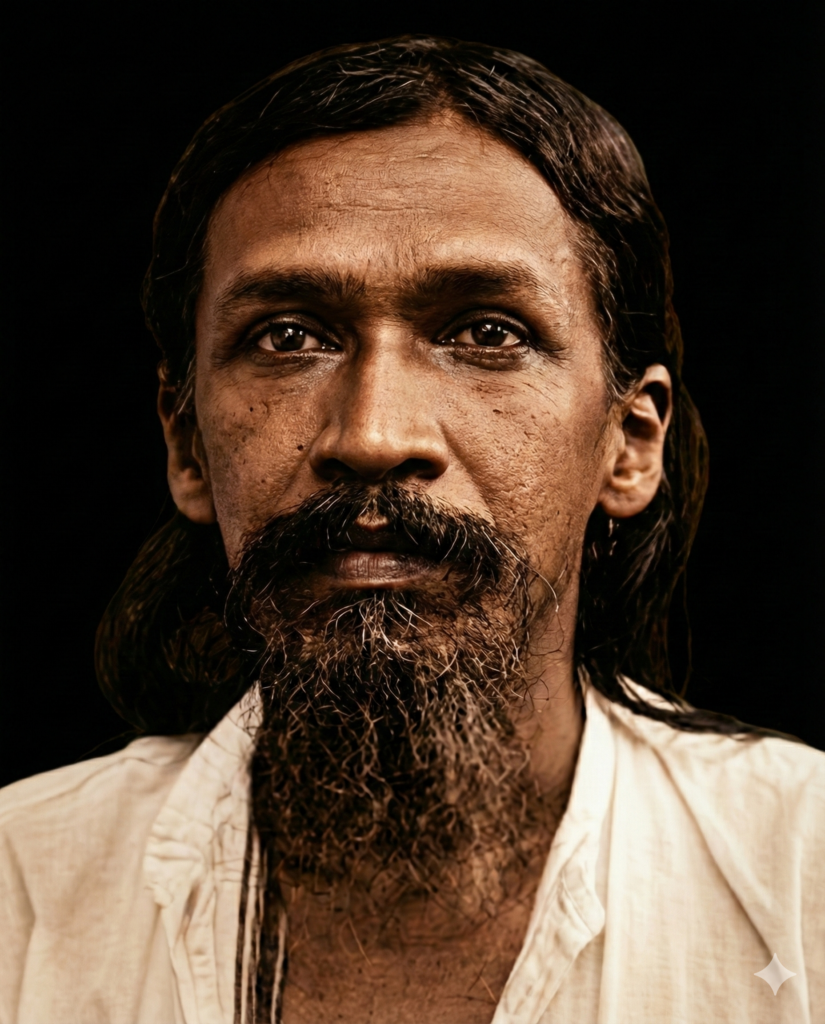
Birth and Early Childhood (1872–1879)
Birth: Sri Aurobindo was born as Aurobindo Ghose on August 15, 1872, in Calcutta (Kolkata), Bengal.
Significance of Date: His birthday would later become India’s Independence Day (August 15, 1947), a coincidence he described as a “divine sanction.”
Father: Dr. Krishna Dhan Ghose was a brilliant civil surgeon. He was a confirmed Anglophile who believed British culture was superior to Indian culture. He wanted his children raised as English gentlemen, completely insulated from Indian influence.
Mother: Swarnalata Devi, the daughter of the famous social reformer Rajnarayan Bose.
Early Education: At the age of five, Aurobindo was sent to the Loreto Convent School in Darjeeling, a school almost exclusively for British children.
The English Phase: Complete Westernization (1879–1893)
In 1879, Dr. Ghose took his three sons to England. He left them with a clergyman in Manchester with strict instructions: they were not to be allowed to make friends with Indians or learn about Indian religion.
Manchester (1879–1884): Aurobindo was educated at home. He learned Latin and French at a very young age and became a voracious reader, absorbing Shakespeare, Shelley, and Keats.
St. Paul’s School, London (1884–1890): The headmaster was impressed by Aurobindo’s brilliance and taught him Greek. He won the Butterworth Prize for literature and the Bedford Prize for history. During this time, he began writing poetry.
Cambridge University (1890–1892): He won a scholarship to King’s College, Cambridge. He excelled in the Classics (Greek and Latin) and passed the high-level Tripos.
The ICS Rebellion: His father wanted him to join the Indian Civil Service (ICS), the administrative steel frame of the British Empire.
Aurobindo passed the difficult written exams with a high rank.
However, he had no desire to serve the British. He deliberately disqualified himself by refusing to attend the mandatory horse-riding test. This was his first act of passive resistance.
The Baroda Period: Re-Indianization (1893–1906)
In 1893, at the age of 21, Aurobindo returned to India. As he stepped onto the soil at Apollo Bunder in Bombay, he experienced a “vast calm” and spiritual silence descending upon him—his first spiritual experience, though he did not label it as such at the time.
Service: He joined the state service of the Maharaja of Baroda (Sayajirao Gaekwad III). He worked in the Revenue Department and later became a Professor of English and Vice-Principal at Baroda College.
Self-Study: Realizing he was a stranger in his own land, he began an intense program of self-education.
He learned Sanskrit, Bengali, Marathi, and Gujarati.
He read the Ramayana, Mahabharata, Upanishads, and works of Kalidasa.
This period produced his early literary works, including plays like Vasavadutta and narrative poems like Urvasie.
Political Awakening: He began writing anonymous articles (titled New Lamps for Old) in the journal Indu Prakash, severely criticizing the Indian National Congress for its “mendicant policy” (begging the British for small reforms).
The Revolutionary Leader (1906–1910)
In 1905, the British Viceroy Lord Curzon partitioned Bengal, igniting a firestorm of protest. Aurobindo left his comfortable job in Baroda to jump into the freedom struggle in Calcutta.
The Leader of the Extremists: He joined the “Extremist” (Nationalist) faction of the Congress, alongside Bal Gangadhar Tilak and Bipin Chandra Pal (Lal-Bal-Pal).
Journalism: He became the editor of the English daily Bande Mataram. His editorials were fiery, intellectual, and inspiring. He was the first leader to publicly demand Purna Swaraj (Complete Independence), not just colonial self-government.
The Alipore Bomb Case (1908): The police raided his brother Barin’s revolutionary center. Although Aurobindo was not directly involved in making bombs, he was considered the “brain” behind the movement. He was arrested and charged with conspiracy to wage war against the King.
The Jail Experience: The Spiritual Turning Point (1908–1909)
Aurobindo spent one year in solitary confinement in the Alipore Jail. This year transformed him from a politician into a sage.
The Gita in Practice: He practiced the Yoga of the Bhagavad Gita intensely in his cell.
The Vision: He had a profound vision of Vasudeva (Krishna). He saw that the jail walls, the tree in the courtyard, the thief in the next cell, the guards, and even the judge were all forms of Narayana (God).
The Voice: He heard the voice of Swami Vivekananda (who had died in 1902) guiding him on higher planes of consciousness.
Acquittal: He was defended by the brilliant lawyer C.R. Das. In a famous speech, Das prophesied that Aurobindo would one day be looked upon as the “poet of patriotism, the prophet of nationalism, and the lover of humanity.” He was acquitted in May 1909 due to lack of evidence.
The Sage of Pondicherry (1910–1950)
Upon release, he briefly continued his political work (editing the Karmayogin), but the British were planning to deport him. In 1910, obeying a specific inner spiritual command (Adesh), he secretly sailed to Pondicherry, a French colony in South India, to escape British jurisdiction and focus entirely on his spiritual work.
1. The “Arya” Period (1914–1921) For the first few years, he lived in simplicity with a few young disciples. In 1914, he began publishing a philosophical monthly called Arya. Over the next seven years, he wrote almost all his major works in serial form, including:
The Life Divine: His magnum opus on metaphysics and evolution.
The Synthesis of Yoga: A guide to his “Integral Yoga.”
Essays on the Gita.
The Human Cycle (Social philosophy).
2. The Mother In 1914, Mirra Alfassa (a French woman of great spiritual depth) met Sri Aurobindo. She recognized him as the guide she had seen in her visions. She returned permanently in 1920. Sri Aurobindo acknowledged her as his spiritual equal and collaborator, referring to her as “The Mother.” She took charge of the daily life of the disciples, leading to the formation of the Sri Aurobindo Ashram.
3. The Day of Siddhi (November 24, 1926) Sri Aurobindo experienced a major realization—the descent of the “Overmind Krishna consciousness” into the physical body. Following this, he withdrew into complete seclusion to concentrate on the descent of the Supermind (a consciousness higher than the Overmind) which he believed was necessary to transform human life on earth. He communicated with disciples mostly through letters (thousands of which were later published).
4. Savitri During his seclusion, he worked on his epic poem, Savitri: A Legend and a Symbol. Spanning nearly 24,000 lines, it is the longest epic in English. It is considered a “spiritual autobiography,” describing the soul’s journey through various planes of existence to conquer death.
Philosophy: Integral Yoga
Sri Aurobindo’s philosophy is unique because it is life-affirming.
Traditional Yoga: Often seeks Moksha (liberation)—escaping the cycle of birth and death to merge into Nirvana.
Integral Yoga: Seeks Transformation. Sri Aurobindo argued that “All Life is Yoga.” The goal is not to escape the world, but to bring the Divine Consciousness down into the world to transform matter, life, and mind.
Evolution: He taught that man is a “transitional being.” Just as the ape evolved into man, man is destined to evolve into a Supramental Being (or Gnostic Being).
Final Years and Passing
World War II: Despite his opposition to the British Empire, Sri Aurobindo publicly supported the Allies during WWII. He saw Hitler and Nazism as dark, “Asuric” forces that threatened the spiritual evolution of humanity.
Independence: On August 15, 1947, India became free. In a radio message, Sri Aurobindo noted the significance of this happening on his 75th birthday, seeing it as a seal of the Divine on his work.
Mahasamadhi: Sri Aurobindo left his body on December 5, 1950. His body lay in state for four days without any signs of decomposition and emitting a golden glow. On December 9, he was interred in the Ashram courtyard.
Legacy
His work was continued by The Mother, who founded Auroville (the City of Dawn) in 1968 as an international experiment in human unity. Sri Aurobindo remains a towering figure—a revolutionary who fought for India’s freedom and a Rishi who charted the future evolution of humanity.
Themes
The Spiritual Descent (Involution)
The most central theme of the poem is the concept of Descent. Unlike traditional spiritual paths that focus on “Ascent” (climbing up to Heaven or Nirvana to escape the world), this poem describes a movement downwards. The Pilgrim voluntarily travels from the spiritual heights down into the “abyss” and “Night.” This reflects Sri Aurobindo’s philosophy of Integral Yoga, where the goal is to bring the Divine Consciousness down into the material world rather than abandoning the earth.
Key Line: “I made an assignation with the Night / In the abyss was fixed our rendezvous.”
Sacrifice and Selfless Service
The poem highlights the theme of the “Bodhisattva” or the Savior-figure who sacrifices personal liberation for the sake of humanity. The speaker had already achieved the highest state of enlightenment—the “glory of the illumined Mind” and the “calm rapture.” He could have remained in that eternal bliss. However, he chooses to give up his own peace and endure the “dull slime” and suffering of the lower world to help others.
Key Line: “I left the glory of the illumined Mind / And the calm rapture of the divinised soul.”
Transformation of the Unconscious
The Pilgrim does not enter the darkness to destroy it or fight it in a traditional sense. The theme here is Transformation through Love. He goes to “woo” the “dark and dangerous heart” of the Night. This suggests that the darkness (the Inconscient) is not evil, but simply “ignorant.” It needs to be touched by “God’s deathless light” to be healed and awakened. The mission is to turn the “ignorant waters” into a conscious existence.
Key Line: “I came her dark and dangerous heart to woo.”
The Dark Night of the Soul
This theme explores the intense psychological and spiritual ordeal of the seeker. As the Pilgrim enters the deepest layers of the material world, he experiences total isolation. The connection to the Divine (the “lustrous godhead”) is severed, and the inner guidance (the “celestial Friend”) falls silent. This tests the Pilgrim’s faith and endurance to the breaking point, proving that the work of transformation involves immense suffering and loneliness.
Key Line: “Lost is the lustrous godhead beyond Time / There comes no voice of the celestial Friend.”
Evolution and Immortality
The final theme is Evolutionary Hope. The poem asserts that this suffering is not meaningless. The Pilgrim is a pioneer clearing a path through the “virgin forest” of ignorance. By walking this difficult road, he is creating a “track” that will make it easier for the rest of humanity to follow. The ultimate goal is “Immortality”—not in a heaven after death, but a divine life established here on earth.
Key Line: “And yet I know my footprints’ track shall be / A pathway towards Immortality.”
Word Meaning
| Tough Word | Meaning in English | Meaning in Hindi |
| Assignation | An appointment to meet someone in secret (often between lovers). | गुप्त भेंट / मिलन का समय |
| Abyss | A deep or seemingly bottomless chasm or pit; the depths. | रसातल / गहरी खाई / पाताल |
| Rendezvous | A meeting at an agreed time and place. | मिलन स्थल / पूर्व-निश्चित भेंट |
| Deathless | Immortal; never dying or ending. | अमर / अविनाशी |
| Woo | To try to gain the love of someone; to court. | रिझाना / प्रेम-याचना करना / मनाना |
| Illumined | Enlightened; filled with light or spiritual knowledge. | प्रकाशित / ज्ञानदीप्त |
| Rapture | A feeling of intense pleasure, joy, or bliss. | परमानंद / अत्यंत उल्लास |
| Divinised | Made divine; transformed into a god-like nature. | दिव्य बनाया हुआ / देवत्व प्राप्त |
| Vastness | A very great extent or size; immense space. | विशालता / असीमता |
| Dim | Not shining brightly; unclear or obscure. | धुंधला / अस्पष्ट |
| Ignorant | Lacking knowledge or awareness. | अज्ञानी / अनजान |
| Chill | Unpleasantly cold. | ठंडी / सर्द |
| Slime | Soft, moist, slippery mud or substance. | कीचड़ / दलदल |
| Weary | Very tired, especially from exertion or endurance. | थका हुआ / क्लांत |
| Lustrous | Shining; radiant; reflecting light. | चमकीला / तेजस्वी |
| Godhead | Divine nature or essence; the state of being God. | देवत्व / परमात्मा / ईश्वरत्व |
| Celestial | Belonging to heaven; divine or heavenly. | स्वर्गीय / दिव्य / आकाशीय |
| Immortality | The state of living forever; eternal life. | अमरता / मोक्ष |
Very Short Answer Questions
Who is the author of the poem The Pilgrim of the Night?
The poem was written by Sri Aurobindo.
What type of poem is The Pilgrim of the Night?
It is a Shakespearean sonnet (14 lines).
In which collection was this poem published?
It was published in the collection titled Last Poems (1952).
Who is the “Pilgrim” in the poem?
The Pilgrim is the poet himself (or a spiritual traveler) who descends into the darkness to transform it.
What does the “Night” symbolize in the poem?
The Night symbolizes the Inconscient—the state of spiritual ignorance, darkness, and inertia.
What does the speaker carry in his breast?
He carries “God’s deathless light.”
What is the meaning of the word “assignation”?
It means a secret or appointed meeting, often between lovers.
Why does the speaker go to the “dark and dangerous heart” of the Night?
He goes to “woo” her, meaning to transform the darkness through spiritual love.
What state of consciousness did the speaker leave behind?
He left the “glory of the illumined Mind” and the “calm rapture of the divinised soul.”
What does the “dull slime” represent?
It represents the primitive, muddy, and resistant nature of the material unconscious world.
How is the “vastness” described in the poem?
It is described as “dim and blind.”
Who is the “celestial Friend” mentioned in the poem?
The “celestial Friend” refers to the Divine Guide or the inner voice of God.
Why does the speaker say “There comes no voice of the celestial Friend”?
It signifies the “Dark Night of the Soul,” where the seeker feels completely isolated from the Divine.
What is the “grey shore”?
It is the border of the Inconscient world where the “ignorant waters” roll.
What poetic device is used in the phrase “ignorant waters”?
Personification (attributing human ignorance to water) and Metaphor.
What is the rhyme scheme of the poem?
The rhyme scheme is ABAB CDCD EFEF GG.
What does the speaker know his footprints will become?
He knows they will become a “pathway towards Immortality.”
What is the central theme of the poem?
The central theme is the voluntary descent of the soul into darkness to open a path for the world’s transformation.
When was the poem originally written?
It was written in 1938 and revised in 1944.
What philosophical concept of Sri Aurobindo does the poem illustrate?
It illustrates the concept of the “Descent” in Integral Yoga.
Short Answer Questions
What is the significance of the speaker making an “assignation with the Night”?
The use of the word “assignation”—which typically refers to a romantic appointment between lovers—signifies that this journey into darkness is voluntary, not accidental. The speaker has not “fallen” into sin or ignorance; rather, he has deliberately chosen to meet the “Night” (the Inconscient) to transform it. By saying he comes to “woo” her dangerous heart, the poet changes the nature of the spiritual battle from a war of destruction into a mission of love. He intends to heal the darkness by uniting it with “God’s deathless light.”
Q2. What sacrifice does the Pilgrim describe in the second stanza?
The Pilgrim describes leaving behind “the glory of the illumined Mind” and the “calm rapture of the divinised soul.” This indicates that the speaker had already achieved the highest state of enlightenment and spiritual bliss (Nirvana/Moksha). His sacrifice lies in renouncing this personal safety and peace to descend into the “vastness dim and blind” of the material world. It highlights that his mission is an act of compassion—he trades his own ecstasy for the world’s agony to bring light to the “ignorant waters.”
Q3. How does the imagery of “dull slime” and “chill wave” contribute to the poem’s meaning?
Sri Aurobindo uses repulsive and tactile imagery to strip away any romanticism from the spiritual journey. “Dull slime” represents the primitive, muddy, and resistant nature of the material world (the Inconscient), while the “chill wave” suggests the cold indifference of a universe devoid of spirit. This imagery emphasizes that the work of transformation is not abstract or airy; it is a “weary journeying” through the heavy, sticky, and obscure habits of earthly existence that resist change and drag the spirit down.
Q4. Explain the significance of the line: “There comes no voice of the celestial Friend.”
This line depicts the ultimate spiritual ordeal known as the “Dark Night of the Soul.” Having descended into the depths of matter, the Pilgrim is cut off from the higher planes of consciousness. The “celestial Friend” (the Divine Guide or Inner Voice) falls silent, leaving the speaker in absolute isolation. This silence serves as the supreme test of faith; the Pilgrim must continue his work in the darkness relying solely on his own inner will (“I know”) without any external reassurance, guidance, or comfort from God.
Q5. How does the final couplet resolve the conflict presented in the poem?
The final couplet introduces a dramatic shift in tone with the phrase “And yet,” moving from despair to triumphant certainty. The speaker realizes that his suffering in the “slime” is not meaningless misery but constructive labor. He declares that his “footprints’ track” will serve as a “pathway towards Immortality” for others. This resolves the conflict by revealing the purpose of the descent: the Pilgrim is a pioneer clearing a road so that the rest of humanity can eventually follow him from darkness into the Light.
Essay Type Questions
Discuss “The Pilgrim of the Night” as a poem of spiritual descent. How does it differ from the traditional concept of spiritual liberation (Moksha)?
“The Pilgrim of the Night” is a quintessential expression of Sri Aurobindo’s unique spiritual philosophy, which centers on the concept of “Descent.” In traditional Indian spirituality and many other mystical traditions, the ultimate goal is often described as “Ascent.” The seeker strives to rise above the physical body, ignore the world of suffering (Maya), and climb the ladder of consciousness to reach a transcendent heaven or Nirvana (Moksha). In such a view, the world is a trap to be escaped. However, this poem flips that narrative entirely. The protagonist does not climb up; he climbs down.
The poem begins with the Pilgrim already in possession of the highest spiritual treasures. He speaks of leaving “the glory of the illumined Mind” and “the calm rapture of the divinised soul.” These lines indicate that the speaker is not a novice seeker looking for God; he is a realized soul (a Siddha) who has already achieved the peace and bliss that others spend lifetimes seeking. Yet, instead of remaining in that state of “calm rapture,” he voluntarily abandons it. He makes an “assignation with the Night,” choosing to enter the “abyss” rather than stay in the heavens. This marks the poem as a narrative of the Bodhisattva or Avatar—one who sacrifices personal liberation for the collective good.
The destination of this journey is the “Inconscient”—symbolized by the “grey shore,” “chill wave,” and “dull slime.” This represents the lowest, most resistant layers of material existence where the Divine presence is completely hidden. The Pilgrim’s mission is to “woo” this “dark and dangerous heart.” This suggests that the goal of Sri Aurobindo’s Yoga is not to reject the world as an illusion, but to embrace it and transform it. The Pilgrim carries “God’s deathless light” into the darkness not to burn it away, but to heal it from within.
Finally, the poem resolves the purpose of this descent in the concluding couplet. The suffering endured in the “slime” and the silence of the “celestial Friend” is justified by the result: the creation of a “pathway towards Immortality.” This redefines Immortality. It is not a state found only after death in a distant heaven, but a reality to be established here on earth. The Pilgrim descends to build a road that allows the “deathless state” to come down and exist within the mortal world. Thus, the poem serves as a manifesto for an earth-affirming spirituality rather than a world-negating one.
Analyze the use of symbolism and imagery in the poem. How does Sri Aurobindo use these devices to make abstract spiritual experiences feel physically real?
Sri Aurobindo uses potent symbolism and tactile imagery in The Pilgrim of the Night to translate high metaphysical concepts into a visceral, almost physical experience for the reader. The poem does not treat spirituality as an abstract mental exercise; it is depicted as a gritty, dangerous expedition. The central symbol is the “Night.” This is not merely the absence of the sun, but a personified cosmic force—the “Inconscient.” By giving the Night a “dark and dangerous heart” that can be “wooed,” the poet turns the abstract concept of ignorance into a living character, a “Dark Mother” figure whom the Pilgrim must confront and embrace.
The imagery used to describe the lower world is intentionally heavy, oppressive, and repulsive. Sri Aurobindo employs words like “abyss,” “chill wave,” and “dull slime.” These symbols appeal to the senses of touch and sight. “Slime” is particularly effective; it suggests something viscous, sticky, and unclean—the evolutionary mud from which life struggles to emerge. It represents the inertia (Tamas) of the physical world that resists change. The “chill wave” conveys the absolute lack of warmth and love in the material universe when it is divorced from the Spirit. These images make the reader feel the weight and coldness of the Pilgrim’s ordeal, moving the poem beyond mere philosophy into the realm of physical struggle.
Contrast is another major device used to heighten the symbolism. The poem is structured around the duality of Light and Darkness. The “lustrous godhead” and “illumined Mind” are set against the “vastness dim and blind” and the “ignorant waters.” This binary opposition highlights the vast gap the Pilgrim must bridge. The “ignorant waters” are a powerful symbol for the collective unconscious—the mechanical, repetitive habits of life that flow blindly without purpose. By contrasting the “deathless light” carried in the breast with the “grey shore” outside, the poet emphasizes the isolation of the spiritual pioneer who is a bearer of light in a world of shadow.
The final symbol of the “footprints” anchors the poem in reality. Footprints imply weight, impact, and a physical presence on the ground. They transform the Pilgrim’s journey from a fleeting dream into a permanent construction project. The footprints becoming a “pathway” suggests that spiritual evolution is cumulative; the work done by one individual makes the journey easier for those who follow. Through these layered symbols, Sri Aurobindo successfully communicates that his “Integral Yoga” is not a flight into the clouds, but a laborious march through the mud of the earth to pave a way for the future.
“The Pilgrim of the Night” depicts the spiritual experience known as the ‘Dark Night of the Soul.’ Discuss how this theme is explored in the poem and how the speaker overcomes it.
The “Dark Night of the Soul” is a classic concept in mysticism, most famously described by St. John of the Cross. It refers to a phase in spiritual development where the seeker feels completely abandoned by God, stripped of all spiritual consolation, and left in a state of inner desolation. Sri Aurobindo explores this profound psychological state in the third stanza of the poem. After leaving the “glory” and “rapture” of the higher planes, the Pilgrim finds himself in a place where “Lost is the lustrous godhead beyond Time.” The connection to the Eternal is severed.
The most poignant expression of this theme is the line: “There comes no voice of the celestial Friend.” The “celestial Friend” represents the Antaryamin—the inner guide or the Divine presence that usually sustains a Yogi. For a spiritual seeker, the silence of this voice is a torment greater than physical pain. It signifies absolute isolation. The Pilgrim is walking through “dull slime” and “chill waves,” and yet, the one source of comfort that could make this bearable is denied to him. This silence is not a punishment, but a test. It forces the Pilgrim to rely entirely on his own inherent divinity rather than external support.
However, the poem distinguishes itself by the speaker’s reaction to this abandonment. In many traditional accounts, the Dark Night involves doubt, despair, and a feeling of sinfulness. But the Pilgrim in this poem does not despair. He does not cry out for help or question his mission. Instead, the poem pivots on the phrase “And yet I know.” Despite the silence of God and the darkness of the world, the Pilgrim possesses an unshakable inner “Gnosis” (higher knowledge). He maintains a heroic stance, driven by the certainty of his purpose.
The Pilgrim overcomes the Dark Night not by escaping back to the light, but by pushing through the darkness with conviction. He realizes that this abandonment is the necessary condition for his work. He cannot build a “pathway towards Immortality” if he remains in the safety of the “illumined Mind.” He must inhabit the darkness fully to transform it. Thus, the poem reframes the Dark Night of the Soul not as a crisis of faith, but as the supreme sacrifice of the Savior, who accepts the silence of heaven to bring heaven down to earth.
Critical Analysis
Introduction
The Pilgrim of the Night is one of the most significant sonnets by Sri Aurobindo, appearing in his posthumous collection Last Poems (1952). Written in the late 1930s and revised in 1944, this poem serves as a spiritual autobiography of the poet’s final years. Unlike the romantic or devotional poetry of earlier eras, which often sought escape from the world into a heavenly paradise, this poem documents a spiritual descent. It describes the Yogi’s voluntary plunge into the “Inconscient”—the darkest, most unconscious layers of existence—to transform them. It is a defining work of Integral Yoga, illustrating that true spirituality is not about fleeing the world, but about conquering the darkness within it.
Central Idea
The core concept of the poem is the Paradox of the Divine Descent. In most spiritual traditions, the soul’s journey is depicted as an ascent—climbing the mountain to reach God. Here, the movement is reversed. The central idea is that the highest Light must descend into the deepest Night to heal the world. The protagonist is a “Warrior Yogi” or a Bodhisattva figure. He has already attained the “glory of the illumined Mind” (Enlightenment/Moksha) but voluntarily renounces this bliss. He chooses to enter the “abyss” of human suffering and ignorance to forge a path for humanity’s future evolution.
Detailed Summary
Quatrain 1 (The Mission): The poem opens with a startling declaration: “I made an assignation with the Night.” The speaker frames his journey not as a punishment or a fall, but as a romantic appointment (“assignation”). He enters the “abyss” armed with “God’s deathless light,” intending to “woo” the dangerous heart of darkness. This establishes the mood: this is a mission of love and transformation, not destruction.
Quatrain 2 (The Sacrifice): The speaker details what he has sacrificed. He leaves behind the “glory” and “calm rapture” of the higher spiritual planes (Illumined Mind). He trades the vision of the soul for a “vastness dim and blind” and arrives at the “grey shore” of the material world, described as “ignorant waters.” This highlights the immense cost of his mission.
Quatrain 3 (The Ordeal): The tone shifts to gritty realism. The Pilgrim trudges through “chill waves” and “dull slime,” symbolizing the inertia and resistance of the earth. The greatest pain is not physical but spiritual: he experiences the “Dark Night of the Soul.” The “lustrous godhead” is lost, and the “voice of the celestial Friend” (the inner Divine Guide) falls silent, leaving him in absolute isolation.
The Couplet (The Resolution): The poem pivots on the phrase “And yet.” Despite the slime and silence, the Pilgrim asserts his inner knowledge. He realizes that his struggle is not in vain; his “footprints” are creating a “pathway” that will allow the rest of humanity to eventually reach Immortality.
Structure and Rhyme Scheme
Form: The poem is a Shakespearean Sonnet (14 lines).
It is divided into three quatrains (4 lines each) that develop the narrative of the descent, and a final couplet (2 lines) that provides the resolution.
Effect: The rigid structure of the sonnet imposes order on the chaotic subject matter (the abyss/darkness), reflecting the Yogi’s disciplined will amidst the chaos of the Inconscient.
Rhyme Scheme: ABAB CDCD EFEF GG.
Meter: Iambic Pentameter.
Key Themes
Involution (The Descent): This is the philosophical backbone of the poem. Sri Aurobindo posits that Spirit is involved in Matter. To liberate it, one must go down (Involve) to evolve. The Pilgrim travels from the “Mind” down to the “Slime.”
The Bodhisattva Ideal: The theme of sacrificial love. The speaker could have stayed in the “calm rapture,” but he chose the “grey shore” for the sake of the world. This parallels the Mahayana Buddhist vow to delay Nirvana until all beings are saved.
Transformation vs. Rejection: The Pilgrim does not try to kill the “Night”; he tries to “woo” her. This suggests that the dark, unconscious parts of ourselves are not evil to be excised, but ignorant energies waiting to be transformed by Light.
Evolutionary Hope: The poem suggests that human evolution is not finished. The “footprints” indicate that a new stage of life (“Immortality”) is being prepared for the earth.
Style and Tone
Mantric Quality: Sri Aurobindo attempted to write “Overhead Poetry”—poetry that originates from a spiritual plane of consciousness. The language is designed to induce a meditative state.
Diction: The vocabulary is elevated, archaic, and cosmic. Words like Assignation, Rendezvous, Lustrous, Godhead, and Immortal give the poem a majestic, timeless quality.
Tone:
Beginning: Heroic and determined.
Middle: Melancholic, desolate, and heavy.
End: Prophetic, authoritative, and triumphant.
Poetic Devices
Extended Metaphor: The entire poem is a metaphor for spiritual psychology. The “journey” is an internal one; the “slime” is the inertia of human nature; the “pathway” is the psychological opening made for others.
Personification:
The Night: She is personified as a dark goddess or a resistant lover with a “dangerous heart.”
The Waters: Described as “ignorant,” attributing human lack of awareness to the material world.
Tactile Imagery: The poem is incredibly sensory.
Touch: “Chill wave,” “dull slime,” “fixed.”
Sight: “Dim,” “blind,” “grey,” “lustrous.”
Effect: This prevents the poem from becoming abstract philosophy. The reader feels the cold and the mud.
Alliteration:
“dark and dangerous” (emphasizes the threat).
“Lost is the lustrous…” (soft sounds emphasizing sadness).
Critical Commentary
The Pilgrim of the Night offers a stark contrast to the “sweetness and light” often associated with mysticism. It acknowledges the “Dark Night of the Soul” (a term coined by St. John of the Cross) but reinterprets it. For traditional mystics, the Dark Night is a purging of the ego. For Sri Aurobindo, it is a strategic operation—a descent into the enemy’s territory (the Inconscient) to plant the flag of Light. Critics often view this poem as a companion piece to his epic Savitri. Just as Savitri descends into Death’s kingdom to reclaim life, the Pilgrim here enters the Abyss. The silence of the “celestial Friend” (Line 12) is particularly poignant; it suggests that at the deepest level of spiritual work, one must proceed without any external support, relying solely on the “Godhead” within.
Message
The poem delivers a message of profound courage and optimism.
Confront the Darkness: We cannot change the world (or ourselves) by ignoring the darkness. We must enter it (“woo it”) with light.
Purpose in Suffering: Our struggles are not meaningless. Every individual who overcomes a dark trait in themselves creates a “footprint”—making it slightly easier for the collective humanity to overcome that same trait.
The Goal is Earthly: The ultimate spiritual goal is not to vanish into the clouds, but to make the earth a place of “Immortality.”
Conclusion
The Pilgrim of the Night is a masterpiece of spiritual realism. It strips away the glamour of enlightenment to reveal the hard labor involved in transforming human nature. Through its masterful use of the sonnet form, vivid imagery of “slime” and “night,” and its heroic narrative, Sri Aurobindo provides a roadmap for the future of humanity. It is a poem that assures us that even in the deepest silence and darkest night, a path to the Light is being built.