Vasavadutta Summary
Vasavadutta was written by Sri Aurobindo in 1915, shortly after he settled in Pondicherry. However, like several of his literary works, it remained in manuscript form for decades and was not published during his lifetime.
It was finally published for the first time in 1957, seven years after Sri Aurobindo’s passing. The first edition was brought out by the Sri Aurobindo Ashram in Pondicherry.
Today, the play is available as part of the Collected Works of Sri Aurobindo (CWSA), specifically in Volumes 3 and 4, titled Collected Plays and Stories.
The tale originally comes from Sanskrit works like Bāṇa’s Harshacharita, Somadeva’s Kathasaritsagara, and the classical play Svapnavāsavadatta by Bhāsa.
The play is a romantic tale about two rival kingdoms. It shows how the power of Love (represented by King Vuthsa) is stronger than the power of Force and War (represented by King Mahasegn).
The Problem
King Mahasegn of Avunthy is a powerful and ambitious ruler. He wants to conquer the neighboring kingdom of Cowsamby. However, the young King of Cowsamby, Vuthsa, is very popular and cannot be defeated in battle. Mahasegn thinks Vuthsa is weak because Vuthsa loves music, art, and beauty more than war. Mahasegn decides to use a trick instead of an army to defeat him.
The Trap
Mahasegn sends his son, Gopalaca, to trick Vuthsa. Gopalaca pretends to be banished from his own home and asks Vuthsa for help. Vuthsa, who is kind and trusting, welcomes Gopalaca as a brother. Once they are in the forest hunting, Gopalaca and his soldiers ambush Vuthsa. They capture him and take him to Avunthy as a prisoner.
The “Golden Cage”
Mahasegn does not throw Vuthsa in a dungeon. Instead, he keeps him in the palace as an “honored captive.” Mahasegn has a secret plan: He wants Vuthsa to become the servant of his beautiful daughter, Princess Vasavadutta. He believes that Vuthsa will fall in love with her and become so distracted by her beauty that he will agree to become Mahasegn’s slave just to stay with her.
The Romance
Vasavadutta is proud and dutiful at first. She tries to act like a strict mistress to her “slave” Vuthsa. However, Vuthsa is not weak; he is charming and has a “divine” personality. Instead of Vuthsa submitting to her, Vasavadutta falls deeply in love with him. Her mother, Queen Ungarica (who is wise and spiritual), secretly encourages this love, knowing that love is the only way to unite the two kingdoms. With the help of Munjoolica (a captured princess serving as a maid), the two admit their love for each other. Vuthsa vows to make Vasavadutta his Queen.
The Great Escape
Vuthsa refuses to ask Mahasegn for permission to marry. He wants to take his bride like a hero. With the help of Munjoolica and Vasavadutta’s younger brother, Vicurna (who hates his father’s trickery), they plan an escape.
They get the guards drunk.
They steal a chariot.
Vuthsa, Vasavadutta, and Munjoolica race toward the border of Cowsamby.
The Chase
King Mahasegn is furious when he finds out. He sends his army to catch them and orders that Vuthsa be killed if caught. However, Vicurna rides with them and helps them escape. They race through the forest and reach the border just as Vuthsa’s own army arrives to save them.
The Happy Ending
The armies of the two kingdoms face each other, ready for war. But Gopalaca arrives and declares peace. He realizes that Vuthsa has won fairly—not by war, but by daring and love.
Vuthsa and Vasavadutta are reunited in freedom.
Mahasegn accepts the marriage.
Vicurna goes into exile to live with Vuthsa.
The two kingdoms become allies.
Conclusion: The play ends with the idea that while Mahasegn tried to control the world with iron rules and force, Vuthsa won the world through the soft, irresistible power of love and delight.
Plot
The scene begins in the palace of Ujjayini. King Mahasegn is sitting in a room, feeling very angry and worried. His mood is dark because his enemy, King Udayana (also called Vuthsa) of Vatsa, is winning the war. Mahasegn calls Udayana just a “boy who loves luxury,” yet this young man is somehow beating Mahasegn’s powerful armies and ruining his plans.
His son, Gopalaca, is with him. Gopalaca has seen Udayana on the battlefield and tells his father that Udayana is no ordinary fighter. He explains that Udayana fights with amazing grace, moving as lightly as a beautiful dancing girl. His skill doesn’t look like hard work; it looks natural, charming, and effortless.
Mahasegn sadly admits that if Udayana’s army reaches the gates of his city, his life’s work is over. He shares his big dreams with his son. He had wanted to conquer great kingdoms like Oudh and Kausambi. He wanted his empire to cover the holy rivers like the Ganga, Godavari, and Narmada. He imagined the whole continent sleeping peacefully under his rule. But now, he feels those were just empty dreams because fate is against him.
Gopalaca tries to cheer him up. He asks, “Aren’t you strong enough to make those dreams real?” But Mahasegn answers philosophically. He says that many brave people try and fail before one great thing is finally achieved on earth. No one knows who will be the chosen one to succeed. One generation dreams, and maybe a later generation actually lives that dream.
Gopalaca points to the mountains and compares Mahasegn’s spirit to the spear of Rudra (the fierce god), ready to strike. But Mahasegn feels that Vishnu (the preserver god) has blocked his spear with a casual hand. The gods are not helping him.
Gopalaca asks if his father will give up and beg for peace. Mahasegn refuses immediately. He is too proud to bow down. However, he admits that Udayana seems very lucky. Three gods blessed Udayana at birth:
Lakshmi gave him good fortune.
Vishnu promised him success.
Saraswati gave him the gifts of art and music.
Gopalaca then points out Udayana’s one big problem. Even though the gods like him, Udayana is not disciplined. He loves pleasure too much. He spends his days with wine, music, songs, and beautiful things. He is like a bird with bright wings that flies too close to the ground instead of soaring high like an eagle. He is too careless to be a truly great king.
Mahasegn sees a chance here. He decides they shouldn’t fight Udayana with soldiers anymore. Instead, they should attack his weakness.
Mahasegn explains his new secret plan. He wants to capture Udayana, not by killing him, but by trapping him with beauty. He wants to bring Udayana to their palace in Ujjayini as a prisoner. The plan is to use Mahasegn’s own daughter, Vasavadutta, as the jailer. Mahasegn believes that once Udayana sees her beauty, he will fall in love. He will be so charmed by her smile and her eyes that he won’t want to escape. He will happily stay as a “prisoner of love” and become a servant to their kingdom without a fight.
Gopalaca loves the idea. He compares himself to the giant bird Garuda swooping down to grab a sleeping snake. He promises to capture Udayana. But to make the plan work, he asks his father for a favor: “Please banish me from the kingdom.”
If Gopalaca is officially kicked out of Ujjayini, Udayana will trust him. Mahasegn agrees at once. He tells his son, “I banish you. Do not return until the plan is done.”
The scene ends with this clever trick: Gopalaca leaves as a “fake exile” to go and capture the enemy king using friendship and deceit.
The scene takes place in the palace hall of Cowsamby. The wise minister Yougundharayan and the army general Roomunwath are talking about King Udayana. Yougundharayan believes that even though Udayana looks like he only cares about pleasure and flowers, there is a great strength hiding inside him. Roomunwath is not so sure, but the minister explains his worry: young men face many temptations that can poison their strength. To save Udayana from this, the minister wants to find him a wife. When asked who, Yougundharayan names Vasavadutta, the beautiful princess of Avanti. He says only she has enough charm to keep Udayana steady.
Roomunwath thinks this is impossible because their families are enemies. Yougundharayan argues that smart men must shape destiny, not just accept it. He explains the political benefit:
If Udayana marries Vasavadutta, her father (King Mahasegn) will not attack Cowsamby because he won’t want to hurt his own daughter.
Eventually, Udayana’s children would inherit both kingdoms. Yougundharayan believes that if Mahasegn suffers one more defeat, he will be forced to agree to this marriage.
Udayana enters the room in a happy mood. He talks about the morning breeze and wants to listen to music. He holds a flower and says poetically that “each petal is a thought.” Yougundharayan tries to talk to him about his duties as a King. Udayana playfully refuses. He says, “You are wise, so you handle the difficult state matters.” When the minister asks what will happen when he dies, Udayana jokes that he forbids the minister to die. He trusts that nature will slowly teach him how to be a mature king, but not yet.
Udayana asks to go play his harp, but the minister tells him he should practice self-control. Udayana replies that government work is boring, but war is beautiful—he loves the look of shining armor and flying arrows. They talk about marriage. Udayana admits he is afraid of it. He feels that wanting a woman is sweet, but actually having one might be disappointing. He likes the dream better than reality. However, when the minister mentions the name Vasavadutta, Udayana is excited. He says the name sounds magical and beautiful, like a dream he wants to keep.
A guard announces that a traveler is at the gate. Udayana immediately wants to welcome him. Yougundharayan warns the King to be careful, saying that people in courts often lie and the world is dangerous. Udayana disagrees, saying not everyone is bad.
Gopalaca (the stranger) enters. When he meets Udayana, he admits two things:
He fought against Udayana in the war.
He is the son of Mahasegn (Udayana’s worst enemy). Instead of being angry, Udayana is delighted. He says brave enemies are like friends because they share the thrill of battle.
Gopalaca then tells a lie: he says his father has banished him and he has nowhere to go. He asks for a small hut to live in. Yougundharayan whispers to the King that this is a trick, but Udayana ignores him. Udayana’s heart is too generous. He hugs Gopalaca, calls him a brother, and invites him to live in the palace with full freedom. Gopalaca promises loyalty, and the trap is set.
Udayana and Gopalaca leave together as best friends. Yougundharayan is left alone with the general. He is very worried. He saw the lies in Gopalaca’s eyes and knows the King has walked into a trap. Roomunwath says it is too late to stop it because Udayana is already charmed by Gopalaca. The minister decides to put guards everywhere to watch them. The scene ends with a sad observation by Yougundharayan: In the old days, Udayana’s trusting and noble behavior would have been considered wisdom. But in this “Iron Age,” being too good and trusting leads to defeat, while cunning and tricky people rule the world.
In a quiet room inside the palace of Cowsamby, two of King Vuthsa’s companions, Alurca and Vasuntha, are talking about the new guest, Gopalaca. Alurca observes that Gopalaca looks like he was born to rule Cowsamby. Vasuntha corrects him, saying that Gopalaca looks more like a hunter staring at his prey. He says Gopalaca is a natural ruler, not because he wants power, but because his personality is strong and commanding.
Alurca compares Gopalaca to a giant stone or a mountain peak that has suddenly come to life—he is silent, firm, and unmoving. Vasuntha explains that this hard nature is exactly why Vuthsa likes him. Vuthsa is the opposite: he is gentle, soft, and bright, like the moon hiding behind clouds or a jasmine flower in spring.
Alurca worries about Vuthsa. He wonders when Vuthsa will grow up and act like a real King. Right now, the tough General Roomunwath and the wise Minister Yougundharayan run the country. Vuthsa stands between them like a pretty puppet—everyone loves him and moves him around, and he just smiles gracefully. Alurca feels that with Gopalaca’s arrival, Vuthsa has just found another “master” to control him because he is fascinated by Gopalaca’s silent strength.
Vasuntha tries to explain Vuthsa’s behavior. He says Vuthsa has a playful spirit that loves everything in the world. He suggests that this might actually be wisdom, not weakness. Vasuntha believes the world isn’t run by human rules, but by a great, mysterious cosmic spirit. Humans can’t understand the big plan. Since we can’t control life, why blame Vuthsa for enjoying it? He says the purpose of life is simply to enjoy the ride and gather rich experiences before death takes us away to a new world.
Alurca argues that the old kings of the past were tough like the Himalayas. But Vuthsa is soft like a valley full of flowers and bees. Vasuntha laughs and says God created the world because He was bored. That is why God mixes opposites—life and death, fate and luck. He believes the confusion of the world is actually part of a divine plan.
Alurca mentions that the Minister (Yougundharayan) is watching Gopalaca very closely, suspecting danger. Vasuntha jokes that the Minister is so paranoid that if he saw two pigeons cooing on a roof, he would think they were plotting a conspiracy.
Vuthsa enters the room with Gopalaca. Vuthsa is very excited, talking about oceans, mountains, and forests. He compares the ocean to the mountains where he was born. Gopalaca asks Vuthsa to show him the Vindhya mountains, where the forest leads toward his home, Avunthy. Gopalaca says he dreams of wandering in the wild forest, disturbing nothing, just letting nature surround him. Vuthsa loves this idea. He immediately decides they should go hunting. He sends Alurca to ask the Minister for permission, though he jokes that his own royal will doesn’t matter much compared to the Minister’s authority.
Vasuntha teases Vuthsa, saying he needs a bandage to keep him quiet. Vuthsa offers music instead. He talks about the magic of the harp and his guitar. He claims his music is so enchanting that it can charm elephants and snakes, turning the dangerous forest into a happy festival.
Suddenly, Gopalaca becomes serious. He asks to be left alone for a while, claiming that memories of his home in Avunthy are bothering him. Vasuntha makes a sarcastic joke, suggesting that maybe Gopalaca is receiving secret messages from his father through the clouds. Gopalaca ignores the joke. Vuthsa is kind and gives Gopalaca his space. He agrees to meet him later. Gopalaca chooses a spot by the river, under the red branches of a tree, and walks away.
After Gopalaca leaves, Vuthsa talks about how much he enjoys finding a “kindred soul” who matches his nature. Vasuntha jokes that if Vuthsa is a rose, he (Vasuntha) is the thorn underneath.
Alurca returns with the Minister’s answer: The King can go hunting, but because the path is dangerous, armed soldiers must go with them. Furthermore, the Minister himself will come along to guard the King against “wild beasts” (hinting that he wants to guard him against Gopalaca). Vuthsa calmly accepts this.
Alurca warns the King that trusting everyone is a noble habit, but it isn’t very smart. Vuthsa replies that he sees Gopalaca as an elder brother. Alurca worries that Gopalaca doesn’t truly love Vuthsa back. Vuthsa replies that love is sweet even if it isn’t returned. He uses a poetic comparison: Gopalaca is like a rock, and Vuthsa is like a flower climbing up the rock. Nature likes to bring opposites together. Vuthsa ends the scene happily, saying that the earth is full of honey, and he wants to taste all of its sweetness before he moves on to the next world.
Deep in the forest of the Vindhya hills, a young warrior named Vicurna (Mahasegn’s younger son) is waiting with an army captain. They can hear the sounds of Vuthsa’s royal hunt in the distance. Vicurna is excited and wants to fight, even though the woods are full of Cowsamby’s guards. Suddenly, Gopalaca arrives. He is angry that Vicurna is here because it risks their secret mission. Vicurna admits he came uninvited just for the thrill of danger. Gopalaca scolds him but accepts his help. The captain reports that their chariots are hidden near a secret tunnel—legend says a divine Boar dug it through the hill leading to Avunthy. Armed men are waiting in a place called the Elephant Cave. Gopalaca explains the plan: he knows secret paths the guards don’t know. When he gives a signal (a clap of hands), the soldiers must surround King Vuthsa. Since Vuthsa will be alone with Gopalaca, there will be no fighting. Vicurna is disappointed because he wanted a battle.
Vuthsa, his friend Vasuntha, and Alurca arrive in the clearing. They are now separated from the rest of the hunting party because their chariot “accidentally” broke. Alurca suspects a trap, asking how this could happen when the General Roomunwath was guarding the roads. Vuthsa decides to rest in the beautiful green spot. He sends Alurca away to find the other hunters. Alurca is very worried about leaving the King unprotected, but he goes. Vasuntha and Vuthsa are left alone. Vasuntha warns Vuthsa that danger is near. Suddenly, Gopalaca returns. He lies and says he was chasing a magical white deer deep into the woods, but instead, he found strange hunters who were talking about Vuthsa’s path. He claims he came back to warn the King.
Vasuntha sees through the lie. He begs Vuthsa to go back to safety. He asks, “Do you really know what you are doing?” Vuthsa replies calmly that his eyes are open. He knows exactly what is happening, but he insists on staying. He tells Vasuntha to leave and give a message to the Minister Yougundharayan: “Whatever happens, do not send armies to rescue me. No one must interfere. I will rescue myself.” Vasuntha realizes he can’t stop the King, so he leaves to deliver the message.
Now Vuthsa and Gopalaca are alone. Vuthsa acts very happy. He hangs up his bow and arrows, saying he doesn’t need them anymore. He tells Gopalaca how much he loves being free from the palace, the guards, and the formalities. He dreams of living a simple life in the forest with Gopalaca—hunting, wrestling tigers, and sleeping in huts. Gopalaca listens quietly and says, “Someday we shall.” Vuthsa trusts Gopalaca completely. He even asks Gopalaca to take his sword away. Gopalaca refuses, keeping his own weapons ready “in case of wild beasts.” Vuthsa says he is happy to be entirely in Gopalaca’s hands.
Then, Gopalaca reveals his true feelings. He tells Vuthsa that he loves him like a brother, a mother, or a lover—but he is also jealous. He wants Vuthsa all for himself, not shared with the kingdom of Cowsamby. He wants to take Vuthsa to his own world where he is not a King, just a man. Vuthsa gently replies, “That is why I came alone with you.”
Suddenly, Gopalaca reveals the truth: “Mahasegn has sent for you.” He declares that Vuthsa is his captive and he will carry him away like an eagle snatches prey. Gopalaca signals, and his hidden soldiers rush out. They surround Vuthsa and quickly hurry him toward the secret tunnel to Avunthy.
Vasuntha returns to the clearing, but it is empty. He says, “The die is cast.” Immediately, the Minister Yougundharayan, General Roomunwath, and Alurca arrive with soldiers. They see Vuthsa’s abandoned weapons. Yougundharayan demands to know where the King is. Vasuntha delivers Vuthsa’s strange message: Do not send the army. Do not start a war. The King will save himself.
Roomunwath thinks this is madness and wants to chase them immediately. But Yougundharayan understands what has happened. He realizes that Vuthsa’s “kingly spirit” has finally woken up. Vuthsa has chosen to walk into the enemy’s trap on purpose, trusting his own power to survive. It is a reckless, heroic act. Roomunwath rushes off to try and catch them before they cross the border, but Yougundharayan knows it is likely too late. He decides to return to the capital to plan their next move, knowing that even in captivity, his spies will reach Vuthsa.
The scene takes place on a wooded hillside in the kingdom of Avunthy. Gopalaca’s chariot stops here, carrying the captured King Vuthsa. Gopalaca points to the plains below, where lights are glimmering like fireflies. He explains that these lights belong to the army of Avunthy coming to meet them.
Vuthsa wakes up from his sleep. He asks if they have reached Avunthy yet. Gopalaca tells him they have already crossed the border. Vuthsa calls Gopalaca a “dear traitor,” realizing that this kidnapping was Gopalaca’s plan all along. Gopalaca calmly replies that this is only the beginning—there is much more planned for the future.
Vuthsa asks if he is being taken to King Mahasegn’s city. Gopalaca says yes, and promises that Vuthsa will be kept there like a “precious jewel,” guarded as the most valuable treasure they have. Vuthsa laughs bitterly. He complains that he is just moving from one prison to another. In his own kingdom (Cowsamby), his ministers guarded and controlled him; now, his enemies will lock him in a “golden cage.” He feels that everyone—friends and enemies alike—treats him like an object to be used, rather than a person with his own will.
However, Vuthsa issues a bold warning. He swears he will not stay trapped. He promises to win back his freedom using even cleverer tricks or greater force than Gopalaca used. Gopalaca doubts this, saying Vuthsa is surrounded by strong guards and has no weapons. Vuthsa makes a mysterious threat: He declares that he will take revenge by stealing something even more valuable from Avunthy than what Gopalaca stole from Cowsamby. Gopalaca dismisses this, saying there is nothing in Avunthy more valuable than Vuthsa himself.
Vuthsa notices Vicurna (Mahasegn’s younger son) riding behind the chariot. He calls him forward and hugs him warmly, praising him as a noble warrior. Vicurna speaks with great respect. He says he used to dream of fighting Vuthsa in battle to prove his worth, but being close to him like this is even better.
Vuthsa asks if Mahasegn has any other children. Gopalaca mentions that only one sister remains. Vuthsa immediately thinks of Vasavadutta and her famous beauty. Gopalaca promises that Vuthsa will see her soon. Hearing this, Vuthsa becomes excited and happy. He says that if he is being taken to see her, then his capture is actually a gain, not a loss. The atmosphere is beautiful—the sky is full of stars, and the forest is filled with the loud, musical ringing of millions of cicadas. Vuthsa asks when they will reach the city. Gopalaca says they will arrive before dawn, so Vuthsa won’t see the famous temples until the sun comes up.
They see their own soldiers approaching to escort them. Gopalaca worries that the Cowsamby army might be chasing them. Vuthsa assures him that no one is coming—he has chosen to travel to Avunthy freely and his fate must not be interrupted.
Gopalaca orders fast riders to gallop ahead and tell King Mahasegn that they have secured the “glorious prize”—a victory greater than twenty wars. Gopalaca claims that Shiva (the god of destruction, worshipped by Mahasegn) has blessed them. Vuthsa replies confidently that Vishnu (the preserver god) is with him, and perhaps the two gods will meet and become one through this conflict.
The scene opens in the royal apartments of Avunthy. King Mahasegn enters, looking very proud and happy. He tells his wife, Queen Ungarica, that he has won a great victory—not by fighting a war, but by using his brain. He announces that he has captured Vuthsa, the young King of Cowsamby.
Ungarica laughs at his bragging. She teases him, comparing him to the Monkey-God (Hanuman) who once trapped the sun under his arm. She asks, “Now that you have him, what will you do with him?” Mahasegn says he will use Vuthsa like the moon uses the sun—he will shine with Vuthsa’s reflected glory and become the master of the eastern world.
Ungarica doubts this will work. Mahasegn calls her his “beloved sceptic” and reminds her that he always gets what he wants. He reminds her that he won her by dragging her from her mysterious home into his bright world. Ungarica replies that he won her by force, but he has not captured Vuthsa by force—he used a trap. She warns him that if he tries to do things that go against nature, he will fail. She explains that her soul comes from the “shadows,” so she can see things that people blinded by the “light” (like Mahasegn) cannot see. Mahasegn asks what she sees. She tells him: Vuthsa is too great and too clever to be controlled. He will not submit to you.
Mahasegn disagrees. He thinks Vuthsa is just a soft, delicate boy—heroic, maybe, but gentle like a flower or a lily in the waves. Ungarica realizes Mahasegn’s secret plan. She guesses that he wants their daughter, Vasavadutta, to be the “wave” that carries this “flower.” She realizes he wants to use Vasavadutta to control Vuthsa. Mahasegn confirms this—he wants their future grandson to rule the empire. Ungarica says it doesn’t matter who rules; she is just happy that her passionate daughter will find love with the greatest man of the age.
Mahasegn orders Vasavadutta to be called in. He wants to teach her how to use her beauty for politics. Ungarica warns him that the heart is dangerous and powerful. Mahasegn insists that the mind must rule. Vasavadutta enters. Mahasegn explains the situation immediately. He tells her that Vuthsa, his enemy, is a prisoner. The Plan: Vuthsa will become Vasavadutta’s husband. She must make him fall in love with her so that he becomes her slave. Through her control over Vuthsa, Mahasegn will rule the world.
Vasavadutta answers obediently. She says, “Your will is my will.” She agrees to marry whomever he commands. Mahasegn tells her she must be more than just a wife; she must be his instrument. She must use her mind to bend Vuthsa’s will. Vasavadutta asks, “Will he submit?” Mahasegn says yes, if she wishes it. Vasavadutta promises to put her country and her father’s glory above everything else. She promises not to let emotions or physical attraction make her weak. She says she is proud to be a tool for her father’s ambition. Mahasegn is delighted. He thinks she has learned his lessons perfectly.
Mahasegn asks Ungarica if she sees how noble their daughter is. Ungarica dismisses him, telling him to leave so she can speak to her daughter alone. Mahasegn agrees and exits.
Once they are alone, Ungarica hugs Vasavadutta and speaks very differently. She speaks with fierce, motherly love. She tells Vasavadutta that she is about to face the biggest test of a woman’s life—Love. She warns her daughter that soon, “fire” will be in her heart, and all her father’s cold logic will melt away. Ungarica says:
A flower blooms for itself, not to make its parents look good.
She did not give birth to Vasavadutta to serve Mahasegn’s political plans, but to find joy and love.
She advises Vasavadutta: “Let him be your god, and you be his goddess.” She urges her daughter to follow her heart when it wakes up, not the cold commands of ambition. She promises to watch over her. Then, Ungarica leaves.
Vasavadutta is left alone, feeling confused. She loves her mother best, but she admits she understands her father’s logic better. Her mother’s words about love seem mysterious to her. She decides that if she must marry, she will marry a man she can rule. Finally, she speaks Vuthsa’s name for the first time. She becomes curious. She has only heard of him from far away. She wonders what he looks like—is he like a flame? A flower? Is he tall like her brother Gopalaca, or is he a soft, golden youth? Despite her tough words earlier, she feels a flutter in her heart at the thought of finally seeing him.
Gopalaca brings the captured King Vuthsa into the presence of King Mahasegn in Avunthy. Gopalaca proudly announces that his mission is complete: Vuthsa, the young rival who used to fight Mahasegn’s armies, is now a prisoner. Mahasegn is very happy and praises Gopalaca, calling him a true son.
Vuthsa greets Mahasegn with calm dignity. He acknowledges Mahasegn as a great king and mentions that they have met before in battle as equals, but now he comes in a different situation. Mahasegn insults him, calling him vain. He says Vuthsa didn’t come here by choice, but because fate punished him for daring to fight against Mahasegn’s destiny.
Vuthsa quietly asks why he has been brought here by force. Mahasegn answers boldly: Vuthsa must serve him and accept Mahasegn as the ruler of the world, just like other kings have done.
Vuthsa disagrees. He says Mahasegn has made a mistake. He explains:
“You have captured Vuthsa, the man, but you have not captured the King of Cowsamby.”
He says true kingship isn’t a person; it is the spirit of the nation. It sits on the empty throne back in Cowsamby. It passed from ancient kings like Parikshith to him, and it will continue after him. This spirit cannot be caught or killed.
Mahasegn dismisses this as “childish philosophy.” He says grown men deal with real things—bodies and power—not ideas. He is happy enough to have Vuthsa’s physical body in his control. Vuthsa replies: “You can do what you want with my body. As a man, I am your prisoner. But as a King, I will never surrender my nation’s freedom.”
Mahasegn warns Vuthsa that he cannot escape. Vuthsa calmly replies that he doesn’t want to escape—if he did, iron bars and guards couldn’t stop him. Mahasegn then reveals his specific plan. He says he will give Vuthsa jailors so powerful that Vuthsa won’t dare fight them. The Plan: Vuthsa will be a servant in Mahasegn’s house. Specifically, because Vuthsa is young, he will serve Vasavadutta (Mahasegn’s daughter). She and her maids will be his jailors. He will live in her chambers and learn to obey her.
Mahasegn expects Vuthsa to be insulted by this menial role. Instead, Vuthsa surprises him. Vuthsa smiles and says he welcomes it. He declares that serving Vasavadutta is an honor and a blessing. He says this service will actually make him greater, not weaker.
Mahasegn is pleased. He orders Gopalaca to take Vuthsa to Vasavadutta. He lists Vuthsa’s talents—music, painting, singing—and says all of these will now belong to her. Mahasegn notices Vuthsa smiling again and asks why. Vuthsa replies mysteriously: “I smile at how confident powerful men are that they control the results of their actions.” Gopalaca leads Vuthsa away.
Mahasegn is delighted. He tells his wife, Queen Ungarica, that Vuthsa is a “charming boy” who talks big but submits easily. Ungarica corrects him: “He showed you exactly what he wanted you to see.” Mahasegn laughs, thinking he is a genius, and wonders if Ungarica thinks this pretty boy is actually cunning. He leaves feeling triumphant.
Left alone, Ungarica speaks the final truth of the scene: By following their own selfish desires, Mahasegn and she are actually helping Heaven fulfill a greater plan for Vuthsa and their daughter.
In her private room, Princess Vasavadutta is waiting anxiously with her maids, Munjoolica and Umba. She keeps asking Munjoolica if she has seen the prisoner, King Vuthsa. Munjoolica teases her mistress by staying silent. Vasavadutta gets impatient, complaining that Munjoolica usually talks too much, but is quiet now when it matters. Finally, Munjoolica speaks. She praises Vasavadutta’s luck, saying she has always had beauty, wealth, and power. And now, the greatest King on earth has become her servant.
Vasavadutta waves away the talk of politics and power. She doesn’t care about that. She wants to know one thing: What is he like? Munjoolica answers poetically: “I have seen the God of Love himself, wearing a human body made of gold.” Vasavadutta smiles with delight. Munjoolica adds that he is as beautiful as Vasavadutta herself, or maybe even more. Vasavadutta is surprised, but Munjoolica describes his proud smiling eyes and his voice, which sounds like Spring calling to the world. Vasavadutta is so happy with this description that she takes off her own necklace and puts it around Munjoolica’s neck as a reward. She begs for more details, pretending she is just curious, but clearly, she is already charmed. Munjoolica tells her, “You won’t need words. Your own eyes will learn everything soon.”
Gopalaca enters, bringing Vuthsa with him. Vasavadutta greets her brother warmly since he has been away for a long time. Gopalaca tells her that everything he did was for her. He says that previous gifts he gave her were not good enough. But today, he brings a truly precious gift: Vuthsa, the King of Cowsamby. He captured Vuthsa with his own hands to be her servant. Vasavadutta looks at Vuthsa carefully, but not openly. Gopalaca asks her to love Vuthsa, because he (Gopalaca) loves him too. Vasavadutta plays the role of the proud princess. She jokes, “He is dear to me, even if he is a slave.” Gopalaca praises her beauty and says she deserves the whole world. He reminds her that she must now claim Vuthsa’s kingdoms (Cowsamby and Ayodhya) as her own. Vasavadutta glances at Vuthsa and says, “Since he is my slave, those kingdoms are already mine.” Gopalaca corrects her: she must make them hers through her influence. He orders Vuthsa to obey his new mistress and then leaves them alone.
Left alone with Vuthsa, Vasavadutta studies him. She thinks to herself that he is just a “marvellous golden boy,” surely younger than her. She feels confident she can play with him easily without any danger. She asks his name. He replies, “Vuthsa.” She notices he is trembling and asks, “Do you fear me?” Vuthsa admits, “Perhaps. Sometimes there is fear in too much joy.”
She smiles and assures him that since her brother loves him, he is safe if he serves her well. She calls him the King of Cowsamby. Vuthsa replies humbly, “Men call me that.” She reminds him, “You are now my servant.” Vuthsa answers, “My heart repeats that to me.” She pretends not to hear this romantic confession.
She decides to test him. She asks, “What can you do to please me?” Vuthsa lists his talents:
He can sing songs that move the gods.
He can create art that makes reality look pale.
He possesses divine gifts given to him at birth by spirits (Gandharvas). Vasavadutta says this is not enough. Vuthsa offers more: If she sends him to war, he can conquer the whole earth for her with his bow. She accepts this, but says she is still not satisfied. Finally, Vuthsa asks, “What do you truly want?” She answers hesitantly that she wants nothing less than all he has, all he can give, and… all he is. Vuthsa replies simply, “All is yours.”
Vasavadutta suddenly feels troubled. The conversation has become too deep and intimate. She realizes she doesn’t fully understand what they are saying. Vuthsa explains that deep truths are felt in silence, not understood by thought. She tries to stop this dangerous emotional connection. She insists they return to being mistress and slave. She orders her maids, Munjoolica and Umba, to guard him. She tells Vuthsa to go to his room.
Vuthsa falls at her feet to show his devotion. She protests, saying this is not allowed. He begs to be the “earth beneath her feet.” She becomes overwhelmed and panicked by his love. She sharply orders Umba to take him away. She warns Umba not to let Vuthsa bribe her. Umba jokes that she would only take a bribe to punish Vasavadutta for being so strict. Vasavadutta orders him to be kept in the turret rooms near the terrace—the place where she walks in the moonlight (showing she wants him close). Umba leads him away.
Alone at last, Vasavadutta tries to calm down. She wonders if his smile is powerful enough to ruin her plans. She admits to herself that he is overwhelmingly beautiful, and she feels a “strange happy fear.” She tries to reassure herself: “He is mine. His eyes have already accepted my control. I will succeed.” But then she remembers his voice, his face, and his soft eyes. She feels shaken. The scene ends with her whispering to herself: “Perhaps this will be difficult.”
The scene takes place in a tower room next to a terrace lit by moonlight. Vuthsa is lying on a couch, but he is not sleeping. He is completely overwhelmed by thoughts of Vasavadutta. He whispers to himself that she is even more beautiful than he ever imagined. Reality is better than his dreams. He feels like a winner. He notices that she trembled when he touched her, and three times she looked away shyly when their eyes met. These signs tell him that her spirit already belongs to him.
Vuthsa closes his eyes, pretending to sleep. Munjoolica enters quietly and looks at him. She calls him “golden Love” because he looks so perfect, like he isn’t from this earth. She thinks to herself that he, too, belongs to Vasavadutta now, just like the servants, the treasure, and the future empire. She speaks softly to him, guessing correctly that he is awake. Vuthsa admits he can’t sleep because another image (Vasavadutta) fills his eyes. Munjoolica reminds him that the Princess ordered him to sleep. Vuthsa jokes that sleep is the one disobeying orders, not him. He then asks her why she is awake. Munjoolica reminds him that she is his jailor and has to patrol the area. Vuthsa flirts gently, calling her a “bright jailor.” He asks, “Who would want to escape from a prison that feels like heaven?” He compliments her beauty, saying she is like a garden full of beautiful things.
Munjoolica reveals a secret: she wasn’t always a maid. She used to be the Princess of Sourashtra. Just as Vuthsa is a captured King, she is a captured Princess. Gopalaca defeated her in battle and brought her here as a gift for Vasavadutta. Vuthsa suggests that since they are both royal captives with similar fates, they should be allies. Munjoolica asks him boldly what his plan is. Vuthsa asks if she wants her freedom and if she will help him. Munjoolica firmly refuses to do anything that would hurt Vasavadutta, because she loves her mistress. Vuthsa promises that his plan won’t hurt Vasavadutta. In fact, they will work together to serve her and make her the Queen of the entire Aryan world.
Munjoolica agrees to the alliance, but she asks for a payment. Vuthsa tells her to name her price later. She warns it will be a large payment, and Vuthsa agrees to it, no matter how big. Munjoolica becomes eager. She feels she will finally get revenge on her bad luck. Then, she reveals the truth Vuthsa wanted to hear: Vasavadutta loves him. She describes Vasavadutta’s love poetically: it is like a flower bud just starting to tremble and open at the first light of dawn. She assures Vuthsa that he will succeed because Vasavadutta is already his.
Vuthsa thanks her deeply for this good news. Munjoolica says she is greedy and wants more than thanks right now. She points to the ring on his finger. Vuthsa takes it off and gives it to her, saying it will look happier on her beautiful hand. She is pleased and promises to work hard for him. She reminds him that she will claim her “big reward” later in his own city, Cowsamby. She tells him to sleep again, and Vuthsa says that with her help, he finally can. She leaves.
Vuthsa’s Reflection Left alone, Vuthsa thinks about life. He concludes that:
Music is sweet, but controlling the human heart is sweeter.
Art is great, but achieving big goals through danger and struggle is higher.
But above all—greater than art, ambition, or power—is Love.
In her private apartment, Vasavadutta is walking back and forth nervously. She feels like she is losing control of her own words and actions. She wonders if this feeling is the “fire” her mother warned her about—the sweet, overwhelming fire of love. She admits it feels delicious, but she is proud. She refuses to be ruled by anyone. She wants Vuthsa to remain her obedient servant and her “toy” to play with. But she is worried because he seems too bold and confident. She decides to call him here to scold him and “put him down” so he remembers he is just a slave. Then she remembers her father’s plan. She decides she must force Vuthsa to make a promise of submission. She thinks this will be easy because he is already under her spell.
She calls her maid, Umba, and orders her to bring Vuthsa from the tower. While waiting, she confesses to herself that Vuthsa’s music pulls at her heart like a living voice. His songs wrap chains around her heart. She tries not to listen to them often because they make her forget that he is an enemy. When she hears him, she forgets everything except Vuthsa.
Umba brings Vuthsa and leaves. Vasavadutta acts cold and commanding. She tells him to stand before her. Vuthsa replies respectfully that he hears the voice of his ruler. She orders him to lower his eyes because they are too bold for a slave. Vuthsa replies poetically: “My eyes are not bold; they are just following my heart, which lifts up to worship you.” This shakes her confidence. She asks softly, “Do you really adore me, Vuthsa?” He answers simply: “Yes, you are Earth’s one goddess.”
She tries to stay in control. She says that men who adore a goddess must look at her feet humbly. Vuthsa immediately kneels. He asks for permission to worship at her feet and listen to her voice as if it were a song from heaven. Trembling, Vasavadutta tells him not to go too far. Vuthsa says even her quietest word touches his soul. She asks if he will release his hold on her. He says he will if she commands it, but begs her not to. She bends down, touches his hair, and whispers that if he is truly just her adoring slave, she will not stop him.
Now she tests him. She says, “If you are mine, then everything you own is mine. Why do you keep your things from me?” Vuthsa tells her to claim everything. She demands Cowsamby (his kingdom). Vuthsa promises it will be a jewel for her feet. She says she wants to rule it. Vuthsa says it will be the garden of her glory. She demands that this happen immediately. Vuthsa explains the reality: The journey is long. She must come with him to Cowsamby to receive it. (He is hinting at escape).
Vasavadutta says she wants to go, but she demands a vow first. She asks him to swear two things:
No other woman will ever be Queen in Cowsamby.
He will live as her obedient servant under her throne.
Vuthsa agrees to the first part. He promises she will be the only Queen of his heart and his life. However, he refuses to obey anything that would force him to be disloyal to her true self. Vasavadutta is half-annoyed and half-pleased by this answer.
Then she gives the ultimate test. She asks: “What if, as a subject of my father King Mahasegn, I order you to serve him?” Vuthsa answers calmly: “My Queen, that order will be void.” Vasavadutta is shocked. She asks if his vow means nothing. Vuthsa rises up, looking like a true King. He explains that it would be disloyal to serve another master when he has chosen her as his sovereign.
She scolds him, saying he is playing games. But Vuthsa explains a deep truth:
His Body: She can take everything that belongs to him personally.
His Kingship: This does not belong to him alone. It belongs to his ancestors, the great Aryan lineage, the Kuru race, and his people. He cannot give away the dignity of his nation.
Vasavadutta admits his thoughts are noble. But she worries—what if he stays here as a prisoner until he dies? Her father will not change his mind. Vuthsa asks, “Do you really want that? If I am degraded, aren’t you degraded too?” She insists he promised to obey. He answers gently: “Yes—in Cowsamby, where I will be King and you my Queen. But not here, where I am your father’s captive.”
Confused and shaken, Vasavadutta orders him to leave. Umba returns to take him away. Umba whispers a joke to Vasavadutta: “Who is bribed now? We are all traitors now.” She leaves with Vuthsa.
Alone, Vasavadutta bursts into an emotional confession. She realizes how much she wants him. She wishes he were entirely hers—his heart, his kingdom, and his future. She wants to be Queen of him and Queen of the world. With fear and astonishment, she realizes the truth: She is becoming a rebel against her father.
Queen Ungarica and Princess Vasavadutta are sitting together in the royal apartments. Vasavadutta has been singing. Ungarica notices something special in the song and tells her daughter that her voice now carries the “cry of Vuthsa’s art.” This means Vuthsa’s emotions and influence have entered Vasavadutta’s spirit so deeply that they are coming out in her singing. Ungarica pulls Vasavadutta lovingly onto her lap. She asks her daughter to look up so she can read the secrets in her eyes. She says she can understand hearts just by looking into silence.
Vasavadutta looks down and hides her eyes. Ungarica says this reaction is answer enough. Vasavadutta begs her mother not to tease her because her own heart is already tormenting her. Ungarica asks why, even though she already knows the answer. Vasavadutta refuses to speak, so Ungarica starts to say it for her. Vasavadutta quickly covers her mother’s mouth in alarm. Ungarica explains gently: Vasavadutta is suffering because her soul wants to love Vuthsa with total passion, but her human pride is still resisting. She hasn’t learned how to surrender yet. Vasavadutta cries softly and says, “If only you knew.” Ungarica comforts her, telling her that she is still a beginner in love. She has the will to love, but not the art. Ungarica assures her that she doesn’t need to worry—Vuthsa will find the way to break down her pride, and she will eventually feel the joy of giving in to her heart’s desire.
Ungarica then asks about the political plan: “Have you done your father’s will? Have you made Vuthsa submit to Mahasegn?” Vasavadutta bursts out emotionally. She declares that she has no father, no family, and no house anymore. Only Vuthsa exists for her. Ungarica accepts this rebellion with quiet joy. She gives her daughter advice on how to be a Queen in Cowsamby. She tells her she must live entirely for Vuthsa—bringing him happiness, protecting his heart from sorrow, and never being selfish. Vasavadutta asks, “Can’t you see my heart? I already feel this devotion. I couldn’t act any other way even if I wanted to.” Then, Vasavadutta makes a funny confession: She admits she loves to rule. She wonders if it is okay to rule Vuthsa “for his own good.” Ungarica laughs and says she cannot be changed—if she must be a Queen, then let her rule.
Ungarica sends Vasavadutta away because her brother is coming. Vasavadutta leaves quickly. Vicurna enters, looking very angry and troubled. Ungarica asks him what is wrong. Vicurna demands to know why Vuthsa is still being kept as a prisoner in Ujjayiny. Ungarica says it is King Mahasegn’s will. Vicurna demands the truth. Ungarica explains that he is being kept so he can marry Vasavadutta.
Vicurna thinks this is wrong. He says, “Fine, let him marry her, but then set him free.” He believes keeping Vuthsa captive is staining their family’s honor. He says the people in the city are whispering against them, and Cowsamby is preparing for war. Their cause looks wicked. Ungarica explains that Vuthsa cannot be released until he agrees to be their vassal (servant). Vicurna is outraged. He says this is shameful and not how empires should be built. He demands that Vuthsa be freed first; if they must fight, they should fight with honor on the battlefield.
Ungarica warns him that Mahasegn has an “iron will” and they must obey. Vicurna refuses to obey evil commands. Ungarica asks why he cares so much about the man who endangers their kingdom. Vicurna replies: “Vuthsa is a hero—and my friend.” Ungarica reminds him that he helped capture Vuthsa. Vicurna admits it, but says he did that for his sister’s sake. Now, he plans to fix it. He vows to take Vuthsa and Vasavadutta in his chariot and escape to the hills. He threatens to cut down anyone who stands in his way.
Ungarica calls him rash and violent. She urges him to wait. She tells him to wait for the “right hour”—when Vuthsa himself asks for help. Vicurna asks if that hour will ever come. She promises him that Vuthsa will be free one day. Vicurna agrees to wait a little, but warns that if it doesn’t happen soon, he will act on his own. He leaves in a fury. Ungarica watches him go and smiles with deep satisfaction. She praises Lord Shiva that the proud, noble spirit of the ancient ages still lives in her son’s heart. She feels blessed that both her sons—Gopalaca (the clever one) and Vicurna (the noble one)—are so different, yet both are great.
Vuthsa and Vasavadutta are alone in her private room. Vuthsa is trying to teach her how to play a string instrument. He explains that a musician doesn’t just touch the strings physically; the touch must have feeling to wake up the spirit of the music. Vasavadutta tries but fails again. She says her hand won’t obey. Vuthsa gently says, “Then I will force it,” and takes her hand to guide it. She doesn’t get angry. She thinks to herself that she is tired of scolding him. Besides, how can she control a boy who seems to enjoy being scolded? And after all, he only touched her hand.
Suddenly, Vuthsa grabs her arms and pulls her close to him. Startled, she asks what he is doing. Vuthsa replies that he is doing what her eyes have been telling him to do for days—what his heart is hungry for. She cries out, “You are too bold!” and orders him to let go. Vuthsa answers softly, “Not until your heart gets what it wants.” He pulls her down onto his knees. She struggles and shouts that she didn’t give him permission. But he is stronger than her, and he holds her against his chest until her head falls on his shoulder. He begs her not to fight the joy they both feel. He asks for the “sweet privilege” of a kiss. She calls his name desperately, “Vuthsa! Vuthsa!” but he lifts her face and kisses her. The moment is intense. Vuthsa feels like the sweetness of her lips has given him heaven.
Vasavadutta breaks free, shaking. She stands far away and orders him not to come closer. Instead of apologizing, Vuthsa says, “I thought one kiss would satisfy me for ages, but it hasn’t.” She commands him to go to his room. Vuthsa stops and asks if he has really made her that angry. He pretends to obey and turns to leave. Vasavadutta stops him immediately. She says she isn’t truly angry and calls him back. She tries to scold him for abusing her kindness, but she admits to herself she can’t be too harsh because he is “only a boy.” She tells him that she allowed him to love her because he couldn’t help it, but he must not grab her like that again. Vuthsa asks innocently, “Then teach me how to do it properly.” She smiles helplessly, not knowing how to handle his persistence. She decides she must punish him.
Suddenly, overcome with emotion, she rushes to him, pulls his head to her chest, and kisses him passionately. Vuthsa cries out happily, “If this is the punishment, I will offend you again!” She hugs him tight, then forces herself to push him away. She orders him to leave again. Vuthsa agrees because it is her will. Immediately, she panics and asks, “Will you really leave me?” Vuthsa replies, “Never!” and pulls her back into a hug. They cling to each other.
Vasavadutta finally bursts out with the truth. She cries, “O Vuthsa! Your name is the only sweet thing on earth! I have whispered it in the silence.” She begs him to stay holding her forever. Vuthsa wishes they could stay like this for ages, with Time stopped. Vasavadutta whispers that she has loved him always, even before she knew it. She realizes this secret love is what brought him to Avunthy. Vuthsa declares that she will be his Queen, and he will be her “enthroned slave.” She accepts him as her King. She asks worriedly, “What if your heart looks at other women?” Vuthsa answers honestly: He might look at beauty in the world, but she must forgive him—because when he sees beauty, he is only seeing her reflection in it.
Vuthsa asks softly if they can stay together tonight, “heart on heart.” She whispers “No,” but Vuthsa pushes gently—doesn’t her heart say yes? He argues they are already married in spirit, so why wait outside paradise? Vasavadutta weakly calls for her maid, Munjoolica. At that moment, Munjoolica enters. Vuthsa lets go of the Princess. Vasavadutta asks why Munjoolica is here. Munjoolica reminds her, “You called me.” Vasavadutta had forgotten but realizes she did summon her to take the prisoner back. Vasavadutta whispers to Munjoolica that she wants to beat her for smiling, blaming the maid for everything. Munjoolica laughs and says it’s hardly her fault. She warns that the other maids are coming, so Vuthsa must go. She takes Vuthsa by the wrists and leads him away.
Vasavadutta is left alone, completely overwhelmed. She feels a “fire” and a cry inside her. All her hidden desires have broken loose like a flood. She feels helpless. She wants to feel all of Vuthsa and lose her soul inside his. She knows she cannot sleep. She decides to walk on the terrace in the moonlight, hoping the quiet night will give her peace, dreaming only of being in his arms forever.
Vuthsa is asleep on a couch in the tower room. Munjoolica enters and watches him intently. She realizes this is her chance to trick the Princess. She calls softly but urgently for Vasavadutta. Vasavadutta appears at the door. Munjoolica tells her she called her from the moonlight outside to see the real moon inside—meaning Vuthsa, who is glowing in his sleep. She points out that Vasavadutta has never seen him sleeping before. Vasavadutta whispers, “He sleeps!” as if she is looking at something holy. Munjoolica describes his beauty: his golden curls are resting on his arm like soft clouds resting on the moon. She invites the Princess to come closer.
Vasavadutta hesitates. She is too shy to go in; she wants to watch from the doorway. Munjoolica refuses to let her be timid. She says, “Either come in or go away, but no watching from a distance.” Vasavadutta still resists, so Munjoolica suddenly pushes her inside the room. Vasavadutta gasps, but Munjoolica hushes her so Vuthsa doesn’t wake up. Munjoolica drags her right up to the couch and asks, “Is he not beautiful?” Then, happy with her mischief, Munjoolica slips out of the room and shuts the door, leaving the Princess alone with the sleeping King.
Vasavadutta stands beside him in awe. Seeing him asleep makes her feel a deep, motherly tenderness. She understands how a mother feels watching her child at midnight. She realizes sadly that Vuthsa has never known a mother’s love or a sister’s care, having been separated from his family so young. She kneels beside him and whispers a vow to his sleeping soul. She promises that as long as she lives, he will never lack love or comfort again. She lists everything she will be to him: Wife, mother, sister, lover, friend, Queen, companion, and counselor. She promises to be whatever his heart needs. She vows never to be selfish and never to let her love fade with age. She feels a “divine strength” inside her—a power to love endlessly like a goddess.
As she bends over him, a lock of her hair brushes against his face. Vuthsa wakes up joyfully and says, “Vasavadutta has come to me!” Frightened, she jumps back. She insists it wasn’t her choice—Munjoolica dragged her in. Panicking, she runs to the door and calls for the maid. She tries to open the door, but it is bolted from the outside. She begs Munjoolica to open it, threatening to get angry. Munjoolica’s voice answers from the other side, serious now, not joking. She says, “It is bolted.” Vasavadutta pleads, “Have pity, sweet Munjoolica!” Munjoolica replies that she is “settling her accounts” (paying back the favor/revenge for her own capture). She tells Vasavadutta to be happy, says she is leaving, and walks away.
Vuthsa approaches Vasavadutta gently. He calls Munjoolica a “blessed mischief.” He tells Vasavadutta that the prison she put him in is now hers too. They are locked in together with their happiness. He asks, “Why would you want to run away from heaven?” Vasavadutta is overwhelmed. She begs him not to do anything rash tonight. She tries to negotiate: “I will speak to my father, and he will agree to let us marry.”
Vuthsa rejects this idea completely. He says:
He will not take her like a beggar asking for charity.
Children of heroes do not marry by asking for permission.
They marry through daring, courage, and “divine violence.” He declares his plan: He will carry her away by force. He will break through her father’s gates and take her from the city like a hero. He says he will silence her protests with a long kiss, leaving only her heart free to feel joy.
He calls her name with burning desire: “O Vasavadutta!” Vasavadutta finally gives up all resistance. She accepts her fate and his love completely. She whispers: “Do with me what you want, for I am yours.”
Vasavadutta confronts Munjoolica, furious about being locked in the tower room with Vuthsa all night. She demands to know how Munjoolica dares to face her. Munjoolica is not afraid. She challenges Vasavadutta to look her in the eyes—which Vasavadutta cannot do because she is shy about what happened. Munjoolica asks, “Why should I fear punishment? All I did was lock you inside heaven.” Vasavadutta calls her insolent. Munjoolica fires back with equal anger. She reminds Vasavadutta that she (Vasavadutta) dared to turn a real Princess (Munjoolica) into a slave and a toy. She asks, “Do you think my heart didn’t burn with humiliation?” She declares that her revenge is now complete against Vasavadutta, her father, and her brother Gopalaca.
Vasavadutta calls her a traitor and threatens to beat her. Munjoolica dares her to do it. Vasavadutta hits her a few times with the jeweled tassels of her belt. Munjoolica cries out to stop. She scolds the Princess for playing games when the situation is extremely dangerous. She tells Vasavadutta to think about tomorrow: How will she explain this to her father? How will she save Vuthsa from execution? Vasavadutta suddenly realizes the danger. Munjoolica warns that King Mahasegn won’t punish his daughter, but he might kill Vuthsa. Vasavadutta cries that she will shield Vuthsa with her own body. Munjoolica says that won’t work—she would just get hurt, and Vuthsa would still die. Vasavadutta collapses in desperation. She begs Munjoolica to use her clever mind to fix the problem she caused. Munjoolica agrees, but only if the Princess begs properly. Vasavadutta humbles herself completely. She kneels and holds Munjoolica’s feet. She reminds Munjoolica of their friendship and begs her to save Vuthsa. She promises any reward Munjoolica wants.
Munjoolica refuses a reward; her revenge is enough. However, she demands one condition: Vasavadutta must obey her absolutely until Vuthsa is free. Vasavadutta promises. Munjoolica says the problem is as good as solved.
Vuthsa enters. Vasavadutta tries to act calm and says she didn’t call him. He smiles and says he heard her heart calling him. Suddenly, there is noise and laughter in the courtyard. Munjoolica looks out and sees a funny old hunchback entertaining the crowd. Vuthsa looks and instantly recognizes him—it is Vasuntha (his friend/jester) in disguise. Munjoolica asks if they should call him up. Vasavadutta says no, this is no time for jokes. Munjoolica reminds her of her promise to obey. Vasavadutta gives in, and Munjoolica sends her inside so the men can talk.
Vasuntha enters, making jokes until he is revealed to Vuthsa. Then he becomes serious. He reports that the kingdom of Cowsamby is in chaos. The people are angry and demanding their King back; they think the ministers are traitors. War might start soon unless Vuthsa acts. Vuthsa gives orders: Tell the army to hide in the forest on the border until his chariot arrives. Munjoolica brings gold and jewels for Vasuntha to maintain his disguise. Vuthsa thanks his friend for taking such a big risk. Vasuntha leaves.
Munjoolica asks Vuthsa how they will escape. Vuthsa says the palace rooms are too guarded, but the royal pleasure gardens might work. The Plan:
- Vasavadutta must invite her brothers to a party in the gardens on a moonlit night with lots of wine.
- Munjoolica says they can use the Southern Gate, which is guarded by three warrior women. She promises to get them drunk so Vuthsa doesn’t have to fight women.
- Vuthsa says they need a chariot because he can’t fight while carrying Vasavadutta. Munjoolica promises to find one.
- Munjoolica declares that she will be his charioteer. She claims she is the best driver in the kingdom. Vuthsa accepts her as his “battle-comrade.”
After Vuthsa leaves, Munjoolica talks to herself. She feels confident that luck is on their side. She remembers a hint the Queen once gave her and realizes she can use Vicurna’s chariot (the rebellious brother) to carry his sister to freedom and her throne in Cowsamby.
The scene takes place in the pleasure gardens of Ujjayiny. It is a beautiful night full of moonlight, music, and wine. The atmosphere feels magical, as if something big is about to happen. Gopalaca, Vuthsa, and Vicurna are standing together. A little distance away, Queen Ungarica, Vasavadutta, and the maid Umba are walking under the trees. Gopalaca is feeling a bit drunk and dreamy. He praises Vuthsa, saying Vuthsa is a special soul who can charm anyone. Vuthsa replies calmly. He promises Gopalaca that one day they will drink together in Vuthsa’s own city, Cowsamby. Vicurna is acting restless and nervous because he knows the secret plan. When Gopalaca asks him what he is waiting for, Vicurna snaps that he is just “waiting,” but won’t say for what.
Gopalaca calls everyone together. He wants them to drink from one “loving cup” to seal their bond forever. Vuthsa says quietly, “Tonight is the last night of the old order. Tomorrow, a new scene begins.” Gopalaca is happy because he thinks Vuthsa means he is finally giving up and submitting to King Mahasegn. But Vuthsa actually means he is escaping to start a new life.
Munjoolica arrives secretly from the gates. She whispers to Vicurna that the plan is ready: the female warrior guards (Kirathas) are drunk and asleep. Vicurna tells her to let Vuthsa know. Queen Ungarica is watching closely. She guesses what is happening. She asks Munjoolica quietly, “Is it tonight?” Munjoolica pretends not to understand, but the Queen asks again. Munjoolica admits that Vicurna is riding tonight (meaning the escape is happening). The Queen warns her: “Do not tell anyone that I knew about this.”
Ungarica blesses the wine cup. She prays that those who drink from it will be united in heart and blessed by the gods. Gopalaca gives the cup to Vasavadutta first. Ungarica blesses her daughter, calling her a “Queen” of the future destiny (hinting she knows Vasavadutta is leaving to become a real Queen). After everyone drinks, Ungarica hugs Vasavadutta and tells her not to forget her mother when she is happy. Then, to help clear the path for the escape, she leads Gopalaca away, saying she needs to talk to him.
As soon as they are gone, Vuthsa whispers to Munjoolica, “Is it time?” She points to the gate. Vuthsa turns to Vasavadutta with a cry of love. He holds her and tells her to take a last look at her father’s palace. Vasavadutta is terrified. She realizes Vuthsa has no weapons and fears the guards will kill him. Vuthsa tells her not to worry. He says she is his shield. Nothing can hurt them tonight. He tells her to rest against his knees in the chariot while the wind carries them to Cowsamby.
Vicurna returns and says everything is ready. He suggests tying up the maid, Umba, so it looks like she was forced to help them. Umba refuses. She says she doesn’t need ropes. She chooses to stay behind and face the King’s terrible anger to buy time for her mistress. She says she is willing to die for Vasavadutta. Munjoolica tells her to hide in the bushes until the alarm is raised, then pretend to run back to the palace. Umba cries, wishing they had trusted her sooner.
Vicurna signals that Vuthsa is reaching the gates. The escape is happening. Munjoolica celebrates, saying: “I go to my freedom, and she goes to her royal crown!” They rush to the chariot to fly toward Cowsamby.
The scene opens in Vasavadutta’s apartment. King Mahasegn is furious. He storms in with armed women guards, shouting about his daughter’s disappearance. The maid Umba is tied up in front of him. He demands to know where Vasavadutta is and threatens to kill Umba painfully if she was involved. Umba calmly accepts her fate. Queen Ungarica intervenes. She asks the King if he really wants to stain his soul by killing a helpless woman. Mahasegn admits Umba is too small to worry about, but he is burning with anger. He demands to know why the guards were lazy and vows that if Vuthsa is caught, he will be killed.
Ungarica challenges him. She asks if he wants to make things worse. Mahasegn shouts that his pride is destroyed. He says the whole country will laugh at him because a “mere boy” stole his daughter from the middle of his powerful city. He feels shamed. Ungarica argues back with dignity. She says:
Vuthsa acted according to the ancient “Hero’s Law” (Rakshasa marriage), where a hero abducts his bride boldly.
There is no shame in this for Vasavadutta; she was taken with love and honor. Mahasegn rejects this. He says only his own will matters. He declares that Vuthsa must die. If Vuthsa reaches Cowsamby, Mahasegn threatens to burn the city down and scatter Vuthsa’s body.
Ungarica asks if he cares about his daughter’s happiness. Mahasegn shouts that if Vasavadutta chose this rebel against his will, she deserves to watch her lover die. Ungarica calls him selfish. A female guard arrives with bad news: The gardens are empty, and the gate guards are tied up. A terrified captain enters. He reports the unthinkable:
Vuthsa broke through the gates, fighting off the guards.
He is racing across the plains with Vasavadutta in a chariot. Mahasegn goes crazy with rage. He orders everyone to chase them. He calls for his son Vicurna, hoping Vicurna will kill Vuthsa and save their honor.
The captain delivers the crushing news:
It was Vicurna’s own chariot that carried them away.
Vicurna himself guarded them as they escaped.
Even the maid Munjoolica (the captain calls her Bundhumathie) drove the chariot for Vuthsa. Mahasegn is stunned. His entire family—his daughter, his son, and the servants—has rebelled against him.
Gopalaca enters. Mahasegn orders him to lead the army and bring his sister back before the shame is permanent. Gopalaca speaks calmly and wisely. He says:
Their plan to trick Vuthsa failed, but Vuthsa acted like a true hero.
They tried to use Vasavadutta as bait to control him, but Vuthsa refused to be a slave. Instead, he took the prize by noble force.
Since they gambled and lost, they should be good sports. They should accept God’s decision and make peace. This marriage could create a powerful alliance between their two kingdoms.
Mahasegn finally calms down and listens to reason. He gives Gopalaca a specific command:
If they are caught before reaching the border (Vindhya hills): Vuthsa must die.
If they reach the free hills safely: Then Gopalaca must go to Cowsamby peacefully. He must take Vasavadutta’s wealth and servants to her and insist she be crowned Queen. This will seal the peace between the kingdoms.
Gopalaca agrees. He promises to bring Vicurna back too. Mahasegn refuses to forgive Vicurna yet. He exiles Vicurna forever, telling him to go serve his sister’s husband. Mahasegn leaves, still angry but accepting the situation.
Gopalaca unties Umba. Ungarica assures them that Mahasegn’s anger will pass eventually, and he will call Vicurna back. She is confident that no army can catch Vuthsa and Vasavadutta now because fate protects true love. Gopalaca urges everyone to hurry and pack Vasavadutta’s things so he can follow them and ensure peace. Ungarica blesses the mission.”
The scene takes place in the moonlit forest near the border of Vuthsa’s kingdom. Vuthsa’s chariot is racing toward safety. Munjoolica is driving the chariot. Vuthsa praises her, saying she has handled the horses “divinely.” Munjoolica is pleased but warns them that they are not safe yet—enemies still surround them.
Vicurna (Vasavadutta’s brother) climbs up the slope to meet them. He reports that Rebha (the Avunthian captain) wants to talk (parley). Vicurna proposes a trick: He will keep Rebha busy talking while Vuthsa and Vasavadutta slip away through a secret, hidden path in the woods that the enemy doesn’t know about. Vuthsa wants to fight his way out, but Vicurna convinces him to take the safe path for Vasavadutta’s sake. Vuthsa agrees. Vicurna goes down to get Rebha.
Vasavadutta is upset by the violence. She suggests that she should step forward and order her father’s soldiers to stop. She believes they will obey her since she left of her own free will. Vuthsa refuses. He says that would hurt his honor. He wants to keep the glory of having seized her like a hero; he doesn’t want to be “allowed” to leave. Vasavadutta accepts this because she doesn’t want to stain his fame. Meanwhile, Munjoolica is unimpressed by the danger. She yawns loudly and says she wishes they would just call a truce so she can get some sleep.
Vicurna returns with Captain Rebha. Rebha demands surrender. He argues that Vuthsa cannot win because:
He is surrounded by three circles of guards.
More soldiers are coming from Ujjayiny.
His horses are tired.
Vuthsa is running out of arrows (unlike the mythical hero Arjuna).
Rebha offers to let Vuthsa go free if he gives back the Princess. Otherwise, he faces death or capture.
Vuthsa is insulted by the offer. He rejects it with blazing pride. He asks Rebha if he has counted the dead soldiers from the last attack yet. He declares he will break through their lines for a third time. Rebha warns that if they refuse, they will be destroyed by dawn. Vuthsa boldly replies: “I will meet you at midday within my own borders.” (Meaning he is confident he will escape). Rebha leaves.
Now they must move fast before Rebha realizes they are gone. Vicurna orders Munjoolica to take his horse and ride hard to find Yougundharayan (Vuthsa’s wise minister) and bring the army forward to help. Munjoolica proudly claims she needs no instructions because no horse alive can beat her riding skills. She dashes away through the woods like a streak of moonlight.
Vuthsa prepares to ride the final distance. He holds Vasavadutta close to his chest. The night wind and moonlight, which felt like a battle earlier, now fall silent as if blessing the lovers. Vasavadutta whispers that her only wish is to see him safe at last.
It is dawn. The sun is rising over the hills, casting rose and red light. Vuthsa’s allies—General Roomunwath, Minister Yougundharayan, and Alurca—are waiting nervously at the border of the kingdom. Vuthsa had promised to arrive by noon, but time is passing and there is no sign of him. Roomunwath is worried. He thinks Vuthsa is being too reckless. He feels this is just a “boy’s gamble” with his life and the kingdom at stake. Yougundharayan disagrees. He reminds the general that Vuthsa often looks lazy on the outside but hides a powerful will inside. It has only been two days since the hunchback messenger arrived, yet Vuthsa has already planned and started a daring escape.
Suddenly, Alurca spots a lone rider coming over the ridge from the enemy side. The horse looks exhausted, and the rider is leaning forward, searching desperately. As the figure gets closer, Yougundharayan realizes it is a woman. She is armed and riding furiously like a warrior. She jumps off the horse and runs toward them. The men fear the worst. They wonder: Is she bringing news of a disaster? Has Vuthsa been captured?
The woman arrives—it is Munjoolica, out of breath from her hard ride. She immediately asks for Vuthsa’s captain. Roomunwath identifies himself. She gives urgent orders:
Vuthsa is racing toward them right now.
He is being chased by the Avunthian army.
He has already broken through two circles of enemies, but his horses are almost dead.
The enemy numbers are too high; they might catch him before he reaches safety. She tells them the army must advance into the woods immediately to support him. Roomunwath rushes off to get the soldiers ready.
Yougundharayan is cautious. He stops Munjoolica and demands to know who she is. He asks, “Why should we trust a stranger? Are you a spy trying to lead us into a trap?”
Munjoolica answers sharply and clearly. She says she expects him to be suspicious because he is a wise man. She reveals her true identity: She is Bundhumathie, the Princess of Sourashtra, who was captured and made a servant to Vasavadutta. To prove she is telling the truth, she shows him Vuthsa’s ring on her finger. She adds more proof: She explains that she rode Vicurna’s horse to get here, and that Vicurna himself is helping Vuthsa and Vasavadutta escape.
These details convince Yougundharayan. Her story is amazing, but her sincerity is real. He accepts her truth and even jokes lightly with her. The camp springs into action. The rescue army surges forward into the woods. Vuthsa’s final battle for freedom is moments away.
The scene opens with General Roomunwath stopping his troops. Finally, Vuthsa’s chariot arrives. The horses are stumbling and shaking from exhaustion. Behind them, the Avunthian army is pouring out of the forest, still chasing them like a storm. Vuthsa arrives safely with Vicurna and Vasavadutta. Yougundharayan greets Vuthsa with proud affection. He no longer treats him like a student but hails him as a Hero and a King. He praises Vuthsa for rescuing himself and capturing the Princess through his own daring deeds. Vuthsa responds humbly. He says he is still Yougundharayan’s “son at heart.” Vasavadutta smiles happily but admits that although she is now a Queen, the journey was terrifying. Vuthsa explains how close it was—they had narrow escapes and the horses almost died. One more delay, and they would have been caught.
The Avunthian army prepares for battle. Vuthsa does not want a war. He tells Yougundharayan to negotiate peace. He orders his men: “If we must fight, only fight to defend yourselves. Retreat slowly while fighting, unless the enemy gets too close.”
Captain Rebha arrives to talk. Vicurna mocks him for losing. Rebha defends himself, saying his hands were tied—he couldn’t shoot arrows at the chariot because the Princess was inside. Yougundharayan steps in with authority. He asks, “Why fight a private duel when two nations are about to go to war?” Rebha answers bluntly: He has orders from his King to capture Vuthsa and bring back Vasavadutta. He is a soldier; he is not allowed to think, only to obey orders.
Yougundharayan asks if Rebha would stop fighting if new orders came from Ujjayiny. Rebha agrees but refuses to send a messenger himself—he prefers to fight. Just as Rebha turns away angrily, Roomunwath spots a new chariot racing toward them. It flies the Royal Flag of Avunthy. It is Prince Gopalaca. Vasavadutta is relieved and whispers that everything will be okay now.
Gopalaca arrives with the maid Umba. He declares peace and love between the two nations. He presents Umba unpunished, acknowledging that she was loyal to her mistress. Vasavadutta hugs her servant with joy. Gopalaca brings good news: Vasavadutta’s wealth and household are on their way to Cowsamby. However, he brings a demand from Avunthy: Vuthsa must crown Vasavadutta as his only Queen. Gopalaca insists on witnessing this public promise.
Vuthsa refuses the tone of the command.
- He makes it clear: He loves Vasavadutta more than anything.
- But: He will not let a “foreign kingdom” dictate his laws. He says that whether she reigns alone is a decision for him and her to make together, not a condition forced by Avunthy. He says this gently, however, postponing the argument because they are too happy right now. Gopalaca accepts this answer, knowing the future belongs to the lovers.
Gopalaca turns to Vicurna and tells him the bad news: He is exiled forever for disobeying King Mahasegn. Vicurna is happy with this. He says he doesn’t care; he followed what was right, and he looks forward to new adventures in Cowsamby.
Everyone prepares to leave. Vuthsa tells Gopalaca to follow slowly with the servants and luggage. Vuthsa and Vasavadutta will ride ahead quickly. He orders Alurca to ride near them and play love songs on his harp.
Vuthsa turns to Vasavadutta with a triumphant smile: “The storm is past, the peril is over.” They begin their journey together through the beautiful woods toward a life of happiness, and beyond that, toward an eternal spiritual home.
Characters
Vuthsa, the young king of Cowsamby, is the central hero of the play. He is shown as a rare combination of beauty, talent, and nobility. He sings like the gods, paints like a heavenly artist, and possesses a heart that is tender and courageous at the same time. Even though he is young, there is a divine aura around him, suggesting he is destined for greatness. His innocence and gentleness make others underestimate him, but these same qualities also attract love and loyalty.
As the story progresses, Vuthsa reveals his inner strength. Though captured by Gopalaca, he refuses to surrender his royal dignity. He speaks fearlessly to Mahasegn and accepts captivity only in body, not in spirit. His greatest strength is his ability to inspire devotion—Vicurna, Munjoolica, Umba, and even Vasavadutta risk everything for him. This shows his natural kingliness and his power to win hearts without force.
His love for Vasavadutta is passionate and fearless. When he realizes she loves him, he becomes bold and determined, refusing to be ruled or manipulated by Avunthy’s politics. Instead, he shapes his own destiny by escaping with her, even against huge dangers. His love becomes an act of heroism, not weakness.
By the end, Vuthsa proves himself not only a lover but a statesman. He balances love and kingship, avoids unnecessary war, and enters Cowsamby with honour. He represents the ideal Aryan hero—a warrior, lover, poet, and king united in one figure.
Vasavadutta is one of Sri Aurobindo’s most complex and beautifully crafted female characters. She begins as a proud, royal princess—conscious of her beauty, her heritage, and her political role in her father’s ambitions. Trained to rule with dignity and intellect, she believes she will never be overpowered by emotion. Her pride comes from both her royal blood and her self-confidence. Yet beneath this proud exterior, she hides a sensitive heart.
Her transformation begins the moment she sees Vuthsa. She oscillates between pride and surrender, control and passion, anger and longing. Aurobindo portrays her inner struggle with great psychological depth. She tries repeatedly to treat Vuthsa as a slave or political tool, but her heart betrays her every time. Her love grows uncontrollably, turning her from a princess of command to a woman of deep emotional richness.
Vasavadutta’s love is total, consuming, and heroic. Once she accepts it, she becomes fearless. She rebels against her father, abandons her royal security, and embraces danger for Vuthsa’s sake. Her boldness in the forest, her trust in Vuthsa’s strength, and her willingness to share exile all show her transformation from pride to devotion.
By the end, Vasavadutta becomes the perfect queen—tender, passionate, and loyal. She stands beside Vuthsa not as a political trophy but as his equal in spirit. Her journey is the emotional heart of the play, showing how love can refine pride and elevate character.
Gopalaca is a strong and intriguing character—loyal son, brave warrior, and secret admirer of Vuthsa. He begins by deceiving Vuthsa and capturing him, fulfilling his father Mahasegn’s political plan. At first, he appears ruthless and fully obedient to his father. But as we see more of him, a different side emerges—he truly cares for Vuthsa, respects his beauty and courage, and even envies him with affection rather than hatred.
His loyalty to his father’s ambition creates an inner conflict. He captures Vuthsa because he believes it will help Avunthy gain power. Yet Gopalaca’s admiration for the young king grows into friendship and protective affection. This is why he never harms Vuthsa and later supports the union between Vuthsa and Vasavadutta. He represents loyalty that is deep but divided—torn between blood and heart.
Gopalaca is also the bridge between the two kingdoms. His affection for Vuthsa and love for Vasavadutta make him the voice of peace. When Mahasegn is furious, Gopalaca argues wisely for reconciliation instead of war. He helps bring stability at the end by escorting Vasavadutta’s household and accepting Vuthsa’s kingship.
Though his role begins in betrayal, it ends in nobility. Gopalaca symbolizes how understanding and affection can overcome political rivalry, making him one of the play’s moral anchors.
Vicurna, the younger brother of Gopalaca, is bold, hot-blooded, and impulsive. Unlike Gopalaca, he is not political; he is guided by honour and instinct. When he meets Vuthsa, he instantly admires him and dreams of defeating him in battle. But this admiration quickly transforms into loyalty and friendship. Vicurna becomes the unexpected ally who helps Vuthsa in the moment of greatest danger.
His loyalty to Vuthsa shows his chivalrous nature. Even though helping the fugitive king means betraying his father’s house, Vicurna does not hesitate. He believes that what is noble and just must be done, even if it brings personal punishment. His exile at the end is not a tragedy but a choice—he willingly follows Vuthsa’s company rather than stay in a kingdom where injustice rules.
Vicurna is also important dramatically. His energy drives the escape scenes, and his presence gives Vuthsa courage and protection. He represents youthful bravery—quick to anger, quick to love, and ready to risk everything for honour. In him, Aurobindo shows the ideal of heroic friendship.
Though he loses his home, he gains a higher identity as a devoted companion of a great king. His character highlights the theme that true nobility comes from action, not birth.
Mahasegn, the king of Avunthy, is the political antagonist of the play. He is ambitious, authoritative, and obsessed with expanding his empire. His desire to control Vuthsa through marriage to Vasavadutta shows his strategic mind. He sees people—including his daughter—as instruments of political power rather than individuals with emotions.
Yet Mahasegn is not a simple villain. Aurobindo paints him as a strong ruler with a rigid understanding of honour. His anger when Vuthsa escapes is rooted in pride, not cruelty. He fears that his authority will be mocked and that Avunthy’s prestige will fall. This fear drives him to extreme decisions, including the threat of killing Vuthsa.
At the same time, Mahasegn’s character undergoes a subtle change. As the events unfold, he grudgingly respects Vuthsa’s bravery. When Gopalaca advises peace, Mahasegn accepts it because he sees that Vuthsa has acted like a true hero. His final condition—that Vasavadutta be Vuthsa’s only queen—shows his fatherly concern mixed with political caution.
Mahasegn’s character reveals the tension between political ambition and personal love. He represents the old world of rigid authority, which ultimately must bend before youth, courage, and love.
Ungarica, Vasavadutta’s mother, is the most spiritually wise character in the play. She understands human hearts better than any other figure and gently guides her daughter toward true love. Unlike Mahasegn, she is not driven by political ambition. Her advice always revolves around emotional truth, inner fulfilment, and the laws of nature.
She sees the love between Vuthsa and Vasavadutta before anyone else. Instead of resisting it, she blesses it and encourages her daughter to follow her heart. Her speeches about love are poetic and profound, showing Sri Aurobindo’s philosophical depth. Ungarica symbolizes the feminine wisdom that values life, emotion, and harmony over power.
Even in crisis, Ungarica remains calm and insightful. She understands Mahasegn’s rage but does not fear it. She believes destiny will guide the lovers and often predicts events before they happen. Her wisdom is a protective force throughout the play.
Ungarica is the moral centre of the story. She supports love not for political benefit but because it is natural, divine, and necessary for her daughter’s happiness. In her, the audience sees the triumph of intuition over ambition.
Munjoolica is one of the most fascinating characters in the play—a blend of sharp intelligence, playful boldness, and deep loyalty. Originally a captured princess from Sourashtra, she serves Vasavadutta but carries her own wounded pride. She is mischievous, clever, and fearless, using her wit to shape the entire love story.
It is Munjoolica who first brings Vuthsa and Vasavadutta together by describing his beauty. Later she locks them in the tower room, triggering their emotional union. She switches loyalties not out of treachery but out of love—first for Vasavadutta, then for the romance itself. Her actions make her the secret architect of the lovers’ escape.
Munjoolica also shows extraordinary courage. She rides Vicurna’s horse alone through dangerous forests to deliver messages, and she becomes the charioteer during the escape. Her practical intelligence complements the lovers’ emotion, making her essential to the plot.
She represents the theme that destiny often works through unexpected hands. A captive girl becomes the guide of kings and the guardian of love. Her character adds humour, energy, and strategic brilliance to the play.
Yougundharayan, Vuthsa’s chief minister, is the voice of political wisdom and moderation. He understands both human nature and the workings of states. From the beginning, he worries about Vuthsa’s innocence, yet he admires his idealism. He strives to keep the kingdom stable through reason rather than violence.
Even when Vuthsa is captured, Yougundharayan remains calm, trusting the young king’s destiny. He works secretly to protect him but never resorts to reckless war. His speeches during the border confrontation reveal his strength—firm, diplomatic, and morally grounded. He negotiates with Avunthy’s forces sensibly and prevents unnecessary bloodshed.
To Vuthsa, he is more than a minister; he is a mentor and father-figure. Their relationship shows the harmony between youthful passion and mature wisdom. Yougundharayan respects Vuthsa’s love for Vasavadutta and supports it for the good of the kingdom.
His presence ensures that the story remains balanced between emotion and statecraft. He is the stabilizing force who helps transform Vuthsa’s personal adventure into a peaceful political alliance.
Roomunwath, another minister of Cowsamby, represents the military side of the kingdom. He is loyal, practical, and protective—ready to take up arms whenever needed. Though less wise than Yougundharayan, he plays an essential role in coordinating the rescue and defence strategies during Vuthsa’s escape.
Alurca, the gentle court musician, symbolizes the softer, artistic side of Cowsamby. He is devoted to Vuthsa and often accompanies him with music. His role during the final return—singing love songs to Vasavadutta—adds emotional beauty to the union.
Together, these two characters highlight the variety within Vuthsa’s kingdom—strength on one side, culture on the other. They also reinforce Vuthsa’s image as a king loved by warriors and artists alike.
Significance of the Title
The title of Sri Aurobindo’s play, Vasavadutta, is significant because it shifts the focus from a typical tale of a hero’s conquest to a deeper psychological and spiritual drama about the heroine’s transformation. While King Vuthsa (Udayana) is the catalyst of the action, Vasavadutta is the center of the conflict and the character who undergoes the most profound evolution.
She is the Center of the Conflict
The entire plot revolves around Vasavadutta. She is the pivot upon which the fate of two empires rests.
To Mahasegn (Her Father): She is a political tool. He plans to use her beauty as “bait” to enslave Vuthsa and thereby conquer Cowsamby without a war. She represents his ambition.
To Vuthsa (The Hero): She is the ultimate prize. He does not fight for territory or wealth; he risks his life and freedom solely to win her.
The Title’s Implication: By naming the play after her, Sri Aurobindo highlights that she is not just a passive prize, but the battlefield where the war between Force (Mahasegn) and Love (Vuthsa) takes place.
The Journey of Transformation
In drama, the title character is often the one who changes the most.
Vuthsa remains constant throughout the play. He is confident, charming, and spiritually aware from the beginning to the end. He does not need to change; he only needs to act.
Vasavadutta, however, undergoes a radical transformation.
Beginning: She is the proud, arrogant daughter of the “Iron King,” believing in power, dominance, and her father’s imperial ego.
Middle: She is conflicted, struggling between her conditioning (pride) and her awakening heart (love).
End: She surrenders her ego, rebels against her father, and becomes a free soul who chooses love over power. The title signifies that this play is the chronicle of her soul’s journey from pride to surrender.
Symbolism: The Human Soul (Prakriti)
In Sri Aurobindo’s philosophy, characters often represent spiritual forces.
Vuthsa represents the Divine Delight (Ananda) or the Spirit (Purusha)—attractive, free, and blissful.
Vasavadutta represents Nature or the Human Soul (Prakriti). The human soul is initially bound by ego, social rules, and the “iron” laws of the world (represented by her father). To find true freedom, the soul must surrender to Divine Delight (Vuthsa). The title Vasavadutta indicates that the play is about the Earth-Nature’s awakening to the Divine.
The Triumph of “Soft Power”
The title emphasizes the feminine principle (Shakti). King Mahasegn believes in the masculine principle of war, aggression, and control. He thinks these forces rule the world. However, the play proves him wrong. The resolution does not come through a great battle, but through Vasavadutta’s decision to elope. By titling the play Vasavadutta, Sri Aurobindo asserts that the feminine power of love and beauty is ultimately stronger than the masculine power of political strategy and war.
Contrast with Tradition
The legend of Udayana and Vasavadutta is famous in Indian literature (e.g., Bhasa’s Svapnavasavadattam or “The Dream of Vasavadutta”).
In traditional versions, the focus is often on political intrigue or the sorrow of separation.
Sri Aurobindo’s title is simple and direct: Vasavadutta. This places the focus squarely on her personality and her will. It is not about her “dream” or her “loss,” but about her presence and her active choice to defy her father and define her own destiny.
The title is significant because the play is not just a romance; it is a psychological study of a woman. It is the story of Vasavadutta breaking free from the “Iron” world of her father to enter the “Golden” world of Vuthsa. She is the prize, the protagonist of the inner drama, and the symbol of the soul’s liberation.
Sri Aurobindo
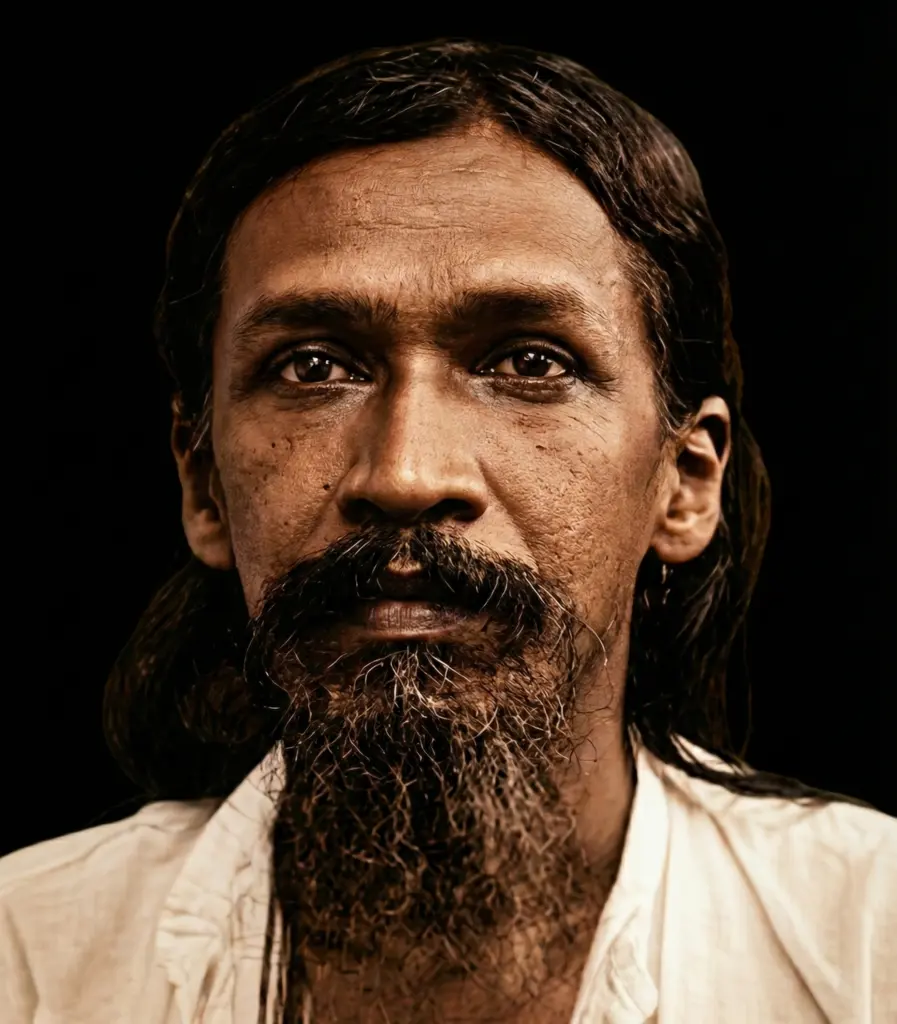
Birth and Early Childhood (1872–1879)
Birth: Sri Aurobindo was born as Aurobindo Ghose on August 15, 1872, in Calcutta (Kolkata), Bengal.
Significance of Date: His birthday would later become India’s Independence Day (August 15, 1947), a coincidence he described as a “divine sanction.”
Father: Dr. Krishna Dhan Ghose was a brilliant civil surgeon. He was a confirmed Anglophile who believed British culture was superior to Indian culture. He wanted his children raised as English gentlemen, completely insulated from Indian influence.
Mother: Swarnalata Devi, the daughter of the famous social reformer Rajnarayan Bose.
Early Education: At the age of five, Aurobindo was sent to the Loreto Convent School in Darjeeling, a school almost exclusively for British children.
The English Phase: Complete Westernization (1879–1893)
In 1879, Dr. Ghose took his three sons to England. He left them with a clergyman in Manchester with strict instructions: they were not to be allowed to make friends with Indians or learn about Indian religion.
Manchester (1879–1884): Aurobindo was educated at home. He learned Latin and French at a very young age and became a voracious reader, absorbing Shakespeare, Shelley, and Keats.
St. Paul’s School, London (1884–1890): The headmaster was impressed by Aurobindo’s brilliance and taught him Greek. He won the Butterworth Prize for literature and the Bedford Prize for history. During this time, he began writing poetry.
Cambridge University (1890–1892): He won a scholarship to King’s College, Cambridge. He excelled in the Classics (Greek and Latin) and passed the high-level Tripos.
The ICS Rebellion: His father wanted him to join the Indian Civil Service (ICS), the administrative steel frame of the British Empire.
Aurobindo passed the difficult written exams with a high rank.
However, he had no desire to serve the British. He deliberately disqualified himself by refusing to attend the mandatory horse-riding test. This was his first act of passive resistance.
The Baroda Period: Re-Indianization (1893–1906)
In 1893, at the age of 21, Aurobindo returned to India. As he stepped onto the soil at Apollo Bunder in Bombay, he experienced a “vast calm” and spiritual silence descending upon him—his first spiritual experience, though he did not label it as such at the time.
Service: He joined the state service of the Maharaja of Baroda (Sayajirao Gaekwad III). He worked in the Revenue Department and later became a Professor of English and Vice-Principal at Baroda College.
Self-Study: Realizing he was a stranger in his own land, he began an intense program of self-education.
He learned Sanskrit, Bengali, Marathi, and Gujarati.
He read the Ramayana, Mahabharata, Upanishads, and works of Kalidasa.
This period produced his early literary works, including plays like Vasavadutta and narrative poems like Urvasie.
Political Awakening: He began writing anonymous articles (titled New Lamps for Old) in the journal Indu Prakash, severely criticizing the Indian National Congress for its “mendicant policy” (begging the British for small reforms).
The Revolutionary Leader (1906–1910)
In 1905, the British Viceroy Lord Curzon partitioned Bengal, igniting a firestorm of protest. Aurobindo left his comfortable job in Baroda to jump into the freedom struggle in Calcutta.
The Leader of the Extremists: He joined the “Extremist” (Nationalist) faction of the Congress, alongside Bal Gangadhar Tilak and Bipin Chandra Pal (Lal-Bal-Pal).
Journalism: He became the editor of the English daily Bande Mataram. His editorials were fiery, intellectual, and inspiring. He was the first leader to publicly demand Purna Swaraj (Complete Independence), not just colonial self-government.
The Alipore Bomb Case (1908): The police raided his brother Barin’s revolutionary center. Although Aurobindo was not directly involved in making bombs, he was considered the “brain” behind the movement. He was arrested and charged with conspiracy to wage war against the King.
The Jail Experience: The Spiritual Turning Point (1908–1909)
Aurobindo spent one year in solitary confinement in the Alipore Jail. This year transformed him from a politician into a sage.
The Gita in Practice: He practiced the Yoga of the Bhagavad Gita intensely in his cell.
The Vision: He had a profound vision of Vasudeva (Krishna). He saw that the jail walls, the tree in the courtyard, the thief in the next cell, the guards, and even the judge were all forms of Narayana (God).
The Voice: He heard the voice of Swami Vivekananda (who had died in 1902) guiding him on higher planes of consciousness.
Acquittal: He was defended by the brilliant lawyer C.R. Das. In a famous speech, Das prophesied that Aurobindo would one day be looked upon as the “poet of patriotism, the prophet of nationalism, and the lover of humanity.” He was acquitted in May 1909 due to lack of evidence.
The Sage of Pondicherry (1910–1950)
Upon release, he briefly continued his political work (editing the Karmayogin), but the British were planning to deport him. In 1910, obeying a specific inner spiritual command (Adesh), he secretly sailed to Pondicherry, a French colony in South India, to escape British jurisdiction and focus entirely on his spiritual work.
1. The “Arya” Period (1914–1921) For the first few years, he lived in simplicity with a few young disciples. In 1914, he began publishing a philosophical monthly called Arya. Over the next seven years, he wrote almost all his major works in serial form, including:
The Life Divine: His magnum opus on metaphysics and evolution.
The Synthesis of Yoga: A guide to his “Integral Yoga.”
Essays on the Gita.
The Human Cycle (Social philosophy).
2. The Mother In 1914, Mirra Alfassa (a French woman of great spiritual depth) met Sri Aurobindo. She recognized him as the guide she had seen in her visions. She returned permanently in 1920. Sri Aurobindo acknowledged her as his spiritual equal and collaborator, referring to her as “The Mother.” She took charge of the daily life of the disciples, leading to the formation of the Sri Aurobindo Ashram.
3. The Day of Siddhi (November 24, 1926) Sri Aurobindo experienced a major realization—the descent of the “Overmind Krishna consciousness” into the physical body. Following this, he withdrew into complete seclusion to concentrate on the descent of the Supermind (a consciousness higher than the Overmind) which he believed was necessary to transform human life on earth. He communicated with disciples mostly through letters (thousands of which were later published).
4. Savitri During his seclusion, he worked on his epic poem, Savitri: A Legend and a Symbol. Spanning nearly 24,000 lines, it is the longest epic in English. It is considered a “spiritual autobiography,” describing the soul’s journey through various planes of existence to conquer death.
Philosophy: Integral Yoga
Sri Aurobindo’s philosophy is unique because it is life-affirming.
Traditional Yoga: Often seeks Moksha (liberation)—escaping the cycle of birth and death to merge into Nirvana.
Integral Yoga: Seeks Transformation. Sri Aurobindo argued that “All Life is Yoga.” The goal is not to escape the world, but to bring the Divine Consciousness down into the world to transform matter, life, and mind.
Evolution: He taught that man is a “transitional being.” Just as the ape evolved into man, man is destined to evolve into a Supramental Being (or Gnostic Being).
Final Years and Passing
World War II: Despite his opposition to the British Empire, Sri Aurobindo publicly supported the Allies during WWII. He saw Hitler and Nazism as dark, “Asuric” forces that threatened the spiritual evolution of humanity.
Independence: On August 15, 1947, India became free. In a radio message, Sri Aurobindo noted the significance of this happening on his 75th birthday, seeing it as a seal of the Divine on his work.
Mahasamadhi: Sri Aurobindo left his body on December 5, 1950. His body lay in state for four days without any signs of decomposition and emitting a golden glow. On December 9, he was interred in the Ashram courtyard.
Legacy
His work was continued by The Mother, who founded Auroville (the City of Dawn) in 1968 as an international experiment in human unity. Sri Aurobindo remains a towering figure—a revolutionary who fought for India’s freedom and a Rishi who charted the future evolution of humanity.
Themes
Love as Transformation
Love in the play works like a spiritual fire that changes everyone it touches.
Vuthsa arrives in Avunthy as a captive king, but love turns him into a fearless hero who can challenge armies for Vasavadutta. She too changes—from a proud princess trained to use her beauty for politics into a woman who follows her heart with total surrender. Their relationship reveals new depths of tenderness, passion, and strength. Even Munjoolica, driven first by jealousy and revenge, becomes an active supporter of their union. This theme shows Sri Aurobindo’s belief that love is not weakness but a divine force that brings out the highest in human nature.
Duty vs Desire
Every major character faces the struggle between duty and personal desire.
Vasavadutta’s duty as a princess is to obey her father, yet her desire pulls her irresistibly to Vuthsa. Vuthsa’s duty as king is to his people, yet his love drives him into danger and secrecy. Vicurna’s duty as Mahasegn’s son conflicts with his desire to save his sister and honour true heroism. Even Gopalaca feels torn between loyalty to his father and affection for Vuthsa. This conflict creates much of the drama and shows that real life is complex—duty cannot be rigid, and the heart cannot be silenced. Sri Aurobindo suggests that higher duty often lies in following the truth of love and justice.
Ideal Heroism
The play glorifies an older world filled with warrior ethics, nobility, and moral grandeur.
Vuthsa is the ideal hero—brave in battle, noble in speech, gentle in love, and spiritually elevated. Vasavadutta, though not a warrior, is heroic in her passion, loyalty, and fearlessness. Vicurna’s moral courage shines when he defies his father to help the lovers escape. Even Gopalaca, who first captures Vuthsa, ultimately acts with generosity and dignity. Sri Aurobindo presents heroism not just as physical bravery but as the ability to act with honour, love, and greatness of spirit. This theme gives the play an epic, romantic atmosphere.
Destiny and the Divine Will
A subtle but powerful theme is the presence of destiny guiding events.
Vuthsa repeatedly speaks of an unseen divine Will shaping human paths. The lovers’ meeting, their captivity, the escape, and even the interventions of helpers all feel preordained. Delays turn into advantages; dangers open new paths; enemies inadvertently help the destined union. Sri Aurobindo shows that life is not random—a higher force works through human choices, struggles, and accidents. The final union of Vuthsa and Vasavadutta feels like the fulfilment of cosmic intention, not just human effort.
Power of the Feminine
Women in the play are not secondary figures; they are the driving power of the story.
Vasavadutta is the emotional and spiritual centre, the force around which all action revolves. Her love empowers Vuthsa and even overwhelms Mahasegn’s political ambitions. Ungarica represents deep feminine wisdom—she understands the heart more clearly than logic can. Munjoolica, though a servant, shapes crucial events with her intelligence, daring, and emotional insight. Sri Aurobindo shows the feminine as Shakti—creative, intuitive, passionate, and transformative. The title itself honours this theme: the play belongs to Vasavadutta, symbol of divine feminine force.
Style
English Blank Verse with an Indian Soul
The most striking feature of the play is that it is written in Blank Verse (unrhymed iambic pentameter). This is the same meter used by Shakespeare and Milton. However, Sri Aurobindo adapts this quintessential English form to express a distinctly Indian consciousness.
The Rhythm: The verse flows with a lyrical, musical quality rather than the heavy, dramatic crunch often found in Elizabethan drama. It is smooth and fluid, mirroring the personality of the hero, Vuthsa.
The Fusion: Critics often remark that Sri Aurobindo successfully fuses the Elizabethan dramatic form with the Sanskrit aesthetic. The structure (5 acts) is Shakespearean, but the mood, metaphors, and sensibilities are pure Sanskrit.
The Influence of Sanskrit Aesthetics (Rasa)
Although written in English, Vasavadutta feels like a classical Sanskrit drama (Nataka). It is governed by the theory of Rasa (aesthetic flavor).
Sringara Rasa (The Erotic/Romantic): The dominant mood of the play is Love. The dialogue between Vuthsa and Vasavadutta is not just romantic interaction but a poetic exploration of the soul of love. It focuses on beauty, longing, and union.
Vira Rasa (The Heroic): The play also contains the flavor of Heroism, but of a unique kind. It is not just the noisy heroism of battle (Mahasegn), but the spiritual heroism of Vuthsa—daring, calm, and chivalrous.
Absence of Tragedy: Unlike Western drama which often leans toward tragedy (hubris leading to downfall), this play follows the Indian tradition where order is restored and the ending is harmonious (Mangala).
Poetic Imagery and Nature Symbolism
Sri Aurobindo was a poet before he was a playwright, and this shows in the rich imagery used throughout the text. The dialogue is dense with metaphors drawn from nature.
Nature as a Mirror: The emotions of the characters are constantly reflected in nature. Vuthsa is compared to the moon (gentle, glowing), while Mahasegn is compared to iron or a storm.
Floral Imagery: Flowers are a recurring motif representing Vuthsa’s world of delight. The “jasmine,” the “lotus,” and the “forest glades” are used to contrast against the “stone” and “swords” of Ujjayiny.
Light and Shadow: The interplay of light (knowledge/love) and shadow (ignorance/ego) is constant. The escape takes place in the moonlight, symbolizing that it is an act of the enlightened soul, not a deed of darkness.
Contrast in Dialogue
Sri Aurobindo uses style to differentiate character. The way characters speak reveals their inner nature.
Mahasegn’s Speech: His lines are hard, monosyllabic, and forceful. He uses words related to war, crushing, breaking, and ruling. His rhythm is staccato and commanding.
Example: “The boy must fall… I have a way, Not noble like the sounding paths of war.”
Vuthsa’s Speech: His lines are fluid, polysyllabic, and melodious. He speaks in images and questions. His rhythm is like a song.
Example: “Music is sweet, but sweeter still is ruling the deep chords of the human heart.”
Vasavadutta’s Speech: Her speech evolves. In the beginning, she speaks with the sharp, haughty tone of her father. As she falls in love, her language becomes softer, more hesitant, and finally, lyrically submissive.
Psychological Depth vs. Action
The style of Vasavadutta is psychological rather than action-heavy.
Internal Drama: Much of the “action” happens inside the minds of the characters. The most intense scenes are not the sword fights, but the conversations where Vasavadutta struggles with her pride.
Static Plotting: The first few acts move slowly, focusing on conversation and atmosphere. The pace accelerates only in Act 5 (The Escape). This reflects Sri Aurobindo’s belief that true change happens in the consciousness first, and the physical result follows later.
The style of Vasavadutta is Romantic in the highest sense. It elevates human passion to a spiritual level. It is a “Dramatic Romance” where the tool of expression is English, but the spirit, the imagery, and the emotional landscape are deeply Indian.
Symbolism
The play is not just a historical romance; it is a symbolic drama about the evolution of the human soul. Sri Aurobindo uses characters and settings to represent spiritual forces and psychological states.
The Two Kingdoms (Conflicting Worlds)
The two rival cities represent two different states of consciousness or stages of human evolution.
Ujjayiny (The World of Iron):
Symbolizes: Material Power, Ego, and Struggle.
It is the kingdom of King Mahasegn. It represents the “Iron Age”—a place ruled by rigid laws, military strength, ambition, and the desire to dominate others. It is solid and strong, but lacks joy and freedom.
Cowsamby (The World of Gold):
Symbolizes: Spiritual Delight, Art, and Harmony.
It is the kingdom of King Vuthsa. It represents the “Golden Age” (or Satya Yuga)—a place where culture, music, beauty, and love are more important than war. It represents a higher state of civilization where power is soft and attractive, not hard and coercive.
The Main Characters (Spiritual Forces)
Each main character represents a fundamental cosmic force or a part of the human being.
Vuthsa (The Divine Spirit / Ananda):
Symbolizes: The Divine Delight (Ananda) and the Soul (Purusha).
Vuthsa is not “weak”; he is the spirit of Joy that sustains the universe. He represents the truth that you don’t need to fight to win; you only need to be. His music represents the harmony of the universe. He is the “Golden God” who comes to awaken the sleeping soul.
Vasavadutta (The Awakening Soul / Prakriti):
Symbolizes: Nature (Prakriti) or the Human Soul.
She starts as the daughter of the “Iron King,” representing the soul trapped by pride, ego, and social conditioning. Her journey from arrogance to submission represents the soul’s journey: it must break free from the hard shell of the ego to unite with the Divine Spirit (Vuthsa). Her “abduction” symbolizes the soul being seized by the Divine.
King Mahasegn (The Titan / The Ego):
Symbolizes: The Asura (Titan) or the Intellectual Will.
He represents the force of the Ego that wants to control everything. He thinks he is the master of destiny. He symbolizes the “Hard Power” that tries to conquer the world through force. He is necessary for the story (the obstacle), but he is ultimately destined to fail against the power of Love.
Queen Ungarica (The Divine Mother / Intuition):
Symbolizes: Spiritual Knowledge (Vidya) and Intuition.
She sits between the two worlds. She understands the material world of her husband, but she belongs to the spiritual world. She represents the “Silent Guide” or the Divine Mother who quietly arranges circumstances so that the soul (Vasavadutta) can find the spirit (Vuthsa).
The Supporting Characters (Faculties of Man)
The minor characters represent different parts of human nature that help the soul on its journey.
Gopalaca (The Mind):
He represents the Pragmatic Intellect. He follows rules, obeys his father, and uses logic. He is dutiful but lacks the “fire” of rebellion. He accepts the marriage only when it makes political sense.
Vicurna (The Heart/Vital):
He represents the Emotional Will or the Vital Force. He is impulsive, passionate, and rebellious. He hates injustice and loves heroism. He represents the energy in us that fights for freedom and truth, even against authority.
Munjoolica (The Shakti / Action):
She represents Dynamic Energy (Shakti). She is the one who acts. While Vuthsa dreams and Vasavadutta hesitates, Munjoolica drives the chariot. She represents the active force required to turn a spiritual realization into a physical reality.
Objects and Actions
The Golden Cage:
Mahasegn keeps Vuthsa in a luxurious palace, which Vuthsa calls a “golden cage.” This symbolizes Attachment to Pleasure. Even though the cage is beautiful, it is still a prison. Vuthsa must choose to leave the comfort of the cage to gain true freedom.
The Lute / Music:
Music symbolizes Harmony and Spiritual Vibration. It is the weapon Vuthsa uses to conquer hearts. It suggests that the world is not just matter (Iron) but vibration and spirit.
The Abduction (Rakshasa Marriage):
The fact that Vuthsa steals Vasavadutta away is highly symbolic.
It means that Truth cannot be negotiated. You cannot ask the Ego (Mahasegn) for permission to be free. The Soul (Vasavadutta) must be snatched away from the Ego by the Divine Hero (Vuthsa) through a daring act of will.
Historical Context
The Ancient Historical Setting
The play is not a fantasy; it is based on real historical figures and geography from Ancient India, blended with centuries of romantic legend.
The Period of the Mahajanapadas (6th Century BCE):
The story is set during the era of the 16 Mahajanapadas (Great Kingdoms), a time when powerful states were fighting for supremacy over North India. This was the same era when Gautama Buddha lived and preached.
The two rival kingdoms in the play—Avunthy (Avanti) and Cowsamby (Vatsa)—were real, powerful states.
Ujjayiny (Ujjain) and Cowsamby (Kaushambi) were major thriving cities, known for their wealth and trade.
The Real King Udayana:
Vuthsa (Udayana) was a real historical king of the Vatsa kingdom. He was a contemporary of the Buddha.
In history and legend, Udayana is famous not as a great conqueror, but as a romantic hero known for his skill with elephants and his love for music (the lute).
His elopement with Princess Vasavadutta (the daughter of his rival, King Pradyota/Mahasegn of Avanti) is one of the most famous love stories in Indian literature, comparable to Romeo and Juliet or Paris and Helen, but with a happy ending.
Literary Sources:
Sri Aurobindo did not invent the plot. He adapted it from the Kathasaritsagara (Ocean of the Streams of Story) by Somadeva (11th Century), which contains the cycle of Udayana legends.
The story was also the subject of famous Sanskrit plays by Bhasa (e.g., Svapnavasavadattam), though Sri Aurobindo’s version focuses on the earlier part of the tale (the courtship and elopement).
The Author’s Biographical Context (1915)
The play was written in 1915, a crucial transition period in Sri Aurobindo’s life. Understanding this explains why he wrote the play the way he did.
From Revolutionary to Sage:
Sri Aurobindo had just left active politics (1910) and moved to Pondicherry to escape British persecution.
He had transitioned from being the leader of a violent revolution against the British to a spiritual explorer developing “Integral Yoga.”
Contextual Influence: The play reflects this shift. Vuthsa wins not by “war” (politics/revolution) but by “spiritual delight” (Yoga). Vuthsa is, in a way, an image of the spiritual warrior Sri Aurobindo was becoming—one who conquers the world through inner power rather than outer force.
World War I (1914–1918):
The play was written while WWI was raging in Europe. The character of Mahasegn—the “Iron King” who believes in force and world domination—can be seen as a critique of the aggressive, imperialistic mindset that caused the World War.
Aurobindo contrasts this “Iron Age” of militarism with Vuthsa’s “Golden Age” of culture and harmony.
The Indian Renaissance:
Sri Aurobindo was a key figure in reviving Indian culture. By writing this play in English, he was translating the soul of India (Sanskrit aesthetics) for a modern audience. He wanted to show that Indian heroes were not just muscle-bound warriors, but men of high culture, art, and spirituality.
Very Short Answer Questions
Who is the author of the play Vasavadutta?
The play was written by Sri Aurobindo.
When was the play Vasavadutta first published?
It was published posthumously in 1957.
Which ancient text serves as the primary source for the plot of Vasavadutta?
The plot is based on the Kathasaritsagara by Somadeva.
Who is the hero of the play and which kingdom does he rule?
The hero is Vuthsa (Udayana), the King of Cowsamby.
Who is the “Iron King” in the play?
King Mahasegn of Avunthy is characterized as the “Iron King” representing force and ego.
What is the primary political ambition of King Mahasegn?
He wishes to subjugate Cowsamby and unite the empire under his rule.
How is King Vuthsa captured in the forest?
He is captured through a trap set by Mahasegn involving a wooden elephant.
What is the specific role assigned to Vuthsa during his captivity?
He is appointed to be the servant and music teacher to Princess Vasavadutta.
Who is Munjoolica in reality?
She is the captive Princess of Sourashtra serving as Vasavadutta’s maid.
What does the character of Vasavadutta symbolize in the play?
She symbolizes the human soul (Prakriti) evolving from egoistic pride to spiritual surrender.
Who is Queen Ungarica?
She is Mahasegn’s wife and a spiritual seer who represents intuition and destiny.
Which brother of Vasavadutta helps the lovers escape?
Vicurna, the younger brother, helps them escape because he values honor over trickery.
What is the central philosophical theme of the play?
The central theme is the triumph of Love (soft power) over Force (hard power).
In which literary meter is the play written?
The play is written in English Blank Verse (unrhymed iambic pentameter).
What does the “Golden Cage” refer to in the play?
It refers to Vuthsa’s luxurious captivity within Mahasegn’s palace.
Who mediates the peace between the two armies at the end of the play?
Gopalaca, Mahasegn’s elder son, negotiates the peace and accepts the marriage.
What dominant “Rasa” (aesthetic flavor) governs the play?
The play is governed by Sringara Rasa (the mood of romantic love).
Why does Vuthsa refuse to ask Mahasegn for Vasavadutta’s hand in marriage?
He believes a hero should take his bride by his own daring will, not by begging.
What historical period is the play set in?
It is set in ancient India during the era of the Mahajanapadas (around the 6th Century BCE).
What ultimately defeats Mahasegn’s plans?
The power of Love, which captures his daughter’s heart, defeats his plans of military domination.
Short Answer Questions
How does King Vuthsa’s approach to power differ from King Mahasegn’s?
Vuthsa represents the power of delight and attraction, believing that true conquest comes from winning hearts rather than forcing submission. Unlike Mahasegn, who relies on military might, strategies (“crooked ways”), and an “iron” will to dominate, Vuthsa trusts in the “secret law” of the universe and the power of love. Mahasegn attempts to capture Vuthsa’s physical body to make him a vassal, but Vuthsa ultimately captures the souls of his enemies through his charm and inner divinity. Vuthsa’s strength is “soft power,” which proves superior to Mahasegn’s “hard power”.
What is the significance of the “Golden Cage” metaphor used by Vuthsa?
Vuthsa uses the metaphor of the “Golden Cage” to describe his captivity in Mahasegn’s luxurious palace in Avunthy. While he is treated with honor and surrounded by wealth to seduce him into submission, he recognizes that he is still a prisoner deprived of his freedom and sovereign power. He refuses to be content with this “wealth inert” and warns Gopalaca that he will break free, proving that material comfort cannot replace the liberty of the soul or the dignity of his kingship.
Describe the transformation of Vasavadutta’s character throughout the play.
Vasavadutta begins as a proud, imperial princess who views Vuthsa as a slave to be ruled, echoing her father’s arrogant will and desire for domination. However, as she interacts with Vuthsa, her “iron” pride melts into the “fire” of love, leading to a profound spiritual awakening and internal conflict. She eventually sheds her ego, rebels against her father’s authority, and surrenders completely to Vuthsa, evolving from a tool of political ambition into a free soul united with its divine counterpart.
What role does Queen Ungarica play in the unfolding of the drama?
Queen Ungarica acts as a spiritual seer and the silent guide behind the events, perceiving the deeper spiritual truths that her husband, Mahasegn, is blind to. She recognizes Vuthsa’s divine nature and predicts his ultimate victory, warning Mahasegn that he cannot fight against the true forces of life. She subtly encourages Vasavadutta to follow her heart rather than statecraft, ensuring that the union of the two lovers fulfills a higher cosmic destiny rather than just a political arrangement.
Why does Vuthsa refuse to ask Mahasegn for Vasavadutta’s hand in marriage?
Vuthsa refuses to beg for Vasavadutta because he believes that “heroes’ children” do not wed through diplomacy or by asking for permission like a “poor Brahmin”. He adheres to the heroic code where the bride is seized by force and mutual daring, valuing the “free interchange of looks and hearts” over formal negotiations. He values the dignity of his lineage and insists that their union must be an act of free will and bold action, preserving his honor as an independent king.
How does the character of Munjoolica contribute to the plot?
Munjoolica serves as the dynamic catalyst for action, moving the plot forward when the main characters hesitate or are trapped in indecision. As a captive princess herself, she seeks revenge against her captors by aiding Vuthsa, using her wit to manipulate events, such as locking the lovers together to force a confession of love. She organizes the practical details of the escape, driving the chariot herself, and represents the active energy (Shakti) required to manifest the lovers’ spiritual union in the physical world.
Explain the symbolic meaning of the conflict between Ujjayiny and Cowsamby.
The conflict symbolizes the clash between two opposing forces: the “Iron” force of material power represented by Ujjayiny and the “Golden” force of spiritual delight represented by Cowsamby. Ujjayiny, ruled by Mahasegn, stands for ego, rigid control, and military aggression, while Cowsamby, ruled by Vuthsa, stands for art, beauty, and harmony. The eventual union of the lovers signifies the reconciliation of these forces, suggesting that true power lies in the integration of strength and love rather than in domination alone.
What is the role of Vicurna in the escape plan?
Vicurna, the romantic idealist and younger brother of Vasavadutta, plays a crucial role by providing the physical means for the lovers’ escape. Disgusted by his father’s treachery, he prioritizes honor and friendship over blind obedience, guiding the lovers through secret forest paths and protecting them with his own chariot. His rebellion highlights the theme that loyalty to truth and noble friendship is superior to loyalty to unjust authority or family lineage.
How does the play reinterpret the concept of “Fate” or “Destiny”?
The play presents Fate not as a fixed doom, but as a “secret law” or “huge spirit” that works behind human actions to achieve a divine purpose. While Mahasegn believes he can dictate history through strategy, his actions unknowingly fulfill a greater cosmic design foreseen by Ungarica. The play suggests that human arrogance often blinds one to this divine will, and true wisdom lies in aligning oneself with the deeper, harmonious flow of destiny as Vuthsa does.
What is the significance of the final scene where Gopalaca accepts the marriage?
Gopalaca’s acceptance marks the transition from conflict to harmony and the triumph of “noble gambling” in statecraft. By acknowledging that Vuthsa won the “throw of dice” fairly through heroism rather than deceit, Gopalaca establishes peace between the rival nations and sanctions the marriage. This resolution reinforces the play’s message that acknowledging the truth and embracing love is more honorable than clinging to wounded pride or enforcing a failed political agenda.
Long Answer Questions
Contrast the characters of King Mahasegn and King Vuthsa. How does their conflict represent the clash between “Force” and “Delight”?
King Mahasegn and King Vuthsa represent two diametrically opposing worldviews in the play, symbolizing the conflict between the “Iron” age of force and the “Golden” age of delight. Mahasegn is characterized as the “Titan” or Asura, a ruler who believes in the supremacy of human will, military strategy, and rigid control. He views the world as a battlefield where destiny is written by the strong, declaring, “My own mind’s my seer”. His primary method of operation is domination; he seeks to subjugate Cowsamby and other nations to his “iron will,” viewing Vuthsa’s artistic nature and love for beauty as weaknesses to be exploited.
In sharp contrast, Vuthsa (Udayana) embodies the principle of Ananda (Divine Delight) and spiritual grace. He appears to his enemies as a “luxurious boy” who wastes time with music and flowers, but this passivity masks a deep, intuitive trust in the cosmic order. Unlike Mahasegn, who strives to conquer through aggression, Vuthsa conquers through assimilation and charm, moving through life “as lightly… as moonbeam feet”. He does not rely on the “sounding paths of war” but on the “living voices of the harp” and the power of love to turn enemies into friends.
The conflict between them arises when Mahasegn attempts to impose his “Hard Power” upon Vuthsa’s “Soft Power.” Mahasegn captures Vuthsa’s physical body through a treacherous trap, believing that imprisonment will break the young king’s spirit and make him a vassal. However, Mahasegn fails to understand that Vuthsa’s power lies in a “kingship which exceeds the king”—a spiritual sovereignty that cannot be caged by walls or threats. While Mahasegn controls Vuthsa physically, Vuthsa subtly takes control of the spiritual atmosphere of Mahasegn’s own palace, charming the princes and the princess.
Ultimately, the play demonstrates the superiority of Vuthsa’s philosophy. Mahasegn’s rigid reliance on force backfires; his plan to use his daughter as bait results in her defecting to Vuthsa’s side. Vuthsa proves that true victory comes not from destroying the opposition, but from harmonizing with it. He wins not by defeating Mahasegn in a bloodbath, but by stealing the “jewel” of his house and forcing a marriage alliance that unites the two kingdoms in peace. The resolution signifies that while Force can command obedience, only Delight can command loyalty and love.
Trace the psychological and spiritual evolution of Vasavadutta from a proud princess to a surrendered queen.
Vasavadutta’s journey is the central psychological arc of the play, representing the evolution of the human soul (Prakriti) from egoistic pride to spiritual surrender. At the beginning of the play, she is introduced as a mirror of her father, King Mahasegn—proud, imperial, and fully conscious of her status as the daughter of the world’s most powerful monarch. When her father commands her to enslave Vuthsa using her beauty, she accepts the task readily, viewing Vuthsa not as a person but as a “slave” and a “toy” to be manipulated for the glory of her house. Her initial interactions with him are marked by haughtiness; she commands him to lower his eyes and demands his kingdom as a tribute to her power.
However, as she interacts with Vuthsa, her rigid exterior begins to crack. Vuthsa’s refusal to be cowed, combined with his immense charm and the “witchery” of his voice, awakens a dormant “fire” within her. She finds herself confused by her own feelings, oscillating between the desire to rule him and an overwhelming urge to yield to him. She admits to her mother, Queen Ungarica, that she is tormented by a conflict between her “immortal part” which wills to love, and her “mortal pride” which resists. This stage of her evolution is characterized by internal struggle, where she tries to maintain her dominance even as her heart begins to betray her.
The turning point occurs when she visits the sleeping Vuthsa, urged on by the maid Munjoolica. Seeing him vulnerable and beautiful, her maternal and protective instincts are awakened, and she realizes the depth of his isolation. Overcome by a “strength to love of gods,” she makes a silent vow to be everything to him—wife, mother, friend, and queen—marking the death of her selfish ego. She moves from wanting to possess him for political power to wanting to serve him with “divine strength”.
Her final transformation is completed during the escape. She makes the radical choice to rebel against her father, effectively severing her ties with her old life and identity to embrace her destiny with Vuthsa. By the time they reach the border, she has fully accepted her role not just as a monarch, but as Vuthsa’s “Shakti”—a partner in a spiritual union where two bodies share “one large soul”. She ends the play as a “Queen” in the truest sense, having won her crown through the “desperate alarms” of love and courage rather than inheritance.
Discuss the theme of Destiny versus Human Will in the play, specifically through the characters of Ungarica and Mahasegn.
The play presents a continuous interplay between the arrogance of Human Will and the inevitability of Destiny (or Nature). King Mahasegn represents the illusion of Human Will. He suffers from hubris, believing that he can dictate the course of history through strategy and force. He constructs an elaborate plan to capture Vuthsa and arrange a marriage that will subjugate Cowsamby, convinced that his “own mind” is his only seer. He dismisses the unseen forces of fate, believing that “grown minds keep to earth’s more humble sureness” and that he can force the gods to align with his ambition.
In contrast, Queen Ungarica serves as the voice of Destiny and Intuition. She constantly warns Mahasegn that he is “blinded by the sun” of his own power and cannot see the subtle truths of the world. She perceives that Vuthsa is protected by a destiny greater than Mahasegn’s armies and that the “fathomless desire of some huge spirit” is the secret law of the universe. While Mahasegn plots to use Vuthsa as a tool, Ungarica quietly observes that Mahasegn is actually fulfilling a divine plan he does not understand—bringing the lovers together so they can unite the empires.
The irony of the play lies in how Mahasegn’s exertion of will leads to the exact opposite of his intentions. He brings Vuthsa to Ujjayiny to enslave him, but this action provides the proximity needed for Vuthsa to capture Vasavadutta’s heart. Gopalaca eventually recognizes this irony, admitting to his father that they “chose the throw of dice and lost,” and urging him to accept “God’s hostile chance” like a noble gambler. This realization underscores the theme that human beings are often puppets of a “silent Will” that moves behind their acts.
Ultimately, the play suggests that true wisdom lies in aligning oneself with Destiny rather than fighting it. Vuthsa succeeds because he accepts whatever state the “wiser gods provide,” floating on the current of fate rather than swimming against it. Mahasegn’s eventual acceptance of the marriage signifies the submission of the Titan’s ego to the greater cosmic design foreseen by Ungarica, proving that while man may propose, the Divine disposes.
How does Sri Aurobindo redefine the concept of “Heroism” through the character of Vuthsa?
In Vasavadutta, Sri Aurobindo challenges the traditional definition of heroism, which is usually associated with martial prowess, aggression, and physical dominance. Characters like the captain Rebha and King Mahasegn represent this old view; they dismiss Vuthsa as a “boy” and “unwarlike” because he prefers music to war and seems passive in the face of danger. They mistake his lack of aggression for a lack of strength, failing to see the “hidden greatness” within him.
Vuthsa redefines heroism as a spiritual quality involving self-mastery, charm, and the courage to remain true to one’s nature. His heroism is characterized by “Action in Non-Action.” He walks into the enemy’s trap with his eyes open, trusting in his destiny, which requires a immense inner confidence. Even in prison, he does not act like a victim but like a king, maintaining his dignity and refusing to compromise the “majesty” of Cowsamby. His ability to “rule the heart’s rich chords” is presented as a “sweeter” and more difficult conquest than ruling territory.
However, Vuthsa also proves that his softness is not weakness. When the moment for the escape arrives, he sheds his lethargy and acts with “headlong, subtle, rash” daring. He refuses the safe, diplomatic option of asking Mahasegn for Vasavadutta’s hand, declaring that “heroes’ children” do not beg but take their prize by “noble violence”. He chooses the dangerous path of breaking through the hostile gates, believing that true union requires a “free interchange of looks and hearts” cemented by shared danger.
Thus, Vuthsa represents the “Complete Man” or the Aryan ideal, balancing the feminine aspects of culture, art, and love with the masculine aspects of will and courage. He shows that a hero can be a lover of beauty and a warrior simultaneously. His victory is not a triumph of the sword, but a triumph of the spirit, proving that the highest form of heroism is to harmonize opposing forces rather than to destroy them.
Analyze the role of the supporting characters—Munjoolica and Vicurna—in the resolution of the plot.
Munjoolica and Vicurna act as the essential catalysts for the plot, transforming the internal desires of the main characters into external action. While Vuthsa dreams and Vasavadutta hesitates, Munjoolica represents the Shakti (dynamic energy) that drives the narrative forward. As a captive princess herself, she harbors a deep resentment against Mahasegn’s house, which fuels her desire to aid Vuthsa. She is the one who orchestrates the pivotal moment in the tower, pushing Vasavadutta into the room and locking the door to force a confrontation of feelings. Without her daring intervention and practical planning—from getting the guards drunk to driving the chariot—the spiritual union of the lovers would never have materialized in the physical world.
Vicurna, Vasavadutta’s younger brother, represents the spirit of youthful idealism and rebellion against unjust authority. He is disgusted by his father’s “crooked ways” and the dishonorable trap set for Vuthsa, believing that “empires” should not be built on shame. His role is crucial because he provides the physical means for the escape, betraying his father to uphold the higher Dharma of friendship and honor. He guides the lovers through the secret forest breach and holds off the pursuing captain, Rebha, allowing Vuthsa to escape.
Both characters serve as active agents of the “Golden” world working within the “Iron” world of Ujjayiny. They represent the theme that loyalty to Truth and Love supersedes loyalty to blood or state. Their actions highlight the play’s endorsement of “righteous rebellion.” Munjoolica rebels against her servitude, and Vicurna rebels against his father, yet both are portrayed as noble figures who help restore the cosmic balance.
In the resolution, their fates are sealed by their choices. Munjoolica earns her freedom and a place of honor in Cowsamby, fulfilling her desire for revenge and status. Vicurna accepts exile with joy, preferring the adventure and “right” of Vuthsa’s company over the compromised morality of his father’s court. Together, they ensure that the static situation of the imprisonment is broken, leading to the dynamic resolution of the marriage and peace between the kingdoms.
Critical Analysis
Introduction
Vasavadutta is a “Dramatic Romance” written by Sri Aurobindo in 1915. Although written early in his literary career during his initial years in Pondicherry, it remained unpublished until 1957, seven years after his passing.
The play belongs to a specific genre of Sri Aurobindo’s writings where he reinterprets ancient legends to convey modern spiritual truths. It is a five-act play written in English Blank Verse (unrhymed iambic pentameter). While the narrative backbone is drawn from the Kathasaritsagara (“Ocean of the Streams of Story”) by Somadeva and shares roots with Bhasa’s Sanskrit classic Svapnavasavadattam, Sri Aurobindo’s treatment is unique. He shifts the focus from political intrigue to the psychological evolution of the characters, making it a study of how the human soul (represented by the heroine) awakens to divine love.
Central Idea
The central philosophical idea of the play is the superiority of “Soft Power” over “Hard Power.”
The Conflict: The play sets up a binary opposition between two worldviews
The Asuric (Titanic) Force: Represented by King Mahasegn, characterized by ego, military aggression, rigidity, and the desire to possess and control.
The Daivic (Divine) Delight: Represented by King Vuthsa, characterized by charm, beauty, music, flexibility, and the power to attract and assimilate.
The Resolution: Sri Aurobindo argues that true conquest is not achieved by crushing the enemy (war), but by winning their heart (love). Vuthsa’s victory is total because he turns his captors into his family, proving that Ananda (Delight) is the sustaining force of the universe, stronger than any army.
Plot Summary
Act I: The Trap King Mahasegn of Avunthy is frustrated. His dream of a unified empire is blocked by the small kingdom of Cowsamby and its young king, Vuthsa. Unable to defeat Vuthsa in battle, Mahasegn devises a treacherous plan. He sends his son, Gopalaca, to pose as an exile. Vuthsa, trusting and generous, welcomes Gopalaca. This leads to Vuthsa’s capture during a hunting expedition.
Act II: The Capture Vuthsa is captured not by strength of arms but by deceit. However, even as a prisoner, he remains cheerful and unthreatened. He accepts his captivity with a strange calm, trusting in his destiny. He is brought to Avunthy, where Mahasegn reveals his intention: Vuthsa is to be a servant to Princess Vasavadutta, Mahasegn’s proud daughter.
Act III: The Courtship This act focuses on the psychological interplay between the lovers. Vasavadutta tries to dominate Vuthsa as her slave, but his music and gentle demeanor disarm her. She finds herself unable to command him. Munjoolica (a captive princess serving as a maid) acts as a catalyst, pushing Vasavadutta to admit her feelings. The act culminates in Vasavadutta’s realization that she has fallen in love with her “slave.”
Act IV: The Awakening The emotional climax occurs here. Vasavadutta struggles between her loyalty to her father (duty) and her love for Vuthsa (soul). Vuthsa, no longer passive, demands her love not as a favor but as a right. He refuses to negotiate for his freedom; he insists on taking Vasavadutta with him. Vasavadutta finally surrenders her pride, visiting Vuthsa while he sleeps and vowing her eternal devotion.
Act V: The Escape and Resolution The lovers escape on a chariot driven by Munjoolica, aided by Vasavadutta’s rebel brother, Vicurna. Mahasegn is initially furious and orders their death. However, when the escape succeeds and Vuthsa’s armies meet them at the border, Gopalaca mediates. He convinces his father that Vuthsa has acted heroically. The play ends with the acceptance of the marriage, uniting the two rival empires in peace.
Major Themes
Love as a Transforming Power
Aurobindo presents love not as fleeting emotion but as a force that reshapes the soul. Vasavadutta, once proud and authoritative, becomes tender, selfless, and spiritually awakened. Vuthsa, who begins as a carefree youth, evolves into a courageous leader. Their union is a symbolic ascent from ego to emotional and spiritual fulfilment.
Destiny and Divine Will
Throughout the play, characters speak of unseen powers guiding events: “This world’s the puppet of a silent Will.” Vuthsa’s escape, Vasavadutta’s inner transformation, and the final reconciliation all reflect the idea that destiny works subtly through human action.
Power, Politics, and Kingship
The clash between Mahasegn’s autocratic power and Vuthsa’s nobler idea of kingship reveals Aurobindo’s political philosophy. True leadership, according to Aurobindo, is rooted in moral strength, compassion, and spiritual insight—not conquest or domination.
Freedom and Individual Will
Almost every character seeks freedom:
Vuthsa seeks freedom from captivity.
Vasavadutta seeks freedom from her father’s rigid expectations.
Vicurna seeks freedom from blind obedience.
Munjoolica seeks freedom from her past humiliation.
Aurobindo shows that freedom is essential for love, identity, and political justice.
Reconciliation of Opposites
The union of Vuthsa and Vasavadutta symbolises unity between opposing kingdoms and values—art and power, tenderness and pride, youth and duty. The play suggests that harmony, not conflict, is the natural destiny of human civilisation.
Character Analysis
Vuthsa (Udayana): He is the embodiment of Divine Grace. He does not struggle; he flows. His music is a metaphor for the harmony he brings to the world. He represents the ideal that one does not need to be aggressive to be strong.
Vasavadutta: She is the most complex character. Her journey is from Pride to Submission. She represents the resistance of the material world to the Divine, and its eventual joyful surrender.
King Mahasegn: He is the Titan (Asura). He represents the “Will to Power.” He is not evil, but he is limited. He cannot understand anything that cannot be touched, counted, or killed.
Queen Ungarica: She is the Mystic. She sees the truth that is hidden from the men of statecraft. She quietly facilitates the will of the gods, ensuring her daughter follows her heart rather than her father’s orders.
Munjoolica: She is the Shakti (Energy). While the other characters represent states of being, Munjoolica represents Action. She is the one who locks the door, drives the chariot, and forces the plot to move.
Structure and Style
A. The Blank Verse Sri Aurobindo writes in blank verse (unrhymed iambic pentameter). His style is markedly different from Shakespeare’s. While Shakespeare’s verse is dramatic and often muscular, Sri Aurobindo’s verse is mantric and lyrical. It has a flowing, musical quality that mimics the sound of the lute played by Vuthsa.
Example: “The world’s a shell, / And I the pearl of the ocean.”
B. The Rasa Theory The play is structured around the Indian aesthetic concept of Rasa (Flavor).
Sringara Rasa (Love): This is the dominant mood. The play explores all shades of love: playful, possessive, devotional, and transcendent.
Vira Rasa (Heroism): This appears in the final act during the escape, but it is subordinate to love.
C. Imagery
Iron vs. Gold: Ujjayiny is consistently described with words like “iron,” “stone,” “walls,” and “war.” Cowsamby is described with “gold,” “sunlight,” “flowers,” and “music.”
Nature: The forest and the moonlight play active roles, symbolizing the freedom of the spirit outside the “walls” of social convention.
Historical and Geographic Context
The Era: The play is set in the 6th Century BCE, the age of the Mahajanapadas (Great Kingdoms). This was a time of intense political consolidation in India.
Geography:
Avunthy (Avanti): A powerful, militaristic state in central India (modern-day Madhya Pradesh), with its capital at Ujjayiny (Ujjain).
Cowsamby (Vatsa): A rich, cultural kingdom on the banks of the Yamuna (near modern-day Allahabad/Prayagraj).
Historical Accuracy: While the romance is legendary, the political rivalry between these two specific states is a historical fact. King Udayana and King Pradyota (Mahasegn) were real contemporaries of the Buddha.
Critical Commentary
Strengths:
Psychological Depth: Unlike traditional versions of the story which focus on external events, Sri Aurobindo focuses on the internal changes in Vasavadutta’s mind.
Idealism: The play offers a refreshing, optimistic vision of human nature. Even the “villains” (Mahasegn, Gopalaca) are noble and capable of redemption. There is no pure evil, only ignorance.
Critique:
Lack of Action: A modern critic might find the middle acts (Acts 3 & 4) slow, as they consist almost entirely of dialogue and courtship without much physical movement. The “action” is internal.
Atmosphere over Conflict: The conflict is resolved relatively easily. Mahasegn accepts defeat with surprising grace, which might reduce the dramatic tension for some readers.
Conclusion
Vasavadutta is more than a love story; it is a spiritual fable. Sri Aurobindo uses the romance of the two monarchs to illustrate a deeper truth: that the “Iron Age” of force and ego is destined to be superseded by the “Golden Age” of love and psychic unity. The play remains a testament to Sri Aurobindo’s literary genius, blending the dramatic structure of the West with the spiritual soul of the East.
Famous Quotes
1. “Many high hearts / Must first have striven, many must have failed / Before a great thing can be done on earth.”
Context: King Mahasegn speaks these words to his son, Gopalaca, in the opening scene of the play. Mahasegn is lamenting that his dreams of a unified empire seem to be fading due to the resistance of King Vuthsa. When Gopalaca asks if Mahasegn is not great enough to live out his own dreams, the King responds with this reflection on the nature of historical achievement.
Explanation: This quote encapsulates a philosophy of history and human progress often found in Sri Aurobindo’s works. It suggests that great historical shifts or achievements are not the result of a single individual’s effort, but rather the culmination of a collective struggle that spans generations. Mahasegn acknowledges that failure is an essential precursor to success; the striving of those who came before lays the foundation for the eventual victor.
Furthermore, the quote highlights the transience of individual ambition compared to the longevity of an idea. Mahasegn realizes that a “great thing” requires a buildup of energy and effort that exceeds a single lifetime. It portrays the King not just as a conqueror, but as a thinker aware of his place in the timeline of history, acknowledging that “one age has seen the dreams another lives”.
2. “He ranges / As lightly through the passages of war / As moonbeam feet of some bright laughing girl.”
Context: Gopalaca describes King Vuthsa to Mahasegn in the first scene. Mahasegn is frustrated by Vuthsa’s military success, viewing him as a “luxurious boy”. Gopalaca corrects this perception by describing Vuthsa’s unique fighting style, which blends martial skill with immense grace.
Explanation: This image establishes the central character trait of Vuthsa: his ability to harmonize opposing forces. Unlike Mahasegn, who represents the “Iron” aspect of force and domination, Vuthsa represents the “Golden” aspect of delight and grace. By comparing his movement in war to the “moonbeam feet” of a dancing girl, Gopalaca illustrates that Vuthsa does not fight with heavy aggression, but with a natural, flowing intuition.
The quote also serves to mystify Vuthsa’s power. It suggests that his strength comes from a source superior to mere brute force—specifically, the power of delight and detachment. He turns the horror of war into a “measure of a rapid dance,” implying a spiritual transcendence where action is performed with perfect skill and without the heavy burden of ego or fear.
3. “Nature must flower into art / And science, or else wherefore are we men?”
Context: This line is spoken by Yougundharayan, Vuthsa’s wise minister, during a conversation with Roomunwath in Act I, Scene II. Roomunwath cautions the minister against interfering with Nature by trying to arrange a marriage between the rival houses of Cowsamby and Avunthy. Yougundharayan counters with this defense of human agency and statecraft.
Explanation: Yougundharayan argues that the specific purpose of humanity is to elevate the raw materials of Nature into something higher through intellect and skill. He rejects a passive acceptance of “Nature’s prompting,” asserting that human beings are meant to wake to “God’s complexities”. This reflects the idea that human evolution involves a conscious shaping of destiny rather than a mere animalistic existence.
The minister believes that “human policy” is not a perversion of Nature, but its fulfillment. By taking “crude simple stuff” and turning it into “daily miracles,” man justifies his existence. In the context of the play, this justifies his political maneuvering to secure Vuthsa’s safety and the kingdom’s future, viewing politics as a high art form capable of shaping reality.
4. “The fathomless desire / Of some huge spirit is its secret law.”
Context: Vasuntha, one of Vuthsa’s companions, speaks to Alurca in Act II, Scene I. They are discussing Vuthsa’s seemingly careless nature and his susceptibility to influence. Vasuntha offers a philosophical defense of the world’s apparent chaos and Vuthsa’s wandering heart.
Explanation: This quote touches upon a metaphysical worldview where the universe is governed not by human logic, but by a divine, cosmic will. Vasuntha suggests that what humans perceive as the “wanton” or chaotic nature of life is actually the unfolding of a “huge spirit”. This “fathomless desire” drives the universe, and human standards are too narrow to comprehend it.
It suggests that Vuthsa, who follows his heart and desires, might be more in tune with this cosmic law than the rigid ministers who try to control him. By stating that this spirit “bears us where it wills,” Vasuntha posits that true wisdom lies in aligning oneself with this vast, mysterious force rather than resisting it with petty human fears and moral judgments.
5. “All things here secretly are right; all’s wrong / In God’s appearances.”
Context: Vasuntha continues his philosophical discourse with Alurca in Act II, Scene I. He is observing the “divine confusion” of the world, noting how Nature combines oppositions like life and death.
Explanation: This paradox highlights the difference between surface reality and the deeper spiritual truth. Vasuntha argues that while the world appears chaotic (“God’s appearances”), there is a hidden harmony where everything is “secretly right”. This perspective invites the listener to look beyond immediate conflicts and judgments to see a divine purpose orchestrating events.
The quote serves as a foreshadowing of the play’s events, where the apparent “wrong” of Vuthsa’s capture and the conflict between nations ultimately leads to the “right” outcome of love and unity. It underscores a theme of trust in the workings of fate, suggesting that the “confusion” of the world is actually a “divine” strategy to achieve a higher end.
6. “The harmony of kindred souls… / Is all the music for which life was born.”
Context: Vuthsa speaks these lines to his friend Vasuntha in Act II, Scene I, after Gopalaca asks to walk alone. Vuthsa expresses his deep appreciation for connection and friendship, valuing it above his own artistic pursuits like the harp or verse.
Explanation: Here, Vuthsa identifies the ultimate purpose of existence as connection and resonance between beings. He elevates human relationships—specifically the “harmony of kindred souls”—above solitary artistic creation. This reveals Vuthsa’s heart-centered approach to life; for him, the “strings of body and mind” are instruments meant to play the music of unity.
This sentiment explains why Vuthsa is so easily drawn to Gopalaca and later Vasavadutta. He seeks resonance with others as his primary mode of being. It reframes his perceived weakness (his reliance on others) as his greatest strength: the ability to find and create harmony, which is the play’s definition of the “music for which life was born”.
7. “There is a kingship which exceeds the king.”
Context: In Act III, Scene II, Vuthsa confronts King Mahasegn after being captured. Mahasegn attempts to humiliate Vuthsa, claiming to have captured Cowsamby’s majesty. Vuthsa retorts that while his body is captive, the true essence of his kingship remains free in Cowsamby.
Explanation: Vuthsa distinguishes between the physical person of the monarch and the spiritual or symbolic institution of kingship. He argues that the “kingship” is a collective, immortal entity that “far transcends our petty human forms”. This entity resides in the nation and its lineage—Parikshith, Janamejoya, and Suthaneke—rather than in Vuthsa’s physical body.
This quote demonstrates Vuthsa’s immense dignity and spiritual maturity. Even in chains, he remains unconquered because he identifies with something eternal (“a nation’s greatness”) rather than his transient mortal self. He tells Mahasegn that this spirit “cannot be slain,” thereby stripping Mahasegn of his psychological victory.
8. “My child, the flower blooms for its flowerhood only… / And not to make its parent bed more high.”
Context: Queen Ungarica speaks to her daughter Vasavadutta in Act III, Scene I. Mahasegn has just commanded Vasavadutta to use her charm to enslave Vuthsa for political gain. Ungarica, however, advises her daughter to follow her own nature and destiny.
Explanation: Ungarica uses the metaphor of a flower to teach Vasavadutta about individual destiny. She asserts that a child’s life purpose is self-realization (“its flowerhood only”) and “heart’s delight,” not merely to serve the ambitions of their parents. This is a radical rejection of Mahasegn’s utilitarian view of his daughter as a political pawn.
The quote emphasizes the sanctity of the individual soul. Ungarica encourages Vasavadutta to grow according to her own inner law (“bloom”) and to find fulfillment in love and motherhood. It sets the stage for Vasavadutta’s eventual rebellion against her father’s will in favor of her own “nature’s growth”.
9. “Let him who clasps thee be thy god / That thou mayst be his goddess.”
Context: This is part of Queen Ungarica’s advice to Vasavadutta in Act III, Scene I. She is instructing her daughter on the spiritual dimension of marriage and love, contrasting it with the political manipulation Mahasegn expects.
Explanation: Ungarica elevates the concept of marriage from a social contract to a spiritual discipline. By treating the husband as a god, the wife does not lower herself, but rather elevates herself to the status of a “goddess”. It implies a reciprocal relationship of mutual divinity, where “wedded arms” become “Heaven’s fences.”
This teaching prepares Vasavadutta to submit to love not as a slave, but as a spiritual equal. It suggests that true power in a relationship comes from total self-giving, which transforms the union into a divine state. Ungarica advises her to let Vuthsa’s happiness be her “regal throne,” finding sovereignty through service and love.
10. “The deepest things are those thought seizes not; / Our spirits live their hidden meaning out.”
Context: Vuthsa speaks to Vasavadutta in Act III, Scene III during their first private meeting. Vasavadutta is confused by her own feelings and the abstract nature of their conversation about ownership and the self. Vuthsa explains why words fail to capture their situation.
Explanation: This quote reflects a core spiritual tenet that intellectual reasoning is insufficient for grasping the profound truths of existence. Vuthsa argues that the mind (“thought”) cannot seize the deepest realities; they must be experienced and lived by the spirit.
In the context of their developing romance, Vuthsa is telling Vasavadutta that their connection transcends verbal negotiation or logical understanding. The “hidden meaning” of their bond is being enacted by their spirits, regardless of what their surface minds argue about slave and mistress. It invites her to trust the intuitive pull of her soul over her logical hesitation.
11. “I have a fluttering in my heart to know.”
Context: Vasavadutta speaks to herself at the end of Act III, Scene I, after her parents have left. She has been ordered to enslave Vuthsa, but her mother has spoken of love. She realizes she has only heard Vuthsa’s name and is suddenly seized by curiosity about his physical reality.
Explanation: This simple line marks the beginning of Vasavadutta’s transformation from a haughty princess to a woman in love. The “fluttering” represents the awakening of her psychic being or heart, disrupting her mental composure. It signifies the crack in her armor of pride.
The quote highlights the transition from abstract political plotting to concrete human emotion. She wonders if he is a “flame” or a “flower,” revealing that her interest has shifted from domination to fascination. This curiosity is the first step toward her eventual surrender to Vuthsa.
12. “Song is divine, but more divine is love.”
Context: Vuthsa soliloquizes in Act III, Scene IV, after Munjoolica leaves him with the assurance that Vasavadutta loves him. He reflects on the hierarchy of values in his life, placing his new mission above his artistic past.
Explanation: Vuthsa, known as the artist-king, here re-evaluates his priorities. While he acknowledges the divinity of art (“Song”), he places “love” at a higher spiritual tier. He views love not just as an emotion, but as a force capable of breaking through “proud and violent opposites” to achieve a unified will.
This quote explains Vuthsa’s motivation for enduring captivity. He sees the conquest of the heart (“ruling the heart’s rich chords”) as a “sweeter” and more sovereign aim than mere artistic expression. It positions love as the ultimate transformative power in the play, superior to both art and political ambition.
13. “I am the tossed spray! O my desire / That criest for the beauty of his limbs.”
Context: Vasavadutta speaks these lines alone in Act IV, Scene II, after Munjoolica takes Vuthsa away. She has just shared intimate moments with Vuthsa and is overwhelmed by the physical and emotional intensity of her awakening love.
Explanation: This quote vividly depicts the loss of control associated with intense passion. Vasavadutta compares her longings to a “flood” and herself to the “tossed spray,” indicating that she is no longer the master of her own will. Her ego and pride have been submerged by the sheer force of her desire.
The line “criest for the beauty of his limbs” acknowledges the physical aspect of her love, which she had previously tried to suppress with intellectual justifications. It marks the complete shattering of her “iron” reserve, leaving her vulnerable and fully human in her longing to “lose thy soul in his sweet answering soul”.
14. “I have that strength in me, the strength to love of gods.”
Context: Vasavadutta whispers a vow over the sleeping Vuthsa in Act IV, Scene III. Having been tricked into the room by Munjoolica, she watches him sleep and feels a profound, protective tenderness, realizing his lack of motherly or sisterly love.
Explanation: Here, Vasavadutta discovers her own capacity for infinite love. She asserts that her love is not a weak, mortal emotion, but possesses a divine “strength.” She pledges to be everything to him—”Wife, mother, sister, lover, playmate, friend”—filling every void in his life.
This quote signifies her maturation. She moves from needing to possess or rule him to a desire to nurture and complete him. The “strength to love of gods” implies a love that is unconditional, tireless, and untouched by “wedded strife” or “age,” aligning with the play’s theme of love as a spiritual force.
15. “Not so do heroes’ children wed… / With the free interchange of looks and hearts / Nobly self-given.”
Context: Vuthsa speaks to Vasavadutta in Act IV, Scene III, rejecting her suggestion that he ask her father for her hand. He insists on a marriage based on mutual freedom and bold action rather than diplomatic bargaining.
Explanation: Vuthsa outlines his ideal of a heroic marriage (Gandharva/Rakshasa style). He rejects the humiliating position of a “poor Brahmin begging for a dole”. Instead, he values the “free interchange of looks and hearts,” emphasizing that true union must be a voluntary gift between equals (“Nobly self-given”).
This quote reinforces Vuthsa’s character as a hero of the spirit. He values the authenticity of the bond over social convention. He declares he will bear her away “by force,” but only a force that she “consenting, yet resisting” agrees to. It reframes the abduction not as a crime, but as a romantic assertion of their autonomy against the “house and city of my foes”.
16. “We will not be as man and woman are / … / But one large soul / Parted in two dear bodies for more bliss.”
Context: Vuthsa describes his vision of their future union to Vasavadutta in Act IV, Scene II. He is explaining that their marriage will not be a typical relationship of divided duties (“Divided in our works”) but a total spiritual fusion.
Explanation: This quote expresses the spiritual ideal of non-duality in relationship. Vuthsa envisions a state where they are “one large soul” merely occupying two bodies to experience the joy of interaction (“more bliss”). This transcends the ordinary social roles of husband and wife.
It reflects a deep Vedantic concept of the oneness of consciousness. Vuthsa promises that Vasavadutta will rule all his occupations, suggesting that even when physically apart, their spiritual unity will drive his actions. This elevates their romance to a mystic union, where separation is only a device to increase the delight of oneness.
17. “The lion’s cub breaks forth / Whom we so guarded… / To measure with the large and perilous world.”
Context: Yougundharayan, the minister of Cowsamby, speaks to Roomunwath in Act II, Scene II. He has realized that Vuthsa has escaped into the forest to be captured, and he interprets this not as a disaster, but as a necessary rite of passage.
Explanation: Yougundharayan recognizes that Vuthsa (“The lion’s cub”) has outgrown the “strict control” of his ministers. He sees Vuthsa’s reckless action as a necessary step to “measure” himself against the world. The “bounding rapture of his youth and force” required release from the safety of the palace.
The quote illustrates the minister’s wisdom. Instead of condemning the king’s rashness, he understands it as the spirit waiting for birth. He realizes that for Vuthsa to become a true king, he must face the “foeman’s lair” alone, validating the necessity of danger in the forging of a hero.
18. “Let us be noble gamblers, like a friend / Receive God’s hostile chance.”
Context: Gopalaca speaks to his father, Mahasegn, in Act V, Scene III. Mahasegn is furious that Vuthsa has abducted Vasavadutta. Gopalaca advises his father to accept the defeat of their scheme with dignity and grace.
Explanation: Gopalaca uses the metaphor of gambling to describe statecraft and war. He acknowledges that they “chose the throw of dice”—the plot to entrap Vuthsa—and “lost” because Vuthsa proved stronger and smarter. He urges his father to be a “noble gambler” and accept the outcome without “blind wounded thoughts.”
This quote promotes an ethos of sportsmanship and acceptance of divine will (“God’s hostile chance”). Gopalaca argues that holding onto resentment is for “common natures,” whereas true nobility lies in accepting reality and forging peace (“love twixt Vuthsa’s house and us”) even when one’s plans fail.
19. “My crown was won by desperate alarms.”
Context: Vasavadutta speaks to Yougundharayan in the final scene (Act V, Scene VI) after the successful escape. She smiles happily but acknowledges the terrifying nature of the flight from Avunthy.
Explanation: This brief quote summarizes Vasavadutta’s transition from a sheltered princess to a queen forged in fire. She acknowledges that her status and happiness were not handed to her, but “won” through danger and “desperate alarms”.
It signifies the end of her innocence and the beginning of her maturity. The “perilous race” she endured with Vuthsa has legitimized her queenship more than any arranged marriage could. It suggests that true value is found in what one struggles to achieve, cementing her bond with Vuthsa through shared adversity.
20. “To float for ever in a golden dream, / O earth’s gold Luxmie, till the shining gates / Eternal open to us thy heavenly home.”
Context: These are the final lines of the play, spoken by Vuthsa to Vasavadutta as they ride towards Cowsamby. He envisions their future life together after the “storm is past.”
Explanation: The play concludes with an image of eternal bliss. Vuthsa refers to Vasavadutta as “earth’s gold Luxmie” (Lakshmi), the goddess of abundance and beauty. He envisions their life not just as a worldly reign, but as a “golden dream” that leads eventually to a “heavenly home”.
This ending reinforces the play’s symbolic nature. The “Golden” world of Cowsamby and Vuthsa has triumphed over the “Iron” world of Avunthy. The quote suggests that their union is a bridge to the divine, transforming earthly life into a spiritual journey that culminates in eternal beatitude.