
I Know Only Krishna
(by Mirabai — Translated by Krishna Bahadur)
I know only Krsna,
no other,
I have nothing to do with
relations or cousins,
or even my brother.
People chide me
for moving among saints
let them:
I grieve for those who remain
tied to the world,
I love those who have
devotion.
I have reared
love’s creeper
with my tears.
I have abandoned the world
and live for love only
as one churning curd
to get precious ghee.
The Rana sent me poison
I drank it cheerfully,
Now the news goes round,
bruited in every yard,
let it: I am bound
in love to my Lord.
That’s all that’s real for me
let what will be, be.
I Know Only Krishna Summary
The poem “मेरे तो गिरधर गोपाल, दूसरो न कोई” is one of the most celebrated compositions of Mirabai, expressing her complete devotion and surrender to Lord Krishna. The Hindi text of this poem has been taken from Hindi Kavya Sangrah: Adikal se Chhayavad Tak, edited by Balkrishna Rao and published by Sahitya Akademi, Delhi, in 1963 (page 103). The same poem has also been translated into English under the title “I Know Only Krishna” in the book Mirabai and Her Padas by Krishna Bahadur, published by Munshiram Manoharlal Publishers Pvt. Ltd., New Delhi, in 1998 (pages 40–41). Both versions highlight Mirabai’s fearless devotion, renunciation of worldly ties, and her spiritual union with Krishna.
The poem “I Know Only Krishna” by Mirabai expresses her deep and personal love for Lord Krishna.
In this poem, Mirabai tells us that Krishna is the only truth and reality in her life.
She has given up all her worldly relationships — family, relatives, and even her brother — because her heart belongs completely to Krishna.
She says that people in society criticize her for going among saints and holy men, but she doesn’t care.
Instead, she feels sorry for those who are still tied to worldly attachments, while she admires those who have true devotion.
Mirabai explains that her love for Krishna has grown like a creeper, which she has nurtured with her tears.
Her devotion is the result of suffering, patience, and pure emotion.
She has left the world behind and lives only for love — just as curd is churned to get pure ghee, her soul is purified through her love and devotion.
She also remembers the time when the Rana (the ruler of Mewar) tried to kill her by sending poison, but she drank it fearlessly, trusting Krishna completely.
Her faith was so strong that even poison could not harm her.
In the end, Mirabai says that for her, only Krishna’s love is real.
She doesn’t care what others think or what happens in the world. She has surrendered everything to God and lives in peace and acceptance — letting life unfold as it will.
I Know Only Krishna Analysis
I know only Krsna,
no other,
I have nothing to do with
relations or cousins,
or even my brother.
Reference to Context:
These lines are taken from the poem “I Know Only Krishna” by Mirabai, translated by Krishna Bahadur.
This poem is included in Mirabai and Her Padas (Munshiram Manoharlal Publishers, 1998).
In this poem, Mirabai expresses her complete and unconditional devotion to Lord Krishna, rejecting all worldly relations and attachments. The poem beautifully captures her spiritual surrender and fearless individuality.
Explanation:
In these lines, Mirabai declares her exclusive devotion to Krishna, saying that she knows and loves only Him — “I know only Krishna, no other.” She openly renounces all human relationships — family, relatives, and even her brother — because her heart belongs entirely to the divine.
By saying this, Mirabai shows that her bond with Krishna transcends all earthly ties. Her love is not bound by social or familial duties; it is purely spiritual and eternal. She feels that once one has realized divine love, the relationships of the world lose their meaning and importance.
The tone of these lines is simple yet powerful. It reflects the Bhakti tradition, where the devotee sees God as the supreme beloved and the only truth. Mirabai’s voice here is that of a woman who has broken free from social norms and found inner peace in her union with Krishna. Her statement is both a spiritual confession and a bold assertion of freedom, proving that her life and love are guided only by divine faith, not by worldly expectations.
Thus, these lines reveal Mirabai’s total surrender, spiritual courage, and unwavering devotion, making her one of the greatest mystic poets of the Bhakti movement.
Poetic devices:
Contrast
Mirabai contrasts Krishna with relations, cousins, and brother — showing the difference between divine love and worldly attachments.
The contrast highlights her detachment from family ties and her attachment to God.
Symbolism
Krishna symbolizes God, truth, and ultimate love.
Relations or cousins or brother symbolize earthly bonds and material life that Mirabai has renounced.
Through these symbols, the poem becomes a spiritual declaration of freedom.
Enjambment
The sentences flow smoothly from one line to another without a pause, reflecting the continuity of her devotion and the unbroken rhythm of her thoughts.
Example: “I have nothing to do with / relations or cousins, / or even my brother.”
People chide me
for moving among saints
let them:
I grieve for those who remain
tied to the world,
I love those who have
devotion.
Reference to Context:
These lines have been taken from Mirabai’s devotional poem “I Know Only Krishna”, translated by Krishna Bahadur in Mirabai and Her Padas (1998).
In this part of the poem, Mirabai responds to the criticism she faces from society for breaking traditional rules and associating with saints and holy men. Her words reflect her fearless devotion and spiritual independence.
Explanation:
Here, Mirabai expresses how society condemns her for mingling freely with saints and devotees of Krishna. As a Rajput princess, she was expected to remain confined to her palace, preserving royal dignity and modesty. However, Mirabai boldly defied these norms.
When she says, “People chide me for moving among saints — let them,” she means that she is unaffected by public opinion or social criticism. Her love for Krishna is far more important than the customs of the world. She believes that those who mock or condemn her are bound by worldly attachments, while she herself has found liberation through devotion.
She even expresses compassion for those who remain entangled in material desires — “I grieve for those who remain tied to the world” — and declares her love for the true devotees who have discovered divine truth.
Through these lines, Mirabai establishes a clear contrast between worldly bondage and spiritual freedom. For her, love and devotion to Krishna are the only realities; all else is illusion. This part of the poem beautifully conveys her spiritual courage, emotional depth, and freedom from fear of social disapproval.
Poetic devices:
Contrast
Mirabai contrasts two groups of people:
those “tied to the world,” bound by desires and customs;
and those “who have devotion,” spiritually free and pure.
This contrast reveals her belief that worldly life leads to bondage, while devotion brings liberation.
Symbolism
Saints symbolize purity, faith, and spiritual companionship.
World symbolizes material life, pride, and attachment.
The act of “moving among saints” becomes a symbol of divine fellowship, while “tied to the world” symbolizes spiritual imprisonment.
Enjambment
The poem’s free flow from one line to another without punctuation reflects natural speech and sincere emotion.
Example: “I grieve for those who remain / tied to the world.”
I have reared
love’s creeper
with my tears.
Reference to Context:
These lines are taken from the poem “I Know Only Krishna” by Mirabai, translated by Krishna Bahadur and included in Mirabai and Her Padas (1998).
In these lines, Mirabai uses a beautiful image to describe how her deep and intense devotion for Krishna has grown through her own suffering, longing, and tears.
Explanation:
Here, Mirabai compares her love for Krishna to a creeper (a tender plant) that she has nurtured and grown by watering it with her tears. The “love’s creeper” symbolizes her devotion, while her tears represent the pain, separation, and emotional struggle she endures for her Lord.
This image captures both her spiritual passion and her emotional depth. Just as a plant grows strong when it receives constant care and water, Mirabai’s devotion becomes purer and stronger through her tears of love and longing.
The use of the natural image of a creeper shows her simplicity and purity of expression. The metaphor also reflects the Bhakti tradition, where pain (viraha) is seen as a sacred path to divine union.
Through this short but powerful line, Mirabai reveals that true devotion is not born out of comfort or ritual, but out of intense love and surrender, often accompanied by deep emotional suffering. Her tears are not of despair but of spiritual yearning — the yearning that ultimately leads to divine fulfillment.
Poetic devices:
Metaphor
The entire stanza is built on a metaphor.
“Love’s creeper” symbolizes Mirabai’s devotion to Krishna.
The act of “rearing it with her tears” means that her spiritual love has grown through pain, sacrifice, and deep emotion.
The creeper (a delicate climbing plant) suggests that love needs nurturing, patience, and care to grow — just like her devotion.
Symbolism
Creeper (बेल) → symbolizes pure devotion that climbs upward toward the divine.
Tears (अश्रु) → symbolize suffering, longing, and emotional purification.
Together, they symbolize the process of spiritual growth through emotional surrender.
Imagery
The lines create a vivid image of a tender plant being watered by tears.
This natural imagery reflects Mirabai’s emotional world and connects the human heart with divine nature.
I have abandoned the world
and live for love only
as one churning curd
to get precious ghee.
Reference to Context:
These lines are taken from Mirabai’s poem “I Know Only Krishna,” translated by Krishna Bahadur and included in Mirabai and Her Padas (1998).
Here, Mirabai expresses her complete renunciation of the material world and her dedication to pure divine love. She uses a vivid metaphor of churning curd to get ghee to describe her spiritual discipline and devotion.
Explanation:
In these lines, Mirabai declares that she has renounced all worldly attachments and relationships. She now lives solely for love — the divine love that connects her soul with Lord Krishna. Her life’s purpose is not wealth, status, or pleasure, but attaining spiritual union through pure, selfless devotion.
The comparison she draws — “as one churning curd to get precious ghee” — is deeply symbolic. Just as ghee (clarified butter) is obtained after constant churning and purification of curd, true love for God is achieved through persistent devotion, sacrifice, and emotional refinement. The churning represents spiritual effort, and the ghee represents the pure essence of divine love that remains after worldly desires are removed.
This metaphor beautifully captures the Bhakti ideal: that spiritual joy (ananda) is the result of inner discipline and emotional surrender. Mirabai’s words also suggest that pain and devotion refine the soul, leading to spiritual enlightenment, just as churning refines milk into ghee.
Through this image, she reveals her deep spiritual maturity and her willingness to undergo any suffering to achieve closeness with Krishna.
Poetic devices:
Metaphor
The entire comparison — “as one churning curd to get precious ghee” — is a metaphor for spiritual purification.
Just as curd must be churned with effort to produce pure ghee, Mirabai’s heart is churned through devotion and suffering to achieve the purity of divine love.
The “world” symbolizes material life, while “precious ghee” represents spiritual fulfillment or union with Krishna.
Simile
The word “as” in “as one churning curd to get precious ghee” makes this line a simile.
It directly compares the process of devotional practice to churning curd — suggesting that true love for God requires patience, effort, and self-purification.
Symbolism
World → symbolizes attachment, illusion, and material bondage.
Love → symbolizes divine devotion (bhakti).
Churning → symbolizes spiritual discipline and meditation.
Ghee → symbolizes the essence of divine realization — the spiritual reward of devotion.
Contrast (Antithesis)
There is a contrast between “the world” (symbol of illusion) and “love only” (symbol of truth).
Through this contrast, Mirabai separates worldly existence from spiritual realization.
The Rana sent me poison
I drank it cheerfully,
Now the news goes round,
bruited in every yard,
let it: I am bound
in love to my Lord.
Reference to Context:
These lines are taken from Mirabai’s poem “I Know Only Krishna,” translated by Krishna Bahadur, and included in Mirabai and Her Padas (1998).
In these lines, Mirabai recalls the persecution and trials she faced because of her devotion to Lord Krishna. Her royal family, especially the Rana (her husband’s relative, the ruler of Mewar), opposed her spiritual freedom. Despite their attempts to harm her, Mirabai’s faith and love for Krishna remained unshaken.
Explanation:
Here, Mirabai refers to the famous incident from her life where the Rana sent her a cup of poison to end her life because he could not tolerate her mingling with saints and singing in temples. However, her unwavering devotion transformed the poison into nectar, symbolically showing that nothing can harm a true devotee who is protected by divine grace.
When Mirabai says, “I drank it cheerfully,” she expresses her fearless surrender to Krishna’s will. To her, life and death are equally acceptable if they come from the Lord. She faces danger with calm joy, showing complete detachment from the body and the world.
The line “Now the news goes round, bruited in every yard” means that people talk about her act everywhere, yet she remains undisturbed. Her only concern is her bond with Krishna, which she describes beautifully in “I am bound in love to my Lord.”
This section demonstrates Mirabai’s spiritual strength, courage, and divine faith. Her love is so deep that even death cannot frighten her. Through these lines, she becomes a symbol of devotion that transcends fear, society, and mortality.
Poetic devices:
Symbolism
The Rana symbolizes worldly power, pride, and social authority.
Poison symbolizes the trials, hatred, and persecution that Mirabai faced due to her devotion.
Drinking poison cheerfully symbolizes spiritual courage, detachment from fear, and total surrender to Krishna’s will.
Thus, the stanza becomes a symbolic victory of faith over worldly oppression.
Irony
The irony lies in Mirabai’s response to cruelty: instead of fear, she shows joy and calm acceptance.
The act of “drinking poison cheerfully” reverses expectations — poison, a symbol of death, becomes a sign of divine protection and immortality.
Contrast (Antithesis)
There is a strong contrast between poison (death) and love for Krishna (eternal life).
This contrast underlines the Bhakti idea that divine love conquers all worldly harm.
That’s all that’s real for me
let what will be, be.
Reference to Context:
These concluding lines are from the poem “I Know Only Krishna” by Mirabai, translated by Krishna Bahadur, and included in Mirabai and Her Padas (Munshiram Manoharlal Publishers, 1998).*
In these final lines, Mirabai sums up her life’s philosophy of complete surrender and acceptance of divine will.
Explanation:
In these closing lines, Mirabai expresses the essence of her Bhakti (devotional) faith. For her, the only reality in life is Krishna — her Lord, her love, and her eternal truth. Everything else — society, fame, suffering, or even life and death — is unreal and temporary. When she says, “That’s all that’s real for me,” she means that her entire existence revolves around Krishna alone.
The next line, “Let what will be, be,” reflects her spiritual surrender and absolute peace. She has no desire to control her destiny or to resist what happens in the world. Whatever Krishna wills, she accepts it with joy. This calm acceptance represents the highest stage of Bhakti — complete union with the divine through love and detachment.
These lines also show Mirabai’s inner freedom. She has transcended fear, pain, and worldly judgment. She neither seeks praise nor fears blame, because her heart rests entirely in Krishna’s love.
Through this serene ending, Mirabai conveys that true liberation (moksha) lies in total devotion and surrender to God’s will. Her love has freed her from every chain of the material world — leaving only peace, purity, and divine joy.
Poetic devices:
Repetition
The word “be” is repeated for emphasis and rhythm.
The repetition expresses Mirabai’s complete acceptance of divine will — whatever happens, she accepts it calmly.
It gives the stanza a tone of finality, peace, and surrender.
Symbolism
“All that’s real” symbolizes the eternal truth — Krishna’s love.
Everything else (society, fame, pain, or joy) is unreal or transient.
The line “let what will be, be” symbolizes complete surrender to destiny, showing that Mirabai’s heart is beyond worldly disturbance.
Key Points
Author
Mirabai (1498–1546 CE) was one of the most famous saint-poets of the Bhakti Movement.
Born into a royal Rajput family in Merta, Rajasthan, she is known for her deep devotion to Lord Krishna, whom she saw as her divine husband.
Her poetry expresses love, surrender, and detachment from worldly life.
The English translation of this poem is by Krishna Bahadur, included in Mirabai and Her Padas (Munshiram Manoharlal Publishers, 1998).
Structure
The poem consists of short, free-flowing stanzas with uneven line lengths.
It has no fixed rhyme scheme or meter, which gives it a natural, musical rhythm similar to Bhakti bhajans (devotional songs).
The structure reflects the spontaneous emotion of Mirabai’s devotion — it reads more like a confession or prayer than a formal poem.
Form (Rhyme Scheme & Type)
The poem is written in free verse, without a regular rhyme scheme.
It belongs to the lyric form, since it expresses personal emotions — particularly love and faith.
The verses are translated from a traditional pada (devotional song) written originally in Braj Bhasha.
The rhythm depends on repetition and natural pauses, just like spoken prayer or chanting.
Speaker
The speaker is Mirabai herself, the devotee and lover of Lord Krishna.
She speaks in the first person, directly revealing her emotions, thoughts, and faith.
The poem reads like a spiritual monologue — Mirabai is talking to herself and to God at the same time.
Her voice is honest, fearless, and full of surrender.
Setting
The poem is set in the spiritual world of devotion, rather than a physical place.
Historically, it reflects the social background of 16th-century Rajasthan, where royal women lived under strict traditions.
The poem shows Mirabai breaking those boundaries, finding her true home in the temple of Krishna and the company of saints.
Theme
The central theme of the poem is complete devotion to God and renunciation of the world.
Sub-themes include:
Divine Love: Krishna as the eternal beloved.
Spiritual Freedom: Freedom from social norms, fear, and family pressure.
Faith and Courage: Mirabai’s fearless acceptance of suffering for her devotion.
Surrender: Acceptance of whatever happens as Krishna’s will.
Individual vs. Society: The conflict between personal faith and social expectations.
Summary
Mirabai begins by declaring that she knows only Krishna and has nothing to do with family ties.
People criticize her for meeting saints, but she ignores them and pities those attached to worldly life.
Her devotion has grown like a creeper, nourished by her tears.
She has abandoned the world and lives only for divine love — like curd being churned to produce pure ghee.
When the Rana sends poison, she drinks it cheerfully, protected by her Lord.
Finally, she says that for her, only Krishna is real, and she accepts everything else as His will.
Tone
The tone of the poem is devotional, peaceful, and fearless.
It moves between serenity, defiance, and surrender.
Despite facing persecution, the tone remains calm and full of love — showing Mirabai’s unshakable faith.
At times, the tone also carries a sense of spiritual joy and divine intimacy.
Style
Mirabai’s style is simple, direct, and musical.
She uses everyday images (like creeper, tears, churning curd, poison) to express deep spiritual truths.
Her language is symbolic but never artificial.
The use of first-person narration makes the poem intensely personal.
The translation by Krishna Bahadur retains the original flavor of Bhakti poetry — spontaneous, emotional, and sincere.
Message
The poem teaches that true devotion requires total surrender to God.
Love for the divine gives strength, courage, and inner peace.
Worldly relations, fame, and fear are temporary — only God’s love is eternal.
The poem also conveys the Bhakti ideal that God’s grace is greater than social status, gender, or power.
Mirabai’s life and poetry remind us that faith can conquer fear and that spiritual freedom is the highest form of liberation.
Mirabai
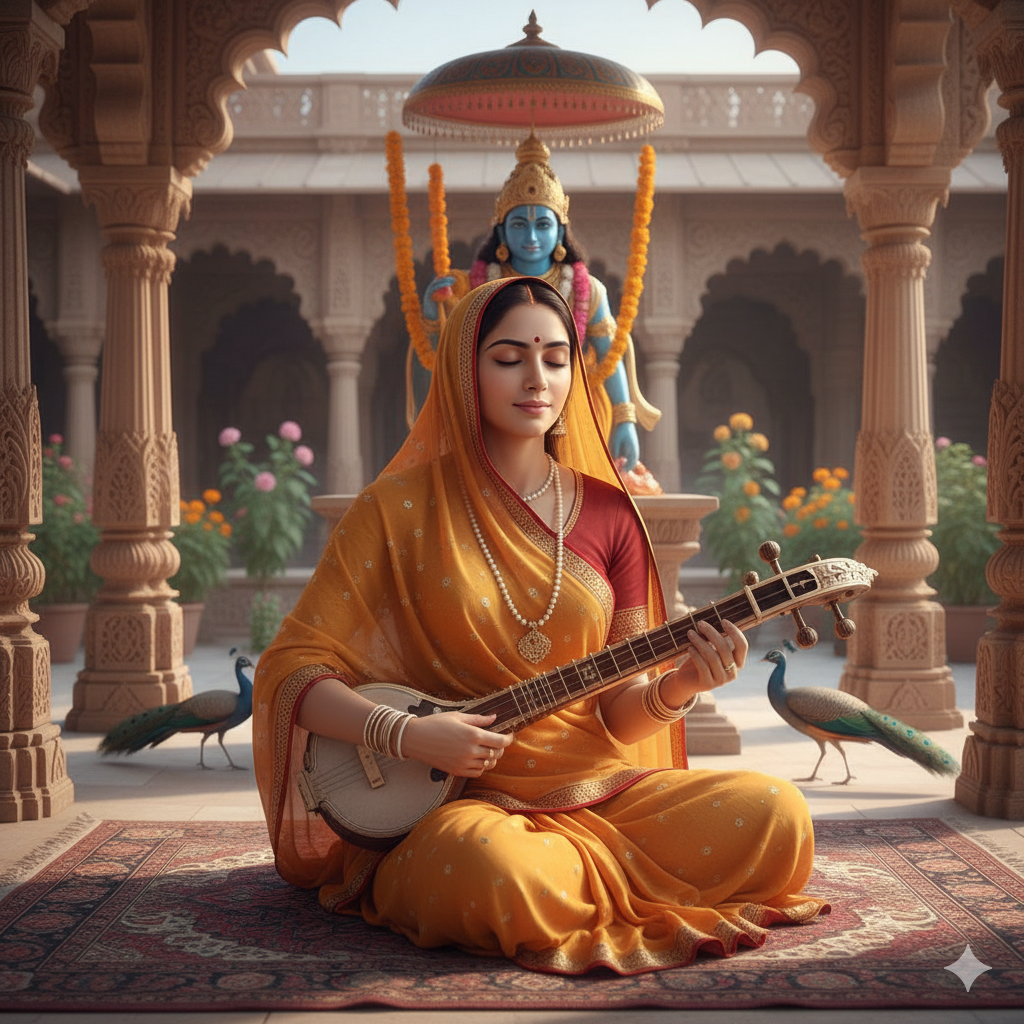
Early Life and Background
Mirabai, also spelled Meera Bai, was one of India’s most celebrated saint-poets of the Bhakti movement.
She was born around 1498 CE in Kudki (near Merta, Rajasthan), into a noble Rathore Rajput family. Her father, Ratan Singh Rathore, was the ruler of Merta — a small principality under the Sisodia clan of Mewar.
From childhood, Mirabai displayed a profound devotion to Lord Krishna.
At the age of about four, during a wedding procession, she saw a bridegroom and innocently asked her mother who her own husband would be. Her mother replied jokingly, “You already have one — Lord Krishna.”
This simple remark took deep root in young Meera’s mind. From then on, she believed with all her heart that Krishna was her eternal husband and lord.
Marriage into Royalty
When Mirabai grew up, she was married to Prince Bhojraj, the eldest son of Rana Sanga, the ruler of Mewar (Udaipur).
Bhojraj was a noble and brave prince who respected her devotion, though he himself was not a mystic.
However, Mirabai’s marriage did not change her faith.
Even as a princess, she continued to spend her days singing bhajans, visiting temples, and worshipping Krishna as her divine beloved.
After a few years, Bhojraj died in battle, leaving Mirabai a young widow.
The death of her husband made her even more detached from worldly life.
She began to live completely for spiritual love and divine devotion.
Devotion and Defiance
After Bhojraj’s death, Mirabai’s in-laws grew hostile towards her.
The ruler of Mewar — Rana Vikramaditya, Bhojraj’s brother — felt that Mirabai’s behavior brought disgrace to royal dignity.
In those days, royal Rajput women were expected to live in seclusion, away from public view.
They were not supposed to meet strangers, saints, or sing and dance in temples.
But Mirabai broke these rigid rules fearlessly. She mingled with saints and common devotees, sang before Krishna’s image, and often danced in ecstasy before the idol.
Her devotion was pure and spiritual, yet society misjudged her actions.
The Rana and the royal family tried to stop her in many ways. They locked her in her rooms, spread false rumors, and even, according to legend, sent her a cup of poison to kill her.
But Mirabai drank it without fear, saying that if her Lord wished, it would not harm her — and miraculously, she survived.
This incident became one of the most famous symbols of her unbreakable faith and divine protection.
Wandering Life and Renunciation
Finally, tired of persecution and misunderstanding, Mirabai left the palace of Mewar.
She renounced her royal status and wandered freely from place to place — singing, praying, and spreading the message of divine love.
She travelled across many sacred sites of India:
Vrindavan, where Krishna spent his childhood,
Mathura, the holy city of his birth,
and finally Dwarka, the coastal city in Gujarat where Krishna is believed to have ruled.
Everywhere she went, she drew large crowds of devotees who were touched by her songs and simple purity.
She refused wealth, comfort, and fame — choosing instead a life of poverty, prayer, and freedom.
Mirabai’s Poetry
Mirabai composed hundreds of padas (short lyrical poems) in praise of Krishna.
Her poetry expresses the entire range of human emotion — love, longing, pain, surrender, and joy.
The tone of her verses is deeply personal; she speaks to Krishna as her beloved, husband, and friend.
Her language is mainly Braj Bhasha (the dialect of Mathura), with influences of Rajasthani and Gujarati.
Her verses are simple, musical, and full of devotion.
She did not follow strict poetic rules; instead, her poetry flows naturally from her heart.
Many of her padas have been translated into English and are still sung as bhajans (devotional songs) throughout India — for example:
“मेरे तो गिरधर गोपाल, दूसरो न कोई” (Mere To Girdhar Gopal, Doosro Na Koyi)
“पायो जी मैंने राम रतन धन पायो” (Payo Ji Maine Ram Ratan Dhan Payo)
“पग घुंघरू बाँध मीरा नाची रे” (Pag Ghunghroo Baandh Meera Naachi Re)
Her poems express the Bhakti ideal — that true love for God transcends social barriers, caste, and gender.
Philosophy and Faith
Mirabai’s spiritual philosophy is based on Bhakti (devotion) and Prem (love).
She believed that God can be attained only through love and surrender, not through rituals or caste restrictions.
Her devotion was intensely personal — she saw Krishna not just as a deity, but as her eternal husband and divine companion.
Her message was revolutionary for her time because she:
Rejected the authority of priests and rituals.
Ignored caste and gender barriers.
Gave women a voice of spiritual independence.
Emphasized love, purity, and equality before God.
Last Years and Death
In her final years, Mirabai lived in Dwarka.
According to legend, when the king of Mewar sent messengers ordering her to return, she went to the temple of Krishna, prayed deeply, and merged into the idol of Krishna, disappearing forever.
This symbolizes her spiritual union with her Lord.
She is believed to have died around 1546 CE, though some traditions place her death a few years later.
Legacy
Mirabai remains one of the most beloved and respected figures in Indian culture.
Her songs are sung in temples, homes, and gatherings across India.
She is admired not only as a saint but also as a symbol of feminine strength, courage, and freedom.
Mirabai’s life stands as a testimony to the power of faith and love — the idea that devotion to God is greater than worldly power or social law.
Her poetry continues to inspire people with its message of spiritual love, purity, and surrender.
She is counted among the greatest Bhakti poets of India, along with Kabir, Surdas, Tulsidas, and Guru Nanak.
I Know Only Krishna Themes
Devotion to God
The poem’s central theme is complete devotion to Lord Krishna.
Mirabai declares that Krishna is her only truth and love.
She gives up all worldly ties to live only for Him.
Her surrender is total — she accepts joy, pain, and even death as His will.
This pure and selfless devotion reflects the spirit of Bhakti.
Renunciation of the World
Mirabai leaves behind her royal life, family, and social duties.
She says she has nothing to do with “relations or cousins.”
The “world” represents illusion and material attachment.
By rejecting it, she chooses spiritual freedom over luxury.
Her detachment shows that true peace lies in loving God alone.
Courage and Faith
The poem shows Mirabai’s fearless courage and unshakable faith.
She faces criticism, hatred, and even a cup of poison from the Rana.
Yet she drinks it cheerfully, trusting Krishna to protect her.
Her calm strength reflects her absolute trust in divine love.
Mirabai proves that faith is stronger than fear or power.
Power of Love
Mirabai’s love for Krishna is pure and spiritual, not worldly.
She compares it to a “creeper” she has nourished with her tears.
Her suffering only makes her love grow stronger.
Love, for her, is the path to salvation and oneness with God.
Through love, she transforms pain into devotion.
Peace and Acceptance
At the end, Mirabai reaches spiritual peace and calm.
She says, “That’s all that’s real for me, let what will be, be.”
This shows her full acceptance of Krishna’s will.
Her heart is free from desire, anger, or fear.
Through surrender, she finds eternal peace and liberation.
Word Meaning
| Tough Word | Meaning in English | Meaning in Hindi |
| Chide | To scold, criticize, or rebuke. | डाँटना, फटकारना, आलोचना करना। |
| Grieve | To feel sorrow or sadness. | दुखी होना, शोक करना। |
| Devotion | Deep love and dedication to God. | भक्ति, श्रद्धा, समर्पण। |
| Reared | Raised or nurtured with care. | पाला-पोसा, विकसित किया। |
| Creeper | A climbing plant; here, it means the growing love or devotion for Krishna. | लता / बेल; यहाँ प्रेम या भक्ति की बढ़ती भावना। |
| Abandoned | Left completely; given up. | त्याग दिया, छोड़ दिया। |
| Churning | Stirring curd or milk to extract butter or ghee. | मथना, दही या दूध को घी बनाने के लिए मथना। |
| Rana | The king or ruler of Mewar, Mirabai’s husband’s relative. | मेवाड़ का राजा (मीरा के परिवार का सदस्य)। |
| Bruited | Spread as news or rumor. | अफवाह के रूप में फैलना, चर्चा होना। |
Very Short Answer Questions
Who is the poet of the poem “I Know Only Krishna”?
The poet of the poem is Mirabai.
Who translated the poem into English?
It was translated by Krishna Bahadur.
From which book is this poem taken?
It is taken from Mirabai and Her Padas (1998).
Who is Krishna for Mirabai?
Krishna is her Lord, husband, and beloved.
What does Mirabai renounce in the poem?
She renounces all worldly relations and attachments.
How does society react to Mirabai’s devotion?
People criticize and mock her for mingling with saints.
How does Mirabai respond to people’s criticism?
She replies fearlessly saying, “Let them,” showing indifference.
What does “love’s creeper” symbolize in the poem?
It symbolizes her growing devotion to Krishna.
What nourishes the creeper of love?
Her tears of longing nourish the creeper of love.
What has Mirabai abandoned?
She has abandoned the world to live only for divine love.
What is the meaning of the line “as one churning curd to get precious ghee”?
It means spiritual purity comes through constant devotion, like ghee comes from churning curd.
Who sent poison to Mirabai?
The Rana, ruler of Mewar and her husband’s relative, sent poison.
How did Mirabai react to the poison?
She drank it cheerfully, trusting in Krishna’s protection.
What happened after she drank the poison?
She remained unharmed, showing her faith’s divine power.
What does the line “That’s all that’s real for me” mean?
It means only Krishna is real; everything else is unreal.
What is the central theme of the poem?
The theme is complete devotion and surrender to God.
What is the tone of the poem?
The tone is devotional, calm, and fearless.
What kind of poem is “I Know Only Krishna”?
It is a lyric poem expressing Bhakti (devotion).
What message does the poem convey?
It teaches that faith in God gives courage, peace, and freedom.
What is the rhyme scheme of the poem?
The poem is written in free verse, with no fixed rhyme scheme.
Short Answer Questions
What is the central idea of Mirabai’s poem “I Know Only Krishna”?
The central idea of the poem is complete devotion and surrender to Lord Krishna.
Mirabai declares that Krishna is her only truth, her Lord, and her eternal companion.
She renounces her worldly relationships, social customs, and royal comforts for the sake of divine love.
Her devotion is so deep that she faces criticism and danger with courage and calmness.
The poem reflects the Bhakti movement’s spirit — that true love for God is above all worldly bonds.
How does Mirabai express her detachment from the world in the poem?
Mirabai expresses her detachment by saying she has nothing to do with relations or cousins or even her brother.
She has abandoned the world completely and lives only for love — divine love for Krishna.
The image of “churning curd to get pure ghee” symbolizes how she purifies her soul through constant devotion.
She no longer cares for social approval or material pleasure.
Her only purpose is spiritual fulfillment, showing total freedom from worldly attachments.
What is Mirabai’s attitude toward social criticism?
Mirabai faces harsh criticism from society for moving among saints and breaking royal traditions.
However, her attitude is fearless and indifferent.
She simply says, “Let them,” showing that public opinion cannot shake her faith.
Instead of being angry, she feels pity for those tied to the world and admires those who are devoted to God.
This reveals her spiritual maturity and courage, proving that divine love gives strength greater than social power.
What is the significance of the incident of poison in Mirabai’s life and poetry?
The incident of poison is a symbol of Mirabai’s unbreakable faith.
When the Rana sent her a cup of poison, she drank it cheerfully, trusting completely in Krishna.
Miraculously, she was unharmed — showing that divine love conquers death and fear.
This event reflects her absolute surrender to God’s will.
It became a turning point in her life and a central symbol in her poetry — of faith stronger than worldly power.
What message does the poem “I Know Only Krishna” convey to readers?
The poem conveys the message of pure devotion, spiritual freedom, and inner peace.
Mirabai teaches that true happiness lies not in wealth or relationships, but in loving God selflessly.
Her courage and simplicity show that faith gives strength to face suffering and criticism.
She accepts everything — joy, pain, life, and death — as Krishna’s will.
The poem inspires us to live with faith, courage, and surrender, realizing that divine love is the only eternal truth.
Essay Type Questions
Discuss “I Know Only Krishna” as a poem of pure devotion and spiritual surrender.
Mirabai’s poem “I Know Only Krishna” is a beautiful expression of divine love, devotion, and total surrender.
In this poem, Mirabai declares that she knows and loves only Krishna, rejecting all worldly attachments — family, relatives, and even her own brother.
Her devotion is exclusive, personal, and unconditional. She does not care for what others think or say about her because her heart and soul belong entirely to Krishna.
The poem shows the Bhakti movement’s central ideal — that the soul’s highest purpose is to unite with God through love, not through rituals or caste rules.
Mirabai’s devotion is not passive; it is full of strength and courage.
When she says, “The Rana sent me poison, I drank it cheerfully,” she symbolizes the power of faith that conquers fear and death.
Her tears and suffering become the means of spiritual purification, as seen in the line “I have reared love’s creeper with my tears.”
Mirabai’s surrender is complete. She accepts everything — pain, criticism, and isolation — as God’s will.
In the end, she attains peace and liberation, saying, “That’s all that’s real for me, let what will be, be.”
This calm acceptance reflects the final stage of Bhakti — absolute surrender to the divine.
Thus, the poem celebrates love as the purest path to God, and Mirabai as the perfect example of spiritual courage, selflessness, and devotion.
How does Mirabai’s poem reflect her defiance of social and royal restrictions?
Mirabai’s “I Know Only Krishna” reflects her bold defiance of the rigid social and royal codes of sixteenth-century Rajput society.
Born into a noble family and married to Prince Bhojraj of Mewar, she was expected to live as a silent, obedient royal woman confined to palace walls.
However, Mirabai broke these boundaries with fearless devotion. She visited temples, sang bhajans, and associated with saints, openly rejecting the royal life of luxury and pride.
When people mocked her, she remained calm and strong, saying, “People chide me for moving among saints — let them.”
This line shows her spiritual independence — she places divine truth above social opinion.
For Mirabai, Krishna is her only Lord, and no worldly authority, not even the Rana, can command her heart.
Her defiance becomes even clearer in the famous incident when the Rana sent her poison, which she drank without hesitation.
Her fearless act symbolized her belief that God protects those who love Him truly.
Through this poem, Mirabai shows that social power and divine power are not equal.
Worldly kings may rule over lands, but God rules over souls.
Her rejection of royal customs was not rebellion, but spiritual freedom.
Mirabai’s defiance was gentle yet unbreakable — she challenged patriarchy and hierarchy through faith, humility, and devotion.
Thus, the poem becomes a timeless declaration of individual freedom, spiritual truth, and feminine strength.
Describe the imagery and symbols used in Mirabai’s poem “I Know Only Krishna.”
Mirabai’s poem “I Know Only Krishna” is full of vivid imagery and rich symbolism that give emotional power to her simple devotional language.
The imagery in the poem is drawn from everyday rural life, making complex spiritual ideas easily understandable.
When she says, “I have reared love’s creeper with my tears,” she uses a beautiful metaphor.
The creeper symbolizes her devotion to Krishna, and her tears represent the suffering, longing, and care that nourish it.
Through this image, Mirabai conveys that true love grows through pain and perseverance.
Another striking image is the simile “as one churning curd to get precious ghee.”
Here, the act of churning curd represents the spiritual effort and discipline required to extract divine truth (symbolized by ghee).
Just as ghee is pure and valuable, divine love is the precious reward of devotion.
This domestic imagery makes spiritual truth simple and relatable.
The poison sent by the Rana becomes a symbol of the trials faced by true devotees.
Mirabai’s cheerful acceptance of it stands for fearless faith and divine protection.
Finally, in the line “That’s all that’s real for me,” the word “real” symbolizes spiritual truth, while the “world” represents illusion and attachment.
All these images and symbols together show Mirabai’s journey from pain to purity, from worldly conflict to spiritual peace.
Her language is plain, but her symbols are profound — they turn personal experience into universal expressions of love, faith, and surrender.
Critical Analysis
Introduction
Mirabai, one of the greatest saint-poets of the Bhakti Movement (16th century), wrote devotional verses expressing her intense love for Lord Krishna.
Born a Rajput princess in Rajasthan, she gave up royal comforts for a life of devotion, song, and prayer.
The poem “I Know Only Krishna” reflects her complete surrender to God and her courage to defy social norms.
It was translated into English by Krishna Bahadur and included in Mirabai and Her Padas (1998).
Through simple yet powerful language, Mirabai expresses spiritual love, faith, and liberation.
Central Idea
The poem conveys Mirabai’s exclusive devotion to Krishna and her rejection of worldly ties.
She declares that she knows only Krishna and no one else — not her relatives, not society, not even fear of death.
Her love for Krishna is her only reality, while the world is illusion.
The poem beautifully captures the Bhakti ideal that divine love is the highest truth and path to liberation.
Summary
In the poem, Mirabai says that she belongs only to Krishna and has no connection with worldly relations.
People criticize her for mingling with saints, but she ignores their judgment.
She feels pity for those still tied to worldly desires and admires those devoted to God.
She compares her love to a creeper that she has nurtured with her tears.
Having renounced the world, she lives only for divine love, as curd is churned to produce pure ghee.
Even when the Rana sends her poison, she drinks it fearlessly, protected by Krishna’s grace.
In the end, she says that only Krishna is real, and she accepts whatever happens as His will.
The poem thus portrays her faith, freedom, and peace through spiritual surrender.
Structure & Rhyme Scheme
The poem is written in free verse, without a fixed rhyme scheme or meter.
Its structure is simple, lyrical, and spontaneous, reflecting the natural flow of Mirabai’s emotion.
Each line or stanza expresses a complete thought or feeling rather than following strict poetic form.
The free rhythm mirrors the devotional song (bhajan) style of the Bhakti poets — heartfelt and musical, not bound by grammar or pattern.
Theme
1. Devotion to God
The poem centers on Mirabai’s deep and total devotion to Lord Krishna.
She gives up everything and lives only for His love and grace.
2. Renunciation of the World
Mirabai abandons royal life and family ties.
She rejects material pleasures and chooses spiritual freedom.
3. Courage and Faith
She faces criticism and danger fearlessly.
Even poison cannot harm her because of her strong faith in Krishna.
4. Power of Love
Her love for Krishna is pure and spiritual.
It grows through her tears and suffering, leading her toward salvation.
5. Peace and Acceptance
In the end, she attains peace by surrendering completely to God’s will.
Her devotion frees her from fear, desire, and worldly pain.
Style
Mirabai’s style is marked by simplicity, clarity, and emotional intensity.
She uses everyday language and domestic imagery to express profound spiritual truths.
Her tone is personal, sincere, and fearless, revealing her deep inner faith.
The repetition of phrases like “I know only Krishna” gives the poem a musical rhythm, like a prayer or chant.
Her direct, heartfelt style makes her poetry accessible and timeless.
Poetic Devices
Mirabai uses several poetic devices to enhance the depth of her devotion:
Metaphor: “Love’s creeper” symbolizes her devotion nurtured by tears.
Simile: “As one churning curd to get precious ghee” compares spiritual effort to making ghee.
Symbolism: Poison stands for worldly trials; Krishna represents divine truth.
Repetition: Emphasizes her faith and surrender.
Contrast: Between worldly attachment and divine love.
Tone: Devotional, calm, and courageous.
These devices make the poem both lyrical and philosophical.
Critical Commentary
“I Know Only Krishna” is not just a devotional hymn — it is a spiritual autobiography.
Mirabai’s voice is deeply personal, yet universal.
Her defiance of social norms — speaking of saints, rejecting family life, drinking poison — symbolizes spiritual independence.
The poem reveals the inner conflict between worldly duty and divine calling, which she resolves through complete faith.
Her use of simple imagery from daily life makes the divine accessible to all.
Mirabai’s poetry broke barriers of caste, gender, and power, giving voice to female spiritual strength and individual freedom centuries ahead of her time.
Message
The poem teaches that true devotion transcends all worldly limits.
Faith in God gives inner strength, peace, and liberation.
Mirabai shows that love for the divine is greater than social status, fear, or suffering.
Her message is universal — to surrender to God’s will and to find joy in spiritual love rather than material life.
She proves that divine faith can conquer fear and death.
Conclusion
“I Know Only Krishna” is a poem of divine love, courage, and spiritual freedom.
It portrays Mirabai’s complete dedication to Krishna and her calm defiance of worldly norms.
Through her words, she shows that true happiness lies in surrendering to the divine, not in seeking approval from the world.
The poem’s simple language, rich imagery, and deep emotion make it a masterpiece of Bhakti poetry.
Mirabai’s voice continues to inspire — reminding us that faith, love, and truth are stronger than fear, power, or tradition.