
Arms and the Man Summary
George Bernard Shaw’s play Arms and the Man was first performed on 21 April 1894 at the Avenue Theatre in London, where it received both laughter and applause for its witty attack on romantic illusions about war and love. Later, it was published in 1898 as part of Shaw’s collection called Plays Pleasant, which also included Candida, The Man of Destiny, and You Never Can Tell.
The title comes from the opening line of the Roman epic The Aeneid by the poet Virgil. In Latin it is “Arma virumque cano,” which means “I sing of arms and the man.” That line begins a serious, heroic poem about war and a great leader.
George Bernard Shaw chose the title as an ironic reference. He uses the grand, epic phrase to point out the difference between romantic, heroic stories about war and the ordinary, often messy truth of real men and soldiers. In Shaw’s play the “arms” (weapons, war) and the “man” (the supposed hero) are shown not as glorious but as practical, frightened, comic, or ordinary.
Act I
Raina Petkoff, a young romantic woman, stands on her balcony dreaming of heroism and of her handsome fiancé, Major Sergius Saranoff. Late at night after a battle, her mother Catherine returns with news: Bulgaria has won at Slivnitza and Sergius is praised for a daring cavalry charge. Raina is proud and carried away by romantic ideas.
Gunfire and commotion break the quiet. The shutters are suddenly opened and a dark figure slips in. Raina finds a tired, muddy stranger in her room — Captain Bluntschli, a Swiss mercenary fighting on the Serbian side. He is exhausted and frightened; if the Bulgarian cavalry catch him he will be killed. He begs Raina to be quiet and hide him. He has no bullets — instead he carries chocolate for energy, not cartridges. This small, practical detail shocks Raina’s idea of the heroic soldier.
Soldiers search outside; a polite Russian officer comes up to their door. Raina bravely shows an empty balcony and lies to protect the hidden man. After the search passes, Bluntschli explains he only fled to save his life and asks to wait until night to leave. Raina gives him her cloak and some chocolates. He is utterly exhausted and soon falls asleep in her bed.
When Raina’s mother Catherine return and see the sleeping stranger, there is alarm. But after hearing his story — that he is a professional soldier, not a villain, Catherine allows him to rest. Act I ends with a clear contrast: Raina’s romantic view of war clashes with the plain, survival-centered reality of a real soldier.
Act II
The scene moves to the Petkoff garden on a bright spring morning. Servants Louka and Nicola argue: Louka is proud and wants more in life; Nicola believes careful service will get him ahead. Major Paul Petkoff returns happy to be home; he announces the war is over and the army is demobilizing.
Sergius arrives, admired for his charge. He brags and acts like a romantic hero, saying “I never withdraw!” Raina greets him like a queen; they talk in high, romantic language about devotion and noble love. But not everything is simple: Louka hints she heard a man in Raina’s room — and Sergius grows jealous.
Bluntschli returns, now clean and polite, to sort out the coat he used when hiding. Catherine fears the secret will come out, so she awkwardly keeps him near and invites him to stay for lunch to avoid scandal. Raina, embarrassed, blurts the nickname “chocolate-cream soldier” in front of everyone, and they invent an explanation to hide the morning’s truth. The family pretends normality, but tension — especially Sergius’s jealousy — builds.
Act III
After lunch in the family library, Bluntschli quietly writes military orders while Sergius signs them. Raina and Bluntschli speak honestly: she admits lying to save him; he replies that practical help matters more to him than praises. Their exchange brings out the central contrast between romantic words and real actions.
Then tempers flare. Louka reveals she saw a man in Raina’s room; Sergius assumes betrayal and challenges the man to a duel. Bluntschli accepts the challenge in an unromantic, matter-of-fact way (joking about bringing a machine-gun but agreeing to fight on foot). The mood becomes tense, but truth soon replaces suspicion.
Raina seizes a coat and pulls from its pocket a photograph with the inscription: “Raina — to her Chocolate-Cream Soldier — a souvenir.” Petkoff and Sergius jump to conclusions. Bluntschli calmly declares he is the chocolate-cream soldier: he had been saved by Raina’s chocolates in battle and so nicknamed. The photograph is not a sign of a romantic affair but a small token of gratitude and a practical act of protection. The idea of betrayal dissolves into a simpler story of human help.
Other secrets surface: Louka and Nicola’s fake engagement — a ruse to protect Louka — is revealed, showing servants’ own plans and cleverness. Sergius, humiliated and shaken, is forced to face how his pride and romantic image blind him. He ends up humbled, apologizing to Louka for his insults and, in a surprising turn, sincerely proposing marriage to her. Louka accepts.
Bluntschli receives a telegram telling him his father has died and left him property; he must go to manage affairs. He leaves with practical calm, having been treated kindly. Raina refuses to be treated like a prize or to be married for social advantage; she becomes clearer-eyed about love.
The play closes with relationships rearranged and illusions broken. Romantic myths of heroism have given way to everyday truth: people choose honest, practical lives over flashy images. The characters are changed — humbler, more real, and ready for ordinary life.
Arms and the Man Plot Summary
The play Arms and the Man by George Bernard Shaw opens with a detailed and vivid scene that sets the stage for a story filled with humor, romance, and a sharp look at the realities of war. Act 1 takes place in a lady’s bedroom in a small Bulgarian town near the Dragoman Pass, late at night in November 1885. The room is a mix of styles—partly rich and colorful with Bulgarian textiles like the bed’s counterpane, window curtains, and small carpet, and partly cheap and plain with Viennese wallpaper. Through an open window with a small balcony on the left, you can see a snowy peak of the Balkan mountains, glowing beautifully under the stars. Above the bed, which is placed diagonally against a small wall in the right corner, there’s a wooden shrine painted blue and gold, with an ivory image of Christ and a light hanging in a pierced metal ball on three chains. On the left side, there’s an ottoman, and nearby is a washstand with an enameled iron basin, a pail underneath, and a single towel on a rail. A simple Austrian bentwood chair with a cane seat sits close by. Between the bed and the window is a plain pine dressing table, covered with a colorful cloth and topped with a fancy toilet mirror. The door is on the right, and between it and the bed is a chest of drawers, also covered with a patterned cloth. On the chest are some paperback novels, a box of chocolate creams, and a small easel holding a large photo of a very handsome officer who looks proud and commanding. The room is lit by two candles—one on the chest and one on the dressing table, with a box of matches nearby. The window is open like a door, and wooden shutters outside are also open.
On the balcony stands Raina Petkoff, a young woman wrapped in a luxurious fur cloak worth much more than all the room’s furniture combined. She’s caught up in the romantic beauty of the night, feeling her own youth and beauty are part of it, gazing at the snowy mountains. Her peaceful moment is interrupted by her mother, Catherine Petkoff, a woman over forty with striking black hair and eyes. Catherine is full of energy and wants to be seen as a refined Viennese lady, so she always wears a fashionable tea gown, even though she could easily pass as the strong wife of a mountain farmer.
Catherine bursts into the room excitedly, calling for Raina (she pronounces it Rah-eena, stressing the “ee”). She heads to the bed, expecting to find her daughter there, but Raina steps in from the balcony. Catherine scolds her for being out in the cold night air, saying she’ll get sick, and mentions that their maid, Louka, said Raina was asleep. Raina explains she sent Louka away because she wanted to be alone—the stars are so beautiful. She asks what’s wrong.
Catherine shares thrilling news: there’s been a battle at Slivnitza, and it was a great victory won by Sergius, Raina’s fiancé. Raina’s eyes light up with excitement. She tosses her cloak onto the ottoman and rushes to her mother, dressed only in her pretty nightgown. They hug tightly as Raina lets out a joyful cry. But then, worried, she asks if her father is safe. Catherine assures her he is, since he sent the news himself. She adds that Sergius is the hero of the moment, adored by his regiment.
Raina eagerly asks for details, pulling her mother to sit on the ottoman, where they embrace again, full of excitement. Catherine, bursting with enthusiasm, describes the amazing cavalry charge led by Sergius. He went against the Russian commanders’ orders, took charge on his own, led the attack himself, and was the first to charge through the enemy’s guns. She paints a vivid picture: their brave Bulgarian soldiers with flashing swords and eyes, charging like an avalanche and scattering the weak Serbian soldiers like dust. Catherine teases Raina for making Sergius wait a year before agreeing to marry him, saying if Raina has any Bulgarian spirit, she’ll worship him when he returns.
Raina wonders if Sergius will care about her small admiration after being cheered by an entire army, but she’s overjoyed and proud. She gets up, pacing excitedly, saying this proves their ideas about heroism, patriotism, and Sergius were true all along. Catherine, a bit offended, asks what she means by “our ideas.” Raina admits that sometimes she doubted if their grand ideas were just dreams, inspired by reading poets like Byron and Pushkin or enjoying operas in Bucharest. Real life rarely matches such romance, she thought. She confesses (making Catherine promise not to tell) that when Sergius held her in his arms and looked into her eyes, she wondered if their heroic ideals were just from books and opera. She even feared Sergius might not shine in a real battle compared to clever Russian officers.
Catherine is shocked, saying it’s shameful to think Sergius would fail. She points out that the Serbians have Austrian officers just as smart as the Russians, but the Bulgarians still won. Raina laughs, sits back down, and calls herself a silly coward. She’s thrilled to know it was all true—that Sergius is as noble and splendid as he seems, and the world is wonderful for women who see its beauty and men who live its romance. Overcome with happiness, she kneels beside her mother, hugging her passionately.
Their moment is interrupted by Louka, a proud and good-looking maid in a colorful Bulgarian peasant dress with a double apron. Louka is bold, almost rude in her service to Raina, though she’s cautious around Catherine. She’s excited like everyone else but doesn’t share Raina’s dreamy enthusiasm, looking at them with a hint of scorn. Louka announces that all windows must be closed and shutters locked because there might be shooting in the streets. Raina and Catherine stand up, alarmed. The defeated Serbians are being chased back through the pass and could reach the town. The Bulgarian cavalry will pursue them, and the townspeople are ready for the fleeing enemies. Louka goes to the balcony, closes the shutters, and steps back inside.
Raina says she wishes their people weren’t so cruel—what’s glorious about killing desperate fugitives? Catherine, snapping into her practical housewife mode, says she needs to make sure everything is secure downstairs. Raina tells Louka to leave the shutters so she can close them if she hears anything. But Catherine firmly says no, Raina might fall asleep and leave them open. She orders Louka to lock them, and Louka does. Raina reassures her mother not to worry; if she hears a shot, she’ll blow out the candles and hide in bed with her ears covered. Catherine agrees that’s smart, says goodnight, and they kiss. Raina, emotional again, wishes her mother joy for the happiest night of her life, hoping no fugitives spoil it. Catherine tells her to go to bed and not think about them, then leaves.
Louka quietly tells Raina that if she wants the shutters open, she just needs to push them, showing her how (pushing them open and closed again). She mentions one shutter should be bolted at the bottom, but the bolt is missing. Raina, with dignity, says thanks but they must follow orders. Louka makes a face, says goodnight casually, and struts out.
Alone now, Raina goes to the chest of drawers and gazes at the photo of Sergius (the handsome officer) with deep devotion. She doesn’t kiss it or hug it but holds it up reverently like a sacred object, saying, “Oh, I shall never be unworthy of you any more, my hero—never, never, never.” She carefully puts it back, picks a novel from the stack, flips through it dreamily, finds her page, and turns the book inside out to mark it. With a happy sigh, she gets into bed to read herself to sleep. Before starting, she looks up at the photo again and whispers, “My hero! my hero!”
A gunshot in the distance breaks the silence. Raina jumps, listening. Two more shots, closer, startle her further. She scrambles out of bed, quickly blows out the candle on the chest of drawers, plugs her ears, runs to the dressing table, blows out that candle, and dives back into bed. The room is now dark, lit only by a faint glow from the shrine’s light and starlight through the shutter slits. More gunfire erupts nearby, loud and startling. As it echoes, the shutters are yanked open from outside, and for a moment, a man’s dark figure is framed against the snowy starlight. The shutters snap shut, plunging the room back into darkness. The silence is broken by heavy breathing, then a scratching sound and a match flaring in the middle of the room.
Raina, crouched on the bed, calls out, “Who’s there?” The match goes out instantly. She asks again. A man’s voice, quiet but threatening, says, “Sh—sh! Don’t call out or you’ll be shot. Be good; and no harm will happen to you.” She’s heard moving toward the door. He warns her not to run; if she shouts, his pistol will fire. He orders her to light a candle so he can see her. After a moment of silence, she goes to the dressing table and lights a candle, revealing the intruder.
He’s about 35, in a terrible state—covered in mud, blood, and snow. His torn blue Serbian artillery officer’s coat is held together by his belt and revolver strap. In the dim candlelight and his messy condition, he seems average—medium height, strong neck and shoulders, a stubborn-looking head with short bronze curls, clear blue eyes, a plain nose like a baby’s, and a neat, soldierly way of carrying himself. Despite his desperate situation, he’s alert, even a bit humorous, but deadly serious. He quickly sizes up Raina—her age, social status, how scared she is—and says politely but firmly, “Excuse my disturbing you; but you recognise my uniform—Servian. If I’m caught I shall be killed. Do you understand that?” Raina says yes. He adds he doesn’t plan to die if he can avoid it, locking the door with a snap.
Raina, with disdain, says, “I suppose not,” standing tall and looking him in the eye, adding, “Some soldiers, I know, are afraid of death.” He replies with grim humor, “All of them, dear lady, all of them, believe me. It is our duty to live as long as we can, and kill as many of the enemy as we can. Now if you raise an alarm—” She interrupts, “You will shoot me. How do you know that I am afraid to die?” He slyly says, “Ah; but suppose I don’t shoot you, what will happen then? Why, a lot of your cavalry—the greatest blackguards in your army—will burst into this pretty room of yours and slaughter me here like a pig; for I’ll fight like a demon: they shan’t get me into the street to amuse themselves with: I know what they are. Are you prepared to receive that sort of company in your present undress?” Raina, suddenly aware of her thin nightgown, pulls it tighter around her. He adds cruelly, “It’s rather scanty, eh?” She moves toward the ottoman; he raises his pistol and shouts, “Stop!” She stops. He asks where she’s going. She calmly says, “Only to get my cloak.” He grabs it first, saying, “A good idea. No: I’ll keep the cloak: and you will take care that nobody comes in and sees you without it. This is a better weapon than the pistol.” He tosses the pistol onto the ottoman.
Raina, disgusted, says, “It is not the weapon of a gentleman!” He replies, “It’s good enough for a man with only you to stand between him and death.” They stare at each other, Raina shocked that even a Serbian officer could be so selfish and ungentlemanly. A loud burst of gunfire in the street interrupts them. His voice grows cold with the threat of death: “Do you hear? If you are going to bring those scoundrels in on me you shall receive them as you are.” Raina glares at him with scorn. They hear a step outside; someone tries the door, then knocks urgently. Raina looks at him, breathless. He lifts his head, realizing he’s trapped, drops his threatening tone, and kindly tosses her the cloak, saying, “No use: I’m done for. Quick! wrap yourself up: they’re coming!”
Raina grabs the cloak gratefully, wrapping it around herself. He draws his sword and faces the door, ready to fight. Louka knocks outside, calling, “My lady, my lady! Get up, quick, and open the door.” Raina asks, “What will you do?” He grimly says, “Never mind. Keep out of the way. It will not last long.” Raina, acting on impulse, says, “I’ll help you. Hide yourself, oh, hide yourself, quick, behind the curtain.” She grabs his torn sleeve and pulls him toward the window. He agrees, saying, “There is just half a chance, if you keep your head. Remember: nine soldiers out of ten are born fools.” He hides behind the curtain, adding, “If they find me, I promise you a fight—a devil of a fight!” before vanishing.
Raina tosses the cloak on the bed and opens the door, pretending to be annoyed at the disturbance. Louka rushes in, saying a Serbian was seen climbing the water-pipe to the balcony, and soldiers want to search the room—they’re wild, drunk, and furious. Raina insists they won’t search here, asking why they were let in. Catherine hurries in, asking if Raina is safe and if she’s seen or heard anything. Raina says she heard the shooting and doubts the soldiers would dare enter. Catherine says she’s found a Russian officer who knows Sergius and calls him in.
A young Russian officer in a Bulgarian uniform enters, sword in hand, polite but formal: “Good evening, gracious lady; I am sorry to intrude, but there is a fugitive hiding on the balcony. Will you and the gracious lady your mother please to withdraw whilst we search?” Raina, annoyed, says, “Nonsense, sir, you can see that there is no one on the balcony.” She throws open the shutters, standing in front of the curtain where the man hides, pointing to the empty balcony. Shots ring out below, and a bullet shatters a windowpane near Raina. She flinches but holds her ground; Catherine screams, and the officer rushes to the balcony, shouting down angrily, “Cease firing there, you fools: do you hear? Cease firing, damn you.” He glares down, then returns to Raina, trying to be polite: “Could anyone have got in without your knowledge? Were you asleep?” Raina says she hasn’t been to bed. The officer, frustrated, says, “Your neighbours have their heads so full of runaway Servians that they see them everywhere.” He apologizes, bows, and leaves with Catherine. Raina closes the shutters.
She tells Louka not to leave her mother while soldiers are around. Louka glances at Raina, the ottoman, and the curtain, smirks secretly, and leaves. Raina slams and locks the door. The man steps out from the curtain, sheathing his sword, calm and businesslike: “A narrow shave; but a miss is as good as a mile. Dear young lady, your servant until death. I wish for your sake I had joined the Bulgarian army instead of the Servian. I am not a native Servian.” Raina, haughty, says, “No, you are one of the Austrians who set the Servians on to rob us of our national liberty, and who officer their army for them. We hate them!”
He corrects her: “Austrian! not I. Don’t hate me, dear young lady. I am only a Swiss, fighting merely as a professional soldier. I joined Servia because it was nearest to me. Be generous: you’ve beaten us hollow.” Raina asks, “Have I not been generous?” He calls her noble and heroic but says he’s not safe yet—the chase will continue all night, and he needs to escape during a quiet moment. He asks if he can wait a bit. Raina agrees, sorry he’ll face danger again, and offers him a seat on the ottoman. She suddenly gasps, spotting the pistol he left there, startling him.
He snaps, “Don’t frighten me like that. What is it?” She points out the pistol was visible to the officer the whole time—what a close call! He, annoyed at being scared, says, “Oh, is that all?” Raina, growing more confident, hands him the pistol: “Pray take it to protect yourself against me.” He grins at her sarcasm: “No use, dear young lady: there’s nothing in it. It’s not loaded.” He drops it into his revolver case. Raina tells him to load it. He admits he has no ammunition, saying, “What use are cartridges in battle? I always carry chocolate instead; and I finished the last cake of that yesterday.”
Raina is shocked: “Chocolate! Do you stuff your pockets with sweets—like a schoolboy—even in the field?” He agrees, “Yes. Isn’t it contemptible?” Unable to respond, she scornfully grabs the box of chocolate creams from the chest and offers it, saying she’s sorry she ate most of them. He eagerly takes them, calling her an angel and gobbling the creams, saying, “Creams! Delicious!” Finding none left, he accepts it with good humor: “Bless you, dear lady. You can always tell an old soldier by the inside of his holsters and cartridge boxes. The young ones carry pistols and cartridges; the old ones, grub. Thank you.” He returns the box; she snatches it and tosses it aside, startling him again. He pleads, “Ugh! Don’t do things so suddenly, gracious lady. Don’t revenge yourself because I frightened you just now.”
Raina, proudly: “Frighten me! Do you know, sir, that though I am only a woman, I think I am at heart as brave as you.” He replies, “I should think so. You haven’t been under fire for three days as I have. I can stand two days without shewing it much; but no man can stand three days: I’m as nervous as a mouse.” He sits on the ottoman, head in hands, asking if she’d like to see him cry. She quickly says no. He adds that scolding him like a child would do it, as soldiers in camp would tease him now.
Raina, softened, says, “I’m sorry. I won’t scold you.” He looks grateful, but she stiffens: “You must excuse me: our soldiers are not like that.” He insists all soldiers are either young or old, and he’s been in service fourteen years—half her army’s soldiers are inexperienced. He says their victory was due to “sheer ignorance of the art of war, nothing else,” calling it unprofessional. Raina teases, “Oh, was it unprofessional to beat you?” He explains it’s foolish to charge cavalry at machine guns, certain to fail if the guns fire. He was shocked to see it.
Raina, excited, asks if he saw the great cavalry charge and begs him to describe it. He asks if she’s ever seen one; she says no, how could she? He describes it as funny—like throwing peas at a window: one comes first, then a few, then the rest in a clump. Raina, thrilled, says, “Yes, first One!—the bravest of the brave!” He casually says the first man was just pulling at his horse, trying not to get killed first. Raina asks why he’d pull back. He impatiently explains the horse is running away with him—nobody wants to die first. The young soldiers are wild, the old ones huddle together, knowing they’re just cannon fodder, often getting broken knees from crashing horses.
Raina insists the first man isn’t a coward but a hero. He agrees that’s what she’d say if she saw him. She presses for more about the leader. He describes him as an operatic figure—handsome, with flashing eyes and a mustache, shouting a war cry and charging like Don Quixote at windmills. They laughed at him until a sergeant revealed they had the wrong cartridges and couldn’t fire for ten minutes. He felt sick, with no ammunition, only chocolate, and no bayonets. The Bulgarians cut them to pieces, and the leader, thinking he was brilliant, should be court-martialed for such madness. Raina, hurt but loyal, asks if he’d recognize the man. He says he’ll never forget him.
She grabs Sergius’s photo and shows it: “That is a photograph of the gentleman—the patriot and hero—to whom I am betrothed.” He looks, apologizes, “I’m really very sorry,” and asks if she tricked him into this. He confirms it’s definitely him, stifling a laugh. Raina demands why he’s laughing. He says he didn’t mean to, but the image of him charging like a fool is funny. She sternly demands the photo back. He, genuinely sorry, returns it, saying he might be wrong—maybe the man knew about the cartridge issue, making it safe. Raina retorts, “That is to say, he was a pretender and a coward! You did not dare say that before.” He, with mock despair, says she can’t see it from a professional soldier’s view. As distant gunfire resumes, she says coldly, “So much the better for you.” He asks how. She replies, “You are my enemy; and you are at my mercy. What would I do if I were a professional soldier?”
He acknowledges her kindness, saying, “I know how good you have been to me: to my last hour I shall remember those three chocolate creams. It was unsoldierly; but it was angelic.” She thanks him coolly and says she’ll act like a soldier now. He can’t stay after insulting her fiancé, but she’ll check the balcony to see if it’s safe for him to climb down. He panics, “Down that waterpipe! Stop! Wait! I can’t! I daren’t! The very thought of it makes me giddy.” He climbed up with death behind him but can’t face it now. He sinks onto the ottoman, defeated, telling her to give the alarm.
Raina, moved by pity, says, “Come, don’t be disheartened.” She leans over him; he shakes his head. She calls him “a very poor soldier—a chocolate cream soldier,” a famous line poking fun at his unheroic practicality. She urges him to cheer up—it takes less courage to climb down than face capture. He, dreamily, says capture means death, and death is sleep—wonderful, undisturbed sleep. Climbing down requires effort and thinking, worse than death. Raina, surprised, asks if he’s that sleepy. He admits he hasn’t slept properly since the war started, being on the staff, and hasn’t closed his eyes for thirty-six hours.
Raina, at a loss, says, “But what am I to do with you.” He stands, rallying himself: “You see, sleep or no sleep, hunger or no hunger, tired or not tired, you can always do a thing when you know it must be done. Well, that pipe must be got down.” He calls himself the “chocolate cream soldier” and heads to the window. Raina warns he might fall. He says he’ll sleep like the stones are a feather bed and bids goodbye. As he reaches the shutters, loud gunfire erupts below. Raina grabs him, saying, “They’ll kill you.” He calmly says it’s part of his job and tells her to put out the candles so no light shows when he opens the shutters, and to stay away from the window.
Raina, clinging to him, says the moonlight will reveal him and begs to save him. He says he doesn’t want to be trouble but asks how. She pulls him back to the room’s center, saying, “You must trust to our hospitality. You do not yet know in whose house you are. I am a Petkoff.” He asks what that is. She proudly explains the Petkoffs are the richest and most famous family in Bulgaria. He pretends to know them, apologizing for his ignorance. She calls out his pretense. He admits he’s too tired to think and begs her not to scold, fearing it might make him cry.
Raina says her father is a Major, the highest-ranking Bulgarian in the army. He acts impressed. She adds he was wrong to climb the balcony—their house, the only one with two rows of windows, has stairs. He calls it grand. She mentions their library, the only one in Bulgaria, to show they’re not ignorant villagers who’d kill him for his uniform but civilized people who visit Bucharest for opera and Vienna for a month. He acknowledges her worldliness. She asks if he knows the opera Ernani, describing a scene where a fugitive is protected by his enemy’s hospitality. He asks if her family shares that idea. She says she and her mother do, and if he’d appealed to their hospitality instead of threatening her, he’d be safe. He asks if she’s sure. She offers her hand as a pledge, saying her father is away fighting. He hesitates, saying his hand is dirty. She appreciates his manners, saying Bulgarians of their class wash nearly daily, and lets him kiss her hand. He feels safe and asks her to tell her mother, as he shouldn’t stay hidden long.
Raina agrees but tells him to stay still while she’s gone. He sits on the ottoman, eyes closing. She wraps herself in the cloak, heads to the door, but notices he’s dozing. She shakes him, warning him not to sleep. He insists he’s awake, just thinking. She sternly tells him to stand while she’s gone. He reluctantly agrees, standing shakily. She leaves, doubting he’ll stay awake. Alone, he mumbles, “Sleep, sleep, sleep, sleep, slee—” and nearly collapses. He jerks awake, confused, muttering about danger to stay alert. Stumbling into the bed, he remembers he’s to sit, not sleep, because of danger. He sits, sighs happily, lies back, puts his boots on the bed, and falls fast asleep.
Catherine and Raina return. Raina, seeing the ottoman empty, says, “He’s gone! I left him here.” Catherine assumes he climbed down. Raina spots him on the bed and points. Catherine, outraged, calls him a brute for sleeping there. Raina shushes her, saying he’s exhausted. Catherine tries to wake him, shaking harder each time, shouting, “Sir!” Raina stops her, saying, “Don’t, mamma: the poor dear is worn out. Let him sleep.” Catherine, shocked, glares at her daughter as the man sleeps deeply.
The second act of George Bernard Shaw’s Arms and the Man shifts the scene to the garden of Major Paul Petkoff’s house, set on a bright spring morning on March 6, 1886. The garden is fresh and pretty, bordered by a wooden fence with fruit bushes and washing hung out to dry. Beyond the fence, minaret tops hint at a small town in a valley, with the Balkan mountains rising in the distance. The house’s side is visible on the right, with a garden door accessed by a few steps. On the left, the stable yard and its gateway encroach on the garden. A path runs along the house, rising two steps at the corner where it turns to the front. In the middle of the garden, a small table is set for breakfast with a Turkish coffee pot, cups, and rolls, though the cups are used and the bread is broken. A wooden garden seat sits against the left wall.
The act opens with a tense exchange between two servants, Louka and Nicola. Louka, a young, proud maid, is smoking a cigarette and standing between the table and the house, ignoring Nicola with angry disdain. Nicola, a middle-aged man with a cool, calculating demeanor, wears a white Bulgarian costume with a decorated jacket, sash, wide knickerbockers, and gaiters. His head is shaved up to the crown, giving him a high forehead. He’s a servant who takes pride in his servility, seeing it as a path to success, and speaks with clear, keen intelligence.
Nicola warns Louka to watch her manners, saying their mistress, Catherine, would fire her if she suspected defiance. Louka boldly declares she defies Catherine and doesn’t care. Nicola, who is engaged to Louka, says if she quarrels with the family, it’s like quarreling with him, as his future depends on their goodwill. He plans to open a shop in Sofia, and their support is crucial. Louka scoffs at his lack of spirit, claiming she knows family secrets that protect her. Nicola warns that if she spoke such secrets, she’d be fired for lying, and no one would hire her again. He reveals he knows secrets too—about Catherine, Petkoff, and even Raina, secrets that could ruin Raina’s engagement to Sergius. Louka, alarmed, asks how he knows, insisting she never told him. Nicola slyly suggests he guessed her secret and advises her to stay respectful to secure her place. Louka retorts that he has “the soul of a servant,” to which he calmly agrees, calling it the secret to success in service.
A loud knock at the stable gate interrupts them, with a voice calling for Nicola. Louka realizes it’s the master, back from the war, and Nicola guesses the war is over. He tells her to get fresh coffee and rushes to the stable yard. Louka, grabbing the coffee pot and cups, mutters that he’ll never put a servant’s soul in her and heads into the house.
Major Paul Petkoff enters from the stable yard with Nicola. Petkoff, about 50, is cheerful, excitable, and unpolished, proud of his new military rank from the war, though glad to be home. His patriotism carried him through, but he’s not ambitious beyond local status and income. He notices the breakfast table and asks if it’s set outside. Nicola confirms that Catherine and Raina have just gone inside. Petkoff orders him to announce his arrival and bring fresh coffee. Louka returns with coffee, a clean cup, and a brandy bottle. Nicola asks if she told the mistress; she confirms she’s coming and brings the coffee to the table. Petkoff jokes that the Serbians didn’t run off with Louka, then asks for cognac, which she provides. He pours some into his coffee as Catherine enters.
Catherine, looking striking despite a simple morning outfit—a worn red dressing gown, Bulgarian apron, colored handkerchief over her hair, and Turkish slippers—kisses Petkoff warmly, delighted by his surprise return. She asks if he has fresh coffee, and he credits Louka. He announces the war is over, with a peace treaty signed in Bucharest three days ago and the army demobilizing yesterday. Catherine, shocked, asks if he let the Austrians force peace. Petkoff sheepishly says he had no choice but ensured the treaty was honorable, declaring peace but not friendly relations. Catherine, fiery, says she’d have annexed Serbia and made Prince Alexander Emperor of the Balkans. Petkoff jokes he’d have needed to conquer Austria first, which would keep him from her too long, softening her with affection.
They chat about her health—she mentions sore throats, which he blames on her daily neck-washing, calling it unhealthy and English. He boasts his father lived to 98 without bathing, saying a weekly wash is enough for status. Catherine teases that he’s still a barbarian, hoping he behaved with Russian officers. He proudly says he mentioned their library. She reveals she installed an electric bell to summon Nicola, which he finds unnecessary, preferring to shout. He notices the washing on the bushes, saying civilized people don’t display it publicly, but she dismisses it as something refined people ignore.
A knock at the stable gates signals Sergius’s arrival. Petkoff shouts for Nicola, despite Catherine’s protest that shouting isn’t nice. Nicola appears, and Petkoff orders him to bring Major Saranoff (pronounced Sarah-noff) around. Nicola places a third chair at the table and leaves. Petkoff tells Catherine to keep Sergius occupied, as he’s tired of Sergius complaining about not being promoted over him. Catherine insists Sergius deserves promotion, especially after marrying Raina, but Petkoff says it’s impossible until peace is secure.
Major Sergius Saranoff enters, the handsome officer from Raina’s photo. He’s tall, romantically striking, with the ruggedness of a mountain chieftain but the refinement of a Parisian. His sharp features—curved eyebrows, observant eyes, thin nose, and assertive chin—reflect a critical mind shaped by Western ideas, giving him a Byronic air of cynicism, idealism, and remorse. He’s Raina’s ideal hero, and Catherine is openly enthusiastic, while Petkoff is less impressed. Catherine greets him warmly, and he kisses her hands gallantly, calling her mother. Petkoff corrects him to “mother-in-law” and offers coffee, which Sergius declines, standing gracefully by the steps.
Catherine looks at Sergius with great admiration. She cannot hide her excitement. She praises his fine appearance, saying how splendid and noble he looks standing there in his uniform. With pride, she adds that everyone in Bulgaria is talking about his famous cavalry charge at the battle of Slivnitza. According to her, people are thrilled and delighted, and Sergius has become the hero of the nation.
But Sergius does not react with simple pride. Instead, he speaks with irony and bitterness. He calls that charge “the cradle and the grave of my reputation.” By this, he means that the charge gave birth to his fame but also destroyed his military career at the same time. It made him a hero in the eyes of ordinary people, but among professional soldiers, it branded him as foolish and unfit for promotion.
He goes on to explain the situation clearly. The Russian generals, who were allies of the Bulgarians and were watching the battle, were deeply upset by the way Sergius won. According to them, his charge was reckless and against the rules of proper military science. In their view, he had succeeded by accident, not by skill. Ironically, the two colonels who failed “properly” — meaning they followed military rules and lost in the correct, expected way — were both rewarded and promoted. Sergius, on the other hand, who actually won the battle, was not promoted at all. He is still just a Major.
This injustice has wounded Sergius’s pride deeply. He tells Catherine and Petkoff that he has decided to resign his commission. His words shock both of them. They cannot believe that such a brave officer, who has just become a national hero, is ready to give up his position so easily. They urge him to reconsider, reminding him that he has won glory and admiration.
But Sergius answers with firmness. In a proud, almost theatrical voice, he declares: “I never withdraw!” This is his famous line, showing both his stubbornness and his sense of romantic heroism. By saying this, he means that once he has made a decision, he never changes it, no matter what others say.
Having made this grand declaration, Sergius does not wish to discuss his resignation further. He suddenly changes the subject. His mood softens as he turns his thoughts to Raina, the woman he loves and to whom he is engaged. With eagerness in his voice, he asks where she is.
Raina appears at the house corner, dressed elegantly in pale green silk with an embroidered canvas overdress and a gold tinsel Phrygian cap, looking charming. Sergius rushes to her, kneels, and kisses her hand. Petkoff whispers to Catherine that Raina always appears perfectly, while Catherine grumbles she eavesdrops. Sergius leads Raina like a queen to the table, where they part formally. She kisses her father, who calls her his “pet girl,” and sits in Sergius’s chair.
Catherine notes Sergius is no longer a soldier. He explains soldiering is a coward’s art—attacking when strong, avoiding harm when weak, the secret to success. Then he adds that he has no interest in becoming what he calls “a tradesman” of war, meaning someone who treats soldiering like a cold business without ideals. He has therefore resigned from active service. His decision, however, is not only from disappointment but also because he was influenced by the example of a certain Swiss captain. Sergius explains that this foreign officer showed great skill and common sense in arranging an exchange of prisoners between the Bulgarian and Serbian armies. This practical wisdom impressed Sergius, but at the same time it pushed him to realise that he himself is not fitted for this mechanical, business-like way of soldiering.
At this point, Major Petkoff remembers the same Swiss captain. Petkoff laughs and recalls that the man was clever in a very tricky way, almost like a dealer in a market. He reminds them of a deal where this captain gave the Bulgarians 200 worn-out horses in exchange for only 50 able-bodied men. According to Petkoff, the Swiss cheated them badly in this bargain. Sergius, however, sees the humor in it. He laughs heartily and admits that the Swiss outwitted them completely. Then, in his usual mocking style, he jokes that instead of leading his famous cavalry charge, he should have stayed back and bought horses. If he had done that, Sergius says, he would have been promoted to Field-Marshal! His remark is both funny and bitter, for it shows how his heroic action has left him unrewarded while ordinary, less risky acts are praised.
Catherine, still curious, asks why a Swiss man was serving in the Serbian army at all. It seems strange to her that someone from a neutral, peaceful country like Switzerland would take part in a Balkan war. Petkoff explains matter-of-factly that the Swiss was not really Serbian; he was a volunteer who joined to learn the art of war as a profession. Foreigners, Petkoff adds, were actually needed to make the war possible in the first place, because the local Serbian officers lacked proper training and experience.
Raina, listening carefully, asks eagerly if there were many Swiss officers in the Serbian army. Petkoff answers firmly that there was only this one Swiss captain. He also says he does not trust the man at all, mainly because of the horse deal, which left a bad impression on him.
Then Petkoff, almost without thinking, mentions another incident. He recalls how this same Swiss officer, after the great battle of Slivnitza, managed to escape capture by hiding in the room of a young Bulgarian lady. Sergius, whose pride and jealousy are easily stirred, picks up this story with irony and mockery. With a sarcastic tone, he retells the incident in detail: this so-called “thorough soldier,” instead of standing bravely at his battery, had run away, climbed into a lady’s bedroom, and begged her for protection. According to Sergius’s teasing version, the young woman received him warmly like a patriotic heroine, entertained him in her room, and then, to avoid scandal, called her mother to help. The mother, he says, was also charmed by the stranger. In the end, the cowardly officer left the house disguised in the master’s coat.
Raina cannot bear this story. It touches her deeply because she knows it is actually true—she herself was the young lady who sheltered the Swiss, Captain Bluntschli. Her face burns with anger and embarrassment. She stands up quickly and declares that such coarse and vulgar stories should not be told in her presence. Her tone is sharp, and she looks both offended and defensive.
Catherine immediately supports her daughter and says that Sergius has indeed gone too far. Sergius suddenly realises he has made a mistake. His cynical mocking has hurt Raina’s feelings. Feeling ashamed, he bows his head and apologises humbly. He blames his rudeness on the rough influence of camp life, which, he says, has made him speak too freely and too crudely.
Petkoff, however, does not take it so seriously. He shrugs the matter off with the practical roughness of a soldier. In his opinion, the daughter of a soldier should not be so sensitive—she ought to be used to hearing strong and blunt talk. Without dwelling on the quarrel, he turns the subject to something more practical. He begins to discuss the movement of three regiments to Philippopolis. The reason, he explains, is that there is no forage left on the road to Sofia, so the army must find another route.
Catherine, seizing this opportunity, suggests that Petkoff let Sergius stay at home with Raina while she herself will help Petkoff with the arrangements for the regiments. She wants to give the young lovers more time together. Sergius objects politely, not wishing to appear lazy or to avoid duty, but Catherine insists strongly. She takes Petkoff’s arm and leads him inside to show off her new electric bell system, which she is very proud of.
Alone, Sergius asks Raina if he’s forgiven. She calls him her “hero” and “king,” placing her hands on his shoulders. He kisses her forehead, calling her his “queen.” Raina envies his battlefield glory, feeling useless at home. He says all his deeds were for her, like a knight for his lady. She believes they’ve found “the higher love,” inspiring noble thoughts. He calls her his “lady” and “saint,” but says she doesn’t know how unworthy men are of such passion. She trusts he’ll never disappoint her. Hearing Louka sing inside, they pull apart, unable to act indifferent before her. Raina suggests going for a walk until lunch, and Sergius urges her to hurry, saying five minutes will feel like hours. She runs to get her hat, waving a kiss, and he watches her, radiant with emotion.
As Raina leaves, Sergius notices Louka clearing the table, her back to him. His mood shifts; he twirls his mustache and swaggers toward her, asking if she knows what “the higher love” is. Louka, surprised, says no. He calls it tiring and says one needs relief, taking her hand. She protests, shocked, but he pulls her to the stable yard gateway, hidden from the house. Louka worries about being seen, possibly by Raina spying. Sergius, stung, releases her, saying not to insult the higher love. She teases he’s one of many “Sergiuses”—hero, buffoon, humbug, blackguard, coward. He demands to know his rival, but she refuses, saying she only heard a man’s voice through Raina’s door. Sergius grabs her arms, accusing her of eavesdropping and betraying Raina. Louka calls him and Raina liars, saying she’s worth more. He releases her, calling her common clay with a servant’s soul, and sits gloomily. She demands he apologize for hurting her. He does, but she says it’s useless to a servant. She offers her bruised arm to kiss, but he refuses vehemently, moving away. Raina returns, joking about him flirting with Louka, and he denies it, kissing her hand remorsefully.
Catherine interrupts, saying Petkoff needs Sergius’s help in the library with the regiments. Raina, disappointed, says she’ll wait outside the library windows, teasing she’ll fetch him if he’s late. He laughs and goes inside. Alone with Catherine, Raina grows thoughtful. Catherine worries about the Swiss captain returning and revealing their secret about hiding him. Raina calls him “the little beast” for telling, wishing she could silence him with chocolate creams. Catherine presses her on how long he was in her room, suspecting he was there during the search. Raina vaguely confirms he was, frustrating Catherine, who warns that if Sergius finds out, their engagement is over. Raina flippantly says she doesn’t care if he knows, even wishing he would, shocking Catherine, who follows her as she strolls away.
Louka returns, announcing a Serbian officer asking for the lady of the house, giving Catherine his card: “Captain Bluntschli.” Catherine, realizing it’s the Swiss, panics, thinking he’s returning the coat. She tells Louka to send him away, then changes her mind, ordering him brought to the garden politely, ensuring the library door is shut. She prepares herself, removing her apron and handkerchief, using the salver as a mirror. Louka announces Bluntschli, who enters, now clean and smart in his uniform, unmistakably the man from Raina’s room.
Catherine urges Bluntschli to leave immediately, as Petkoff and Sergius are back and unaware of their secret. She fears Petkoff’s lingering hatred for Serbians could endanger Raina’s safety. Bluntschli agrees to leave, wanting only to return the coat and thank her. Catherine directs him to the stable gate to avoid the house, promising to send his bag. As he writes his address, Petkoff rushes out, warmly greeting Bluntschli, followed by Sergius, who humorously calls him “our friend the enemy.” Petkoff, proud of his library, invites him in. Catherine, nervous, claims she asked him to lunch, but he must go. Sergius and Petkoff insist he stay to help with moving regiments to Philippopolis, a problem involving forage. Bluntschli, suddenly alert, offers a solution, impressing Petkoff.
Raina enters, blurting out, “Oh, the chocolate cream soldier!” shocking everyone. Catherine quickly covers, introducing him as a Serbian friend. Raina, recovering, claims she meant a chocolate ornament for an ice pudding that Nicola ruined. Bluntschli plays along, relieved. Petkoff, suspicious, questions her cooking and Nicola’s carelessness. Nicola appears with Bluntschli’s bag, following Catherine’s orders via Louka. Confused, Catherine denies ordering it, and Petkoff, furious, accuses Nicola of more blunders, accidentally dropping the bag on his foot. Nicola flees, and Petkoff, calming down, insists Bluntschli stay, supported by Raina and Sergius. Catherine reluctantly agrees, and Bluntschli, with a dry smile, says, “Well, if I must, I must!” as Catherine despairs.
The third act of George Bernard Shaw’s Arms and the Man takes place in the Petkoff family’s library after lunch, set in a cozy but modest room that reflects their claims of grandeur. The library isn’t much—its literary collection consists of a single fixed shelf with old, worn, coffee-stained paperback novels and a couple of small hanging shelves with a few gift books. The walls are mostly covered with trophies from war and hunting, giving it a masculine, rugged feel. Despite its simplicity, it’s a comfortable sitting room. Three large windows at the front offer a stunning view of the Balkan mountains, softened by the mellow afternoon light. In the left corner, a tall, colorful earthenware stove reaches nearly to the ceiling, promising warmth. The room features an ottoman with decorative cushions in the center, upholstered window seats, small Turkish tables (one with a hookah), and a matching screen, creating a handsome effect. However, a small, battered kitchen table, used as a writing desk with a canister of pens, an eggcup of ink, and a tattered piece of pink blotting paper, looks out of place.
At this table, Captain Bluntschli is hard at work, writing orders with maps in front of him, focused and efficient. Major Sergius Saranoff sits at the head of the table, supposedly working but actually gnawing his pen’s feather, watching Bluntschli with a mix of envy and awe at his quick, businesslike skill, which he finds almost miraculous yet too practical to admire fully. Major Paul Petkoff lounges comfortably on the ottoman, reading a newspaper with the hookah’s tube within reach. Catherine sits by the stove, embroidering with her back to them. Raina reclines on a divan under the left window, gazing dreamily at the landscape, a neglected novel in her lap. The door is on the left, with the electric bell button between it and the fireplace.
Petkoff looks up from his paper, asking Bluntschli if he can help. Bluntschli, without pausing or looking up, says he and Sergius have it under control. Sergius, grimly, confirms they’ll manage, explaining that Bluntschli figures out what to do, writes the orders, and he signs them—a division of labor. He signs a paper Bluntschli hands him with exaggerated care, joking that his hand is better suited to a sword than a pen. Petkoff praises Bluntschli’s kindness for taking on the work and asks again if he can help. Catherine, in a low warning tone, tells him to stop interrupting. Petkoff, startled, agrees, saying she doesn’t understand how nice it is to relax after lunch with nothing to do, a luxury he missed during the war. He mentions one thing would make him fully comfortable: his old braided coat, which he feels at home in, unlike his current one that makes him feel on parade.
Catherine insists the coat is in the blue closet where he left it. Petkoff, certain he checked there, bets her any jewelry she wants against a week’s housekeeping money that it’s not there. She accepts the bet confidently and presses the electric bell. When Petkoff questions it, she silently resumes her embroidery with a majestic air. He grumbles that no coat can be made from two of Raina’s old dressing gowns, his waterproof, and his mackintosh, which is all the closet contains. Nicola enters, and Catherine calmly orders him to fetch the coat from the blue closet. Petkoff, excited by the wager, offers Bluntschli six-to-one odds, but Bluntschli declines, sure Catherine is right. Sergius bets his best charger against an Arab mare for Raina that Nicola will find it. Catherine cuts off Petkoff’s enthusiasm, warning an Arabian mare costs 50,000 levas. Raina, snapping out of her daydream, says if Catherine gets jewelry, she wants the mare.
Nicola returns with the coat, astonishing Petkoff, who admits he must be getting old and seeing things. Catherine asks where it was; Nicola confirms it was in the blue closet. Petkoff, flustered, starts to curse but is stopped by Catherine. He changes into the coat with Nicola’s help, joking that Sergius should give Raina the mare since he’s raised her hopes. Raina, lost in the landscape again, doesn’t respond, and Petkoff fondly notes she’s dreaming as usual. Sergius promises she won’t lose out. Petkoff, now comfortable, sits with his newspaper, relieved.
Bluntschli hands Sergius the last order to sign, and Petkoff, thrilled they’re done, asks if he can sign something. Bluntschli says Sergius’s signature is enough. Petkoff praises their work, asking if there’s more to do. Bluntschli tells Sergius to send off the orders, ensuring the soldiers deliver them on time or face harsh consequences. Sergius, indignant at the harsh tone, says he’ll repeat it, but if any soldier dares confront him, he’ll buy his discharge and a pension. He storms out, offended. Bluntschli quietly asks Petkoff to ensure Sergius delivers the orders properly. Petkoff agrees officiously, suggesting Catherine come too, as the soldiers fear her more. She puts down her embroidery, saying she’d better, as Petkoff would only splutter. They leave together.
Alone, Raina strolls to Bluntschli, mischievously noting he looks much nicer than before—cleaned up, rested, and fed. He credits a wash, brush, sleep, and breakfast. She asks if he got back safely that morning after hiding in her room. He confirms he did, and his side wasn’t angry for running from Sergius’s charge, as they all fled too. Raina teases that the story of her hiding him must have been a hit with his comrades. He admits he only told one trusted friend, but Raina reveals that friend told Petkoff and Sergius during the prisoner exchange. Bluntschli is shocked, asking if they know it was her house. She says no, but if Sergius knew, he’d challenge Bluntschli to a duel. Bluntschli, half-joking, begs her not to tell, but Raina, serious, says lying to Sergius pains her, as their “higher love” is the noble part of her life.
Bluntschli, skeptical, suggests she just doesn’t want Sergius to know her ice pudding story was a lie to cover for him. Raina winces, admitting she lied to save his life, marking only her second lie. She reminds him of her first—telling the searching officer he wasn’t there. Bluntschli, touched, sits beside her, reassuring her that soldiers are used to lies and life-saving acts, so she shouldn’t worry. Raina, indignant, accuses him of being incapable of gratitude or noble feelings. He admits he dislikes gratitude, comparing it to something less pleasant than love. Raina, furious, says he thinks she lies constantly, like all women. Bluntschli confesses that when she adopts her noble attitude and thrilling voice, he admires her but can’t believe her words.
Raina, stunned, asks if he means it. He confirms, and she, softening, asks how he saw through her. He credits instinct and worldly experience. She marvels that he’s the first to not take her seriously—or rather, to take her truly seriously. She admits she uses her dramatic persona with everyone—her nurse, parents, Sergius—and they all believe it. Bluntschli suggests Sergius is similar, which startles her. She wonders if he despises her, but he warmly denies it, saying he’s an admirer like the others, charmed by her youth.
Raina asks what he thought of her giving him her portrait. He’s shocked, saying he never got it. She explains it was in the coat’s pocket, panicking that her father might find it. Bluntschli reveals he pawned the coat at Peerot for safekeeping, unsure if the pawnbroker emptied the pockets. Raina, outraged, calls his thinking low and shopkeeper-like. He calmly attributes it to his Swiss nature, and she storms to the window, wishing they’d never met.
Louka enters with a pile of letters and telegrams for Bluntschli, dumping them on the table rudely, still resentful of his Serbian ties. He excuses himself to Raina, noting these are three weeks’ worth of mail. Opening a telegram, he learns his father has died, leaving him many hotels to manage. He reads a letter from the family solicitor, exclaiming over “nine thousand six hundred” hotels, shocking Raina until he clarifies it’s not hotels but assets, though he finds it overwhelming. He rushes out to give orders for his departure. Louka taunts that he shows no grief, unlike Sergius, who has heart. Raina, bitter, calls him heartless, storming toward the door. Louka follows, but Nicola enters with logs, stopping her.
Nicola, flirtatious, says he’s been trying to get Louka alone, noticing her sleeve rolled up to show a bracelet covering a bruise. She calls it her fashion; he warns the mistress will disapprove. She snaps that he has no right to lecture her. He shows her money—twenty levas from Sergius’s swagger and ten from Bluntschli for supporting Catherine and Raina’s lies. He complains about being made a fool but plans to save the twenty and let Louka spend the ten if she’ll treat him kindly. Louka scorns him, refusing to be bought, saying he’s born a servant while she’s not. Nicola insists he’ll be master in his own shop someday, but she rejects the idea of him mastering her. He claims he made her refined, teaching her to ditch false hair and makeup, but she accuses him of wanting to profit from her, even as a servant rather than a husband. He advises her to act like she expects her own way, not defiance, to rise as a lady, promising to support her. Louka, frustrated by his cold wisdom, tells him to tend the fire, dismissing his advice.
Sergius enters, and Nicola smoothly explains he was scolding Louka for sneaking to the library to read, a habit above her station. He tells her to tidy the table and leaves. Sergius notices her bracelet, asking if the bruise hurts. She says yes, but refuses his offer to “cure” it, warning him not to trifle with a servant. He insists the bruise was no trifle, touching it. She asks if he’s sorry; he declares, “I am never sorry.” Louka questions his bravery, suggesting poor men in his charge were as brave as he. Sergius admits his heart jumped at the first shot, but he proved brave in the charge. He scoffs that courage to kill is common, even in his dog, but true bravery defies authority for one’s will and conscience—an officer like him still submits to insults and orders.
Louka challenges that men’s ideas are childish, saying true courage for her, if she were Empress, would be marrying the man she loved, even someone beneath her, daring Sergius to do the same. He passionately declares he’d make her his queen if he loved her, but loves Raina, accusing Louka of jealousy. She retorts that Raina will marry the Swiss, not him, and is worth ten of him. Sergius grabs her, threatening to kill Bluntschli and do as he pleases with her. Louka calmly says Bluntschli may beat him, as he did in love. Sergius, tormented, questions if Raina could love another behind his back. Louka asks if Raina would believe he’s holding her now. In despair, he calls himself a coward and fool, wondering if he should die or laugh it off. He tells Louka she belongs to him, meaning he loves her and would marry her despite Bulgaria’s disapproval if he touches her again. Louka challenges him to keep his word, saying she won’t wait long.
Bluntschli returns, preoccupied with his papers, noting Louka’s striking appearance. Sergius, resolute, accuses him of being his rival and challenges him to a duel at six on the Klissoura road. Bluntschli casually accepts, choosing a machine gun as an artilleryman, ensuring no cartridge mistakes. Sergius warns him not to jest, but Bluntschli agrees to bring a saber and fight on foot to avoid killing him. Raina enters, hearing the challenge, and demands why. Bluntschli dismisses it as harmless, saying he’ll leave in the morning, and they’ll reconcile. Raina, hurt, denies wanting to see him again. Sergius accuses her of loving Bluntschli, claiming she received him in her room. Bluntschli admits he was there, threatening her with a pistol to save himself. Sergius, shocked, demands confirmation. Raina, furious, accuses Bluntschli’s dead friend of spreading the story, but he reveals the friend was shot and burned. Sergius says Louka, not the friend, told him, revealing he was with her that morning.
Raina, devastated, admits she saw Sergius with Louka, shattering their romance. Sergius calls life a farce, and Bluntschli teases he’s found himself out. Sergius refuses to fight, calling Bluntschli a machine, not a man, unfit for a real duel. Raina accuses Sergius of setting Louka to spy, rewarding her with love. Sergius denies it, but Raina, seeing his guilt, dismisses him. Bluntschli tries to calm them, but Raina reveals Louka and Nicola are engaged, shocking Sergius. Petkoff enters, complaining someone with bigger shoulders burst his coat’s back, which Catherine is mending.
Raina, seeing the coat, grabs it from Nicola, slipping out the photograph and tossing it to Bluntschli, who hides it under a paper before Sergius’s eyes. Petkoff finds the inscription, “Raina, to her Chocolate Cream Soldier—a souvenir,” and demands answers, suspecting Sergius. Sergius denies it, and Bluntschli admits he’s the chocolate cream soldier, saved by Raina’s chocolates. Raina, bitter, says she didn’t know Bluntschli was married. He vehemently denies it. Raina reveals she’s engaged to neither, pointing to Louka as Sergius’s new love. Petkoff, stunned, says Louka is engaged to Nicola, but Nicola clarifies it was a pretense to protect her, aiming to gain her patronage for his shop. Sergius praises Nicola’s cunning or heroism, and Bluntschli offers him a hotel manager job.
Louka demands an apology from Sergius for the insults, and he kneels, apologizing, making her his fiancée. Catherine, entering, is shocked to see them together. Sergius declares he’s unbound, and Bluntschli congratulates him. Louka explains she told Sergius Raina would marry Bluntschli, prompting him to propose to Raina, citing his wealth—200 horses, 70 carriages, thousands of linens, and six hotels. Catherine and Petkoff approve, but Raina refuses to be sold. Bluntschli insists she accepted him as a fugitive, and she admits it was for her “chocolate cream soldier.” He joyfully accepts, sets a return date, and leaves, leaving Sergius to marvel, “What a man!”
Significance of the title
The title of George Bernard Shaw’s play Arms and the Man is borrowed from the famous first line of the Roman poet Virgil’s epic poem The Aeneid, which begins with the words “Arma virumque cano” (“Of arms and the man I sing”). In Virgil’s poem, the phrase is used to glorify war and heroic warriors. Shaw deliberately takes this title but uses it in an ironic and opposite sense. Instead of praising war and heroes, Shaw makes fun of the false romantic ideals attached to both.
“Arms” – The Reality of War
The word “arms” in the title refers to war and weapons. In Virgil and other heroic traditions, war is shown as a noble adventure, full of courage and honor. But in Shaw’s play, war is shown in its true form—dangerous, dirty, and foolish. Sergius, who is supposed to be a “hero,” wins a cavalry charge not because of bravery but because of the enemy’s poor ammunition. He is praised as a hero, but in truth he risked the lives of his men recklessly. On the other hand, Captain Bluntschli represents practical wisdom in war. He frankly admits that soldiers fear death, and instead of filling his cartridge pouch with bullets, he carries chocolates to survive. This turns the idea of war upside down and shows that survival and sense are more important than false heroics.
“The Man” – The Reality of Love
The word “man” in the title refers to the idea of the ideal lover or hero. In Raina’s imagination, Sergius is that “man”—a perfect knight, noble and faithful. But as the play develops, Sergius is revealed as vain, unfaithful, and theatrical. He flirts with the servant Louka behind Raina’s back, showing that he is not a true romantic hero at all. In contrast, Bluntschli, who appears ordinary and even comic at first, turns out to be the real man—honest, kind, practical, and sincere. He does not pretend to be heroic or noble, but his truthfulness and maturity make him worthy of Raina’s love. Thus, the “man” in the title ultimately refers to Bluntschli, not Sergius.
Irony of the Title
The greatest significance of the title lies in its irony. When we first hear Arms and the Man, we expect a serious story about warriors and great heroes, like in Virgil. But Shaw gives us a comedy that makes fun of these false images. The title reminds us that Shaw is rewriting the old heroic tradition into a modern realistic one—showing war and love as they really are, not as people imagine them in dreams.
Arms and the Man Characters
Captain Bluntschli, a Swiss mercenary serving in the Serbian army, is the most important male figure in the play and its true hero. At first, he appears comic because he admits to carrying chocolates instead of cartridges, which earns him the name “chocolate cream soldier.” Yet this very habit reveals his practical and realistic outlook. Unlike the romantic Sergius, Bluntschli does not believe in the glory of dying for honor; he values survival, intelligence, and common sense. His frankness shocks Raina when he tells her that all soldiers fear death, but gradually she realizes that he speaks the truth. Bluntschli also brings out Raina’s real self by refusing to be impressed by her noble poses. Instead, he treats her as a human being, not a goddess. In love, too, he is sincere. Unlike Sergius, he does not flatter her with empty words, but offers honesty and stability. By the end of the play, he emerges as the true “man” of the title—simple, wise, and capable of genuine love—thus representing Shaw’s ideal of realism over illusion.
Raina is the young heroine of the play, the daughter of Major and Catherine Petkoff. At the beginning, she is dreamy, idealistic, and full of romantic illusions. She worships Sergius as her “hero” after his cavalry charge, and speaks of their bond as a “higher love.” However, her meeting with Bluntschli forces her to face the difference between appearance and reality. Though she wishes to be seen as noble and perfect, she herself tells lies to protect him, and feels guilty for failing to live up to her ideals. Her journey through the play is one of growth and self-discovery. She realizes that Sergius is vain and unfaithful, and that her love for him was based on illusion. With Bluntschli, she finds honesty and real affection. By the end, she openly admits her love for him, calling him her “chocolate cream soldier.” Thus, Raina develops from a romantic dreamer into a woman who values truth and sincerity.
Sergius, Raina’s fiancé at the start of the play, is presented as the model of a romantic hero. Tall, handsome, and full of noble gestures, he seems to embody the qualities of a Byronic figure. However, Shaw exposes the emptiness of his heroism. His famous cavalry charge succeeds only because of the enemy’s poor ammunition, not because of his bravery. He speaks of “higher love” with Raina, but behind her back he flirts passionately with Louka, the servant. His character is full of contradictions: he despises war but longs for heroics, he admires nobility but acts dishonorably, he claims to be strong yet cannot control his desires. His proud declaration, “I never apologize,” shows his vanity. In the end, his romance with Raina collapses, and he becomes engaged to Louka. Sergius is not evil, but he is weak, confused, and trapped in false ideals of chivalry, which makes him both comic and tragic.
Major Petkoff, Raina’s father, is one of the most humorous figures in the play. Though he is a senior officer, he is lazy, simple, and more concerned with his personal comfort than military matters. He is proud of having “the only library in Bulgaria,” though it contains only a handful of cheap novels. In military affairs, he relies entirely on Bluntschli to do the real work, preferring to enjoy his hookah or his old housecoat. Petkoff represents the shallow and pretentious side of the Bulgarian gentry, who wish to appear modern and cultured but remain childish in many ways. Yet he is affectionate as a father and harmless as a character. By the end, he is impressed by Bluntschli’s wealth and status, and readily accepts him as Raina’s match.
Catherine, Raina’s mother, is ambitious, proud, and socially conscious. She is always anxious to maintain appearances and raise her family’s position in society. She boasts of her household improvements and takes pride in outward signs of gentility, such as fashionable clothes and the library. At the same time, she is clever and resourceful. She helps cover up Raina’s lies about Bluntschli to protect family honor and often manages her husband, who is less practical than she is. Catherine represents the pretensions of the middle-class Bulgarian family that wants to rise to higher social status. In the end, like Petkoff, she accepts Bluntschli as Raina’s suitor when she learns about his wealth, showing her practical side.
Louka, the maidservant of the Petkoff household, is a strong, ambitious, and bold young woman. Unlike Raina, she does not live in illusions. She is very conscious of her lower status, but she also resents it and dreams of rising above her station. She is engaged to Nicola, the manservant, but she refuses to remain tied to a servant’s life. She boldly tells Sergius that if she were Empress of Russia, she would marry the man she loved, showing her courage to break social barriers. Through her determination and cleverness, she wins Sergius’s heart and secures her position as his fiancée by the end of the play. Louka represents the voice of social change, as she challenges the rigid class system and shows that ambition and willpower can overcome social boundaries.
Nicola, the manservant of the Petkoff household, is the opposite of Louka in attitude. He is loyal, polite, and accepts his position as a servant without protest. His dream is to save enough money to open a shop one day, and he believes in serving the gentry faithfully so that they will later become his customers. He even advises Louka to behave properly if she wishes to become a lady someday. Nicola also plays a key role in covering up the truth about Bluntschli’s stay in Raina’s room, proving his usefulness. While Louka is ambitious and rebellious, Nicola represents the traditional servant mentality, which accepts hierarchy and finds security in loyalty. He adds humor to the play and highlights the contrast between ambition and acceptance in the servant class.
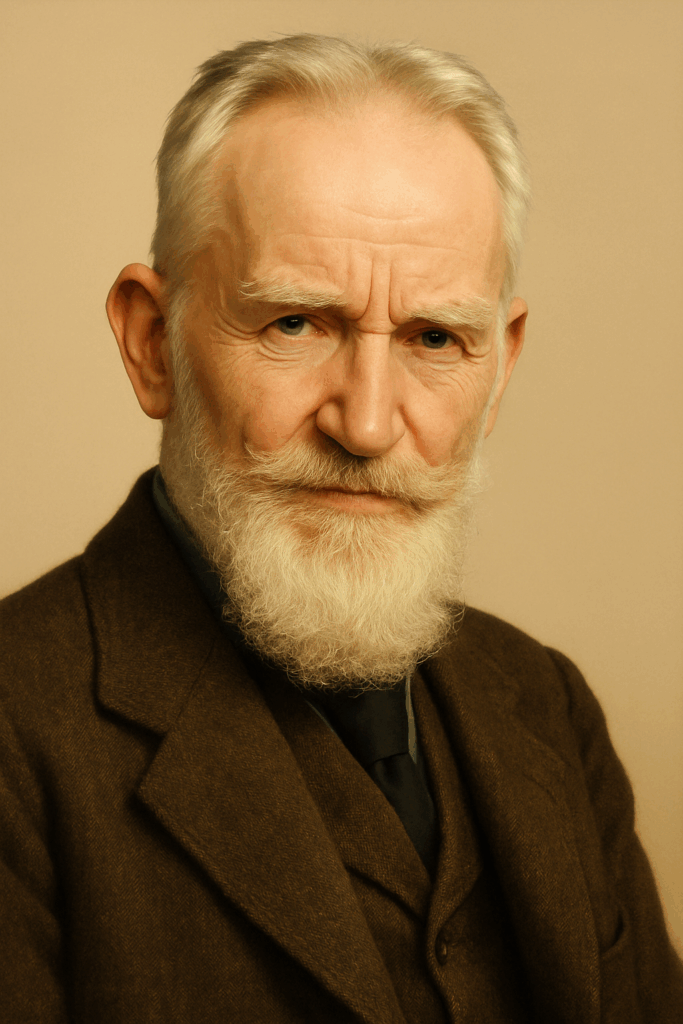
George Bernard Shaw
Early Life and Background
George Bernard Shaw was born on 26 July 1856 in Dublin, Ireland, into a struggling lower-middle-class family. His father, George Carr Shaw, was a failed corn merchant and a man weakened by alcoholism. His mother, Lucinda Elizabeth Gurly Shaw, was talented in music and became a voice teacher. Shaw’s childhood was not particularly happy, as his father’s drinking created instability, while his mother was more absorbed in her music career than in raising her son. These early experiences of poverty and family difficulties shaped Shaw’s outlook on life, making him deeply critical of social inequalities.
As a child, Shaw attended several schools but showed little enthusiasm for formal education. He disliked rote learning and traditional teaching methods. Instead, he became largely self-educated, spending long hours reading books, especially classics of literature, history, and philosophy. This habit of independent learning stayed with him for life and gave him an extraordinary command over ideas and language.
Early Struggles
At the age of 20, in 1876, Shaw left Dublin for London to live with his mother, who had moved there with her daughters. His early years in London were extremely difficult. He had no steady job, little money, and lived in near-poverty. For years, he was financially dependent on his mother while trying to establish himself as a writer.
Shaw spent much of his time in the British Museum Reading Room, which became his “university.” There he read voraciously—on politics, economics, philosophy, art, science, and history. Between 1879 and 1883, Shaw wrote five novels (Immaturity, The Irrational Knot, Love Among the Artists, Cashel Byron’s Profession, and An Unsocial Socialist). None of them were successful initially, though they were published later. These failures discouraged him temporarily but helped him to sharpen his prose style, full of wit, argument, and irony.
Politics and the Fabian Society
Shaw’s intellectual development soon brought him into contact with socialist thought. In 1884, he joined the Fabian Society, a newly founded socialist group in London that promoted gradual reform through democratic means, rather than violent revolution. Shaw quickly became one of its most prominent members.
As a Fabian, Shaw wrote pamphlets, delivered speeches, and participated in debates. His pamphlet The Fabian Essays (1889) became one of the most important socialist documents of its time. Shaw believed strongly in equality, social justice, and reform of economic systems. His socialist beliefs would later find their way into many of his plays, where he attacked class privilege, poverty, and hypocrisy.
Career as a Critic
Before achieving fame as a playwright, Shaw worked as a critic. He became a respected music critic, writing under the name “Corno di Bassetto,” and later a theatre critic. As a critic, he was fearless, witty, and sharp-tongued. He attacked mediocrity and false standards, calling for realism and honesty in art. His criticism prepared him for his own career as a dramatist, since he developed a deep understanding of stagecraft and the weaknesses of the theatre of his time.
Entry into Drama
Shaw’s career as a dramatist began in the 1890s, when he wrote a series of plays with strong social themes. His first play, Widowers’ Houses (1892), dealt with slum landlords and the exploitation of the poor. This was followed by Mrs. Warren’s Profession (1893), which shocked audiences by openly dealing with prostitution and the economic conditions that forced women into it.
His early plays established Shaw as a playwright of ideas. Unlike the romantic and sentimental dramas that were popular in Victorian times, Shaw’s plays were full of debate, satire, and intellectual conflict. He often used comedy as a weapon to expose hypocrisy in society.
Arms and the Man and Rise to Fame
Shaw’s breakthrough came with Arms and the Man (1894), a play that mocked romantic illusions about war. Instead of presenting soldiers as noble heroes, Shaw showed them as practical men concerned with survival. The play was both humorous and thought-provoking, and it was a great success with audiences. It was later published in 1898 in Shaw’s famous collection Plays Pleasant, which also included Candida, You Never Can Tell, and The Man of Destiny.
From this point onwards, Shaw’s reputation as a dramatist grew steadily.
Major Works
Shaw went on to write over 60 plays, covering almost every aspect of human life—love, marriage, war, religion, class, politics, and philosophy. Some of his most important works include:
Candida (1894): A play about marriage, love, and female independence.
The Devil’s Disciple (1897): Set during the American Revolution, it mixes comedy with serious themes.
Man and Superman (1903): A philosophical comedy about human purpose and the “Life Force,” including the famous “Don Juan in Hell” scene.
Major Barbara (1905): Examines morality, poverty, and religion through the story of an arms manufacturer and his daughter in the Salvation Army.
Pygmalion (1913): Perhaps his most famous play, about a professor who transforms a poor flower girl, Eliza Doolittle, into a “lady” by teaching her proper speech. It was later adapted into the musical and film My Fair Lady.
Saint Joan (1923): A serious play about Joan of Arc, which earned him great praise.
Through these plays, Shaw became known as the greatest modern dramatist of England after Shakespeare.
Style and Themes
Shaw’s plays are not just entertainment but weapons of social criticism. He attacked false ideals, exposed hypocrisy, and forced audiences to question their beliefs. His plays are full of wit, irony, and satire, but behind the humor lies a serious purpose—to make people think and reform society. Shaw himself said that he wrote plays to “make the audience sit up and use their brains.”
Recognition and Awards
Shaw achieved worldwide recognition during his lifetime. In 1925, he received the Nobel Prize in Literature “for his work which is marked by both idealism and humanity, its stimulating satire often being infused with a singular poetic beauty.” Shaw accepted the prize but refused the money, saying that his country needed it more.
In 1939, he also received an Academy Award (Oscar) for his screenplay of Pygmalion [The 11th Academy Awards were held on February 23, 1939, at the Biltmore Hotel in Los Angeles, California hosted by Frank Capra]. This made him the only person in history to have won both a Nobel Prize and an Oscar.
Personal Life
Shaw married Charlotte Payne-Townshend, a wealthy Irishwoman, in 1898. The marriage was companionable, though childless. Charlotte supported Shaw in his career and shared his socialist values. Shaw himself was a vegetarian, a teetotaler, and a man of strong convictions. He lived a simple life despite his fame.
Later Life and Death
Shaw continued writing well into his old age, producing plays, essays, and letters. Even in his nineties, he remained intellectually active, though his later plays did not reach the brilliance of his earlier works.
On 2 November 1950, Shaw died at the age of 94 at his home in Ayot St. Lawrence, Hertfordshire, England, after complications from a fall. He left behind a legacy that has shaped modern drama and literature.
Conclusion
George Bernard Shaw was not just a playwright but a thinker, critic, and reformer. He used the stage to attack false ideals and promote truth, justice, and social reform. His combination of wit, intellect, and moral passion made him unique among dramatists. Even today, his works like Arms and the Man and Pygmalion remain relevant, reminding us of his vision that literature and theatre should not only entertain but also enlighten and reform society.
Themes
War versus Illusion
The strongest theme in Shaw’s play is the difference between the romantic illusion of war and its real nature. Raina and Sergius worship war as something heroic and glorious. When Sergius leads a cavalry charge, it is celebrated as a brave victory. However, the audience quickly learns it only succeeded because the enemy ran out of ammunition, making Sergius more reckless than heroic. Captain Bluntschli, the Swiss soldier, destroys these illusions. He admits that soldiers fear death, and instead of carrying cartridges, he carries chocolates. His famous statement about chocolates reveals that survival, food, and practicality are more important than blind courage. By mocking the idea of “noble heroism,” Shaw shows that war is not romantic but a brutal and foolish business shaped by luck and human weakness.
Romantic versus Real Love
The play also contrasts false romantic love with true and honest love. Raina and Sergius constantly speak of their “higher love,” using exaggerated words and poetic gestures. But this relationship is hollow—it depends on pretence rather than sincerity. Sergius flirts with Louka, showing his unfaithfulness, while Raina lies to protect her noble image. When she meets Bluntschli, however, she begins to discover real love. He sees through her heroic poses and tells her openly that he cannot believe her words. Instead of being offended, Raina feels relieved because for the first time someone treats her honestly. In the end, Raina chooses Bluntschli, proving Shaw’s belief that genuine love is built on truth, respect, and human equality, not on empty speeches.
Class and Barriers
Another important theme is class and social divisions. The Petkoffs are proud to be the “richest family in Bulgaria” and boast about their “library,” even though it only has a few cheap novels. They try to imitate European aristocracy but reveal their shallow pretence. Louka, the maid, challenges these class barriers. She tells Sergius boldly that if she were Empress of Russia, she would marry the man she loved without fear of society. She dreams of rising above her status and finally succeeds by getting engaged to Sergius. Nicola, on the other hand, accepts his role as a servant and argues that success lies in “knowing one’s place.” Through Louka’s ambition and Sergius’s surrender to her will, Shaw shows that class barriers are artificial and can be broken through courage and determination.
Appearance versus Reality
Throughout the play, Shaw exposes the difference between what people seem to be and what they really are. Sergius appears as a romantic hero, but in reality, his victory was accidental, and his noble image hides vanity and weakness. Raina seems like a noble, flawless lady, but she too tells lies and puts on heroic poses. Louka appears powerless as a servant, but she is strong-willed, ambitious, and determined to rise above her class. Bluntschli appears ordinary, unromantic, and even comic at first, but in the end, he proves to be the most intelligent, capable, and genuine man in the play. This theme teaches us that appearances can be misleading and that truth lies beneath the surface.
Satire of Society
At its heart, Arms and the Man is a satire on false values. Shaw ridicules society’s shallow ideals of war, love, class, and culture. Sergius is called a hero, but he is vain and unfaithful. Raina and Catherine act like noble ladies but are exposed in their lies and pretence. Major Petkoff is proud of his “library,” though it is just a shelf of old novels, and he fusses about his old coat more than his military duties. All these examples show Shaw’s comic attack on social pride and false heroism. By using laughter, Shaw delivers a serious message: real worth lies in honesty, practicality, and truth, not in empty traditions or false ideals.
Style
Use of Satire and Comedy
Shaw’s style in Arms and the Man is mainly satirical. He uses humor, irony, and witty dialogue to expose false beliefs about war, love, and class. For example, Sergius’s reckless cavalry charge is mocked as “heroic” even though it was pure foolishness. Major Petkoff’s pride in his “library” and his obsession with his old coat make him comic symbols of shallow social pride. By making the audience laugh, Shaw cleverly forces them to think about serious social issues.
Realism instead of Romanticism
Unlike other 19th-century dramatists who filled their plays with romance, sentiment, and melodrama, Shaw used a style of realism. He rejects exaggerated emotions and false ideals. Through Bluntschli, Shaw presents the real side of war—fear, hunger, and survival—rather than glorious battles. Similarly, he shows that true love is not about dramatic gestures (as with Sergius and Raina’s “higher love”) but about honesty and truth (as with Raina and Bluntschli). His style breaks away from fantasy and brings the stage closer to real life.
Lively and Witty Dialogue
One of Shaw’s strongest stylistic features is his brilliant dialogue. Characters do not just talk for entertainment—they argue, debate, and reveal ideas. The quick exchanges between Raina and Bluntschli sparkle with wit, as when Bluntschli bluntly tells her that he cannot believe her noble speeches. Even servants like Louka and Nicola get sharp, memorable lines that challenge social order. Shaw’s dialogue is both comic and intellectually stimulating, which keeps the audience engaged.
Irony and Contrast
Shaw’s style often relies on contrast to highlight truth. Sergius is shown as a “hero,” but his behavior proves the opposite. Raina appears noble, but her lies expose her imperfection. Louka, though a servant, rises above her position, while Nicola accepts his lowly role. These ironies make the audience question appearances versus reality. Shaw’s ironic style prevents the play from becoming sentimental, keeping it sharp and thought-provoking.
Didactic Tone
Shaw’s style is also didactic (teaching in nature). He believed drama should not only entertain but also educate. Through humor and satire, he teaches that war is not glorious, love should be sincere, and class divisions are false. His plays are often called “plays of ideas” because the characters are used to discuss social, political, and moral issues. Arms and the Man is not just a romantic comedy; it is a lesson in realism and honesty.
Blend of Comedy and Seriousness
Another key feature of Shaw’s style is his ability to mix comedy with seriousness. On the surface, Arms and the Man is a light-hearted romantic comedy filled with funny situations—chocolate creams instead of cartridges, Major Petkoff fussing over his coat, and Sergius’s over-the-top heroism. But beneath the comedy, Shaw delivers a serious message about truth, practicality, and social reform. This blending makes his style unique: the audience laughs but also learns.
Symbolism
1. The Chocolate Creams
The most important symbol in the play is Bluntschli’s chocolates, which he carries in his cartridge belt instead of bullets. They represent realism, practicality, and the true nature of war. While romantic heroes are expected to carry weapons and fight bravely, Bluntschli survives by being practical—carrying food instead of ammunition. Raina is at first shocked but later charmed by this honesty. The chocolates symbolize Shaw’s message that war is not about glory but about human survival and common sense.
2. The Old Coat
Major Petkoff’s old coat is another important symbol. It represents the pettiness and shallow pride of the Petkoff family. The Major constantly worries about this coat, even more than about military affairs, showing his childishness. Later, the coat also becomes a symbol of Raina’s secret, since she hides her photograph for Bluntschli in its pocket. Thus, the coat stands both for comic vanity and the theme of appearance versus reality.
3. The Petkoff Library
The “famous” Petkoff library is supposed to be a mark of sophistication and culture. But in reality, it contains only a few cheap, second-hand novels. This symbolizes the false pretensions of the Petkoff family and, more broadly, the shallowness of the upper classes who boast of culture but lack true refinement. Shaw uses the library to mock the artificial social pride of such families.
4. Sergius’s Cavalry Charge
The cavalry charge that makes Sergius a hero is itself a symbol. To the world, it represents “heroism” and “glory.” But in truth, it was reckless and only successful because of the enemy’s shortage of ammunition. It symbolizes the illusion of military heroism—how society glorifies accidents and foolish risks as acts of bravery. Shaw uses this symbol to attack the false ideal of war.
5. The Portrait of Raina
Raina’s photograph, which she secretly gives to Bluntschli, symbolizes romantic illusion and self-image. On it she writes, “To my Chocolate Cream Soldier.” The gesture appears noble and romantic, but when the photograph is later discovered, it exposes her pretence and secret feelings. The tearing of the photograph in Act III symbolizes Raina’s movement away from false romantic gestures toward real honesty in love.
6. Louka’s Bruised Arm
Louka’s bruise, caused by Sergius gripping her arm, becomes a symbol of hidden passion and rebellion. While Sergius pretends to be noble with Raina, the bruise shows his physical attraction to Louka. For Louka, it is also a badge of pride, proving that she has influence over him despite being a servant. It symbolizes the breaking of class barriers and the exposure of hidden truths.
Historical Context
The Serbo-Bulgarian War (1885–1886)
The immediate historical background of the play is the Serbo-Bulgarian War. This war broke out in 1885 after Bulgaria declared unification with Eastern Rumelia, which Serbia opposed. The fighting was short and not very significant militarily, but in the play, it becomes the backdrop for Shaw’s satire. By choosing a small and relatively unimportant war, Shaw is able to mock the romantic myths of “glorious battles” without offending his English audience directly.
The character of Captain Bluntschli, a Swiss mercenary, reflects reality too: in the 19th century, it was common for professional soldiers from neutral countries like Switzerland to fight for pay in other nations’ armies.
Romanticism and Victorian Ideals of War
When Shaw wrote the play in the early 1890s, Europe was still full of romantic ideas of war. Soldiers were seen as noble heroes, and war was often described in terms of honor, courage, and patriotism. In Victorian literature and society, this “glorification of war” was very common.
Shaw directly attacked this idea. Through Bluntschli, he showed war as a matter of fear, survival, and food—not honor. This was shocking for audiences at the time, because they expected plays about war to celebrate bravery.
Social Class in 19th-Century Europe
Another important context is the rigid class system of the 19th century. Families like the Petkoffs represent the rising middle classes in Eastern Europe, who tried to imitate the aristocracy of Western Europe. Their pride in their “library” is a symbol of this social climbing.
At the same time, servants like Louka represent the lower classes, many of whom were dissatisfied with their limited social mobility. Louka’s rebellion against her “place” reflects the growing social unrest of the period, which was also a concern in England at the time Shaw wrote the play.
Shaw’s Socialist Beliefs
The broader historical context is Shaw’s own political involvement. In the 1880s, Shaw joined the Fabian Society, a socialist group in Britain that believed in reforming society through gradual and democratic means. Arms and the Man reflects Fabian ideas by exposing the illusions of war, love, and class. The play suggests that truth, honesty, and practicality are better than false traditions.
Theatre of Ideas
In the late 19th century, drama was mostly romantic, sentimental, or melodramatic. Shaw was influenced by European playwrights like Henrik Ibsen, who introduced realism and social criticism into drama. With Arms and the Man, Shaw brought this new style—sometimes called the “drama of ideas”—to English audiences. Instead of showing noble heroes, he used comedy to discuss war, love, class, and society.
Very Short Answer Questions
Who is the author of Arms and the Man?
George Bernard Shaw.
Where is the play set?
In Bulgaria, during the Serbo-Bulgarian War (1885).
Who is Raina Petkoff’s fiancé at the beginning of the play?
Major Sergius Saranoff.
Who is called the “chocolate cream soldier”?
Captain Bluntschli.
Why is Bluntschli called the “chocolate cream soldier”?
Because he carried chocolates instead of cartridges in battle.
Who is Raina’s mother?
Catherine Petkoff.
Who is Raina’s father?
Major Paul Petkoff.
What is the name of the maid in the Petkoff household?
Louka.
Who is Nicola?
A servant in the Petkoff household.
What is Sergius famous for in the war?
Leading a cavalry charge at Slivnitza.
Why was Sergius’s cavalry charge successful?
The enemy had the wrong ammunition and could not fire.
What does Raina keep in her room that surprises Bluntschli?
A box of chocolate creams.
What does Raina give to Bluntschli to save his life?
Her bed and protection from the soldiers.
What does Major Petkoff often misplace?
His old coat.
What does the “library” in Petkoff’s house actually contain?
A few old novels and gift books.
Who wants to rise above her servant status?
Louka.
Who is secretly in love with Louka?
Sergius.
Who pretends to be engaged to Louka to protect her?
Nicola.
What is Nicola’s dream for the future?
To set up a shop in Sofia.
Who exposes the pretensions of war and romance?
Bluntschli.
Who says, “Nine soldiers out of ten are born fools”?
Bluntschli.
Which character is practical and realistic throughout the play?
Bluntschli.
Which character represents false heroism and empty romantic ideals?
Sergius.
What does Raina tear up at the end of the play?
The photograph she gave to Bluntschli.
Who finally gets engaged to Louka?
Sergius.
Who finally wins Raina’s hand?
Bluntschli.
What does Petkoff boast about to show his family’s status?
Their “library.”
What nationality is Bluntschli?
Swiss.
What is the central theme of the play?
The contrast between reality and romantic illusions.
Short Answer Questions
Why is Captain Bluntschli called the “chocolate cream soldier”?
Bluntschli earns the nickname “chocolate cream soldier” because, instead of carrying bullets, he filled his cartridge belt with chocolates during the war. To him, chocolates were more useful than weapons when hungry. This shocked Raina, who believed soldiers should always carry arms and act heroically. The name symbolizes Bluntschli’s practicality and realism, which contrast with Sergius’s false romantic heroism. It also becomes a symbol of truth and honesty in the play.
How does Shaw contrast Sergius and Bluntschli?
Sergius is a symbol of romantic illusion—brave in appearance, full of poetic speeches, but foolish and impractical. His cavalry charge succeeds by accident, not by skill. In contrast, Bluntschli is practical, realistic, and unromantic. He admits soldiers fear death, and that survival matters more than empty glory. While Sergius represents false ideals of war and love, Bluntschli stands for truth, honesty, and common sense.
Describe the character of Raina at the beginning of the play.
At the start, Raina is dreamy and romantic. She worships Sergius as her “hero” and imagines war as a noble adventure. She reads poetry and opera, filling her mind with ideas of “higher love” and heroic ideals. However, she is also proud and pretentious, often exaggerating her feelings. When she meets Bluntschli, he sees through her false poses. This encounter becomes the beginning of her transformation into a more honest and realistic person.
What is the role of Louka in the play?
Louka, the maid, represents ambition and rebellion against social class restrictions. Unlike Nicola, who accepts his servant status, Louka dreams of rising higher. She boldly tells Sergius that she would marry the man she loved, even if he were above her in class. She also exposes Sergius’s weakness by drawing him into a secret relationship. In the end, she succeeds in becoming engaged to Sergius, showing her determination to break barriers.
How does Shaw satirize the idea of war in Arms and the Man?
Shaw mocks the traditional glorification of war. Instead of presenting brave soldiers, he shows them as hungry, frightened, and dependent on luck. Bluntschli ridicules Sergius’s cavalry charge, comparing it to “slings of peas at a windowpane.” He insists that war is not about honor but survival. By replacing bullets with chocolates, Shaw humorously exposes the reality of war. Through satire, he shows that war is foolish, wasteful, and far from noble.
How does Raina change from the beginning to the end of the play?
In the beginning, Raina is proud, romantic, and pretends to live by “higher ideals.” She worships Sergius and speaks in poetic tones. But when she meets Bluntschli, he exposes her lies and pretensions. Slowly, she realizes that her noble poses are false and childish. By the end, she admits her real feelings and chooses Bluntschli, the practical and truthful man. Thus, Raina transforms from a dreamy girl into a mature woman who values honesty.
What is the significance of Major Petkoff’s coat in the play?
The coat is a running comic symbol in the play. Bluntschli borrows it while escaping, and later it reappears with Raina’s photograph in its pocket. Major Petkoff constantly fusses about his coat, making it a source of humor. More importantly, the coat becomes a symbol of hidden truths, as it almost exposes Raina’s secret about helping Bluntschli. In Shaw’s satire, the coat represents the trivial pride and shallow concerns of the Petkoff family.
How does Shaw present the theme of class in the play?
Shaw shows the rigid divisions of 19th-century society through characters like the Petkoffs, who boast of their “library” to appear aristocratic. Nicola represents the servant who accepts his low position, but Louka refuses to stay in her class and dreams of rising higher. Sergius, though noble, is attracted to Louka, breaking social barriers. In the end, Louka wins Sergius, proving Shaw’s point that class barriers are artificial and can be challenged.
Why is Arms and the Man called an “anti-romantic comedy”?
The play is called an anti-romantic comedy because it breaks traditional romantic ideals. Instead of showing war as glorious, Shaw presents it as dangerous and foolish. Instead of portraying love as noble and pure, he exposes the lies and pretensions behind it. The hero is not Sergius, the dashing cavalry officer, but Bluntschli, the practical “chocolate cream soldier.” The comedy lies in showing the gap between illusion and reality, making it anti-romantic.
What is the importance of the ending of the play?
The ending resolves both the romantic and social conflicts. Sergius, the false hero, is matched with Louka, the ambitious maid who truly suits him. Raina finds her happiness with Bluntschli, who values truth over illusion. The exposure of lies, secrets, and pretensions clears the way for honest relationships. The ending also reinforces Shaw’s main message: real love and life are built on truth, not empty ideals. It is both comic and meaningful.
Long Answer Questions
Discuss Arms and the Man as an Anti-Romantic Comedy.
George Bernard Shaw’s Arms and the Man is widely called an anti-romantic comedy because it challenges the false ideals of love and war that were common in literature and society of the 19th century. Instead of glorifying heroic soldiers and noble lovers, Shaw uses humor and satire to expose their weaknesses and foolishness.
The idea of war, usually presented as noble and brave, is mocked. Sergius Saranoff, who is considered a war hero for leading a cavalry charge at Slivnitza, is actually foolish. His charge only succeeded because the enemy had the wrong ammunition and could not fire back. This makes Sergius’s so-called “heroism” a matter of luck rather than bravery. Captain Bluntschli, the Swiss soldier, further destroys romantic illusions of war. He confesses that he fears death, that soldiers often run away, and that survival is more important than honor. His chocolates instead of cartridges become a comic symbol of practicality over false heroism.
Shaw also makes fun of romantic love. Raina and Sergius both use exaggerated language of “higher love” and behave as if they live in a world of poetry and opera. However, their actions prove otherwise. Raina lies to maintain her noble image, while Sergius secretly flirts with Louka, the maid. Their relationship is full of pretence and hypocrisy. In contrast, Bluntschli speaks plainly and honestly. He does not flatter Raina with grand words but wins her through sincerity.
The comedy arises from the gap between what characters pretend to be and what they truly are. Raina calls Sergius her “hero,” but he is shown as a fool. Bluntschli seems cowardly and comic, but he emerges as the true hero because of his realism and honesty. The ending completes the anti-romantic vision: Sergius is paired with Louka, who matches his character, while Raina finds her real happiness with Bluntschli.
Thus, Shaw’s Arms and the Man is anti-romantic because it rejects the false glamour of war and love. Instead, it celebrates truth, common sense, and realism. It makes the audience laugh, but also think deeply about the illusions people live by.
Give a Character Sketch of Captain Bluntschli. Why is he called the True Hero of the Play?
Captain Bluntschli is the central character of George Bernard Shaw’s Arms and the Man. He is a Swiss professional soldier who fights as a mercenary in the Serbian army. At first, he appears comic because of his unusual behavior, but gradually he proves himself as the most sensible and admirable figure in the play.
Bluntschli is completely different from the usual “romantic hero.” While Sergius is praised as a “noble” soldier for his cavalry charge, Bluntschli openly admits that such charges are foolish. He does not believe in false heroism. For him, war is not about glory but about survival. This is why he carries chocolates instead of cartridges, which earns him the nickname “chocolate cream soldier.” His practical approach makes him more realistic than any other character.
Another important quality of Bluntschli is his honesty. He never pretends to be something he is not. When Raina speaks in her “noble” and “heroic” manner, Bluntschli openly tells her that he cannot believe a word she says. At first, Raina is shocked, but later she realizes that he has seen through her false poses. His directness helps her change from a romantic dreamer into a mature young woman.
Though comic in some ways, Bluntschli is also deeply humane. He refuses to see war as noble slaughter. He speaks of soldiers’ fear, their hunger, and their wish to survive. Unlike Sergius, who plays at heroism, Bluntschli understands the reality of human life.
As a lover, he is different from Sergius. He does not flatter Raina with grand speeches. Instead, he respects her intelligence and treats her as an equal. In the end, when he proposes, it is with sincerity and honesty, not empty words. This makes him the true partner for Raina.
Thus, Bluntschli is the true hero of Arms and the Man. His realism, honesty, and humanity triumph over Sergius’s false heroism and Raina’s illusions. Through him, Shaw shows that true greatness lies not in romance or pretence, but in truth and common sense.
How does Shaw use satire in Arms and the Man? Give examples.
George Bernard Shaw’s Arms and the Man is full of satire—the use of humor and irony to criticize human behavior and social conventions. Shaw satirizes the false ideals of war, love, and social class that dominated 19th-century European society. By exposing these illusions, Shaw makes his audience laugh and think at the same time.
First, Shaw satirizes the romantic idea of war. Instead of showing soldiers as brave heroes, he presents them as hungry, frightened men who want to survive. Captain Bluntschli shocks Raina by admitting that soldiers fear death and often run away. He also carries chocolates instead of bullets, saying, “What use are cartridges in battle? I always carry chocolate instead.” This comically destroys the noble image of war. Sergius’s famous cavalry charge is also satirized. Though it is praised as heroic, Bluntschli calls it foolish because the enemy had the wrong ammunition. Shaw thus shows that war victories are often accidents, not bravery.
Second, Shaw satirizes romantic love. Raina and Sergius both pretend to live by “higher love.” They speak in flowery, exaggerated language and behave as if their love is pure and noble. But Shaw exposes their hypocrisy. Raina lies twice in the play to protect her image of perfection. Sergius, while engaged to Raina, flirts with Louka, the maid. Their romance, instead of being noble, is full of pretence. In contrast, Bluntschli speaks plainly and honestly. His realistic approach makes Sergius and Raina’s so-called “higher love” look foolish.
Finally, Shaw satirizes social class. The Petkoffs boast of their “library,” though it only has a few books, to appear sophisticated. Nicola, the servant, accepts his low status and dreams of running a shop. But Louka refuses to stay in her place. She boldly declares that she would marry the man she loves, even if he is above her in class. In the end, she succeeds in becoming engaged to Sergius, mocking the shallow pride of the Petkoffs and the artificiality of class barriers.
Through this satire, Shaw makes us laugh at human vanity and pretence, but he also forces us to face the truth. Arms and the Man is not just a comedy; it is a sharp attack on false ideals of war, love, and society.
Trace the Transformation of Raina in the Play.
Raina Petkoff, the heroine of George Bernard Shaw’s Arms and the Man, undergoes a major transformation from the beginning to the end of the play. At first, she is shown as a dreamy, romantic young woman, but by the conclusion she becomes a more honest and realistic person. Her change of character is one of the central movements of the play.
At the beginning, Raina is full of romantic illusions. She imagines war as noble and heroic. She worships Sergius, her fiancé, as a perfect hero after hearing of his cavalry charge. She even calls him “my hero, my hero!” She believes her love for him is not ordinary but a “higher love.” She also pretends to be perfect in her behavior, always trying to act noble and generous. However, this perfection is only on the surface.
Her illusions begin to break when she meets Captain Bluntschli, the Swiss soldier. When he enters her room as a fugitive, she expects him to behave like a brave hero. Instead, he shocks her by confessing that soldiers fear death, that war is foolish, and that he carries chocolates instead of bullets. At first, Raina feels insulted, but Bluntschli’s honesty forces her to face the truth about her own pretences.
Raina struggles with this conflict throughout the play. She lies twice—first to protect Bluntschli from the soldiers, and later to hide the photograph she secretly gave him. Each time, she feels guilty because she wants to appear perfect. Bluntschli openly tells her, “When you get into that noble attitude and speak in that thrilling voice, I admire you; but I find it impossible to believe a word you say.” This blunt remark makes Raina realize that she cannot live forever on false appearances.
By the end of the play, Raina abandons her romantic illusions. She sees Sergius as a hypocrite, who flirts with Louka behind her back. She recognizes that their so-called “higher love” was only pretence. Instead, she accepts Bluntschli, who treats her honestly and respects her intelligence. In the final scene, when Bluntschli asks her directly who she gave her love to, she admits shyly, “To my chocolate cream soldier.” This confession shows her growth into honesty.
Thus, Raina’s transformation is from illusion to reality, from a dreamy girl to a mature woman. Through her, Shaw demonstrates the central theme of the play: real love and life are built not on pretence and false ideals, but on truth and honesty.
Discuss the Theme of War in Arms and the Man.
The theme of war is central in George Bernard Shaw’s Arms and the Man. However, unlike traditional writers who glorified war as noble and heroic, Shaw presents war in its true light—foolish, dangerous, and based on luck rather than bravery. Through satire and humor, Shaw breaks the illusion of war and exposes its reality.
The best example of this is Captain Bluntschli. He is a professional soldier but not a romantic hero. He openly admits that soldiers are afraid of death, often run away, and care more about food than about honor. Instead of carrying cartridges, he fills his belt with chocolates. His remark, “What use are cartridges in battle? I always carry chocolate instead,” shows Shaw’s idea that survival is more important than false heroism.
Sergius’s cavalry charge at Slivnitza is also used to mock the idea of war. Though Sergius is praised as a great hero, Bluntschli reveals that the charge succeeded only because the enemy had the wrong ammunition and could not fire back. Sergius’s action, which looks like bravery, was in fact reckless and foolish. Shaw uses this to show that victories in war are often accidents rather than acts of courage.
Even Major Petkoff’s attitude toward war is comic. Instead of being a serious strategist, he is more interested in his coat and his household comfort. This shows how shallow military pride can be. Shaw also highlights how war destroys lives unnecessarily, such as the soldier burned alive in a timber yard, which Bluntschli describes without any false glamour.
Through these examples, Shaw makes it clear that war is not glorious. It is a human weakness that brings hunger, fear, and waste. By using humor, he removes the romantic halo around war and replaces it with common sense.
Thus, the theme of war in Arms and the Man is not about patriotism or heroism but about exposing the truth. Shaw teaches that war is foolish and survival, honesty, and humanity are far more valuable than false glory on the battlefield.
Critical Analysis
Introduction
George Bernard Shaw, one of the greatest playwrights of modern English literature, wrote Arms and the Man in 1894. It was first performed at the Avenue Theatre, London, and was later published as part of his “Plays Pleasant.” Unlike traditional dramas of war and romance, Shaw called it an anti-romantic comedy because it attacks the false ideals of glory, love, and class. The play is full of humor, but behind the laughter lies a serious purpose: Shaw wanted to open the eyes of the audience to the difference between illusion and reality.
At a time when plays were full of melodrama, heroic soldiers, and noble lovers, Shaw shocked audiences by showing that soldiers were frightened men, that so-called heroes were often fools, and that love was not “higher” but full of pretence. His use of sharp wit, satire, and realistic dialogue makes Arms and the Man both entertaining and thought-provoking.
Central Idea
The central idea of the play is the contrast between romantic illusions and realistic truth. Raina and Sergius represent the romantic dreamers who live in a world of poetry and opera, believing in “higher love” and “heroic war.” In contrast, Bluntschli, the Swiss soldier, represents reality and practicality. He openly admits that soldiers fear death, that war is foolish, and that chocolates are more useful than cartridges.
By the end of the play, the illusions of Raina and Sergius are broken. Raina realizes that her love for Sergius was only pretence, while Sergius sees that his heroism is hollow. Both characters move from illusion to reality. The central message of Shaw is clear: truth, honesty, and common sense are more valuable than false ideals.
Plot Summary
The play begins in Bulgaria during the Serbo-Bulgarian War of 1885. Raina Petkoff admires her fiancé Sergius for his heroic cavalry charge at Slivnitza. She imagines him as her noble “hero.” Suddenly, a Swiss soldier, Captain Bluntschli, enters her bedroom as a fugitive. To her shock, he confesses that soldiers are afraid and that he carries chocolates instead of bullets. Raina saves him by hiding him from the soldiers, even giving him her chocolates and bed for safety.
In Act II, Sergius returns as a war hero, but his foolishness is revealed when Bluntschli mocks his charge as reckless. Sergius himself feels dissatisfied with the emptiness of his so-called heroism. Meanwhile, he secretly flirts with Louka, the ambitious maid. Bluntschli reappears, and comic confusion grows when Raina’s photograph is found in Major Petkoff’s old coat.
In Act III, all secrets are revealed. Sergius pairs with Louka, who breaks social barriers to win him. Raina realizes that her love for Sergius was an illusion, and she chooses Bluntschli, the practical and honest soldier. The play ends with the triumph of truth over pretence and illusion.
Themes
Illusion vs. Reality – The most important theme. Sergius’s false heroism and Raina’s “higher love” are exposed as illusions, while Bluntschli’s realism represents truth.
War and Heroism – War is shown as foolish, based on chance, not bravery. Sergius’s charge is foolish, while Bluntschli reveals the hardships of real soldiers.
Love and Romance – False romantic love between Raina and Sergius collapses, while honest love develops between Raina and Bluntschli.
Class and Society – Shaw criticizes rigid class barriers. Louka, a maid, refuses to accept her servant status and rises to marry Sergius, while Nicola remains content in his low role.
Satire and Comedy – Shaw uses humor to criticize society. Characters like Major Petkoff, who fusses about his coat, show how human pride is often ridiculous.
Characters
Captain Bluntschli: A Swiss mercenary, practical and realistic. His chocolates symbolize truth over illusion. He is honest, humane, and becomes the true hero.
Raina Petkoff: At first, a dreamy romantic who worships Sergius. She undergoes a transformation from illusion to realism and finally chooses Bluntschli.
Sergius Saranoff: Raina’s fiancé, a symbol of false heroism. Brave in appearance but foolish in reality, he secretly loves Louka.
Catherine Petkoff: Raina’s mother, obsessed with social appearances. She represents shallow pride in class and status.
Major Paul Petkoff: Raina’s father, a comic figure, more interested in comfort than war. His fussing about his coat is symbolic.
Louka: The maid, ambitious and bold. She refuses to stay in her servant class and rises to marry Sergius.
Nicola: A servant who accepts his low position. He dreams of running a shop but prefers safety to ambition.
Structure and Style
The play has three acts, each moving the plot forward with comic revelations. The structure is tight, with no unnecessary scenes. Shaw’s style is marked by wit, irony, and sharp dialogue. He does not use poetic language except to mock it, as in Raina and Sergius’s exaggerated speeches. His characters speak naturally, often debating and exposing one another’s pretences. The humor comes from irony and contrast—for example, when Bluntschli speaks practical truths while others speak in noble illusions.
Historical Context
The play is set during the Serbo-Bulgarian War of 1885, a conflict between Bulgaria and Serbia after Bulgaria united with Eastern Rumelia. Historically, the war was short, chaotic, and not glorious. Shaw uses this background to mock the idea of “heroic war.” He also reflects 19th-century European society, where class divisions were rigid but beginning to be challenged. Louka’s rise from servant to lady reflects this social change. The play also reflects Shaw’s socialist views, as he criticizes aristocratic pride and praises common sense.
Critical Commentary
Arms and the Man was both praised and criticized when first performed. Some audiences laughed at its comedy but felt uncomfortable with Shaw’s attack on patriotism and romance. However, critics soon recognized it as one of Shaw’s best plays. It has been described as “a laughing play with a serious purpose.” The character of Bluntschli has been admired as Shaw’s mouthpiece, expressing his belief in realism, humanity, and honesty. Sergius and Raina represent the false ideals Shaw wished to destroy. The play’s mixture of humor, satire, and serious social criticism makes it timeless.
Conclusion
In conclusion, Arms and the Man is not just a light comedy but a serious social critique. Shaw destroys the false glamour of war and love, showing them as foolish illusions. At the same time, he celebrates truth, practicality, and honesty through Bluntschli. The play entertains with laughter but also teaches a lesson about life: that real happiness comes not from pretence, but from facing reality. This is why it remains relevant even today as one of Shaw’s greatest anti-romantic comedies.
Free Full PDF Download Now
More Plays by Easy Literary Lessons
The Merchant of Venice by William Shakespeare
The Silver Box by John Galsworthy
Othello by William Shakespeare