
Marina by TS Eliot
Quis hic locus, quae regio, quae mundi plaga?
What seas what shores what grey rocks and what islands
What water lapping the bow
And scent of pine and the woodthrush singing through the fog
What images return
O my daughter.
Those who sharpen the tooth of the dog, meaning
Death
Those who glitter with the glory of the hummingbird, meaning
Death
Those who sit in the stye of contentment, meaning
Death
Those who suffer the ecstasy of the animals, meaning
Death
Are become unsubstantial, reduced by a wind,
A breath of pine, and the woodsong fog
By this grace dissolved in place
What is this face, less clear and clearer
The pulse in the arm, less strong and stronger —
Given or lent? more distant than stars and nearer than the eye
Whispers and small laughter between leaves and hurrying feet
Under sleep, where all the waters meet.
Bowsprit cracked with ice and paint cracked with heat.
I made this, I have forgotten
And remember.
The rigging weak and the canvas rotten
Between one June and another September.
Made this unknowing, half conscious, unknown, my own.
The garboard strake leaks, the seams need caulking.
This form, this face, this life
Living to live in a world of time beyond me; let me
Resign my life for this life, my speech for that unspoken,
The awakened, lips parted, the hope, the new ships.
What seas what shores what granite islands towards my timbers
And woodthrush calling through the fog
My daughter.
Marina by TS Eliot Summary
T. S. Eliot’s Marina was first published in 1930 as part of The Ariel Poems, a special series of illustrated pamphlets issued by Faber and Faber in London. Each pamphlet in this series contained a single poem by a leading poet, accompanied by artwork. Marina was number 29 in the second series of the Ariel Poems and appeared with illustrations by E. McKnight Kauffer.
Later, Eliot included Marina in his Collected Poems 1909–1962, and it has since been read as one of his most tender and spiritual works, reflecting the influence of his Christian faith after his conversion in 1927.
The poem begins with a question in Latin that means, “What place is this, what part of the world is this?” The speaker feels as if he has arrived in an unknown land, surrounded by seas, rocky shores, islands, pine trees, and fog. He hears the song of a woodthrush, and these images bring back memories that move him deeply until he cries out, “O my daughter.” It is a sudden recognition of something precious, a moment of discovery and remembrance.
He then reflects on the fact that all kinds of lives eventually end in death. Those who live violently, those who shine with glory, those who remain content in laziness, and those who live passionately like animals—all of them end the same way. Death is inescapable. Yet against this certainty of death, the small things of nature—the breath of pine, the bird’s song, the fog—seem to dissolve that darkness and suggest a presence of grace and renewal.
The speaker now sees, or imagines, the face of his daughter. At first it appears vague, then clearer, until it seems both far away and yet very near. He feels the pulse of life, the sound of laughter, whispers among the leaves, and the sense of hurrying feet. This presence feels like a gift, though he wonders if it is truly given or only lent. It is mysterious but deeply comforting, as if eternity is touching him through this vision.
He then turns to the image of a ship, which represents his life. The ship is worn out by time—the bowsprit cracked with ice, the paint cracked with heat, the rigging weak, the canvas rotten, and the seams leaking. He remembers building this ship of life half-consciously, almost unknowingly, between one season and another, and now it shows all the marks of age and decay. Yet despite this weakness, he understands the purpose of the journey.
The recognition of his daughter gives meaning to everything. He feels ready to surrender his old life in exchange for this new life, to give up his own speech for the silent grace of her presence. The daughter represents hope, renewal, and the continuation of life beyond his own time. The poem ends by returning to the images of seas, shores, islands, fog, and the woodthrush calling, and finally to the tender cry, “My daughter.”
The whole poem is about a tired soul who has faced the harshness of time and the certainty of death but finds new meaning and hope through the vision of his daughter, who symbolizes innocence, grace, and spiritual renewal.
Marina by TS Eliot Analysis
Quis hic locus, quae regio, quae mundi plaga?
Reference to Context:
The line “Quis hic locus, quae regio, quae mundi plaga?” appears at the very beginning of T. S. Eliot’s lyric poem Marina (1930). It is a quotation from the Roman philosopher Seneca’s play Hercules Furens (The Madness of Hercules). In the original context, Hercules, recovering from madness and not fully aware of where he is, asks: “What place is this? What region, what part of the world?” Eliot uses this line as an epigraph to set the mood of bewilderment, dislocation, and sudden recognition that shapes the entire poem.
Explanation:
The Latin words mean:
Quis hic locus → “What place is this?”
quae regio → “What region?”
quae mundi plaga → “What part of the world?”
By beginning with these questions, Eliot immediately places the reader in a mood of wonder and strangeness. The speaker feels as if he has been carried into an unknown land, surrounded by seas, shores, rocks, islands, fog, and the sound of the woodthrush. This questioning sets up the central experience of the poem: the discovery or recognition of something long-lost and deeply significant.
The line also connects with the theme of recognition in Shakespeare’s Pericles, where the father Pericles is suddenly reunited with his daughter Marina after long wandering and despair. Just like Hercules awakening after madness, or Pericles recognizing his daughter, the speaker of Eliot’s poem is astonished at where he has arrived—he does not know the place, but he knows the significance of the discovery: “O my daughter.”
Thus, the Latin opening prepares the reader for the mood of spiritual awakening, renewal, and grace that follows. It symbolizes a soul that has wandered through suffering and death but suddenly finds itself in a place of recognition, wonder, and hope.
Poetic devices:
Allusion:
The line is a direct quotation from Seneca’s Latin tragedy Hercules Furens (Act V, line 1138), where Hercules, disoriented and emerging from madness, questions his surroundings. By invoking this classical text, Eliot creates an intertextual link to themes of confusion, existential questioning, and spiritual disorientation, aligning the speaker’s journey with Hercules’ moment of crisis and awakening.
The allusion also situates the poem within a broader literary tradition, connecting modernist concerns with classical antiquity.
Epigraph:
The line serves as the poem’s epigraph, setting a contemplative and questioning tone. It functions as a thematic prelude, framing the poem’s exploration of place, identity, and spiritual searching. The use of Latin adds a layer of intellectual weight and universality, distancing the reader while inviting scholarly engagement.
Rhetorical Questions:
The structure of the line consists of three successive questions (“Quis hic locus, quae regio, quae mundi plaga?”). This series of interrogatives creates a sense of urgency and disorientation, mirroring the speaker’s existential uncertainty about their place in the world.
The questions are unanswered, leaving an open-ended ambiguity that invites the reader to ponder alongside the speaker.
Parallelism:
The line employs syntactic parallelism through the repetition of the interrogative pronoun quae (and its variant quis) and the structure of the three clauses. Each question builds on the previous one, escalating from a specific “place” (locus) to a broader “region” (regio) and finally to the cosmic “quarter of the world” (mundi plaga). This progression amplifies the scope of the speaker’s disorientation.
Alliteration:
Alliteration is present in the repetition of the qu sound (quis, quae), which gives the line a rhythmic coherence and emphasizes the questioning tone.
What seas what shores what grey rocks and what islands
What water lapping the bow
And scent of pine and the woodthrush singing through the fog
What images return
O my daughter.
Reference to Context:
These lines are taken from the opening section of T. S. Eliot’s poem Marina (1930), one of his Ariel Poems. In this part of the poem, the speaker is overwhelmed by a flood of images from nature—the sea, the shores, the rocks, the scent of pine, and the song of the woodthrush. The repeated questioning “What seas, what shores…” expresses astonishment and recognition. This leads to the deeply moving cry “O my daughter,” which introduces the central theme of the poem—the rediscovery of innocence, renewal, and spiritual grace symbolized by the daughter.
Explanation:
The speaker lists images of the natural world: seas, shores, rocks, islands, water, pine trees, and birdsong. These are not just ordinary landscapes but symbols of memory and recognition. The repetition of “What…” gives the passage a rhythm of wonder and amazement, as though he cannot fully grasp where he is or what is happening.
The sea imagery suggests life’s long and difficult voyage, while the pine trees and birdsong suggest purity, freshness, and the possibility of new beginnings. The fog represents mystery, uncertainty, and the half-dreamlike state of recognition.
When he cries out “O my daughter,” the mood changes from wonder to profound personal feeling. Just like Pericles in Shakespeare’s Pericles, Prince of Tyre, who after years of suffering is reunited with his daughter Marina, the speaker here experiences an overwhelming recognition. The daughter represents renewal, innocence, hope, and spiritual grace that survives even after the harshness of time and death.
This passage, therefore, sets the emotional tone of the entire poem: a movement from confusion and uncertainty to a discovery that brings peace, meaning, and renewal.
Poetic Device:
Anaphora:
The repetition of “What” at the beginning of the first four lines (“What seas what shores what grey rocks and what islands / What water lapping the bow”) creates a rhythmic, questioning cadence. This anaphora mirrors the epigraph’s rhetorical questions, reinforcing the speaker’s sense of disorientation and search for meaning.
The repetition builds a cumulative effect, emphasizing the multiplicity of images and the speaker’s attempt to grasp or recall something elusive.
Imagery:
Visual Imagery: The lines evoke vivid pictures of a seascape—“seas,” “shores,” “grey rocks,” and “islands.” The adjective “grey” adds a muted, somber tone, suggesting a landscape shrouded in ambiguity or fog, aligning with the poem’s dreamlike quality.
Auditory Imagery: The “woodthrush singing through the fog” introduces a delicate, melodic sound that pierces the obscurity, symbolizing hope or clarity amidst confusion.
Tactile and Olfactory Imagery: The “water lapping the bow” suggests gentle movement and touch, while the “scent of pine” evokes a crisp, natural smell, grounding the abstract questioning in sensory experience.
These sensory details create a textured, immersive scene, blending the physical and the spiritual.
Alliteration:
The repetition of the w sound in “What seas what shores what” and “water” creates a soft, flowing rhythm that mimics the motion of waves or the lapping of water. This enhances the poem’s maritime imagery and soothing tone.
The s sounds in “seas,” “shores,” and “scent” further reinforce the liquid, sibilant quality of the scene.
Enjambment:
The lines flow without punctuation between “What seas what shores what grey rocks and what islands” and “What water lapping the bow,” creating a sense of continuity and fluidity. This mirrors the ceaseless movement of the sea and the speaker’s stream-of-consciousness reflection.
The enjambment between “What images return / O my daughter” shifts the tone abruptly, moving from expansive questioning to an intimate, emotional address, heightening the personal stakes of the speaker’s quest.
Rhetorical Questions:
The repeated “What” introduces a series of unanswered questions, echoing the Latin epigraph (“Quis hic locus, quae regio, quae mundi plaga?”). These questions convey the speaker’s disorientation and yearning to understand or reconnect with a lost or elusive truth, possibly embodied by the “daughter.”
Symbolism:
The maritime imagery (“seas,” “shores,” “islands,” “water lapping the bow”) symbolizes a journey, both physical and spiritual, evoking exploration, transition, or a quest for redemption. The ship’s bow suggests forward movement, perhaps toward revelation.
The “scent of pine” and “woodthrush singing through the fog” symbolize moments of clarity or spiritual insight breaking through confusion. The woodthrush, a bird associated with beauty and transcendence in American literature (e.g., Whitman), may represent hope or divine inspiration.
The “daughter” is a potent symbol, likely drawing on Marina from Shakespeare’s Pericles, representing lost innocence, spiritual rebirth, or a redemptive figure.
Apostrophe:
The direct address “O my daughter” is an apostrophe, invoking an absent or symbolic figure. This emotional outburst shifts the poem from abstract questioning to a deeply personal tone, suggesting the daughter (Marina) is central to the speaker’s longing or spiritual awakening.
Metaphor:
The maritime and natural elements serve as metaphors for the speaker’s inner journey. The “fog” may represent confusion or spiritual blindness, while the “woodthrush singing” and “scent of pine” suggest moments of clarity or grace.
Those who sharpen the tooth of the dog, meaning
Death
Those who glitter with the glory of the hummingbird, meaning
Death
Those who sit in the stye of contentment, meaning
Death
Those who suffer the ecstasy of the animals, meaning
Death
Reference to Context:
These lines appear in the middle section of Marina (1930), one of Eliot’s Ariel Poems. After opening with images of the sea and the cry “O my daughter,” the poem turns to a meditation on the nature of human life. Eliot lists different ways people live—through violence, through glory, through lazy contentment, or through animal passion—but shows that all lead to the same end: death. This passage emphasizes the inevitability of mortality and the futility of worldly pursuits, preparing the way for the recognition of spiritual renewal later in the poem.
Explanation:
The first line, “Those who sharpen the tooth of the dog, meaning / Death”, presents a violent image. To sharpen the tooth of the dog suggests preparing an animal, or a weapon, for attack. The dog here symbolizes cruelty and aggression. By adding “meaning Death” in a separate line, Eliot makes a stark equation: a life built on violence leads inevitably to death. The harsh sound of the words sharpen, tooth, dog reinforces the brutality, while the single isolated word “Death” gives the finality of the outcome.
In the next line, “Those who glitter with the glory of the hummingbird, meaning / Death”, the image shifts from brutality to brilliance. The hummingbird is quick, dazzling, and beautiful, but also fleeting. Glitter and glory suggest surface brightness and fame. Eliot points out that such glory, no matter how radiant, ends in the same result: death. The contrast between sparkling beauty and the blunt word “Death” underlines the futility of relying on appearances or achievements.
The third line, “Those who sit in the stye of contentment, meaning / Death”, describes people who live in laziness and self-satisfaction. A stye is a pigsty, a dirty place of animal contentment. To “sit in the stye” suggests passivity, comfort without growth, and a refusal to strive. Eliot shows that even such an easy, complacent life leads to death. Unlike the earlier lines, which involved active images of sharpening and glittering, this one is passive, but the end is still the same.
Finally, the line “Those who suffer the ecstasy of the animals, meaning / Death” refers to those who give themselves up to physical passion and instinct. The word “suffer” here carries the sense of “allowing oneself” to be overcome. Such sensual abandon may feel like ecstasy, but it belongs to the level of animals, not humans. Eliot concludes that even this most intense physical pleasure ends in death. The mixture of a word like “ecstasy” with the blunt ending “Death” creates a sharp moral tension.
Taken together, these four lines form a catalogue of human choices: violence, glory, complacency, and passion. Each appears different, but Eliot reduces them all to the same conclusion. The repetition of the phrase “Those who…” at the beginning of each line creates a rhythm of universality, as though no one is exempt. The repeated placement of the word “Death” on a line by itself makes mortality seem absolute and unavoidable.
This passage is not meant to be despairing only, but to prepare for what follows. By stripping away illusions about violence, beauty, comfort, or passion, Eliot clears the ground for the next section of the poem, where natural images—the breath of pine, the bird’s song, and the fog—introduce the idea of grace. Soon after, the vision of the daughter appears, offering renewal and hope beyond the certainty of death.
In this way, the catalogue of death becomes a turning point in the poem. It acknowledges the futility of worldly pursuits and the universality of mortality, but it also sets the stage for the redemptive recognition that comes later.
Poetic Device:
Anaphora:
The repeated phrase “Those who” at the beginning of each line creates a rhythmic, incantatory effect, emphasizing the universality of the human conditions being described. This structural repetition mirrors the inevitability of death, reinforcing the idea that diverse paths all lead to the same end.
The anaphora also builds a sense of accumulation, cataloging different types of people and their pursuits, only to collapse them into the singular outcome: “Death.”
Parallelism:
The parallel structure of the lines (“Those who [action], meaning / Death”) creates a stark, almost formulaic equivalence between varied human endeavors and mortality. This parallelism underscores the poem’s philosophical tone, suggesting that no matter the pursuit—ambition, beauty, complacency, or passion—all are reduced to the same fate.
Metaphor:
Each line uses metaphorical language to characterize different human archetypes:
“Sharpen the tooth of the dog”: The dog, often a symbol of aggression or instinct, suggests ambition, violence, or predatory behavior. “Sharpening the tooth” implies honing one’s destructive tendencies, perhaps in pursuit of power or dominance.
“Glitter with the glory of the hummingbird”: The hummingbird, with its vibrant beauty and fleeting energy, symbolizes those who chase aesthetic or ephemeral glory, such as artists or those obsessed with superficial brilliance.
“Sit in the stye of contentment”: The “stye” (a pigpen) evokes complacency or self-satisfied stagnation, portraying those who live comfortably but unreflectively, mired in mundane satisfaction.
“Suffer the ecstasy of the animals”: This suggests raw, primal passion or instinctual abandon, possibly referencing those consumed by physical or emotional intensity without higher purpose.
These metaphors collectively critique human pursuits, equating them with futility in the face of death.
Symbolism:
Death: The repeated word “Death” (capitalized in most editions) serves as a stark symbol of mortality, acting as the great equalizer that renders all human endeavors “unsubstantial” (as noted in the next stanza). It carries a weighty, almost personified presence, aligning with the poem’s spiritual undertones.
The animals (dog, hummingbird, pigs, unspecified animals) symbolize different facets of human nature—aggression, beauty, sloth, and instinct—each tied to a flawed or limited pursuit.
Juxtaposition:
The contrast between the vivid, specific imagery of each pursuit (e.g., the vibrant “glory of the hummingbird” or the visceral “ecstasy of the animals”) and the blunt, monosyllabic “Death” creates a jarring effect. This juxtaposition highlights the tension between life’s richness and its ultimate end, emphasizing the transient nature of human endeavors.
Alliteration:
Alliteration: The sh sound in “sharpen” and “tooth” and the gl in “glitter” and “glory” create a sonic texture that enhances the vividness of the imagery. The s sounds in “sit,” “stye,” and “suffer” add a hissing, almost judgmental tone to the descriptions.
Irony:
The irony lies in equating seemingly positive or neutral pursuits (e.g., “glory” or “contentment”) with death. For example, the “glory of the hummingbird” suggests beauty and vitality, yet it is reduced to the same fate as the aggressive “tooth of the dog.” This irony critiques the emptiness of worldly achievements when viewed through the lens of mortality.
Repetition:
The repetition of “meaning / Death” at the end of each line acts as a refrain, hammering home the inevitability of mortality. This repetition creates a somber, almost ritualistic tone, as if the speaker is reciting a litany of human flaws.
Enjambment:
The enjambment between the action (“Those who…”) and the consequence (“meaning / Death”) creates a pause that heightens the dramatic effect. The word “Death” lands like a verdict, isolated on its own line for emphasis, reinforcing its finality.
Are become unsubstantial, reduced by a wind,
A breath of pine, and the woodsong fog
By this grace dissolved in place
Reference to Context:
These lines occur in the middle of T. S. Eliot’s Marina (1930). The poem begins with wonder and recognition (“What seas what shores… O my daughter”), then moves into a harsh meditation on mortality, where all human pursuits—violence, glory, complacency, passion—end in Death. Immediately after this heavy section, Eliot introduces these lines. Here, the harsh finality of death is contrasted with delicate natural images: wind, pine, fog, and birdsong. This marks the turning point of the poem, where death begins to dissolve into grace, preparing for the mystical recognition of the daughter.
Explanation:
The phrase “Are become unsubstantial” refers to the conditions of life and death described earlier. Violence, brilliance, laziness, and passion—each ending in death—are shown here to be insubstantial, without lasting substance. They seem solid at first, but they fade like mist when touched by grace.
“Reduced by a wind” suggests that even the heaviest human experiences can be swept away lightly, like smoke scattered by a breeze. Wind is an invisible force, a symbol of spirit, showing how easily mortality dissolves in the presence of something higher.
“A breath of pine” introduces olfactory imagery, suggesting freshness, purity, and renewal. The pine, an evergreen tree, has long been a symbol of endurance and immortality. A mere breath of its scent is enough to dissolve the weight of death.
“And the woodsong fog” blends sound and sight: the fog represents obscurity and mystery, while the birdsong within it introduces a note of life, beauty, and grace. This combination suggests that grace works mysteriously, within the fog of uncertainty, yet brings guidance and renewal.
Finally, “By this grace dissolved in place” makes the spiritual point explicit. Death, which seemed universal and final, is now dissolved—not by human effort, but by divine grace. This grace does not remove the reality of death but transforms it, reducing its power and opening the way to renewal.
Poetic Device:
Metaphor:
The phrase “Are become unsubstantial” metaphorically suggests that the human pursuits described earlier (“Those who sharpen the tooth of the dog,” etc.) lose their solidity or significance. They are reduced to something intangible, like mist or air, in the face of a greater force.
The “wind” and “breath of pine” serve as metaphors for a transformative, possibly divine force that disperses these worldly endeavors. The “breath” evokes life or spirit (recalling the biblical “breath of life”), while “pine” connects to the earlier natural imagery, grounding the metaphor in the sensory world.
The “woodsong fog” is a metaphor blending the auditory (the woodthrush’s song) with the visual and tactile (fog), suggesting a mystical or transcendent atmosphere where clarity and obscurity coexist.
Imagery:
Tactile and Olfactory Imagery: The “breath of pine” evokes the sharp, fresh scent of pine, grounding the abstract idea of dissolution in a sensory experience. It recalls the earlier “scent of pine” (line 4), tying the poem’s imagery together.
Auditory and Visual Imagery: The “woodsong fog” combines the sound of the woodthrush (from line 5) with the visual and tactile obscurity of fog, creating a synesthetic image that blends senses to evoke a mystical state.
Natural Imagery: The “wind,” “pine,” and “fog” root the passage in nature, contrasting with the human pursuits of the previous lines and suggesting a return to a purer, elemental state.
Personification:
The “wind” and “breath of pine” are subtly personified, acting as agents that “reduce” human endeavors. This personification imbues nature with a quasi-divine power, aligning with the poem’s spiritual undertones.
Symbolism:
Wind and Breath: These symbolize a spiritual or divine force, possibly the Holy Spirit in a Christian context, given Eliot’s Anglicanism. They dissolve the illusions of worldly pursuits, suggesting purification or transcendence.
Pine and Woodsong Fog: The pine recalls resilience and eternity (evergreen trees), while the “woodsong fog” blends the woodthrush’s song (a symbol of hope or divine inspiration) with fog (ambiguity or mystery), symbolizing a liminal space where spiritual clarity emerges from confusion.
Grace: The word “grace” is a key Christian symbol, suggesting divine mercy or salvation that dissolves the false solidity of human endeavors, offering a path to spiritual renewal.
Oxymoron and Paradox:
The phrase “woodsong fog” is oxymoronic, combining the clarity of song with the obscurity of fog. This paradox reflects the poem’s tension between confusion and revelation, a central theme in Eliot’s spiritual exploration.
“Dissolved in place” is also paradoxical, suggesting both dissolution (disappearance) and rootedness (in place). This captures the idea of transcendence within the present moment, a state of being both lost and found.
What is this face, less clear and clearer
The pulse in the arm, less strong and stronger —
Given or lent? more distant than stars and nearer than the eye
Whispers and small laughter between leaves and hurrying feet
Under sleep, where all the waters meet.
Reference to Context:
These lines occur after Eliot’s meditation on the inevitability of death. Having dismissed violence, glory, comfort, and passion as paths that all end in death, the speaker now experiences a sudden vision of life and renewal. He seems to see, or feel, the presence of his daughter. This passage captures the mysterious, dream-like moment of recognition, where the daughter becomes both real and unreal, both distant and near, a symbol of innocence, renewal, and grace.
Explanation:
The line “What is this face, less clear and clearer” shows the speaker trying to grasp a vision that comes to him uncertainly. At first, the daughter’s face seems vague, almost as if seen through mist, yet at the same time it grows clearer in his perception. It is a paradox: the more he tries to see, the less definite it appears, yet the more powerful its presence becomes. This strangeness conveys the mystery of recognition—something half remembered, half discovered.
The phrase “The pulse in the arm, less strong and stronger” continues the paradox. He feels the living pulse of his daughter—her heartbeat, her life-force—but it is both faint and intense. This suggests that the vision is not entirely physical but spiritual, a presence that cannot be measured in ordinary terms.
In the line “Given or lent? more distant than stars and nearer than the eye”, the speaker questions whether this gift is permanent or temporary. Is the daughter’s presence truly “given” as a lasting reality, or only “lent,” something that might be taken away? Again the paradox deepens: she feels unimaginably far away, like the stars, but at the same time she is closer than anything else, closer even than the speaker’s own eye to himself. The line captures the tension between human fragility and the mystery of grace.
The next line, “Whispers and small laughter between leaves and hurrying feet”, evokes the sound and atmosphere of the daughter’s presence. She is imagined as playful, youthful, alive, with the sounds of laughter and running feet mixing with the rustling of leaves. The imagery here suggests innocence, vitality, and joy.
Finally, “Under sleep, where all the waters meet” gives the scene a dream-like quality. The vision seems to come in a state of half-sleep, where memory, dream, and reality blend together. The meeting of all waters suggests a place of unity, eternity, or the soul’s deepest resting place. The daughter’s presence here becomes not only a personal recognition but also a symbol of spiritual renewal, as though all the streams of life join in this one experience.
Poetic Device:
Paradox:
The phrases “less clear and clearer” and “less strong and stronger” are paradoxical, presenting contradictory qualities within the same subject (the “face” and “pulse”). These paradoxes suggest a figure or truth (possibly Marina or a divine presence) that is simultaneously elusive and vivid, weak yet vital. They reflect the poem’s theme of grappling with something intangible yet profoundly real.
The question “Given or lent?” further deepens the paradox, questioning whether this presence is permanent (given) or temporary (lent), adding to the speaker’s uncertainty.
The phrase “more distant than stars and nearer than the eye” juxtaposes cosmic distance with intimate proximity, capturing the transcendent yet immanent nature of the “daughter” or spiritual truth.
Imagery:
Visual Imagery: The “face” and “pulse in the arm” evoke a human presence, grounding the abstract questioning in bodily, tangible images. The face is a universal symbol of identity, while the pulse suggests life and vitality.
Auditory Imagery: “Whispers and small laughter between leaves” conjures soft, delicate sounds, suggesting a fleeting, almost supernatural presence. The “hurrying feet” add a sense of movement and urgency, enhancing the dreamlike quality.
Natural and Spatial Imagery: The “leaves” and “waters meet” evoke a natural, almost mystical setting, suggesting a convergence of elements (literal or metaphorical) in a liminal space “under sleep.”
The imagery is both specific and vague, creating a sense of mystery that invites multiple interpretations.
Metaphor:
The “face” and “pulse” are metaphorical, likely representing the “daughter” (Marina) or a spiritual ideal. They suggest a presence that is both human and divine, fragile yet enduring.
“Under sleep, where all the waters meet” is a powerful metaphor for a subconscious or spiritual realm where boundaries dissolve, and unity is achieved. The “waters” may symbolize life, emotions, or the collective human experience, converging in a transcendent moment.
Rhetorical Question:
The question “Given or lent?” introduces a philosophical inquiry into the nature of the presence the speaker perceives. It reflects the speaker’s uncertainty about whether this vision (the “face” or “daughter”) is a permanent gift or a fleeting moment, aligning with the poem’s exploration of spiritual epiphany.
Enjambment:
The enjambment between “less clear and clearer / The pulse in the arm, less strong and stronger” creates a flowing, unbroken rhythm that mirrors the paradoxical blending of opposites. The dash after “stronger” pauses the line, emphasizing the shift to the questioning “Given or lent?”
The lack of punctuation between “leaves and hurrying feet / Under sleep” creates a seamless flow, suggesting a continuous, dreamlike state where images and sensations merge.
Symbolism:
Face and Pulse: These symbolize the “daughter” (Marina) or a divine presence, embodying both human fragility and spiritual vitality. They may also represent the speaker’s own renewed sense of life or connection.
Stars and Eye: The stars symbolize cosmic distance or transcendence, while the eye suggests intimate, personal perception, reinforcing the paradox of a presence that is both far and near.
Whispers, Laughter, Leaves, and Feet: These evoke a fleeting, almost ghostly presence, possibly the “daughter” or a spiritual memory, moving through a natural world that feels alive yet elusive.
Waters Meet: This is a potent symbol of convergence, suggesting a spiritual or emotional unity, possibly referencing the Christian idea of salvation or the mystical union of all things in a divine realm.
Bowsprit cracked with ice and paint cracked with heat.
I made this, I have forgotten
And remember.
The rigging weak and the canvas rotten
Between one June and another September.
Made this unknowing, half conscious, unknown, my own.
The garboard strake leaks, the seams need caulking.
This form, this face, this life
Living to live in a world of time beyond me; let me
Resign my life for this life, my speech for that unspoken,
The awakened, lips parted, the hope, the new ships.
What seas what shores what granite islands towards my timbers
And woodthrush calling through the fog
My daughter.
Reference to Context:
These lines come near the end of Eliot’s Marina (1930), one of his Ariel Poems. After the earlier meditations on death and the mysterious vision of the daughter, Eliot turns to the image of a ship to symbolize his life and its long voyage. The imagery of wear, decay, and repair conveys the passage of time and human mortality, but this leads finally to an affirmation of renewal through the daughter, who represents innocence, hope, and grace.
Explanation:
The line “Bowsprit cracked with ice and paint cracked with heat” introduces the image of a battered ship, worn down by opposite extremes of weather. The bowsprit, a piece of wood extending from the front of a ship, has been damaged by cold, while the paint has cracked under heat. This imagery shows how the speaker’s life has been weathered and marked by the harsh experiences of time.
In “I made this, I have forgotten / And remember,” the speaker reflects on the fact that he has shaped his life like a shipbuilder, though he did so without full awareness. There is a tension between forgetting and remembering, as though his past efforts were unconscious but now come back to him with clarity.
The lines “The rigging weak and the canvas rotten / Between one June and another September” emphasize decay and the passage of time. The rigging that holds the ship together has grown fragile, and the sails are worn out. The mention of months suggests how time passes silently, wearing things down even when one is not fully aware of it.
In “Made this unknowing, half conscious, unknown, my own,” the speaker acknowledges that he built his life without full understanding—half aware, half blind—but it is still his own creation, for better or worse.
The image of decay continues in “The garboard strake leaks, the seams need caulking.” The garboard strake is a plank in the bottom of the ship, and if it leaks, the vessel is in danger of sinking. The seams also need repair. This image reinforces the fragility of human life: the ship is close to failing, just as the human body ages and weakens.
The next lines move to a recognition of something greater: “This form, this face, this life / Living to live in a world of time beyond me.” The speaker realizes that his own body and life are part of something larger and lasting, a world that stretches beyond his own individual time. This recognition prepares him for an act of surrender.
Thus he declares: “Let me / Resign my life for this life, my speech for that unspoken.” He is ready to give up his own life in exchange for the new life symbolized by the daughter. His own words and achievements are nothing compared to the unspoken grace and purity that she embodies.
The description “The awakened, lips parted, the hope, the new ships” suggests renewal, the stirring of fresh possibilities. The daughter’s presence is connected with awakening, innocence, and the hope of new journeys to come, just as new ships sail out after old ones decay.
Finally, the poem closes with a return to the imagery of the beginning: “What seas what shores what granite islands towards my timbers / And woodthrush calling through the fog / My daughter.” The repetition of “What seas what shores” echoes the opening, creating a circular structure. The granite islands remind us of firmness and permanence, while the woodthrush song and fog suggest mystery and grace. The poem ends with the moving cry “My daughter,” the central recognition that transforms death and decay into hope and renewal.
Poetic Device:
Imagery:
Maritime Imagery: The “bowsprit cracked with ice,” “paint cracked with heat,” “rigging weak,” “canvas rotten,” and “garboard strake leaks” vividly depict a ship in disrepair, symbolizing the speaker’s life, body, or creative work weathered by time and experience. The tactile and visual details evoke a sense of decay and struggle.
Natural Imagery: The “woodthrush calling through the fog” (recalling line 5) and “granite islands” reintroduce the poem’s earlier natural elements, blending the concrete (granite) with the ethereal (fog), suggesting a journey toward clarity or redemption.
Human Imagery: “This form, this face, this life” and “lips parted” evoke a human presence, likely the “daughter” (Marina), symbolizing spiritual rebirth or a divine vision. These images ground the abstract themes in a bodily, emotional reality.
Metaphor:
The ship is a central metaphor for the speaker’s life, work, or soul, worn by the trials of existence (“ice,” “heat,” “rotten canvas”). Its decay reflects the human condition, yet its continued journey toward “granite islands” and “new ships” suggests resilience and hope.
The “daughter” and “new ships” metaphorically represent spiritual renewal, redemption, or a higher purpose, possibly inspired by the reunion of Pericles and Marina in Shakespeare’s Pericles.
“This life / Living to live in a world of time beyond me” uses time as a metaphor for transcendence, suggesting a life oriented toward eternity or a divine realm beyond the temporal.
Enjambment:
Enjambment, such as between “I made this, I have forgotten / And remember” and “This form, this face, this life / Living to live,” creates a flowing, reflective rhythm that mirrors the speaker’s oscillation between memory and forgetting, decay and renewal.
The pause after “let me” in “let me / Resign my life” heightens the emotional weight of the speaker’s surrender to a higher purpose.
Paradox:
The phrase “I have forgotten / And remember” is paradoxical, capturing the speaker’s conflicted relationship with their creation (the ship, life, or poem). It suggests a fragmented memory that is both lost and recovered, aligning with the poem’s theme of spiritual rediscovery.
Symbolism:
Ship: The ship symbolizes the speaker’s life, body, or poetic work, battered by time but still navigating toward hope. The “new ships” suggest renewal or salvation, contrasting with the decaying vessel.
Daughter: The final address to “My daughter” (echoing earlier lines) symbolizes spiritual rebirth, grace, or the redemptive figure of Marina from Pericles, embodying hope and reconciliation.
Woodthrush and Fog: The woodthrush, a recurring symbol of beauty and transcendence, calls through the fog (obscurity or confusion), suggesting divine inspiration or clarity amidst uncertainty.
Granite Islands: These evoke permanence and solidity, contrasting with the fluid sea and fragile ship, symbolizing a stable, perhaps divine destination.
Apostrophe:
The direct address “My daughter” at the poem’s close is an apostrophe, invoking the absent or symbolic figure of Marina. This emotional plea underscores the personal stakes of the speaker’s spiritual journey, framing the poem as a quest for reconnection or redemption.
Key Points
Author
T.S. Eliot: Thomas Stearns Eliot (1888–1965), an American-British poet, critic, and playwright, is a central figure in modernist poetry. Known for works like The Waste Land and Four Quartets, Eliot’s poetry often explores spiritual crisis, fragmentation, and redemption.
Context: Written in 1930, Marina reflects Eliot’s conversion to Anglicanism in 1927, blending Christian themes with modernist techniques. It draws inspiration from Shakespeare’s Pericles, Prince of Tyre, specifically the reunion of Pericles with his daughter Marina.
Structure
The poem is a single, unbroken piece with 31 lines, flows in five natural movements, each marked by a change in imagery and mood:
Opening invocation: Wonder at seas, shores, fog, and the sudden cry, “O my daughter.”
Meditation on death: Catalogue of human conditions (violence, glory, contentment, passion), all reduced to “Death.”
Dissolution of death: Natural images (wind, pine, fog, birdsong) dissolve the heaviness of mortality.
Vision of the daughter: A mysterious recognition, described through paradox (near and far, weak and strong).
Ship and renewal: The worn ship (life) leads to recognition, surrender, and hope in “My daughter.”
This loose structure mirrors a spiritual journey: confusion → death → grace → recognition → renewal.
Structure and Form
Free Verse: Marina lacks a consistent rhyme scheme, typical of modernist poetry, allowing flexibility to mirror the speaker’s shifting thoughts.
Sound Patterns: While unrhymed, the poem uses alliteration (e.g., “what seas what shores”), assonance (e.g., “less clear and clearer”), and repetition (e.g., “What seas what shores”) to create a lyrical rhythm.
Cadence: The irregular line lengths and pauses (e.g., dashes in “less strong and stronger —”) contribute to a conversational yet incantatory flow, evoking a spiritual quest.
Speaker
Identity: The speaker is an unnamed, reflective voice, often interpreted as Eliot himself or a persona inspired by Pericles from Shakespeare’s play. The speaker grapples with memory, loss, and spiritual awakening.
Perspective: The speaker shifts between introspection (“I made this, I have forgotten / And remember”) and direct address (“O my daughter”), suggesting a personal and universal quest.
Tone: The speaker’s voice is contemplative, longing, and reverent, moving from disorientation to hope.
Setting
Physical Setting: The poem evokes a maritime landscape with “seas,” “shores,” “grey rocks,” “islands,” and a ship (“bowsprit cracked with ice”). Natural elements like “pine,” “woodthrush,” and “fog” create a vivid, sensory backdrop.
Symbolic Setting: The setting is also metaphysical, representing a liminal space between life and death, confusion and clarity. The “fog” symbolizes obscurity, while “granite islands” suggest permanence or a spiritual destination.
Temporal Setting: References to “one June and another September” and “a world of time beyond me” evoke a fluid sense of time, blending past, present, and eternity.
Theme
Mortality: No matter how humans live—through violence, brilliance, laziness, or passion—they end in death.
Decay and Time: Life is worn down gradually, like the ship’s rigging, canvas, and timbers.
Grace and Renewal: Natural images of pine, fog, and birdsong suggest divine presence.
Recognition of Innocence: The daughter represents purity, hope, and new life.
Journey to Eternity: Life is a voyage that moves beyond time into eternal significance.
Plot
The poem opens with wonder and mystery: the speaker questions where he is, surrounded by seas, rocks, fog, and the cry of “O my daughter.” He then reflects that all human pursuits, whether violent, glorious, lazy, or passionate, are futile, ending in death. But this dark vision dissolves in the gentle grace of nature: the breath of pine, the woodthrush, the fog.
The speaker then has a mysterious vision of a face—his daughter—described in paradoxes of clarity and obscurity, nearness and distance. He hears whispers, laughter, and feet, images of innocence and vitality. Finally, he shifts to the metaphor of the ship, battered and decayed by time, symbolizing his own life. Yet this worn vessel has carried him to recognition. He is ready to resign his own life in exchange for the new life represented by the daughter. The poem closes with the refrain-like return to “What seas what shores…” and the final tender cry: “My daughter.”
Tone
Bewildered and questioning at the start (Latin epigraph and repeated “What…”).
Harsh and blunt in the catalogue of death (“meaning / Death”).
Gentle and serene in the images of pine, fog, and birdsong.
Mystical and tender in the vision of the daughter.
Affirmative and hopeful in the final cry.
The shifts of tone mirror the spiritual progression from despair to renewal.
Style
Modernist free verse, but with liturgical and classical resonances.
Imagery: Rich, sensory images of sea, ship, pine, fog, bird.
Symbolism: Daughter = innocence, grace; ship = human life; fog = mystery; bird = renewal.
Paradox: Daughter’s vision described as near yet far, faint yet strong.
Repetition: “What seas what shores,” “Those who… meaning Death” for rhythm and emphasis
Allusion: To Seneca, Shakespeare, biblical cadences, Christian theology.
Contrast: Between the heavy refrain of “Death” and the delicate grace of pine and birdsong.
Message
Life, however lived, ends in death; human achievements are transient.
Yet grace, symbolized by nature and embodied in the daughter, can redeem mortality.
Innocence and renewal survive decay and suffering, giving hope of eternity.
The weary voyage of human life finds its meaning in recognition, love, and spiritual awakening.
T. S. Eliot
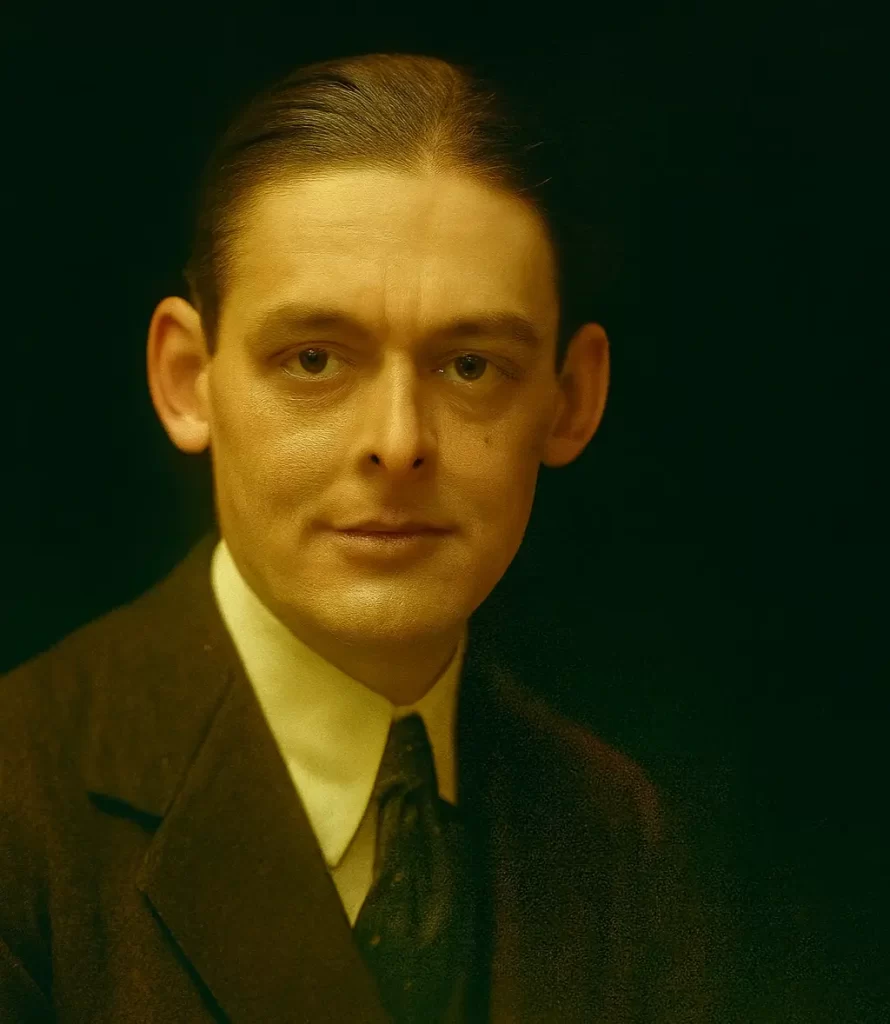
Full Name: Thomas Stearns Eliot
Birth and Death: Born September 26, 1888, in St. Louis, Missouri, USA; died January 4, 1965, in London, England.
Nationality: American-born, later became a British citizen in 1927.
Early Life and Education
Family Background: Born into a prominent Unitarian family with New England roots. His grandfather founded Washington University in St. Louis.
Education:
Attended Harvard University (1906–1910), earning a bachelor’s degree and studying philosophy and literature.
Studied at the Sorbonne in Paris (1910–1911), where he was influenced by French Symbolist poets like Charles Baudelaire and Jules Laforgue.
Returned to Harvard for graduate studies in philosophy (1911–1914), working on a dissertation on F.H. Bradley.
Studied at Merton College, Oxford, in 1914, but left to pursue writing in London.
Literary Career
Early Works:
Published The Love Song of J. Alfred Prufrock in 1915, a groundbreaking modernist poem that established his reputation.
The Waste Land (1922), edited by Ezra Pound, became a defining work of modernist literature, exploring fragmentation and cultural despair.
Marina (1930):
Written as part of the Ariel Poems series, published by Faber and Faber, where Eliot worked as an editor.
Inspired by Shakespeare’s Pericles and reflecting Eliot’s Anglican conversion, Marina explores spiritual renewal and redemption.
Later Works:
Ash-Wednesday (1930) and Four Quartets (1935–1942) further developed his spiritual and philosophical themes.
Wrote influential essays, including Tradition and the Individual Talent (1919), shaping modernist literary theory.
Plays: Authored verse dramas like Murder in the Cathedral (1935) and The Cocktail Party (1949), blending poetry and theater.
Nobel Prize: Awarded the Nobel Prize in Literature in 1948 for his “outstanding, pioneer contribution to present-day poetry.”
Personal Life
Marriages:
Married Vivienne Haigh-Wood in 1915; their tumultuous relationship, marked by her mental and physical health issues, ended with her institutionalization in 1938 (she died in 1947).
Married Valerie Fletcher in 1957, a happier union that brought personal stability in his later years.
Religious Conversion: Converted to Anglicanism in 1927, a pivotal moment that deeply influenced his later works, including Marina, which reflects Christian themes of grace and redemption.
Citizenship: Became a British citizen in 1927, renouncing his American citizenship, and embraced British culture and the Church of England.
Professional Life
Publishing: Joined Faber and Gwyer (later Faber and Faber) in 1925 as an editor, where he published Marina and supported other poets like W.H. Auden.
Other Roles: Worked as a bank clerk at Lloyds Bank (1917–1925) and taught briefly before focusing on writing and editing.
Literary Style and Influence
Modernism: A leading modernist, Eliot used fragmented structures, free verse, and dense allusions to explore the alienation and spiritual crises of the modern world.
Influences: Drew from Dante, Shakespeare, the Bible, French Symbolists, and metaphysical poets like John Donne, blending classical and contemporary traditions.
Legacy: Redefined poetry with works like The Waste Land and Four Quartets, influencing poets like W.B. Yeats, Ezra Pound, and later generations. His critical essays shaped literary criticism.
Context Relevant to Marina
Religious Shift: Written post-conversion, Marina reflects Eliot’s Anglican faith, exploring grace and spiritual renewal, contrasting with the despair of The Waste Land.
Shakespearean Inspiration: The poem draws on Pericles, where the reunion of Pericles and his daughter Marina symbolizes hope and redemption, mirroring Eliot’s personal search for meaning.
Publication: Published in 1930 as part of the Ariel Poems series, a set of illustrated pamphlets, showcasing Eliot’s concise yet profound style.
Later Years and Death
Later Career: Continued writing poetry, plays, and criticism, while editing at Faber and Faber. His later works, like Four Quartets, are deeply philosophical and spiritual.
Death: Died of emphysema in London on January 4, 1965, aged 76. His ashes were interred at St. Michael’s Church in East Coker, referenced in Four Quartets.
Posthumous Recognition: Remains a towering figure in 20th-century literature, with his works widely studied and celebrated for their intellectual depth and emotional resonance.
Word Meaning
| Tough Word | Meaning in English | Meaning in Hindi |
| Quis hic locus, quae regio, quae mundi plaga? | Latin: “What place is this, what region, what part of the world?” | लैटिन वाक्य: “यह कौन-सी जगह है, कौन-सा क्षेत्र है, दुनिया का कौन-सा हिस्सा है?” |
| Seas / Shores | Large bodies of salt water / edges of land where sea meets land | समुद्र / तट |
| Grey rocks | Rocks of dull, lifeless colour (symbolizing age, endurance) | धूसर पत्थर |
| Lapping the bow | Gentle striking or washing of water against the bow (front) of a ship | जहाज़ के अगले हिस्से (प्रौ) पर पानी की थपकियाँ मारना |
| Scent of pine | Smell of pine trees | चीड़ की गंध |
| Woodthrush | A bird known for its melodious song | वुड़थ्रश पक्षी (मधुर आवाज़ वाला पक्षी) |
| Sharpen the tooth of the dog | Metaphor for violence or cruelty | कुत्ते के दाँत तेज़ करना = हिंसा या क्रूरता |
| Glitter with the glory of the hummingbird | To shine brilliantly but briefly, like a hummingbird | हमिंगबर्ड की महिमा के साथ चमकना = क्षणिक शोभा |
| Stye of contentment | Pigsty; symbol of lazy self-satisfaction | संतोष का सूअरखाना = आलसी संतोष की स्थिति |
| Ecstasy of the animals | Intense, instinctive pleasure of animals (symbol of raw passion) | पशुओं का परमानंद = शारीरिक वासना |
| Unsubstantial | Without real substance; unreal, insubstantial | अस्थिर / अवास्तविक |
| Reduced by a wind | Made to disappear or vanish like being blown away by wind | हवा से मिट जाना |
| Breath of pine | Light air carrying pine scent; symbol of purity | चीड़ की खुशबू की साँस |
| Woodsong fog | Mist filled with birdsong; mysterious natural grace | कोहरे में गूंजता पक्षियों का गीत |
| grace dissolved in place | Mortality and despair disappearing in the presence of divine grace | अनुग्रह से मृत्यु और निराशा का मिट जाना |
| Face, less clear and clearer | Vision appearing faint yet distinct (paradoxical clarity) | चेहरा – कम स्पष्ट फिर भी ज़्यादा स्पष्ट |
| Pulse in the arm | Beating of blood in the body; life-force | बाजू की नाड़ी / जीवन की धड़कन |
| Given or lent | Permanent gift or temporary loan | दिया गया या उधार (क्षणिक) |
| More distant than stars and nearer than the eye | Paradox: unimaginably far yet intimately near | तारों से भी दूर और आँख से भी पास |
| Whispers | Very soft, low voices or murmurs | धीमी फुसफुसाहट |
| Hurrying feet | Quick steps, symbol of liveliness | तेज़ी से चलते पैर |
| Sleep, where all the waters meet | Dreamlike state where everything unites (symbol of eternity) | नींद – जहाँ सभी नदियाँ मिलती हैं = अनंत का प्रतीक |
| Bowsprit | Spar (long pole) extending from the front of a ship | जहाज़ का प्रौ-डंड |
| Rigging | Ropes and chains supporting a ship’s masts | जहाज़ की रस्सियाँ और जंजीरें |
| Canvas | The sails of the ship, made of cloth | जहाज़ का पाल (कपड़े का) |
| Rotten | Decayed, spoiled | सड़ा-गला |
| Garboard strake | The bottom plank of a ship’s hull (near the keel) | जहाज़ के तल का सबसे निचला पटरा |
| Caulking | Filling the seams of a ship to make it watertight | सीवन पाटना / रिसाव रोकना |
| Form, face, life | Human body, identity, existence | रूप, चेहरा, जीवन |
| Resign my life | To surrender one’s life willingly | अपना जीवन त्याग देना |
| Awakened, lips parted | Image of fresh life, innocence, new hope | जाग्रत, होंठ खुले हुए (नवीन जीवन का संकेत) |
| New ships | Symbol of renewal, future journeys | नए जहाज़ = नया जीवन / नई आशा |
| Granite islands | Solid, enduring islands of stone | ग्रेनाइट (कठोर पत्थर) के द्वीप |
| Timbers | Wooden parts of the ship’s structure | जहाज़ की लकड़ी की संरचना |
| My daughter | Symbol of recognition, innocence, renewal, grace | मेरी बेटी (निर्दोषता, अनुग्रह, पुनर्जन्म का प्रतीक) |
Very Short Answer Questions
Who is the poet of Marina?
T. S. Eliot.
In which year was Marina published?
1930.
Marina was part of which series of poems?
The Ariel Poems.
Who is Marina in Shakespeare’s play Pericles?
The daughter of Pericles.
What does the Latin epigraph “Quis hic locus, quae regio, quae mundi plaga?” mean?
“What place is this, what region, what part of the world?”
From which classical author is the epigraph taken?
Seneca.
What type of verse form does Marina use?
Free verse.
What is repeated at the beginning and end of the poem?
“What seas what shores.”
Which bird’s song is mentioned in the poem?
The woodthrush.
What natural scent is described in the poem?
The scent of pine.
What happens to all types of human life according to the poem?
They all end in death.
What is symbolized by the ship in the poem?
Human life.
What do “rigging weak and the canvas rotten” signify?
Decay and the passage of time.
Which word is repeatedly isolated on its own line?
“Death.”
What does the daughter symbolize in the poem?
Innocence, grace, and renewal.
What tone dominates the middle section (“Those who sharpen the tooth…”)?
Harsh and prophetic.
What dissolves the weight of death in the poem?
A wind, the breath of pine, and the woodsong fog.
What does “Given or lent?” suggest about the daughter’s presence?
It questions if she is a lasting gift or temporary grace.
How does the poem end?
With the cry “My daughter.”
What is the central message of Marina?
Life ends in death, but grace and renewal bring eternal hope.
Short Answer Questions
What is the significance of the Latin epigraph in Marina?
The poem opens with Seneca’s line “Quis hic locus, quae regio, quae mundi plaga?” meaning “What place is this, what region, what part of the world?” It sets the mood of bewilderment and mystery. The speaker feels disoriented, as if awakening in a new spiritual space. This matches the recognition theme in Shakespeare’s Pericles, where Pericles is astonished to discover his daughter Marina. Eliot uses it to frame the poem’s movement from confusion to recognition.
What images dominate the opening of the poem?
The opening is filled with natural imagery: seas, shores, grey rocks, islands, pine scent, fog, and the song of the woodthrush. These images appeal to multiple senses—sight, sound, and smell. They create a mysterious, dreamlike setting that prepares for the recognition of the daughter. The repetition of “What…” shows the speaker’s astonishment. The cry “O my daughter” transforms these natural images into spiritual signs of renewal.
How does Eliot present the universality of death?
Eliot lists four kinds of life: those who live violently, those who shine with glory, those who rest in contentment, and those who indulge in passion. Each description ends with the word “Death” isolated on its own line. This stark repetition shows that no matter how differently people live, they all share the same end. Violence, brilliance, laziness, or sensuality—all are futile against death. The style is chant-like, almost biblical, emphasizing universality.
How does Eliot contrast death with grace in the poem?
After the heavy refrain of “Death,” Eliot shifts to lighter, delicate images: “a wind, a breath of pine, and the woodsong fog.” These natural symbols suggest grace, purity, and spiritual renewal. The contrast is striking—death is heavy and final, but grace is soft and dissolving. Eliot implies that mortality is not the ultimate reality; grace has the power to transform despair into hope. This marks the turning point of the poem.
What is the role of paradox in the vision of the daughter?
When the speaker describes his daughter’s face, he uses paradoxes: “less clear and clearer,” “less strong and stronger,” “more distant than stars and nearer than the eye.” These contradictions show the mystery of recognition. The daughter seems both near and far, both faint and intense, both given and perhaps only lent. Paradox conveys that this vision cannot be fully explained in human terms—it belongs to a higher, spiritual reality.
What does the ship symbolize in the poem?
The ship represents human life itself. Its parts—the bowsprit, rigging, canvas, and seams—are damaged, weak, or leaking, symbolizing the decay and fragility of existence. Time (“between one June and another September”) has worn it down. Yet, despite its broken state, the ship has carried the speaker to recognition. Life, though battered, has meaning because it leads to renewal and discovery. The ship imagery thus unites decay with hope.
Explain the significance of the line “I made this, I have forgotten / And remember.”
This paradoxical statement shows how the speaker built his life unconsciously. Like a shipbuilder, he created a vessel (his life) without fully knowing or remembering how. Now, in reflection, he recalls both the effort and the forgetfulness. This line conveys the strange mixture of awareness and unawareness that shapes human existence. It also prepares for the realization that life’s meaning is not in the building, but in the recognition it brings.
How does Eliot portray time in the poem?
Time appears as a destructive force: ice, heat, rotting canvas, and leaking seams all show how life is worn down. The phrase “between one June and another September” highlights the slow, unnoticed passing of months. Yet Eliot also suggests that life points beyond time: “Living to live in a world of time beyond me.” Thus, time brings decay, but recognition of grace opens a vision of eternity. Time and eternity are held in tension.
What is the tone of the poem and how does it change?
The tone shifts several times. At first, it is one of bewilderment and wonder. It then turns harsh and prophetic in the catalogue of death. Next, it softens into serenity with natural grace images. Later, it becomes mystical and tender in the vision of the daughter. Finally, it ends in a tone of affirmation and renewal with the cry “My daughter.” These shifts mirror the poem’s spiritual journey from despair to hope.
What message does Eliot convey in Marina?
The central message is that all human life, however lived, ends in death, but death is not the final reality. Through grace, innocence, and renewal (symbolized by the daughter), life finds eternal meaning. The battered ship of existence still carries the voyager to recognition. The poem affirms that despair can be dissolved by grace, and mortality can be transcended through spiritual awakening. It is a message of hope, renewal, and transcendence.
Essay Type Questions
Discuss the significance of the title Marina and its relation to Shakespeare’s play.
The title Marina refers to the daughter of Pericles in Shakespeare’s Pericles, Prince of Tyre. In the play, Pericles is shipwrecked, loses his wife, and is separated from his daughter Marina, only to be reunited with her after years of wandering. This moment of recognition brings renewal, joy, and restoration. Eliot takes inspiration from this dramatic reunion but reshapes it into a spiritual allegory.
In the poem, “Marina” is not only the lost daughter but also a symbol of innocence, purity, and divine grace. The cry “O my daughter” is at once paternal and spiritual. It represents the weary voyager’s recognition of renewal after despair and mortality. Just as Pericles’s joy transcends suffering, Eliot suggests that spiritual recognition dissolves death and affirms eternal life.
The title is therefore both literal and symbolic. On the literal level, it alludes to Shakespeare’s play and its scene of reunion. On the symbolic level, Marina embodies the possibility of rebirth, innocence rediscovered, and spiritual awakening. By choosing this title, Eliot transforms a classical dramatic motif into a meditation on mortality, grace, and renewal, showing how personal recognition mirrors the universal human search for meaning beyond death.
How does Eliot use imagery and symbolism to express the central ideas of Marina?
Imagery and symbolism form the backbone of Marina. Eliot begins with vivid natural imagery: seas, shores, grey rocks, pine scent, fog, and the song of the woodthrush. These images appeal to multiple senses—sight, sound, smell—and create an atmosphere of mystery and wonder. The cry “O my daughter” turns the natural landscape into a symbolic setting of recognition and renewal.
Symbolism is central. The sea represents life’s journey, vast and uncertain. Rocks and islands symbolize obstacles and permanence. The pine is a traditional symbol of purity and immortality. The woodthrush represents hope and renewal, its song breaking through fog and mystery. The fog itself symbolizes uncertainty but also the space where grace appears.
The most sustained symbol is the ship, representing human life. Its cracked bowsprit, rotten canvas, weak rigging, and leaking seams stand for fragility, decay, and the effects of time. Yet the ship still carries the voyager to recognition, suggesting that life, though worn out, has meaning because it leads to spiritual awakening.
Thus, Eliot’s imagery and symbolism elevate the poem from a personal recognition scene to a universal meditation on mortality and renewal. The daughter becomes not just a human figure but the embodiment of innocence, grace, and eternal hope.
Examine the theme of mortality and renewal in Marina.
Mortality is the starting point of Marina. Eliot lists four human conditions: those who live violently, those who shine with glory, those who rest in contentment, and those who indulge in passion. Each of these lifestyles, however different, ends in the same conclusion: Death. By repeating and isolating the word on its own line, Eliot underscores its universality and inevitability.
Yet Eliot does not end in despair. Death is followed by dissolution—“a wind, a breath of pine, and the woodsong fog”—delicate natural images that symbolize grace. This grace dissolves mortality, suggesting that death is not ultimate.
The daughter Marina represents renewal. Her face, described in paradox as “less clear and clearer,” “more distant than stars and nearer than the eye,” captures the mystery of spiritual recognition. She embodies innocence and purity, life rediscovered in the midst of decay.
The ship imagery further highlights the theme: the vessel is cracked, leaking, and decayed by time, yet it still brings the voyager to discovery. Life, though fragile and mortal, carries meaning because it leads to renewal.
Thus, Marina presents mortality as universal but not final. Renewal through grace transforms death into affirmation. The theme reflects Eliot’s post-conversion Christian vision, where human despair is redeemed by divine hope.
Analyze the role of paradox in Eliot’s Marina.
Paradox is one of Eliot’s main devices in Marina, used to convey the mystery of recognition and the coexistence of mortality and grace. The vision of the daughter is described in paradoxical terms: “less clear and clearer,” “less strong and stronger,” “more distant than stars and nearer than the eye.” These contradictions show that the experience cannot be fully explained in rational language—it is both real and unreal, near and far, faint and intense.
The question “Given or lent?” is another paradox. Is the daughter’s presence a permanent gift or only a temporary grace? This highlights the uncertainty of human life but also the preciousness of renewal.
The ship imagery also contains paradox. The vessel is decayed, cracked, and leaking, yet it is the very thing that delivers the speaker to recognition. Life is fragile and worn down, yet it carries the soul to discovery and hope.
Paradox in Marina is not ornamental but essential. It mirrors the tension between despair and renewal, time and eternity, mortality and grace. Recognition is beyond ordinary logic, and paradox is the only way Eliot can capture its strangeness and depth.
What is the message of Eliot’s Marina?
The message of Marina is that while human life is bound by mortality and time, it is redeemed by grace and renewal. The catalogue of death shows that all human conditions—whether violent, glorious, complacent, or passionate—end in the same fate. Life is fragile, decayed, and worn out, like the battered ship described in the poem.
Yet Eliot insists that this is not the final truth. Grace, symbolized by natural images of pine, fog, and birdsong, dissolves despair. The daughter Marina embodies innocence and renewal, offering hope beyond mortality. Her recognition is both personal (as in Shakespeare’s play) and symbolic (the soul recognizing divine grace).
The message is therefore twofold: mortality is universal, but grace is transformative. Life, though fragile, has meaning because it leads to recognition of eternal hope. Eliot suggests that despair is not the end; renewal is possible through innocence, faith, and grace.
In a broader sense, the poem conveys Eliot’s Christian vision that death is not ultimate and that spiritual awakening brings eternal life. Marina thus stands as a lyrical affirmation of hope in the face of despair.
Long note on themes of the poem.
Mortality and Death
A central theme of Marina is the inevitability of death. Eliot lists four kinds of life—violent, glorious, complacent, and passionate—and reduces each to the single word “Death.” By isolating this word on its own line, he emphasizes the absolute power of mortality. Human effort, whether destructive or beautiful, ends in the same fate. This echoes Eliot’s modernist concern with the futility of worldly pursuits. Yet unlike The Waste Land, where death dominates, in Marina death is not the final word. Eliot acknowledges it fully, but then moves beyond it toward renewal. The theme of mortality thus sets the stage for the poem’s spiritual transformation.
Grace and Renewal
Against the heavy refrain of death, Eliot introduces delicate images of grace: “a wind, a breath of pine, and the woodsong fog.” These natural symbols dissolve the weight of mortality, showing that something lighter and more enduring exists beyond death. The daughter, Marina, becomes the embodiment of this grace. She represents innocence, purity, and the possibility of new life. Grace in the poem is mysterious—fragile yet powerful, fleeting yet eternal. It is not earned by human effort but appears unexpectedly, transforming despair into hope. The theme of renewal reflects Eliot’s Christian faith after his conversion, suggesting salvation through divine grace.
Recognition and Innocence
The cry “O my daughter” and the vision of her face are moments of recognition. The daughter represents innocence, renewal, and a return to purity. The speaker describes her paradoxically—“less clear and clearer,” “more distant than stars and nearer than the eye”—to show the mystery of such recognition. She is both real and symbolic, human and spiritual. Recognition here is not merely a father finding a child; it is the soul discovering grace, the weary voyager discovering purpose. Innocence is central: Marina’s presence is uncorrupted, fresh, and life-giving, standing against the decay of time.
Life as a Voyage
The ship is a major metaphor in the poem, symbolizing the journey of life. Its bowsprit cracked with ice, paint cracked with heat, weak rigging, rotten canvas, leaking seams—all represent human decay, fragility, and the effects of time. The ship, though battered, still carries the voyager forward. It becomes a vehicle of discovery, leading the speaker to recognition of the daughter. This imagery connects life’s suffering with its ultimate meaning: though existence is worn out and fragile, it can deliver us to renewal. The voyage motif echoes ancient and biblical traditions of life as a sea journey.
Time and Eternity
Another deep theme is the contrast between time and eternity. Time appears destructive: it wears out the ship, cracks paint, rots canvas, and weakens rigging. The line “Between one June and another September” symbolizes the unnoticed passage of months that erodes life. Yet the vision of the daughter suggests something beyond time: “Living to live in a world of time beyond me.” Eternity here means grace and renewal, a life that transcends decay. Eliot presents time as unavoidable but not ultimate; it prepares the soul for recognition of what lies beyond. The daughter thus symbolizes eternal hope.
Critical Analysis
Introduction
Background: Marina, published in 1930 as part of the Ariel Poems series by Faber and Faber, is one of T.S. Eliot’s shorter yet profoundly spiritual works. Written after his 1927 conversion to Anglicanism, it marks a shift from the despair of The Waste Land (1922) to a more hopeful exploration of redemption.
Inspiration: The poem draws on the reunion scene in Shakespeare’s Pericles, where Pericles rediscovers his daughter Marina, presumed dead, symbolizing hope and renewal. The Latin epigraph from Seneca’s Hercules Furens (“Quis hic locus, quae regio, quae mundi plaga?”) sets a tone of existential questioning.
Significance: As a modernist masterpiece, Marina blends personal longing, spiritual quest, and rich imagery, offering a meditation on life, death, and transcendence.
Central Idea
The central idea of Marina is that although human life is fragile, decayed, and ultimately destined for death, it can be redeemed by grace and renewal. The daughter symbolizes innocence, purity, and eternal life. The ship represents the weary voyage of human existence, battered by time and suffering, yet carrying the soul toward recognition. Through the symbolic cry of “My daughter,” Eliot conveys the truth that despair and mortality can be dissolved by divine grace, leading to hope and affirmation.
Summary
The poem begins with a Latin quotation from Seneca’s tragedy Hercules Furens: “Quis hic locus, quae regio, quae mundi plaga?” meaning, “What place is this, what region, what part of the world?” These words express bewilderment and astonishment, setting the tone for the entire poem. The speaker describes seas, shores, rocks, islands, pine trees, and the woodthrush singing through the fog, culminating in the tender exclamation, “O my daughter.”
The mood then turns to a meditation on death. Eliot lists four conditions of human life: violence (“Those who sharpen the tooth of the dog”), brilliance (“Those who glitter with the glory of the hummingbird”), complacency (“Those who sit in the stye of contentment”), and passion (“Those who suffer the ecstasy of the animals”). Each ends with the stark word “Death,” repeated like a refrain. This section emphasizes the universality of mortality.
Yet the heaviness of death dissolves in natural grace: “a wind, a breath of pine, and the woodsong fog.” These delicate images symbolize purity, mystery, and spiritual renewal.
The speaker then describes a vision of his daughter’s face, using paradox: “less clear and clearer,” “less strong and stronger,” “more distant than stars and nearer than the eye.” This recognition is mysterious, beyond rational explanation. Whispers, laughter, and the sound of hurrying feet suggest innocence and joy, while the phrase “Under sleep, where all the waters meet” evokes eternity.
Finally, Eliot introduces the extended metaphor of the ship. The vessel is battered: “bowsprit cracked with ice,” “paint cracked with heat,” “rigging weak,” “canvas rotten,” “garboard strake leaks,” “seams need caulking.” This symbolizes the fragility and decay of human life under the passage of time. Yet despite its weakness, the ship has carried the speaker to recognition. He is ready to surrender his own life—“Resign my life for this life, my speech for that unspoken”—in exchange for the renewal symbolized by the daughter.
The poem ends by returning to its opening refrain: “What seas what shores what granite islands towards my timbers / And woodthrush calling through the fog / My daughter.” The circular structure suggests that the bewilderment of the beginning has been transformed into recognition and affirmation.
Structure and Rhyme Scheme
The poem consists of 31 lines in a single, unbroken block, with no formal stanzas.. The poem is organized into five movements: (1) wonder and recognition, (2) catalogue of death, (3) dissolution by grace, (4) vision of the daughter, and (5) ship imagery and renewal.
Written in free verse, it has no fixed rhyme scheme or meter, reflecting Eliot’s modernist style.
Instead of rhyme, Eliot uses rhythmic repetition and liturgical cadence: “What seas what shores…” and “Those who… Death.”
Themes
Mortality and Death
All human pursuits—violence, glory, laziness, passion—end in death. The repeated word “Death” shows its universality and finality.
Grace and Renewal
Death is not the last word. Natural images of wind, pine, fog, and birdsong suggest divine grace that dissolves mortality and brings renewal.
Recognition and Innocence
The cry “O my daughter” represents rediscovery of purity, innocence, and spiritual truth. Recognition here is not only paternal but also symbolic of the soul’s encounter with grace.
Life as a Voyage
The ship is a central metaphor for human life, worn out by time yet carrying the voyager to recognition. Its cracks, leaks, and decay symbolize fragility, while its endurance shows purpose.
Time and Eternity
Time erodes life (“between one June and another September”), but eternity transcends time. The daughter symbolizes eternal life and hope.
Style
Eliot combines modernist free verse with liturgical rhythm. His style in Marina blends:
Imagery: vivid details of seas, rocks, fog, pine, birds, and the ship.
Paradox: the daughter’s presence is both near and far, faint and strong.
Symbolism: daughter as innocence, ship as life, bird as renewal, fog as mystery.
Allusion: to Seneca (classical tragedy), Shakespeare (Pericles), and Christian theology.
Contrast: between the blunt inevitability of death and the delicate grace of renewal.
Tone: shifts from wonder → despair → serenity → recognition → affirmation.
Poetic Devices
Imagery: Maritime (“seas,” “bowsprit”), natural (“pine,” “woodthrush”), and human (“face,” “pulse”) imagery create a vivid, sensory world that bridges the physical and spiritual.
Metaphor: The ship represents the speaker’s life or work, while the “daughter” and “new ships” symbolize redemption and hope.
Anaphora: Repetition of “What” (“What seas what shores”) and “Those who” creates a questioning and cataloging rhythm, emphasizing disorientation and mortality.
Paradox: Phrases like “less clear and clearer” and “more distant than stars and nearer than the eye” capture the elusive nature of spiritual truth.
Alliteration and Assonance: Sounds like w (“what seas what shores”), s (“whispers and small laughter”), and o (“forgotten,” “rotten”) enhance musicality.
Apostrophe: The address “O my daughter” invokes an absent figure, infusing the poem with emotional intimacy.
Enjambment: Lines like “I made this, I have forgotten / And remember” flow without pause, mirroring the speaker’s stream-of-consciousness.
Symbolism: The woodthrush (hope), fog (obscurity), and grace (divine mercy) carry spiritual significance, unifying the poem’s themes.
Critical Commentary
Marina is one of Eliot’s most moving affirmations of spiritual renewal. Unlike The Waste Land, which ends in fragmentation, or The Hollow Men, which ends in despair, Marina ends with hope. The daughter functions both literally (as in Shakespeare’s play) and symbolically (as innocence, grace, eternal renewal). The ship metaphor ties the personal (a father recognizing his child) with the universal (the soul recognizing eternity).
Critics admire how Eliot combines modernist fragmentation with timeless spiritual themes. The catalogue of death is liturgical, echoing biblical prophecy, while the vision of the daughter recalls mystical moments of recognition in Dante. The poem foreshadows Eliot’s later masterpiece, Four Quartets, where time, eternity, and grace are fully explored.
Message
The message of Marina is that human life is fragile and destined for death, yet it is not meaningless. Grace, innocence, and renewal survive beyond mortality. Life’s voyage, however weary, ultimately leads to recognition of eternal hope. Death is universal, but through grace it is dissolved, and spiritual affirmation takes its place.
Conclusion
T. S. Eliot’s Marina is a meditation on mortality, grace, and renewal. Through powerful sea and ship imagery, paradoxical descriptions, and the tender recognition of the daughter, Eliot dramatizes the journey from despair to hope, from death to grace. The poem blends modernist free verse with classical and biblical echoes, uniting Eliot’s technical mastery with his spiritual vision. Tender, lyrical, and deeply moving, Marina remains one of Eliot’s greatest affirmations of life, innocence, and eternal renewal.