
The Sea And The Skylark
(Gerard Manley Hopkins)
On ear and ear two noises too old to end
Trench—right, the tide that ramps against the shore;
With a flood or a fall, low lull-off or all roar,
Frequenting there while moon shall wear and wend.
Left hand, off land, I hear the lark ascend,
His rash-fresh re-winded new-skeinèd score
In crisps of curl off wild winch whirl, and pour
And pelt music, till none ’s to spill nor spend.
How these two shame this shallow and frail town!
How ring right out our sordid turbid time,
Being pure! We, life’s pride and cared-for crown,
Have lost that cheer and charm of earth’s past prime:
Our make and making break, are breaking, down
To man’s last dust, drain fast towards man’s first slime.
Structure
1. Form
The poem is a Petrarchan (Italian) sonnet → 14 lines in total.
Divided into two sections:
Octave (first 8 lines): Describes the eternal sounds of nature—the sea and the skylark.
Sestet (last 6 lines): Reflects on the corruption and decline of mankind.
Volta (turn): At line 9, where Hopkins shifts from admiring nature to lamenting humanity.
Function of form: Octave = celebration of purity; Sestet = lament on corruption.
2. Meter
Hopkins does not use strict iambic pentameter.
Instead, he employs his own invention: Sprung Rhythm.
Each line has about five strong stresses (like pentameter),
But the number of unstressed syllables between stresses can vary (1–3 or more).
This makes the rhythm irregular, closer to natural speech and song.
3. Rhyme Scheme
Standard Petrarchan sonnet scheme:
Octave: abbaabba
Sestet: cdcdcd
Example:
end / shore / roar / wend / ascend / score / pour / spend → abbaabba
town / time / crown / prime / down / slime → cdcdcd
Sprung Rhythm
Traditional English verse (like Shakespeare or Milton) is written in regular meter (e.g., iambic pentameter = da-DUM da-DUM da-DUM da-DUM da-DUM).
Hopkins thought this was too mechanical and didn’t capture natural speech or the wild rhythms of nature.
So he invented Sprung Rhythm:
Each line has a fixed number of stressed syllables (beats).
But the number of unstressed syllables between stresses can vary (0, 1, 2, or more).
This makes the rhythm “springy” or irregular, like natural speech or bird song.
Basically: count stresses, not syllables.
Features of Sprung Rhythm
Stresses dominate: The line “springs” from one stress to the next.
Freedom of movement: Allows sudden bursts, pauses, or rushes of energy.
Natural imitation: Matches real-life rhythms (waves, skylark’s song, spoken prayer).
Musical intensity: More dramatic than ordinary meter, with heavy use of alliteration and internal rhyme.
Example in The Sea and the Skylark
“On ear and ear two noises too old to end”
Stresses fall on: On ÉAR | and ÉAR | two NÓI | ses too ÓLD | to ÉND stresses are strong, but the number of light syllables between them varies.
The Sea and the Skylark Summary
Gerard Manley Hopkins composed “The Sea and the Skylark” in 1877, during his stay at Rhyl, a coastal town in North Wales, while he was undergoing theological training at St. Beuno’s College. Like most of his poetry, the sonnet remained unpublished during his lifetime. It was only after his death that his close friend, Robert Bridges, collected and edited Hopkins’s poems. The poem first appeared posthumously in the volume Poems of Gerard Manley Hopkins in 1918, published by Humphrey Milford.
Gerard Manley Hopkins’s sonnet “The Sea and the Skylark” presents a powerful contrast between the eternal purity of nature and the moral corruption of human society. The poem is divided into two parts: the octave, which describes the sea and the skylark, and the sestet, which reflects on the fallen state of mankind.
On one side, the poet hears the sea, whose tide rises and falls endlessly. Sometimes it whispers softly, sometimes it roars with great force, but it never ceases. Its movements are guided by the moon, making it part of the eternal rhythm of God’s creation. The sea stands as a symbol of purity, permanence, and divine order.
On the other side, he hears the skylark soaring upward into the sky, showering the air with its joyful music. Its song is fresh, bold, and ever-renewed, as though it is woven afresh each time. The notes rise in curls and spirals, pouring down like a shower of melody that never runs dry. The skylark becomes a symbol of overflowing joy, energy, and spiritual renewal.
Together, the sea and the skylark represent the unchanging voices of nature—pure, eternal, and free from corruption.
Hopkins then turns to human life. In comparison with the purity of the sea and the skylark, human society appears shallow, weak, and morally degraded. The modern age, he says, is “sordid and turbid”—dirty, confused, and full of corruption. Humanity, once the “crown of creation” and the pride of God’s work, has lost the cheer and charm of its earlier, purer days. Both our nature (what we are) and our achievements (what we do) are breaking down. Hopkins sees mankind rushing towards destruction, sliding from dignity to dust, and from dust back to its lowest beginnings—“man’s first slime.”
On ear and ear two noises too old to end
Trench—right, the tide that ramps against the shore;
With a flood or a fall, low lull-off or all roar,
Frequenting there while moon shall wear and wend.
Reference to Context:
These lines form the beginning of Gerard Manley Hopkins’s sonnet “The Sea and the Skylark” (1877). Hopkins, walking near the seaside in Wales, listens carefully to two natural sounds around him—the endless roaring of the sea on one side and the song of a skylark on the other. Both are eternal and pure, untouched by human corruption. Here, he first describes the sound of the sea, showing its power, variety, and connection with the great cosmic order of the moon.
Explanation:
“On ear and ear two noises too old to end”
Hopkins is listening with both ears and hears two everlasting voices of nature. One is the sea, the other is the skylark. He calls them “too old to end” because they are not temporary like human noises—they are as ancient as the world itself. They have been sounding since the beginning of time and will continue as long as nature lasts.
“Trench—right, the tide that ramps against the shore;”
On his right side, Hopkins hears the sea. The tide rushes forward and crashes against the shore with strength and energy. The word “ramps” gives an image of a wild creature leaping or charging—suggesting that the sea is alive, powerful, and untiring. It always attacks the land but never wins, returning again and again.
“With a flood or a fall, low lull-off or all roar,”
The poet notices how the sea changes its tone. Sometimes it rises like a flood and covers the shore, sometimes it falls back softly. At times it makes a low, soothing lull as if singing a cradle-song, and at other times it bursts into a mighty roar like thunder. Hopkins captures these different moods to show that the sea is both gentle and fierce, quiet and violent—yet always musical and eternal.
“Frequenting there while moon shall wear and wend.”
The sea’s movements are not random. They are ruled by the moon, which causes the tides. The moon “wears” (grows smaller as it wanes) and “wends” (moves on its path), and as long as the moon keeps moving in the sky, the sea will continue to rise and fall, sing and roar. This shows a great divine order in nature: the sea and the moon are part of God’s eternal design.
Poetic devices:
Alliteration (repetition of initial consonant sounds)
“flood or a fall, low lull-off” → repetition of f and l sounds mimics the rise and fall of waves.
“ramps… right” → harsh r sound imitates the forceful striking of the tide.
This gives a musical effect and imitates the sound-patterns of the sea.
Assonance (repetition of vowel sounds)
“low lull-off or all roar” → long o vowels echo the booming sound of the sea waves.
“two noises too” → repetition of the oo sound suggests continuity and depth.
This creates a sonorous echo, reinforcing the endless rhythm of the sea.
Imagery (auditory + visual)
Auditory imagery: “two noises too old to end” → we can hear the timeless sounds of nature.
Visual imagery: “the tide that ramps against the shore” → we picture the sea rushing and striking the land.
Hopkins combines hearing and sight to make the sea alive and eternal.
Personification
“the tide that ramps against the shore” → “ramps” gives the sea an animal-like energy, as if it is leaping or charging.
“noises too old to end” → suggests the sea has an ancient, almost living existence.
This makes nature feel like a living creature with power and will.
Hyperbole
“two noises too old to end” → waves are described as if they are eternal, beyond time.
Expresses the timelessness of nature compared to human life.
Enjambment
Definition: The continuation of a sentence or clause across a line break, creating a sense of flow or urgency.
“On ear and ear two noises too old to end / Trench—right, the tide that ramps against the shore” flows without pause, mimicking the ceaseless movement of the tide.
Caesura:
Definition: A pause or break within a line, often marked by punctuation, to create emphasis or rhythm.
“Trench—right, the tide that ramps against the shore” uses a dash to create a dramatic pause, emphasizing “right” and the tide’s forceful action.
Left hand, off land, I hear the lark ascend,
His rash-fresh re-winded new-skeinèd score
In crisps of curl off wild winch whirl, and pour
And pelt music, till none ‘s to spill nor spend.
Reference to Context:
These lines are from the octave of Gerard Manley Hopkins’s sonnet “The Sea and the Skylark.” After describing the eternal voice of the sea on his right side, Hopkins now turns his ear to the other side and hears another sound: the skylark singing high above the land. By placing the sea and the skylark together, Hopkins brings two eternal natural voices—one from the depths of the sea and the other from the heights of the sky—into harmony. Both are pure and endless, unlike the shallow noise of human civilization.
Explanation:
“Left hand, off land, I hear the lark ascend,”
On his left side, Hopkins hears the skylark rising into the sky from the fields. The bird ascends higher and higher, filling the air with its joyful song. Just as the sea gives a voice to the earth’s depths, the skylark gives a voice to the sky above.
“His rash-fresh re-winded new-skeinèd score”
The skylark’s song is described as rash and fresh—full of boldness, energy, and newness every time. Hopkins calls it “re-winded new-skeinèd score,” meaning the tune seems to be rewound and freshly woven again and again like a new thread of melody. The bird never repeats a dull song; each time its music feels alive, impulsive, and freshly made.
“In crisps of curl off wild winch whirl, and pour”
The song does not rise in a straight line but moves in curls and spirals, like whirls of air. Hopkins compares the music to curls tossed about by a winch (a machine that winds). The skylark’s voice seems to twist, whirl, and spin upward, pouring out sound as it flies higher.
“And pelt music, till none ’s to spill nor spend.”
The bird throws out its song in showers, almost like pelting drops of rain or hail. It pours out so much music that it seems as if nothing is left to waste or spend. Yet the music never runs dry—the skylark always has more to give, an endless stream of joy.
Poetic Device:
Alliteration
“rash-fresh re-winded” → repetition of r and f sounds creates a lively, bursting energy.
“crisps of curl” → c sound imitates sharp, bright notes of the lark’s song.
Mimics the musical quality and speed of the skylark’s song.
Compound/Hyphenated Words (Hopkins’ coinages)
“rash-fresh”, “re-winded”, “new-skeinèd” → Hopkins invents compressed compounds to capture qualities of freshness, rush, and renewal.
These unusual words give the skylark’s song a newness and vitality impossible to express in ordinary diction.
This is Hopkins’ poetic innovation — condensing meaning, rhythm, and energy.
Imagery:
Vivid descriptive language appealing to the senses, here primarily auditory and visual.
“I hear the lark ascend” creates an auditory image of the bird’s rising song, paired with the visual of its upward flight.
“His rash-fresh re-winded new-skeinèd score” evokes the image of a freshly unwound thread (a “skein”) of music, suggesting clarity and renewal.
“In crisps of curl off wild winch whirl” paints a vivid picture of the lark’s spiraling flight, with “crisps of curl” suggesting tight, crisp loops and “wild winch whirl” evoking a rapid, mechanical-like spinning motion.
“Pour and pelt music” conveys the abundance and force of the lark’s song, as if it’s cascading or striking like rain.
Personification
The lark’s song is described like a score (a musical composition), as if the bird were a composer or musician.
“pour and pelt music” makes song feel like a physical substance being showered upon the earth.
Transforms the skylark into a divine artist of nature.
Metaphor
“new-skeinèd score” → compares the lark’s song to a freshly woven skein (thread), full of twists and patterns.
Suggests intricate weaving of melody, freshly made each morning.
Symbolizes purity, creation, and divine energy.
Hyperbole (Exaggeration)
“till none’s to spill nor spend” → the skylark sings so much that there is no more music left.
Exaggerates the bird’s song to show its limitless outpouring of joy.
How these two shame this shallow and frail town!
How ring right out our sordid turbid time,
Being pure! We, life’s pride and cared-for crown,
Reference to Context:
These lines are taken from the sestet of Gerard Manley Hopkins’s “The Sea and the Skylark.” After listening to the eternal voices of the sea and the skylark, Hopkins reflects on their moral significance. He says that their purity puts human society to shame. Unlike nature, which is timeless, fresh, and God-ordained, humanity has lost its dignity and is sinking into corruption.
Explanation:
“How these two shame this shallow and frail town!”
The sea and skylark make the nearby human settlement (the town) look weak, shallow, and insignificant. Compared to the eternal strength and purity of natural sounds, the noises of the town seem petty, temporary, and without depth. The word “frail” also hints at moral weakness—human life is fragile, easily corrupted, and far from the purity of nature.
“How ring right out our sordid turbid time,”
The pure voices of the sea and skylark ring out clearly against the background of the present age, which Hopkins calls “sordid” (dirty, corrupt) and “turbid” (muddy, unclear, polluted). In other words, the contrast between nature’s music and human society highlights how corrupt and impure the modern world has become.
“Being pure! We, life’s pride and cared-for crown,”
The sounds of nature are pure, and in their purity they remind humans of what they themselves were meant to be. Humanity was created as the “pride of life” and the “cared-for crown” of creation—God’s masterpiece, the highest part of His work. Yet instead of living up to this crown of dignity, people have lost their original beauty and purity.
Poetic Device:
Alliteration:
“Shame this shallow” repeats the “sh” sound, highlighting the town’s superficiality.
“Ring right” and “sordid turbid time” emphasize the “r” and “t” sounds, evoking the clear, resonant quality of nature’s purity against humanity’s murky era.
Alliteration enhances the musicality and draws attention to the contrast between the sea and skylark’s strength and the town’s weakness.
Assonance:
Repetition of vowel sounds in nearby words to create a musical effect or emphasize mood.
“Shame this shallow” repeats the short “a” sound, creating a sharp, critical tone.
“Ring right” uses the long “i” sound, suggesting clarity and purity.
Assonance reinforces the emotional tone, with short vowels conveying disdain for humanity’s flaws and longer vowels emphasizing nature’s purity.
Imagery:
Vivid descriptive language appealing to the senses, here primarily visual and auditory.
“Shallow and frail town” paints a visual picture of a weak, insubstantial human settlement, lacking depth or resilience.
“Ring right out our sordid turbid time” evokes an auditory image of the sea and skylark’s sounds resonating clearly, cutting through the murky, disordered era of humanity.
The imagery contrasts the tangible purity of nature with the abstract, degraded state of human society, making the critique vivid.
Metaphor:
The sea and skylark “shame” the town, implying they expose its inadequacy as a superior moral standard.
“Ring right out” compares the sounds of the sea and skylark to a clear, resonant bell, symbolizing their purity and truth.
“Life’s pride and cared-for crown” metaphorically describes humanity as the pinnacle of creation, cherished by God, yet failing to live up to this status.
Metaphors elevate the sea and skylark to symbols of divine purity while highlighting humanity’s fall from its intended glory.
Personification:
Attributing human qualities to non-human entities.
The sea and skylark “shame” the town, suggesting they actively expose or judge its inadequacy.
“Ring right out” personifies their sounds as deliberately proclaiming truth or purity.
Personification elevates the sea and skylark to moral agents, emphasizing their superiority over human society.
Have lost that cheer and charm of earth’s past prime:
Our make and making break, are breaking, down
To man’s last dust, drain fast towards man’s first slime.
Reference to Context:
These lines come from the closing part of Gerard Manley Hopkins’s sonnet “The Sea and the Skylark.” After describing the eternal, pure music of the sea and the skylark, and after contrasting that with the corruption of his own time, Hopkins concludes with a sad reflection: mankind has lost its original beauty and dignity and is moving rapidly towards decay and destruction.
Detailed Explanation:
“Have lost that cheer and charm of earth’s past prime:”
Human beings have lost the joy, freshness, and beauty that once belonged to the world in its best days (“earth’s past prime”). In earlier times, mankind carried a sense of innocence and purity, but now that has faded away. The poet suggests that humanity has fallen from its golden age.
“Our make and making break, are breaking, down”
Here Hopkins uses strong repetition (“break, are breaking, down”) to stress the seriousness of human decay. “Our make” means our very nature, the way God created us. “Our making” means our works—our culture, society, and achievements. Both are falling apart: the human body, the human spirit, and human civilization are all crumbling.
“To man’s last dust, drain fast towards man’s first slime.”
This is a powerful, almost shocking image. Humanity is moving quickly (“drain fast”) towards total collapse. From the “last dust” (the state of death and destruction) we are sliding back to the “first slime” (the primitive, base, and sinful origin). Instead of progressing upward spiritually, mankind is regressing downward into corruption and decay.
Poetic Device:
Alliteration:
“Cheer and charm” repeats the “ch” sound, highlighting the lost qualities of joy and allure.
“Make and making” uses the “m” sound to underscore humanity’s essence and creative process.
“Break, are breaking” repeats the “b” sound, emphasizing the ongoing process of collapse.
“Dust, drain” use “d” and “s” sounds to evoke the finality of decay.
Alliteration creates a rhythmic flow that ties the lines together, reinforcing the sense of loss and disintegration with a mournful tone.
Imagery:
Vivid descriptive language appealing to the senses, here primarily visual and tactile.
“Cheer and charm of earth’s past prime” evokes a nostalgic image of a lost golden age, full of vitality and beauty.
“Our make and making break, are breaking, down / To man’s last dust” creates a stark image of collapse, with “dust” suggesting the biblical “dust to dust” of mortality.
“Drain fast towards man’s first slime” paints a visceral picture of humanity sinking into a primordial, degraded state, with “slime” evoking something formless and base.
The imagery contrasts the idealized past with the grim present and future, making humanity’s decline palpable and tragic.
Metaphor:
“Earth’s past prime” compares the world’s earlier state to a period of peak vitality, like the prime of life.
“Our make and making break” metaphorically describes humanity’s essence and creative endeavors as fracturing or collapsing.
“Man’s last dust” and “man’s first slime” symbolize the endpoints of human existence, from mortality’s end (dust) to its origins (slime, possibly alluding to creation or sin).
Metaphors deepen the theme of decline, framing humanity’s trajectory as a fall from a divine or natural ideal to degradation.
Allusion:
Indirect reference to another text, often biblical or literary, to enrich meaning.
“Man’s last dust” alludes to Genesis 3:19 (“for dust thou art, and unto dust shalt thou return”), evoking human mortality.
“Man’s first slime” may allude to the primordial chaos of creation (Genesis 1) or the Fall into sin, suggesting a return to a degraded state.
These biblical allusions, resonant with Hopkins’ Jesuit faith, frame humanity’s decline in a theological context, emphasizing its spiritual fall.
Enjambment:
Continuation of a sentence across a line break, creating flow or urgency.
“Our make and making break, are breaking, down / To man’s last dust” flows across the line, mirroring the continuous process of decay.
Enjambment propels the reader toward the grim conclusion, emphasizing the relentless movement toward dissolution.
Contrast:
The “cheer and charm of earth’s past prime” contrasts with the current state of decay, highlighting what humanity has lost.
“Last dust” and “first slime” contrast the end and beginning of human existence, framing decay as a cyclical return to origins.
Contrast reinforces the poem’s central theme of humanity’s fall from a pure, vibrant state to degradation, set against the eternal purity of the sea and skylark.
Key Points
1. Author
Gerard Manley Hopkins (1844–1889), one of the most original voices of Victorian poetry.
A Jesuit priest, he combined deep religious devotion with innovative poetic technique.
His invention of sprung rhythm and his use of compressed, musical language set him apart from his contemporaries.
Much of his poetry, including this sonnet, was published only posthumously in 1918 by his friend Robert Bridges.
2. Form (Rhyme Scheme)
A Petrarchan sonnet (14 lines).
Structure:
Octave (abbaabba): describes the two eternal voices of nature—the sea and the skylark.
Sestet (cdcdcd): reflects on the corruption and decline of mankind.
Written in sprung rhythm, giving the poem a flexible, speech-like music.
The sound patterns echo the sea’s roar and the skylark’s song.
3. Speaker
The speaker is a thoughtful observer—essentially Hopkins himself.
He listens to nature with both ears, perceiving not just sound but also its spiritual meaning.
He sees the sea and skylark as symbols of divine purity and contrasts them with the frailty of human life.
4. Setting
Written in 1877 at Rhyl, a coastal town in North Wales.
The poet stands in a spot where he hears:
On the right: the sea waves ramping against the shore.
On the left: the skylark ascending from the fields into the sky.
The poem captures a seascape and soundscape where earth, sea, and sky come together.
5. Theme
Purity vs. Corruption: Nature is eternal and pure, mankind is shallow and decaying.
Nature’s voices as divine order: The sea and skylark reflect God’s eternal design.
Human decline: Man, once the crown of creation, has lost dignity and spiritual beauty.
Warning against moral collapse: Humanity is moving backward—from dust to slime.
6. Plot
Opening (Octave):
The poet hears two sounds too old to end—the eternal music of the sea and the skylark.
The sea: sometimes soft, sometimes roaring, always tied to the moon’s cycle.
The skylark: fresh, bold, ever-renewed, showering music in spirals of joy.
Together, they symbolize purity, permanence, and divine harmony.
Turn (Sestet):
These two natural voices shame the town and the age, exposing its corruption.
Humanity, once “life’s pride and cared-for crown,” has lost joy and charm.
Both human nature and human works are breaking down.
Mankind rushes towards destruction, sliding from greatness to dust, and from dust to primitive slime.
7. Tone
Admiring and reverent in the octave (nature’s sounds).
Sorrowful, critical, and lamenting in the sestet (human decline).
The poem ends in a tragic, prophetic tone, warning of humanity’s downfall.
8. Style
Characterized by sprung rhythm, allowing strong stresses and musical freedom.
Rich use of alliteration, internal rhyme, and compound words (e.g., “rash-fresh re-winded new-skeinèd score”).
Dense, energetic language imitates the power of the sea and the spirals of the skylark’s song.
Contrast between eternal nature and decaying man is made sharp through diction and rhythm.
9. Message
The poem reminds us that while nature remains pure and eternal, mankind is heading toward spiritual and moral collapse.
Humanity, meant to be the crown of creation, is losing its dignity and drifting into corruption.
The voices of the sea and skylark act as symbols of divine order and purity, standing in judgment against human weakness.
Hopkins suggests that to recover, man must recognize and return to the eternal truth of God’s creation.
Gerard Manley Hopkins
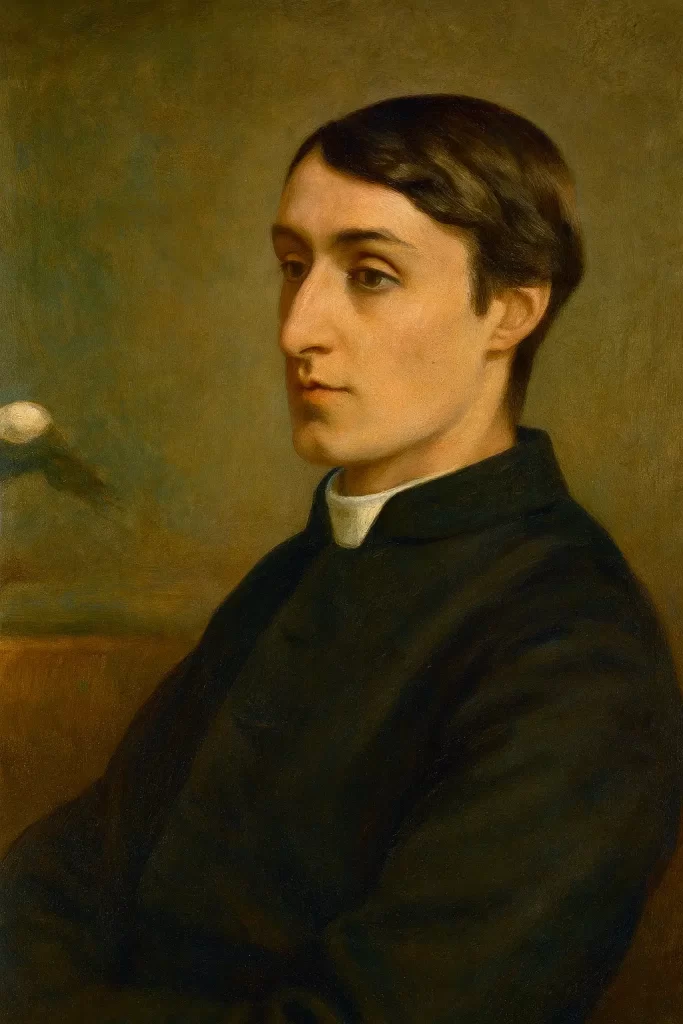
Early Life
Born on 28 July 1844 in Stratford, East London, into a cultured, artistic, and deeply religious Anglican family.
He grew up in a cultured household where his father, Manley Hopkins, was a marine insurance adjuster and also a published poet.
His mother, Catherine Hopkins, had a strong religious influence on him.
Hopkins was the eldest of nine children, many of whom were also talented in arts and literature.
Education
Attended Highgate School, where his gift for poetry first became evident.
In 1863, he entered Balliol College, Oxford, to study Classics.
At Oxford, he came under the influence of the great critic John Henry Newman, whose writings later inspired his conversion to Catholicism.
Religious Life
In 1866, Hopkins shocked his Anglican family by converting to Roman Catholicism, under Newman’s guidance.
In 1868, he decided to become a Jesuit priest and entered the Jesuit novitiate.
He studied theology at St. Beuno’s College, Wales, where he wrote some of his most famous nature poems (including “The Sea and the Skylark”).
Hopkins was ordained a priest in 1877.
Poetic Career
Hopkins often struggled between his religious vocation and his love of poetry.
At one point, he even stopped writing poetry, considering it a distraction from his priestly duties.
However, the beauty of nature and his religious devotion brought him back to verse.
His style was revolutionary:
He invented sprung rhythm, which gave his poetry a new musical pattern.
His language was rich in alliteration, internal rhyme, and compound words.
He combined intense religious feeling with vivid descriptions of nature.
Major Works
Most of Hopkins’s poetry was unpublished during his lifetime.
Famous poems include:
God’s Grandeur
The Windhover
Pied Beauty
Carrion Comfort
The Sea and the Skylark
After his death, his friend Robert Bridges published Poems of Gerard Manley Hopkins in 1918, which brought Hopkins posthumous fame.
Later Life and Death
Hopkins lived a life of self-denial and strict religious duty.
He often felt isolated and spiritually troubled, especially during his years in Dublin, where he worked as a professor of Greek at University College.
He died on 8 June 1889 in Dublin, Ireland, at the age of 44, from typhoid fever.
His last words reportedly were: “I am so happy, I am so happy. I loved my life.”
Legacy
Hopkins was virtually unknown during his lifetime.
Today, he is regarded as one of the greatest poets of the Victorian age.
His innovations in rhythm, sound, and imagery influenced modernist poets such as T.S. Eliot, W.H. Auden, and Dylan Thomas.
He is remembered as a poet who fused faith, nature, and linguistic creativity into a unique and enduring body of work.
Word Meaning
| Tough Word | Meaning in English | Meaning in Hindi |
| Trench | Deep cut, ditch, or channel; here, direction (to the right). | खाई, नाली; यहाँ “दायीं ओर” का संकेत |
| Ramps | Leaps, rushes, or charges forward aggressively. | छलांग लगाना, जोर से आक्रमण करना |
| Shore | The land along the edge of a sea or ocean. | तट, किनारा |
| Lull-off | Quiet pause; soft, soothing sound. | शांति, धीमी गूंज, सुकून देने वाली ध्वनि |
| Roar | A loud, deep, resounding sound like thunder or the sea. | गरज, दहाड़ |
| Frequenting | Happening repeatedly or regularly. | बार-बार होना, लगातार होना |
| Wear and wend | Wax and wane; the moon’s growing and fading. | चाँद का घटना और बढ़ना |
| Ascend | To rise or go up. | ऊपर उठना, चढ़ना |
| Rash-fresh | Bold, impulsive, and full of new energy. | हिम्मत भरा, नया और जोश से भरा |
| Re-winded | Rewound; started again as if freshly played. | फिर से चलाया गया, नया सा शुरू |
| New-skeinèd | Like freshly woven thread; newly made or created. | नया बुना हुआ, नया रचा गया |
| Score | A piece of music; musical composition. | संगीत का रचना, धुन |
| Crisps of curl | Sharp curls or spirals (here, of sound). | घुमावदार लहरें, सर्पिल आकार |
| Winch whirl | A mechanical winding motion; here, rapid spiraling movement. | घुमावदार गति, मशीन जैसे घूमना |
| Pour | To flow or stream continuously. | बहना, बरसना |
| Pelt | To shower or throw in quick succession. | लगातार बरसाना, झरना |
| Frail | Weak, delicate, easily broken. | कमजोर, नाज़ुक |
| Sordid | Morally dirty, corrupt, shameful. | गंदा, भ्रष्ट, नीच |
| Turbid | Muddy, unclear, confused. | गंदला, अस्पष्ट, भ्रमित |
| Prime | Best stage, peak, golden age. | श्रेष्ठ काल, उत्कर्ष का समय |
| Make and making | Human nature (make) and human works/achievements (making). | मनुष्य का स्वभाव (make) और उसकी रचनाएँ (making) |
| Dust | Symbol of death or mortality; what man returns to. | धूल, मृत्यु का प्रतीक |
| Slime | Primitive, filthy substance; symbol of man’s lowest, base origin. | कीचड़, नीच और प्रारंभिक अवस्था |
Very Short Answer Questions
Who is the poet of “The Sea and the Skylark”?
Gerard Manley Hopkins.
When was the poem written?
In 1877, at Rhyl, North Wales.
What type of poem is it?
A Petrarchan sonnet.
What is the rhyme scheme of the sonnet?
abbaabba cdcdcd.
How many lines does the poem have?
Fourteen lines.
What two natural sounds does Hopkins hear?
The sea and the skylark.
What does the sea symbolize in the poem?
Purity, power, and eternity.
What does the skylark symbolize?
Joy, freshness, and renewal.
What is meant by “two noises too old to end”?
The eternal sounds of the sea and skylark.
What controls the rhythm of the sea?
The waxing and waning of the moon.
How does Hopkins describe the skylark’s song?
Rash, fresh, bold, and ever-renewed.
What contrast does Hopkins draw in the sestet?
Between pure nature and corrupt humanity.
What does Hopkins call the present age?
“Sordid turbid time.”
What was man originally meant to be?
Life’s pride and cared-for crown.
What has humanity lost, according to Hopkins?
The cheer and charm of earth’s past prime.
What does “Our make and making break” suggest?
Human nature and human works are collapsing.
What is meant by “man’s last dust”?
Death and destruction.
What is meant by “man’s first slime”?
Humanity’s primitive, degraded origin.
What literary technique dominates the poem’s style?
Sprung rhythm, alliteration, and sound imagery.
What is the central message of the poem?
Nature is pure and eternal, but mankind is falling into corruption.
Short Answer Questions
Describe the central contrast presented in “The Sea and the Skylark.”
The poem contrasts the purity of nature with the corruption of human society. The sea and the skylark, eternal and God-ordained, symbolize permanence, purity, and harmony. In contrast, mankind has lost its innocence and dignity, sliding into moral and spiritual decay. Hopkins uses this contrast to highlight humanity’s fall from being the “crown of creation” to becoming shallow and sordid.
How does Hopkins describe the sea in the poem?
Hopkins presents the sea as an eternal, living voice. It crashes against the shore with varied moods—sometimes flooding, sometimes falling, sometimes lulling, sometimes roaring. Its rhythm is tied to the moon’s waxing and waning, which makes it part of a divine, cosmic order. The sea becomes a symbol of purity, timelessness, and God’s eternal design.
How is the skylark’s song portrayed by Hopkins?
The skylark’s song is described as rash, fresh, and ever-renewed. Hopkins compares it to a thread being rewound and rewoven each time, making it always new. The song spirals upward in curls and pours down like showers of music, abundant and inexhaustible. The skylark symbolizes joy, freshness, and spiritual renewal, contrasting with humanity’s decline.
What does Hopkins mean by “two noises too old to end”?
The phrase refers to the two eternal voices of nature: the sound of the sea and the skylark’s song. These have existed from the beginning of time and will continue as long as creation lasts. They are not temporary like human voices but are everlasting, symbolizing God’s eternal harmony. Through them, Hopkins hears reminders of divine order and purity.
What criticism of humanity does Hopkins make in the sestet?
Hopkins criticizes humanity as shallow, frail, and corrupt. He calls his age “sordid” and “turbid,” suggesting it is morally dirty and confused. He laments that man, once the “cared-for crown” of creation, has lost joy, charm, and spiritual dignity. Both human nature and human achievements are breaking down, and mankind is sliding back into degradation.
Explain the meaning of the line: “Our make and making break, are breaking, down.”
Hopkins emphasizes both human nature (“our make”) and human achievements (“our making”) are collapsing. Humanity’s very essence, as well as its culture, society, and works, are falling apart. The repetition of “break, are breaking” stresses the seriousness of decline. It shows Hopkins’s despair at the rapid disintegration of mankind’s dignity and values.
How does the rhyme scheme of the poem support its meaning?
The poem follows the Petrarchan sonnet rhyme scheme (abbaabba cdcdcd). The octave describes the natural voices of the sea and skylark, while the sestet turns sharply to criticize mankind. This division mirrors the poem’s structure: first celebrating purity, then lamenting corruption. The sonnet form allows Hopkins to present a balanced, dramatic contrast between nature and man.
What role does the moon play in the description of the sea?
Hopkins links the sea’s rhythm to the waxing and waning of the moon. This connection shows that the sea is not random but part of a divine, cosmic order. As long as the moon wears and wends, the tides will rise and fall. The moon thus represents constancy, reinforcing the sea’s image as eternal and pure, unlike the corruption of human society.
How does Hopkins use sound imagery in the poem?
Hopkins’s language is rich with sound effects that imitate what he describes. For the sea, he uses heavy stresses, roaring vowels, and contrasts like “low lull-off or all roar.” For the skylark, he uses quick, light, spiraling sounds such as “rash-fresh re-winded new-skeinèd score.” These patterns make the reader almost hear the sea’s crash and the bird’s song.
What is the final message of “The Sea and the Skylark”?
The final message is that nature remains eternal and pure, while humanity is falling into corruption. The sea and the skylark remind us of God’s eternal order, but human society has lost its innocence and joy. Once the pride of creation, mankind is breaking down, rushing from dust to slime. Hopkins warns that unless humanity returns to divine purity, it will continue in spiritual decline.
Long Answer Questions
Long note on themes of the poem.
1. Purity and Permanence of Nature
A central theme of the poem is the eternal purity of nature. Hopkins listens to two natural sounds—the sea and the skylark—and sees them as symbols of permanence. The sea, with its endless rhythm tied to the moon, is a voice that will never cease. The skylark, singing boldly and freshly, pours out music as though it can never be exhausted.
For Hopkins, these voices of nature are not only beautiful but also spiritual. They reflect the eternal order set by God and remain pure and uncorrupted. Unlike man-made sounds, which fade away, these natural sounds are “too old to end,” reminding humanity of divine eternity.
2. Corruption and Decline of Humanity
In contrast to nature, humanity is portrayed as frail, shallow, and corrupt. Hopkins criticizes his age as “sordid” and “turbid,” meaning morally dirty and confused. Mankind, once the “cared-for crown” of creation, has lost its original dignity and innocence.
Hopkins laments that human nature (“our make”) and human achievements (“our making”) are both collapsing. Instead of progressing spiritually, humanity is breaking down and regressing toward dust and slime. This theme reflects Hopkins’s religious concern about the moral decay of Victorian society, which he saw as increasingly materialistic and spiritually empty.
3. Man versus Nature
Another key theme is the contrast between man and nature. Nature is presented as pure, eternal, and in harmony with divine order, while man is weak, corrupt, and spiritually declining. The sea and the skylark serve as eternal reminders of purity, exposing the shallowness of human life.
By listening to these voices, Hopkins recognizes how small and degraded mankind has become. Human society, with its noise, corruption, and decay, pales in comparison to the timeless music of nature. This theme emphasizes the poet’s belief that human beings must learn from nature’s purity and constancy.
4. Religious and Spiritual Vision
Hopkins was a Jesuit priest, and his poetry always carried a religious undertone. In this sonnet, the sea and skylark are not just natural sounds but symbols of God’s eternal presence. The tide’s connection with the moon shows divine order in creation, while the skylark’s endless joy symbolizes spiritual renewal.
By contrast, humanity’s fall into corruption reflects sin and separation from God. Hopkins suggests that mankind has lost touch with its spiritual roots and is moving toward destruction. The poem, therefore, serves as a religious meditation: nature reveals God’s eternity, while human corruption shows the need for repentance and renewal.
5. The Fall of Man
The final theme is humanity’s fall from glory. Hopkins describes man as once being “life’s pride and cared-for crown,” the highest part of creation. But now, he says, we have lost the “cheer and charm of earth’s past prime.” Humanity has moved away from its golden age of innocence and is fast declining.
The closing lines—“to man’s last dust, drain fast towards man’s first slime”—are especially powerful. They suggest that mankind is not evolving upward but regressing downward, from dignity into destruction, from dust back to slime. This theme echoes the Biblical idea of the Fall: man, through sin, loses the glory he once had and sinks into corruption.
Critical Analysis
Introduction
Gerard Manley Hopkins (1844–1889) is one of the most original poets of the Victorian era, celebrated for his religious intensity and technical innovations, especially his invention of sprung rhythm. His poetry often unites three great concerns: faith, nature, and humanity. “The Sea and the Skylark” was written in 1877 during his theological training at St. Beuno’s College, Wales. The poem reflects Hopkins’s profound sensitivity to natural sounds, his ability to translate them into poetry, and his moral anxiety about the state of mankind. The sonnet stands as both a celebration of eternal nature and a lament for human corruption.
Central Idea
The central idea of the poem is the sharp contrast between the purity and permanence of nature and the weakness and corruption of human society. The sea and the skylark, eternal voices of God’s creation, are presented as pure, musical, and everlasting. In contrast, mankind, once meant to be the “cared-for crown” of creation, has lost its innocence, joy, and dignity. Hopkins laments that humanity is breaking down morally and spiritually, rushing towards dust and slime.
Summary
In the octave (lines 1–8), Hopkins listens carefully to two natural sounds. On his right, he hears the sea: sometimes soft and lulling, sometimes roaring and violent, yet always eternal in rhythm, tied to the moon’s cycle. On his left, he hears the skylark: bold, fresh, and joyful, singing a tune that seems endlessly renewed, pouring out music in spirals of sound. These two voices are “too old to end,” representing eternal purity.
In the sestet (lines 9–14), the poet turns from nature to mankind. He says that the sea and skylark “shame” the town, exposing the corruption of his age, which is “sordid” and “turbid.” Humanity, once the pride of life and the crown of creation, has lost its cheer and charm. Both human nature (“our make”) and human achievements (“our making”) are breaking down. Humanity is rushing from dignity to dust, and from dust to primitive slime. The poem ends on a tragic note of moral and spiritual decline.
Structure and Rhyme Scheme
The poem is a Petrarchan sonnet of 14 lines.
Octave (abbaabba): describes the sea and skylark, symbols of eternal purity.
Sestet (cdcdcd): reflects on mankind’s fall and corruption.
The volta (turn) occurs at line 9, where the focus shifts from nature to humanity.
Hopkins employs his unique sprung rhythm, which gives the lines a dynamic, natural music that imitates the sounds described: the rolling of the sea, the spirals of the skylark, and the broken heaviness of mankind’s decline.
Themes
Purity and Permanence of Nature – The sea and skylark are eternal voices of divine harmony.
Corruption of Humanity – Mankind has lost innocence, joy, and dignity, becoming sordid and shallow.
Man versus Nature – Nature is pure and eternal, while human society is frail and corrupt.
Religious Vision – The sea and skylark reflect God’s eternal order, while man’s decline reflects sin.
The Fall of Man – Humanity, once noble, now slides from glory into dust and slime, echoing Biblical imagery of the Fall.
Style
Hopkins’s style is innovative and intense.
Uses sprung rhythm to mimic natural sound and movement.
Dense, compressed language with compound words (e.g., “rash-fresh re-winded new-skeinèd”).
Frequent alliteration, internal rhyme, and neologisms.
Musicality mirrors subject: heavy stresses for the sea, spirals for the skylark, broken rhythm for mankind’s decline.
Poetic Devices
Alliteration: “rash-fresh re-winded,” “sordid turbid time.”
Imagery: Vivid auditory and visual images of waves and skylark’s song.
Personification: Tide “ramps” like a beast; skylark’s song is woven like thread.
Metaphor: Skylark’s song as a “new-skeinèd score.”
Symbolism: Sea = eternity; Skylark = joy and renewal; Town = corrupt human society.
Contrast/Antithesis: Nature’s purity vs. human decay.
Biblical Allusion: “Dust” and “slime” recall Genesis (creation and mortality).
Enjambment: Lines run on, mirroring continuity of sea and bird song.
Critical Commentary
This sonnet is both a nature poem and a religious meditation. Hopkins sees in the sea and skylark symbols of God’s eternal purity. Their voices expose the weakness and moral decay of mankind. Hopkins’s originality lies in how he makes sound itself a medium of meaning: the rhythm, alliteration, and word-compounds echo the sea’s roar and the skylark’s spiraling song. The sestet turns prophetic and tragic, lamenting the fall of man from his original glory.
Message
The message of the poem is clear: nature remains pure, eternal, and God-ordained, while humanity is decaying morally and spiritually. Man, once the “crown of creation,” has lost his dignity and is sliding into corruption. The voices of the sea and skylark remind us of God’s eternal order and shame mankind’s weakness. Hopkins warns that unless humanity returns to divine purity, it will continue to decline toward ruin.
Conclusion
“The Sea and the Skylark” is one of Hopkins’s finest sonnets, combining rich nature description, religious symbolism, and moral criticism. The sea and skylark are celebrated as eternal voices of purity, while mankind is condemned for its corruption and decline. Hopkins’s use of sprung rhythm, musical imagery, and symbolic contrast makes the poem a masterpiece of both technique and meaning. It remains a timeless reflection on the contrast between God’s eternal creation and man’s moral fall.